Domina Conceptos Médicos

Estudia para la escuela de medicina y tus examenes con Lecturio.

Colecistitis

La colecistitis es la inflamación de la vesícula biliar generalmente causada por la obstrucción del conducto cístico (colecistitis aguda). La irritación mecánica por cálculos biliares también puede producir inflamación crónica de la vesícula biliar. La colecistitis es una de las complicaciones más comunes de la colelitiasis (colecistitis calculosa), pero la inflamación sin cálculos biliares (colecistitis acalculosa) puede ocurrir en EN Erythema nodosum is an immune-mediated panniculitis (inflammation of the subcutaneous fat) caused by a type IV (delayed-type) hypersensitivity reaction. It commonly manifests in young women as tender, erythematous nodules on the shins. Erythema Nodosum una minoría de pacientes. El tipo agudo generalmente se presenta con dolor Dolor Inflammation en EN Erythema nodosum is an immune-mediated panniculitis (inflammation of the subcutaneous fat) caused by a type IV (delayed-type) hypersensitivity reaction. It commonly manifests in young women as tender, erythematous nodules on the shins. Erythema Nodosum el cuadrante superior derecho, fiebre y leucocitosis. El diagnóstico se realiza clínicamente y se confirma mediante ultrasonido. El tratamiento definitivo es la colecistectomía, preferentemente dentro de las 72 horas. Esta condición puede presentarse como una condición leve o como una enfermedad grave (con complicaciones como gangrena de la vesícula biliar, perforación, empiema) que requieren una intervención urgente.

Last updated: Dec 15, 2025

Editorial responsibility: Stanley Oiseth, Lindsay Jones, Evelin Maza

Descripción General

Definición

La colecistitis es la inflamación de la vesícula biliar.
Tipos:
  • Colecistitis calculosa: inflamación de la vesícula biliar como complicación de cálculos biliares o colelitiasis
    • Aguda: obstrucción del conducto cístico/inflamación de la vesícula biliar de aparición súbita, asociada con dolor Dolor Inflammation intenso
    • Crónica: inflamación crónica y fibrosis Fibrosis Any pathological condition where fibrous connective tissue invades any organ, usually as a consequence of inflammation or other injury. Bronchiolitis Obliterans de la vesícula biliar, asociada a:
      • Menor intensidad del dolor Dolor Inflammation
      • Irritación mecánica por cálculos biliares
      • Episodios recurrentes de colecistitis aguda
  • Colecistitis acalculosa: inflamación de la vesícula biliar por estasis e isquemia
    • Ausencia de colelitiasis.
    • Generalmente, en EN Erythema nodosum is an immune-mediated panniculitis (inflammation of the subcutaneous fat) caused by a type IV (delayed-type) hypersensitivity reaction. It commonly manifests in young women as tender, erythematous nodules on the shins. Erythema Nodosum pacientes críticamente enfermos y/o inmunocomprometidos

Epidemiología

  • Mujeres > hombres
  • Incidencia máxima: 40–50 años
  • Se desarrolla en EN Erythema nodosum is an immune-mediated panniculitis (inflammation of the subcutaneous fat) caused by a type IV (delayed-type) hypersensitivity reaction. It commonly manifests in young women as tender, erythematous nodules on the shins. Erythema Nodosum 6%–11% de los LOS Neisseria pacientes con cálculos biliares sintomáticos
  • Factores de riesgo:
    • Embarazo o terapia hormonal
    • Edad avanzada
    • Nativo americano o hispano
    • Obesidad; rápido aumento/pérdida de peso
    • Diabetes Diabetes Diabetes mellitus (DM) is a metabolic disease characterized by hyperglycemia and dysfunction of the regulation of glucose metabolism by insulin. Type 1 DM is diagnosed mostly in children and young adults as the result of autoimmune destruction of β cells in the pancreas and the resulting lack of insulin. Type 2 DM has a significant association with obesity and is characterized by insulin resistance. Diabetes Mellitus

Etiología y fisiopatología

  • Etiología: más comúnmente debido a la obstrucción por cálculos biliares en EN Erythema nodosum is an immune-mediated panniculitis (inflammation of the subcutaneous fat) caused by a type IV (delayed-type) hypersensitivity reaction. It commonly manifests in young women as tender, erythematous nodules on the shins. Erythema Nodosum la vesícula biliar, causando síntomas
  • Fisiopatología:
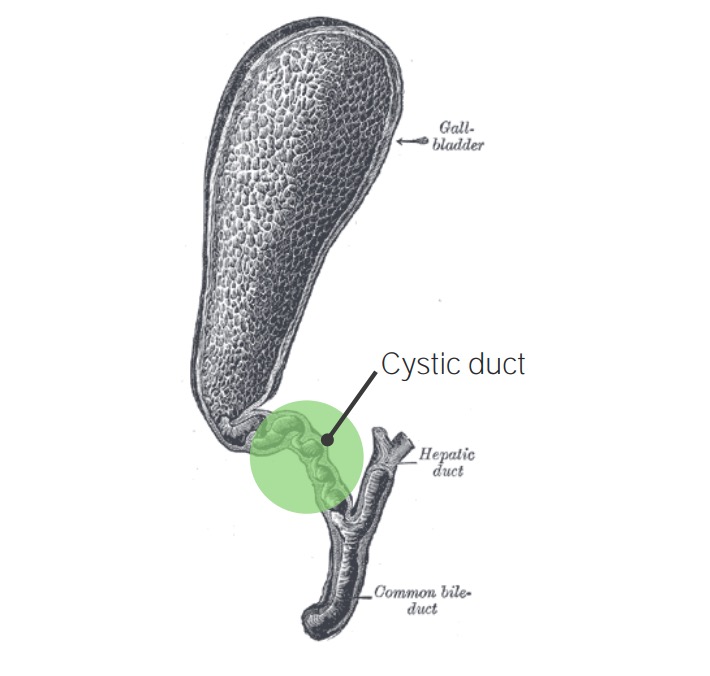
    • El cálculo biliar migra al AL Amyloidosis conducto cístico → obstrucción
    • La obstrucción conduce a la distensión e inflamación de la vesícula biliar.
    • Otros factores que contribuyen a la inflamación de la vesícula biliar:
      • Prostaglandinas (↑ contracción de la vesícula biliar)
      • Lisolecitina, un mediador inflamatorio que normalmente está ausente, pero que se produce en EN Erythema nodosum is an immune-mediated panniculitis (inflammation of the subcutaneous fat) caused by a type IV (delayed-type) hypersensitivity reaction. It commonly manifests in young women as tender, erythematous nodules on the shins. Erythema Nodosum casos de traumatismo de la pared de la vesícula biliar
      • Puede o no estar asociado con infección bacteriana ( Escherichia coli Escherichia coli The gram-negative bacterium Escherichia coli is a key component of the human gut microbiota. Most strains of E. coli are avirulent, but occasionally they escape the GI tract, infecting the urinary tract and other sites. Less common strains of E. coli are able to cause disease within the GI tract, most commonly presenting as abdominal pain and diarrhea. Escherichia coli, Enterococcus Enterococcus Enterococcus is a genus of oval-shaped gram-positive cocci that are arranged in pairs or short chains. Distinguishing factors include optochin resistance and the presence of pyrrolidonyl arylamidase (PYR) and Lancefield D antigen. Enterococcus is part of the normal flora of the human GI tract. Enterococcus, Klebsiella Klebsiella Klebsiella are encapsulated gram-negative, lactose-fermenting bacilli. They form pink colonies on MacConkey agar due to lactose fermentation. The main virulence factor is a polysaccharide capsule. Klebsiella pneumoniae is the most important pathogenic species. Klebsiella, Enterobacter Enterobacter Multidrug-resistant Organisms and Nosocomial Infections)
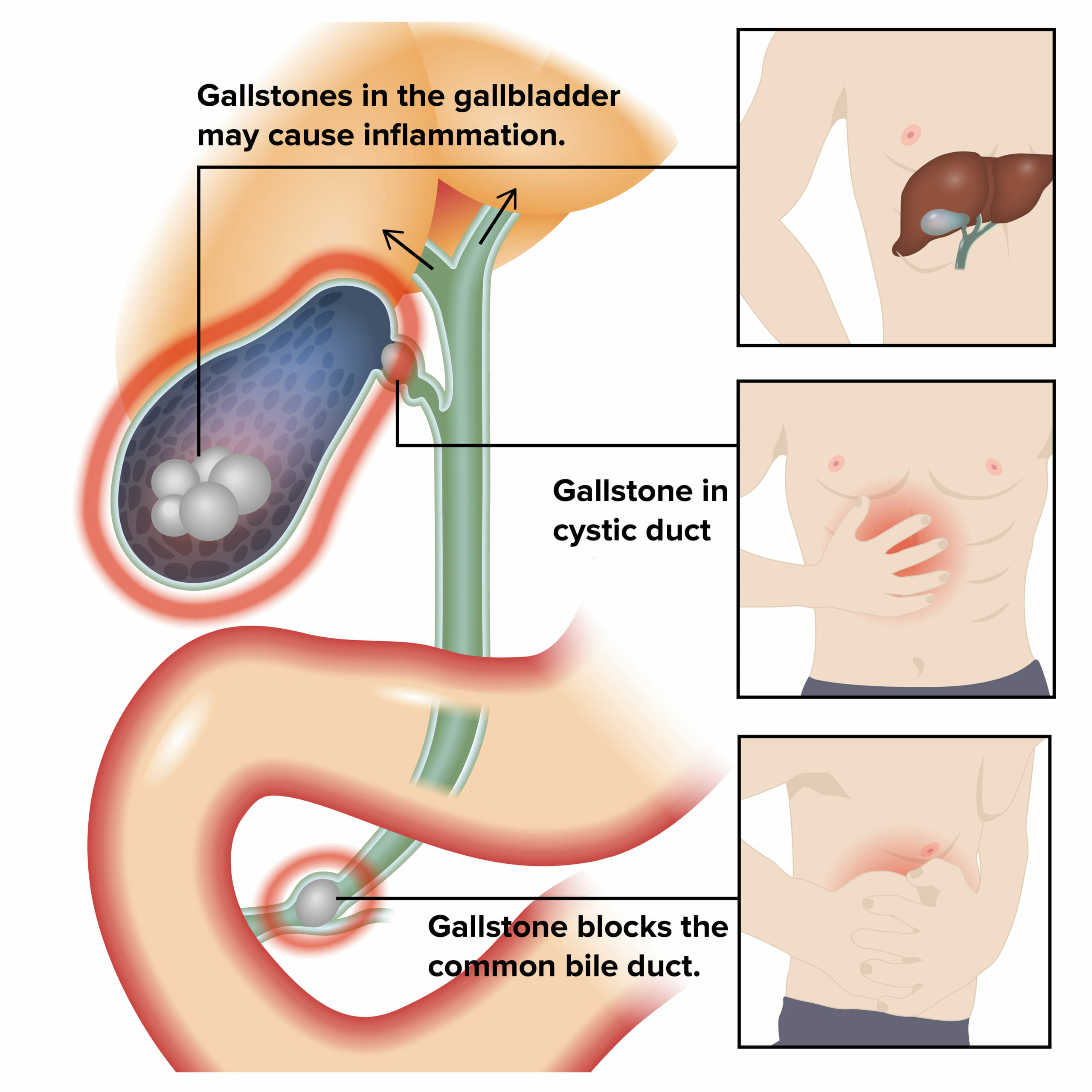
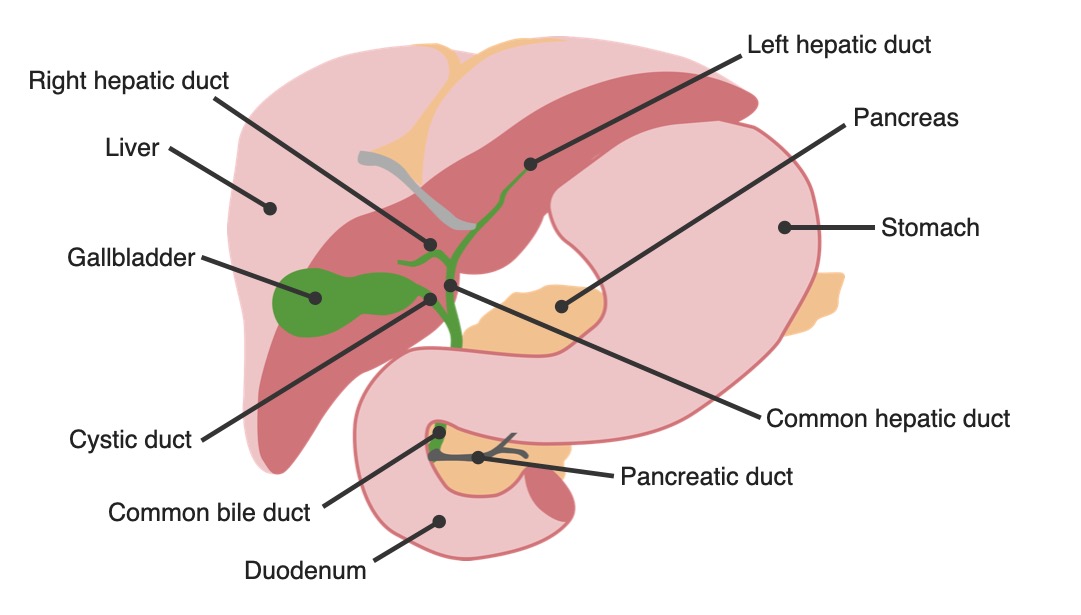
Anatomía del árbol biliar

Anatomía del árbol biliar: vesícula biliar en relación con otros órganos

Imagen por Lecturio.
Presentación Clínica

Antecedentes clínicos

  • Dolor Dolor Inflammation en EN Erythema nodosum is an immune-mediated panniculitis (inflammation of the subcutaneous fat) caused by a type IV (delayed-type) hypersensitivity reaction. It commonly manifests in young women as tender, erythematous nodules on the shins. Erythema Nodosum el cuadrante superior derecho
    • Prolongado (> 6 horas)
    • Después de una comida grasosa
    • Irradiado a la escápula derecha (signo de Boas)
  • Fiebre
  • Anorexia Anorexia The lack or loss of appetite accompanied by an aversion to food and the inability to eat. It is the defining characteristic of the disorder anorexia nervosa. Anorexia Nervosa, náuseas, vómitos
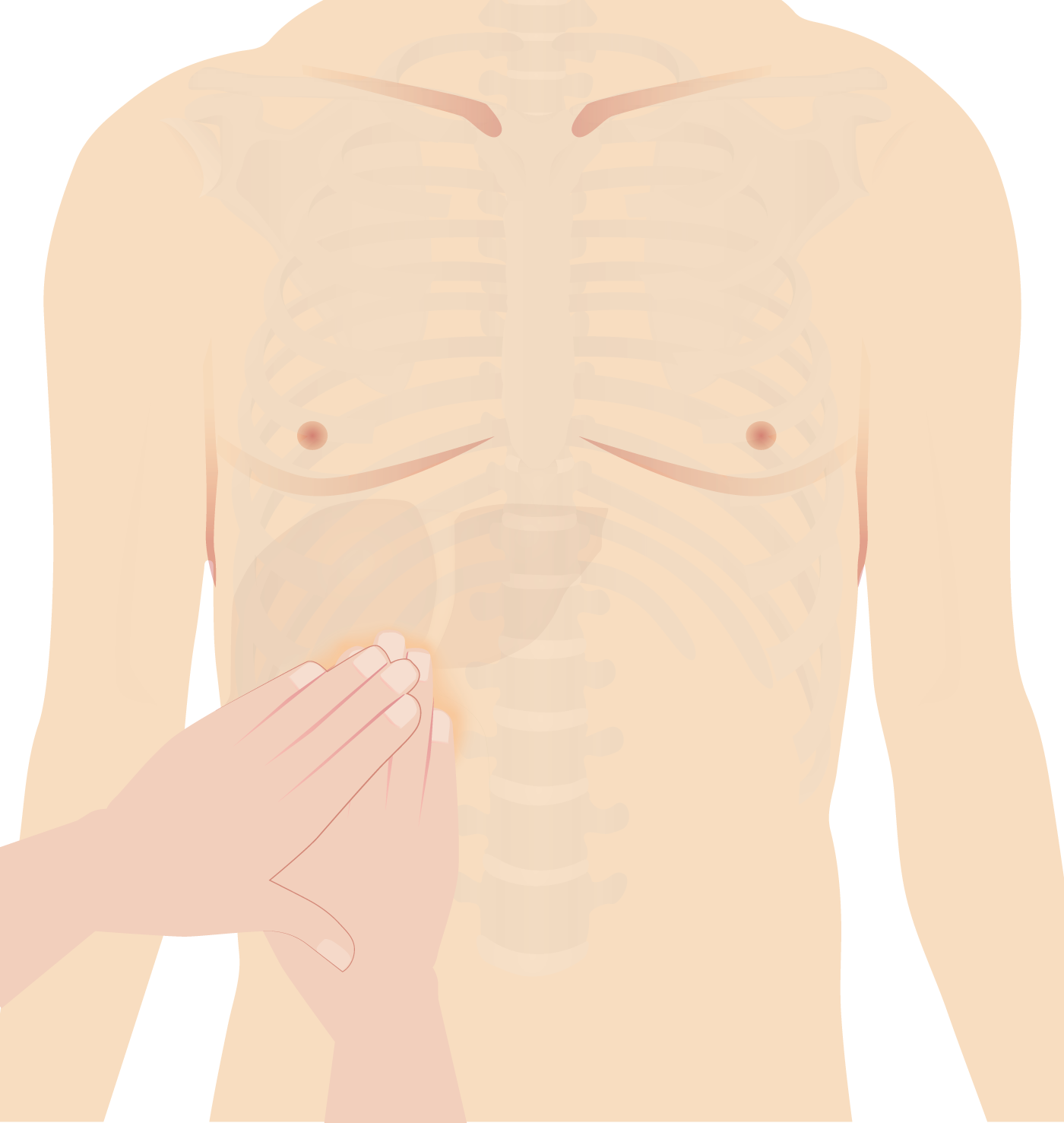
Zona de presión típica en la colelitiasis

El signo de Boas es hiperestesia debajo de la escápula derecha (observada en la colecistitis aguda).

Imagen por Lecturio.
Examen físico

  • Signo de Murphy positivo:
    • El examinador palpa el área de la vesícula biliar mientras el paciente realiza una inspiración profunda.
    • La vesícula biliar inflamada desciende y entra en EN Erythema nodosum is an immune-mediated panniculitis (inflammation of the subcutaneous fat) caused by a type IV (delayed-type) hypersensitivity reaction. It commonly manifests in young women as tender, erythematous nodules on the shins. Erythema Nodosum contacto con la mano del examinador, provocando dolor Dolor Inflammation/malestar y cese brusco de la respiración.
  • Defensa abdominal, rebote: inflamación peritoneal local
Signo de Murphy

Signo de Murphy: El examinador coloca la mano en el área de la vesícula biliar (área subcostal derecha). Se le indica al paciente que respire profundamente. En la inspiración, la vesícula biliar inflamada desciende, entra en contacto con la mano del examinador y causa dolor.

Imagen por Lecturio.
Diagnóstico

  • Examen físico:
    • Sensibilidad a la palpación en EN Erythema nodosum is an immune-mediated panniculitis (inflammation of the subcutaneous fat) caused by a type IV (delayed-type) hypersensitivity reaction. It commonly manifests in young women as tender, erythematous nodules on the shins. Erythema Nodosum el cuadrante superior derecho abdominal/área epigástrica
    • Signo de Murphy
    • Fiebre, taquicardia
  • Pruebas de laboratorio:
    • Pruebas de función hepática:
      • Elevación de bilirrubina y fosfatasa alcalina (pero puede ser normal en EN Erythema nodosum is an immune-mediated panniculitis (inflammation of the subcutaneous fat) caused by a type IV (delayed-type) hypersensitivity reaction. It commonly manifests in young women as tender, erythematous nodules on the shins. Erythema Nodosum casos no complicados)
      • Elevación leve de alanina aminotransferasa ( ALT ALT An enzyme that catalyzes the conversion of l-alanine and 2-oxoglutarate to pyruvate and l-glutamate. Liver Function Tests) y aspartato aminotransferasa ( AST AST Enzymes of the transferase class that catalyze the conversion of l-aspartate and 2-ketoglutarate to oxaloacetate and l-glutamate. Liver Function Tests)
    • Hemograma: leucocitosis (con desviación a la izquierda)
  • Imagenología:
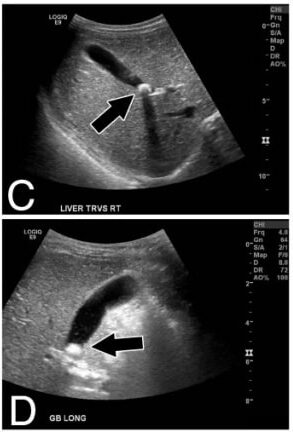
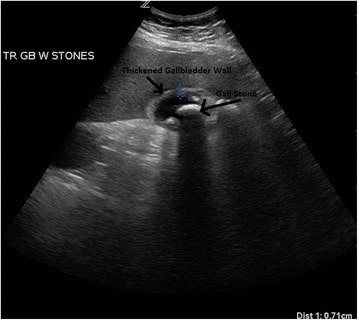
    • Ultrasonido: prueba de elección
      • Engrosamiento de pared de la vesícula biliar > 4 mm
      • Edema Edema Edema is a condition in which excess serous fluid accumulates in the body cavity or interstitial space of connective tissues. Edema is a symptom observed in several medical conditions. It can be categorized into 2 types, namely, peripheral (in the extremities) and internal (in an organ or body cavity). Edema de pared de la vesícula biliar (signo de doble pared)
      • Signo ecográfico de Murphy (obtenido con la sonda de ultrasonido presionando el abdomen)
      • Líquido pericolecístico
      • Presencia de cálculos biliares
    • Gammagrafía con ácido iminodiacético hepatobiliar:
      • Realizado si el ultrasonido revela resultados equívocos
      • Inyección intravenosa de trazador radiactivo que se excreta en EN Erythema nodosum is an immune-mediated panniculitis (inflammation of the subcutaneous fat) caused by a type IV (delayed-type) hypersensitivity reaction. It commonly manifests in young women as tender, erythematous nodules on the shins. Erythema Nodosum la bilis
      • Si el conducto cístico no está obstruido, el trazador se verá en EN Erythema nodosum is an immune-mediated panniculitis (inflammation of the subcutaneous fat) caused by a type IV (delayed-type) hypersensitivity reaction. It commonly manifests in young women as tender, erythematous nodules on the shins. Erythema Nodosum la vesícula biliar.
      • Anormal si la vesícula biliar no se visualiza dentro de 30–60 minutos
    • Tomografía computarizada (TC):
      • No es una prueba de primera elección para la sospecha de colecistitis, ya que la mayoría de los LOS Neisseria cálculos biliares no se visualizarán en EN Erythema nodosum is an immune-mediated panniculitis (inflammation of the subcutaneous fat) caused by a type IV (delayed-type) hypersensitivity reaction. It commonly manifests in young women as tender, erythematous nodules on the shins. Erythema Nodosum la TC
      • Mostrará inflamación de la vesícula biliar
      • Se usa si el paciente presenta peritonitis Peritonitis Inflammation of the peritoneum lining the abdominal cavity as the result of infectious, autoimmune, or chemical processes. Primary peritonitis is due to infection of the peritoneal cavity via hematogenous or lymphatic spread and without intra-abdominal source. Secondary peritonitis arises from the abdominal cavity itself through rupture or abscess of intra-abdominal organs. Penetrating Abdominal Injury, obstrucción intestinal o sepsis Sepsis Systemic inflammatory response syndrome with a proven or suspected infectious etiology. When sepsis is associated with organ dysfunction distant from the site of infection, it is called severe sepsis. When sepsis is accompanied by hypotension despite adequate fluid infusion, it is called septic shock. Sepsis and Septic Shock
    • Colangiopancreatografía por resonancia magnética (RM): se utiliza si se sospecha coledocolitiasis

Tratamiento

Consideraciones generales

  • Terapia de soporte:
    • Analgesia Analgesia Methods of pain relief that may be used with or in place of analgesics. Anesthesiology: History and Basic Concepts: medicamentos antiinflamatorios no esteroideos (AINE) (preferible), opioides
    • Hidratación con fluidos intravenosos + corrección de electrolitos
    • Antieméticos
  • Antibióticos intravenosos:
    • Terapia complementaria
    • Puede usarse como tratamiento primario si la cirugía está contraindicada ( en EN Erythema nodosum is an immune-mediated panniculitis (inflammation of the subcutaneous fat) caused by a type IV (delayed-type) hypersensitivity reaction. It commonly manifests in young women as tender, erythematous nodules on the shins. Erythema Nodosum pacientes de alto riesgo)
    • Régimen de agente único:
      • Infección abdominal de bajo riesgo: piperacilina– tazobactam Tazobactam A penicillanic acid and sulfone derivative and potent beta-lactamase inhibitor that enhances the activity of other anti-bacterial agents against beta-lactamase producing bacteria. Cephalosporins o ertapenem Ertapenem A carbapenem derivative antibacterial agent that is more stable to renal dehydropeptidase I than imipenem, but does not need to be given with an enzyme inhibitor such as cilastatin. It is used in the treatment of gram-positive and gram-negative bacterial infections including intra-abdominal infections, acute gynecological infections, complicated urinary tract infections, skin infections, and respiratory tract infections. It is also used to prevent infection in colorectal surgery. Carbapenems and Aztreonam
      • Infección abdominal de alto riesgo: imipenem Imipenem Semisynthetic thienamycin that has a wide spectrum of antibacterial activity against gram-negative and gram-positive aerobic and anaerobic bacteria, including many multiresistant strains. It is stable to beta-lactamases. Clinical studies have demonstrated high efficacy in the treatment of infections of various body systems. Its effectiveness is enhanced when it is administered in combination with cilastatin, a renal dipeptidase inhibitor. Carbapenems and Aztreonam, meropenem Meropenem A thienamycin derivative antibacterial agent that is more stable to renal dehydropeptidase I than imipenem, but does not need to be given with an enzyme inhibitor such as cilastatin. It is used in the treatment of bacterial infections, including infections in immunocompromised patients. Carbapenems and Aztreonam, piperacilina– tazobactam Tazobactam A penicillanic acid and sulfone derivative and potent beta-lactamase inhibitor that enhances the activity of other anti-bacterial agents against beta-lactamase producing bacteria. Cephalosporins
    • Régimen de agente doble:
      • Infección abdominal de bajo riesgo: cefazolina/ceftriaxona/ciprofloxacino/levofloxacino + metronidazol
      • Infección abdominal de alto riesgo: cefepima/ceftazidima + metronidazol

Tratamiento quirúrgico

  • Colecistectomía:
    • Tratamiento definitivo
    • Abordaje:
      • La laparoscopia es el estándar de atención (menor riesgo de infección, estancia hospitalaria más corta).
      • Cirugía abierta: reservada para casos complicados
    • Duración:
      • Cirugía realizada tempranamente (dentro de las 72 horas de la presentación): mejores resultados
      • Cirugía de emergencia: puede ser necesaria para vesícula biliar enfisematosa, perforación/gangrena de vesícula biliar, peritonitis Peritonitis Inflammation of the peritoneum lining the abdominal cavity as the result of infectious, autoimmune, or chemical processes. Primary peritonitis is due to infection of the peritoneal cavity via hematogenous or lymphatic spread and without intra-abdominal source. Secondary peritonitis arises from the abdominal cavity itself through rupture or abscess of intra-abdominal organs. Penetrating Abdominal Injury generalizada
    • Complicaciones de la cirugía:
      • Lesión del conducto biliar
      • Fugas biliares
      • Lesión a estructuras cercanas.
      • Síndrome postcolecistectomía
  • Colecistostomía percutánea:
    • La vesícula biliar se drena/descomprime con un tubo colocado percutáneamente bajo guía radiológica.
    • Para pacientes con:
      • Contraindicaciones de la cirugía
      • Colecistitis que no se resuelve con antibióticos/tratamiento de soporte
      • Colecistitis acalculosa (especialmente en EN Erythema nodosum is an immune-mediated panniculitis (inflammation of the subcutaneous fat) caused by a type IV (delayed-type) hypersensitivity reaction. It commonly manifests in young women as tender, erythematous nodules on the shins. Erythema Nodosum pacientes gravemente enfermos)
  • Colangiopancreatografía retrógrada endoscópica antes de la cirugía si el ultrasonido mostró la presencia de cálculos en EN Erythema nodosum is an immune-mediated panniculitis (inflammation of the subcutaneous fat) caused by a type IV (delayed-type) hypersensitivity reaction. It commonly manifests in young women as tender, erythematous nodules on the shins. Erythema Nodosum el conducto biliar común

Complicaciones

  • Colecistitis gangrenosa
    • Complicación más común
    • La inflamación severa conduce a la necrosis Necrosis The death of cells in an organ or tissue due to disease, injury or failure of the blood supply. Ischemic Cell Damage de la pared de la vesícula biliar
    • Generalmente, afecta a pacientes con diabetes Diabetes Diabetes mellitus (DM) is a metabolic disease characterized by hyperglycemia and dysfunction of the regulation of glucose metabolism by insulin. Type 1 DM is diagnosed mostly in children and young adults as the result of autoimmune destruction of β cells in the pancreas and the resulting lack of insulin. Type 2 DM has a significant association with obesity and is characterized by insulin resistance. Diabetes Mellitus, pacientes de edad avanzada o con diagnóstico tardío
  • Colecistitis enfisematosa
    • Infección con bacterias formadoras de gas (Clostridium)
    • Gas en EN Erythema nodosum is an immune-mediated panniculitis (inflammation of the subcutaneous fat) caused by a type IV (delayed-type) hypersensitivity reaction. It commonly manifests in young women as tender, erythematous nodules on the shins. Erythema Nodosum la pared de la vesícula biliar (puede manifestarse como crepitantes de la pared abdominal en EN Erythema nodosum is an immune-mediated panniculitis (inflammation of the subcutaneous fat) caused by a type IV (delayed-type) hypersensitivity reaction. It commonly manifests in young women as tender, erythematous nodules on the shins. Erythema Nodosum el examen físico)
    • Generalmente en EN Erythema nodosum is an immune-mediated panniculitis (inflammation of the subcutaneous fat) caused by a type IV (delayed-type) hypersensitivity reaction. It commonly manifests in young women as tender, erythematous nodules on the shins. Erythema Nodosum pacientes diabéticos.
  • Hidropesía
    • También llamado mucocele Mucocele A retention cyst of the salivary gland, lacrimal sac, paranasal sinuses, appendix, or gallbladder. Dacryocystitis de la vesícula biliar
    • La vesícula biliar muy distendida y llena de líquido mucoide incoloro (bilis blanca)
    • Impactación prolongada de un cálculo biliar en EN Erythema nodosum is an immune-mediated panniculitis (inflammation of the subcutaneous fat) caused by a type IV (delayed-type) hypersensitivity reaction. It commonly manifests in young women as tender, erythematous nodules on the shins. Erythema Nodosum el conducto cístico → absorción de bilirrubina dentro de la vesícula biliar
  • Íleo biliar
    • Se forma una fístula entre la vesícula biliar inflamada y el duodeno (fístula colecistoentérica).
    • El cálculo biliar viaja al AL Amyloidosis intestino delgado → obstrucción del intestino delgado
    • Tríada de Rigler: neumobilia (aire en EN Erythema nodosum is an immune-mediated panniculitis (inflammation of the subcutaneous fat) caused by a type IV (delayed-type) hypersensitivity reaction. It commonly manifests in young women as tender, erythematous nodules on the shins. Erythema Nodosum el árbol biliar), obstrucción intestinal y cálculo biliar ectópico
  • Perforación de la vesícula biliar
    • Se presenta en EN Erythema nodosum is an immune-mediated panniculitis (inflammation of the subcutaneous fat) caused by a type IV (delayed-type) hypersensitivity reaction. It commonly manifests in young women as tender, erythematous nodules on the shins. Erythema Nodosum 10% de las colecistitis agudas
    • Conduce a un absceso pericolequístico o peritonitis Peritonitis Inflammation of the peritoneum lining the abdominal cavity as the result of infectious, autoimmune, or chemical processes. Primary peritonitis is due to infection of the peritoneal cavity via hematogenous or lymphatic spread and without intra-abdominal source. Secondary peritonitis arises from the abdominal cavity itself through rupture or abscess of intra-abdominal organs. Penetrating Abdominal Injury generalizada
  • Síndrome de Mirizzi
    • Compresión extrínseca del conducto hepático común por el cálculo alojado en EN Erythema nodosum is an immune-mediated panniculitis (inflammation of the subcutaneous fat) caused by a type IV (delayed-type) hypersensitivity reaction. It commonly manifests in young women as tender, erythematous nodules on the shins. Erythema Nodosum el conducto cístico
    • Se presenta con ictericia, fiebre y dolor Dolor Inflammation abdominal
    • Asociado con el cáncer de vesícula biliar

Diagnóstico Diferencial

Otras condiciones biliares/hepáticas

  • Cólico biliar: dolor Dolor Inflammation/náuseas postprandiales causados por una obstrucción intermitente breve del conducto cístico. Asociado con análisis de sangre normales, cálculos biliares (sin signos de inflamación) en EN Erythema nodosum is an immune-mediated panniculitis (inflammation of the subcutaneous fat) caused by a type IV (delayed-type) hypersensitivity reaction. It commonly manifests in young women as tender, erythematous nodules on the shins. Erythema Nodosum ultrasonido.
  • Discinesia biliar: motilidad disfuncional de la vesícula biliar (sin cálculos). El cuadro clínico es similar al AL Amyloidosis cólico biliar/colecistitis. Diagnosticado por gammagrafía con ácido iminodiacético hepatobiliar con inyección de colecistoquinina donde los LOS Neisseria resultados muestran una fracción de eyección de la vesícula biliar baja.
  • Coledocolitiasis/colangitis: los LOS Neisseria cálculos biliares en EN Erythema nodosum is an immune-mediated panniculitis (inflammation of the subcutaneous fat) caused by a type IV (delayed-type) hypersensitivity reaction. It commonly manifests in young women as tender, erythematous nodules on the shins. Erythema Nodosum el conducto biliar común causan obstrucción (coledocolitiasis), lo que puede provocar una infección (colangitis). Esta condición se presenta con hiperbilirrubinemia (> 2,0) y fosfatasa alcalina elevada, con elevación precoz de transaminasas.
  • Pancreatitis Pancreatitis Inflammation of the pancreas. Pancreatitis is classified as acute unless there are computed tomographic or endoscopic retrograde cholangiopancreatographic findings of chronic pancreatitis. The two most common forms of acute pancreatitis are alcoholic pancreatitis and gallstone pancreatitis. Acute Pancreatitis por cálculos biliares: la obstrucción intermitente de la unión del colédoco y el conducto pancreático por un cálculo biliar migratorio provoca pancreatitis Pancreatitis Inflammation of the pancreas. Pancreatitis is classified as acute unless there are computed tomographic or endoscopic retrograde cholangiopancreatographic findings of chronic pancreatitis. The two most common forms of acute pancreatitis are alcoholic pancreatitis and gallstone pancreatitis. Acute Pancreatitis. En EN Erythema nodosum is an immune-mediated panniculitis (inflammation of the subcutaneous fat) caused by a type IV (delayed-type) hypersensitivity reaction. It commonly manifests in young women as tender, erythematous nodules on the shins. Erythema Nodosum los LOS Neisseria estudios se evidencian niveles elevados de amilasa/lipasa con inflamación pancreática observada en EN Erythema nodosum is an immune-mediated panniculitis (inflammation of the subcutaneous fat) caused by a type IV (delayed-type) hypersensitivity reaction. It commonly manifests in young women as tender, erythematous nodules on the shins. Erythema Nodosum ultrasonido o TC.
  • Hepatitis: inflamación del parénquima hepático de etiología infecciosa u otras causas. Generalmente asociado con transaminasas muy altas y bilirrubina elevada. El ultrasonido no mostraría ningún cálculo biliar.

Condiciones no biliares

  • Enfermedad ulcerosa péptica: ulceración de la mucosa gástrica o duodenal. Se presenta con dolor Dolor Inflammation epigástrico, náuseas/vómitos. A diferencia de la colecistitis, el dolor Dolor Inflammation a menudo se alivia al AL Amyloidosis comer. El diagnóstico es por endoscopia digestiva alta.
  • Gastroenteritis Gastroenteritis Gastroenteritis is inflammation of the stomach and intestines, commonly caused by infections from bacteria, viruses, or parasites. Transmission may be foodborne, fecal-oral, or through animal contact. Common clinical features include abdominal pain, diarrhea, vomiting, fever, and dehydration. Gastroenteritis aguda: infección viral generalmente autolimitada del tracto gastrointestinal. Las manifestaciones incluyen dolor Dolor Inflammation abdominal, náuseas/vómitos y diarrea. Los LOS Neisseria síntomas se resuelven con tratamiento de soporte.
  • Apendicitis aguda: una infección/inflamación del apéndice. La presentación habitual incluye náuseas/vómitos, anorexia Anorexia The lack or loss of appetite accompanied by an aversion to food and the inability to eat. It is the defining characteristic of the disorder anorexia nervosa. Anorexia Nervosa con dolor Dolor Inflammation en EN Erythema nodosum is an immune-mediated panniculitis (inflammation of the subcutaneous fat) caused by a type IV (delayed-type) hypersensitivity reaction. It commonly manifests in young women as tender, erythematous nodules on the shins. Erythema Nodosum el cuadrante inferior derecho. En EN Erythema nodosum is an immune-mediated panniculitis (inflammation of the subcutaneous fat) caused by a type IV (delayed-type) hypersensitivity reaction. It commonly manifests in young women as tender, erythematous nodules on the shins. Erythema Nodosum determinados casos (embarazo, posición retrocecal del apéndice), también puede presentarse con dolor Dolor Inflammation en EN Erythema nodosum is an immune-mediated panniculitis (inflammation of the subcutaneous fat) caused by a type IV (delayed-type) hypersensitivity reaction. It commonly manifests in young women as tender, erythematous nodules on the shins. Erythema Nodosum cuadrante superior derecho.
  • Pancreatitis Pancreatitis Inflammation of the pancreas. Pancreatitis is classified as acute unless there are computed tomographic or endoscopic retrograde cholangiopancreatographic findings of chronic pancreatitis. The two most common forms of acute pancreatitis are alcoholic pancreatitis and gallstone pancreatitis. Acute Pancreatitis: inflamación del páncreas. El dolor Dolor Inflammation epigástrico o en EN Erythema nodosum is an immune-mediated panniculitis (inflammation of the subcutaneous fat) caused by a type IV (delayed-type) hypersensitivity reaction. It commonly manifests in young women as tender, erythematous nodules on the shins. Erythema Nodosum el cuadrante superior derecho es de inicio repentino y generalmente agudo, se irradia hacia la espalda y se alivia al AL Amyloidosis inclinarse hacia adelante. Las etiologías incluyen cálculos biliares y aumento del consumo de alcohol.
  • Nefrolitiasis: también conocida como cálculos renales. Se presenta con inicio repentino de dolor Dolor Inflammation intenso en EN Erythema nodosum is an immune-mediated panniculitis (inflammation of the subcutaneous fat) caused by a type IV (delayed-type) hypersensitivity reaction. It commonly manifests in young women as tender, erythematous nodules on the shins. Erythema Nodosum el flanco derecho o izquierdo. El dolor Dolor Inflammation es de naturaleza cólica y se asocia con síntomas urinarios (disuria, hematuria Hematuria Presence of blood in the urine. Renal Cell Carcinoma). El diagnóstico se realiza mediante TC sin contraste (a veces, radiografía simple), que muestra cálculos en EN Erythema nodosum is an immune-mediated panniculitis (inflammation of the subcutaneous fat) caused by a type IV (delayed-type) hypersensitivity reaction. It commonly manifests in young women as tender, erythematous nodules on the shins. Erythema Nodosum las vías urinarias.

Referencias

  1. Steel, P. (2022) What are the risk factors for biliary colic and cholecystitis? In Brenner, B. Medscape. Retrieved on June 26, 2025, from https://www.medscape.com/answers/1950020-67786/what-are-risk-factors-for-biliary-colic-and-cholecystitis
  2. Vollmer, C., Zakko, S., Afdhal, N. (2025) Treatment of acute calculous cholecystitis. In Ashley, S., Chen, W. (Eds.) UpToDate. Retrieved on June 26, 2025, from https://www.uptodate.com/contents/treatment-of-acute-calculous-cholecystitis
  3. Zakko, S. (2025). Acute calculous cholecystitis: Clinical features and diagnosis. In Chopra, S and Grover, S (Eds). UpToDate. Retrieved on June 26, 2025, from https://www.uptodate.com/contents/acute-calculous-cholecystitis-clinical-features-and-diagnosis

¡Crea tu cuenta gratis o inicia una sesión para seguir leyendo!

Regístrate ahora y obtén acceso gratuito a Lecturio con páginas de concepto, videos médicos y cuestionarios para tu educación médica.

User Reviews

Que tengas una sesión de estudio alegre y navideña 🎁 Ahorra 50% en todos los planes >>

Details