


Osteomielite

A osteomielite é uma infeção do osso que resulta da disseminação de microrganismos do sangue (hematogénica), tecidos infetados próximos ou feridas abertas (não hematogénica). As infeções são causadas mais frequentemente por Staphylococcus aureus, mas há uma variedade de organismos que tem sido associada à osteomielite. A maioria dos pacientes apresenta dor, rubor e edema no local afetado e pode ter sintomas associados, como febre e arrepios. Os valores laboratoriais demonstrarão leucócitos, PCR e velocidade de sedimentação (VS) elevados na maioria dos casos. O exame de imagem mais MAIS Androgen Insensitivity Syndrome sensível e específico para diagnosticar a osteomielite é a ressonância magnética. O tratamento pode exigir antibioterapia de longo prazo e potencial desbridamento cirúrgico.

Last updated: Dec 15, 2025

Editorial responsibility: Stanley Oiseth, Lindsay Jones, Evelin Maza

Epidemiologia e Etiologia

Epidemiologia

Etiologia e classificação

A osteomielite é classificada com base no curso da infeção.

Osteomielite não hematogénica (80% dos casos):

  • Inoculação direta de bactérias devido a:
    • Cirurgia
    • Dispositivos protésicos
    • Trauma
    • Dispositivos para fixação de fraturas
    • Infeção de tecidos moles Moles Primary Skin Lesions
  • Polimicrobiana:
    • Staphylococcus aureus Staphylococcus aureus Potentially pathogenic bacteria found in nasal membranes, skin, hair follicles, and perineum of warm-blooded animals. They may cause a wide range of infections and intoxications. Brain Abscess (presente em > 50% dos casos)
    • S. epidermidis S. epidermidis A species of staphylococcus that is a spherical, non-motile, gram-positive, chemoorganotrophic, facultative anaerobe. Mainly found on the skin and mucous membrane of warm-blooded animals, it can be primary pathogen or secondary invader. Staphylococcus
    • Streptococcus Streptococcus Streptococcus is one of the two medically important genera of gram-positive cocci, the other being Staphylococcus. Streptococci are identified as different species on blood agar on the basis of their hemolytic pattern and sensitivity to optochin and bacitracin. There are many pathogenic species of streptococci, including S. pyogenes, S. agalactiae, S. pneumoniae, and the viridans streptococci. Streptococcus
    • Bactérias Gram-negativas
    • Bactérias anaeróbias

Osteomielite hematogénica (20% dos casos):

  • As bactérias disseminam-se através do suprimento de sangue a partir do local primário de infeção.
  • Monomicrobiana:
    • S. aureus S. aureus Potentially pathogenic bacteria found in nasal membranes, skin, hair follicles, and perineum of warm-blooded animals. They may cause a wide range of infections and intoxications. Staphylococcus ( mais MAIS Androgen Insensitivity Syndrome comum)
    • Streptococcus Streptococcus Streptococcus is one of the two medically important genera of gram-positive cocci, the other being Staphylococcus. Streptococci are identified as different species on blood agar on the basis of their hemolytic pattern and sensitivity to optochin and bacitracin. There are many pathogenic species of streptococci, including S. pyogenes, S. agalactiae, S. pneumoniae, and the viridans streptococci. Streptococcus
    • Bactérias Gram-negativas entéricas
    • Pseudomonas aeruginosa Pseudomonas aeruginosa A species of gram-negative, aerobic, rod-shaped bacteria commonly isolated from clinical specimens (wound, burn, and urinary tract infections). It is also found widely distributed in soil and water. P. Aeruginosa is a major agent of nosocomial infection. Pseudomonas
    • Serratia Serratia A genus of gram-negative, facultatively anaerobic, rod-shaped bacteria that occurs in the natural environment (soil, water, and plant surfaces) or as an opportunistic human pathogen. Acute Cholangitis
    • Salmonella Salmonella Salmonellae are gram-negative bacilli of the family Enterobacteriaceae. Salmonellae are flagellated, non-lactose-fermenting, and hydrogen sulfide-producing microbes. Salmonella enterica, the most common disease-causing species in humans, is further classified based on serotype as typhoidal (S. typhi and paratyphi) and nontyphoidal (S. enteritidis and typhimurium). Salmonella
    • Mycobacterium tuberculosis Mycobacterium tuberculosis Tuberculosis (TB) is an infectious disease caused by Mycobacterium tuberculosis complex bacteria. The bacteria usually attack the lungs but can also damage other parts of the body. Approximately 30% of people around the world are infected with this pathogen, with the majority harboring a latent infection. Tuberculosis spreads through the air when a person with active pulmonary infection coughs or sneezes. Tuberculosis
    • Neisseria gonorrhoeae Neisseria gonorrhoeae A species of gram-negative, aerobic bacteria primarily found in purulent venereal discharges. It is the causative agent of gonorrhea. Neisseria
    • Kingella
    • Bartonella henselae Bartonella henselae A species of gram-negative bacteria that is the etiologic agent of bacillary angiomatosis. This organism can also be a cause of cat-scratch disease in immunocompetent patients. Bartonella
    • Candida Candida Candida is a genus of dimorphic, opportunistic fungi. Candida albicans is part of the normal human flora and is the most common cause of candidiasis. The clinical presentation varies and can include localized mucocutaneous infections (e.g., oropharyngeal, esophageal, intertriginous, and vulvovaginal candidiasis) and invasive disease (e.g., candidemia, intraabdominal abscess, pericarditis, and meningitis). Candida/Candidiasis
    • Histoplasmose
    • Blastomicose
    • Coccidioidomicose

Fatores de risco

  • Não hematogénica:
    • Trauma
    • Úlceras de pressão
    • Corpos estranhos (próteses)
    • Diabetes Diabetes Diabetes mellitus (DM) is a metabolic disease characterized by hyperglycemia and dysfunction of the regulation of glucose metabolism by insulin. Type 1 DM is diagnosed mostly in children and young adults as the result of autoimmune destruction of β cells in the pancreas and the resulting lack of insulin. Type 2 DM has a significant association with obesity and is characterized by insulin resistance. Diabetes Mellitus
    • Doença vascular periférica
    • Neuropatia periférica
  • Hematogénica:
    • Anemia Anemia Anemia is a condition in which individuals have low Hb levels, which can arise from various causes. Anemia is accompanied by a reduced number of RBCs and may manifest with fatigue, shortness of breath, pallor, and weakness. Subtypes are classified by the size of RBCs, chronicity, and etiology. Anemia: Overview and Types falciforme
    • Diabetes Diabetes Diabetes mellitus (DM) is a metabolic disease characterized by hyperglycemia and dysfunction of the regulation of glucose metabolism by insulin. Type 1 DM is diagnosed mostly in children and young adults as the result of autoimmune destruction of β cells in the pancreas and the resulting lack of insulin. Type 2 DM has a significant association with obesity and is characterized by insulin resistance. Diabetes Mellitus
    • Utilização de drogas IV
    • Cateteres internos
    • Imunodeficiência
    • Endocardite
Tabela: Causas comuns de osteomielite com base nos fatores de risco subjacentes dos pacientes
Fatores de risco Agentes infeciosos
Nenhum fator de risco específico S. aureus S. aureus Potentially pathogenic bacteria found in nasal membranes, skin, hair follicles, and perineum of warm-blooded animals. They may cause a wide range of infections and intoxications. Staphylococcus
Substituição de prótese articular
  • S. aureus S. aureus Potentially pathogenic bacteria found in nasal membranes, skin, hair follicles, and perineum of warm-blooded animals. They may cause a wide range of infections and intoxications. Staphylococcus
  • S. epidermidis S. epidermidis A species of staphylococcus that is a spherical, non-motile, gram-positive, chemoorganotrophic, facultative anaerobe. Mainly found on the skin and mucous membrane of warm-blooded animals, it can be primary pathogen or secondary invader. Staphylococcus (cria biofilmes em próteses)
Anemia Anemia Anemia is a condition in which individuals have low Hb levels, which can arise from various causes. Anemia is accompanied by a reduced number of RBCs and may manifest with fatigue, shortness of breath, pallor, and weakness. Subtypes are classified by the size of RBCs, chronicity, and etiology. Anemia: Overview and Types falciforme
  • S. aureus S. aureus Potentially pathogenic bacteria found in nasal membranes, skin, hair follicles, and perineum of warm-blooded animals. They may cause a wide range of infections and intoxications. Staphylococcus
  • Salmonella Salmonella Salmonellae are gram-negative bacilli of the family Enterobacteriaceae. Salmonellae are flagellated, non-lactose-fermenting, and hydrogen sulfide-producing microbes. Salmonella enterica, the most common disease-causing species in humans, is further classified based on serotype as typhoidal (S. typhi and paratyphi) and nontyphoidal (S. enteritidis and typhimurium). Salmonella
Doença granulomatosa crónica
  • Serratia Serratia A genus of gram-negative, facultatively anaerobic, rod-shaped bacteria that occurs in the natural environment (soil, water, and plant surfaces) or as an opportunistic human pathogen. Acute Cholangitis
  • Aspergillus Aspergillus A genus of mitosporic fungi containing about 100 species and eleven different teleomorphs in the family trichocomaceae. Echinocandins
Osteomielite vertebral
  • M. tuberculosis Tuberculosis Tuberculosis (TB) is an infectious disease caused by Mycobacterium tuberculosis complex bacteria. The bacteria usually attack the lungs but can also damage other parts of the body. Approximately 30% of people around the world are infected with this pathogen, with the majority harboring a latent infection. Tuberculosis spreads through the air when a person with active pulmonary infection coughs or sneezes. Tuberculosis (doença de Pott)
  • S. aureus S. aureus Potentially pathogenic bacteria found in nasal membranes, skin, hair follicles, and perineum of warm-blooded animals. They may cause a wide range of infections and intoxications. Staphylococcus
Sexualmente ativo, nenhum outro fator de risco N. gonorrhoeae N. gonorrhoeae A species of gram-negative, aerobic bacteria primarily found in purulent venereal discharges. It is the causative agent of gonorrhea. Neisseria ( mais MAIS Androgen Insensitivity Syndrome provável de causar artrite sética do que osteomielite)
Mordida de gato ou cão Pasteurella multocida Pasteurella Multocida A species of gram-negative, facultatively anaerobic, rod-shaped bacteria normally found in the flora of the mouth and respiratory tract of animals and birds. It causes shipping fever; hemorrhagic bacteremia; and intestinal disease in animals. In humans, disease usually arises from a wound infection following a bite or scratch from domesticated animals. Dog and Cat Bites
Utilização de drogas IV ou imunocomprometidos
  • P. aeruginosa P. aeruginosa A species of gram-negative, aerobic, rod-shaped bacteria commonly isolated from clinical specimens (wound, burn, and urinary tract infections). It is also found widely distributed in soil and water. P. Aeruginosa is a major agent of nosocomial infection. Pseudomonas
  • S. aureus S. aureus Potentially pathogenic bacteria found in nasal membranes, skin, hair follicles, and perineum of warm-blooded animals. They may cause a wide range of infections and intoxications. Staphylococcus
  • Candida Candida Candida is a genus of dimorphic, opportunistic fungi. Candida albicans is part of the normal human flora and is the most common cause of candidiasis. The clinical presentation varies and can include localized mucocutaneous infections (e.g., oropharyngeal, esophageal, intertriginous, and vulvovaginal candidiasis) and invasive disease (e.g., candidemia, intraabdominal abscess, pericarditis, and meningitis). Candida/Candidiasis

Fisiopatologia

A osteomielite é uma infeção do osso que resulta da disseminação hematogénica ou não hematogénica de organismos infeciosos.
  • Uma vez que o osso geralmente é resistente à infeção, geralmente é necessário:
    • Um grande inóculo de organismos
    • Dano ósseo
    • Material estranho
  • A patogénese é mal compreendida, mas parece ser afetada por vários fatores:
    • Status imunológico do hospedeiro
    • Doença subjacente
    • Virulência dos organismos:
      • Aderência
      • Mecanismos de defesa
      • Atividade proteolítica
    • Vascularização e localização do osso (por exemplo, a metáfise do osso é frequentemente afetada na disseminação hematogénica devido ao rico suprimento vascular das placas de crescimento)
  • Linha do tempo da infeção:
    • A osteomielite aguda evolui ao longo de dias ou semanas.
    • A osteomielite crónica persiste durante meses a anos e causa:
      • Isquemia e necrose óssea
      • Perda óssea
      • Formação de trajetos fistulosos
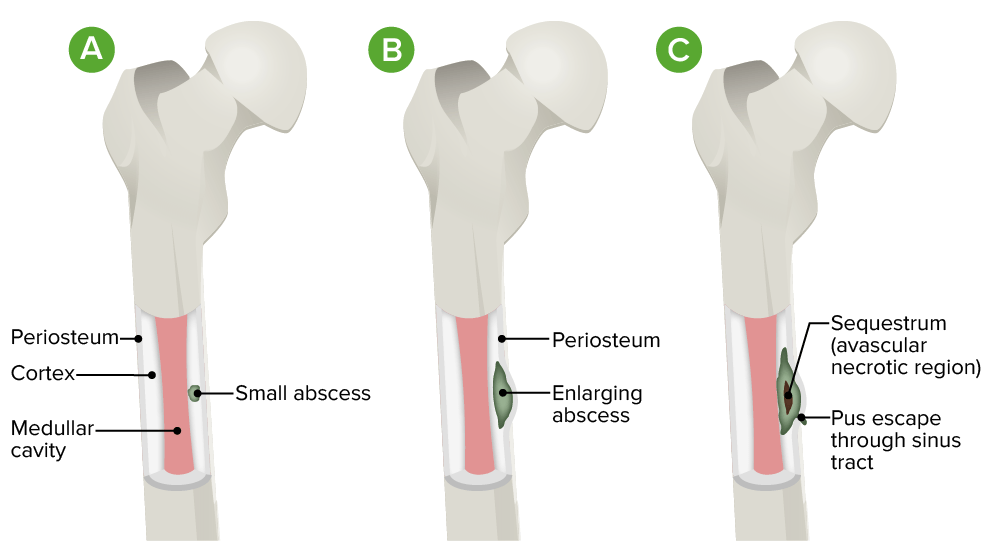
Pathophysiology of osteomyelitis

Fisiopatologia da osteomielite:
A. A infeção inicial localiza-se na região cortical.
B. Há progressão para o espaço subperiósteo com elevação do periósteo.
C. Ocorre infeção difusa com sequestro (região avascular necrótica) e formação de trajetos fistulosos.

Imagem por Lecturio.

Apresentação Clínica

Osteomielite aguda

  • O início pode ser gradual.
  • Sinais e sintomas:
    • Febre e arrepios
    • Edema Edema Edema is a condition in which excess serous fluid accumulates in the body cavity or interstitial space of connective tissues. Edema is a symptom observed in several medical conditions. It can be categorized into 2 types, namely, peripheral (in the extremities) and internal (in an organ or body cavity). Edema localizado
    • Calor Calor Inflammation
    • Eritema
    • Dor surda

Osteomielite crónica

  • Semelhante à osteomielite aguda
  • Dor óssea intermitente
  • Trajeto fistuloso com drenagem (patognomónico)
  • Febre e arrepios são menos comuns.

Exame físico

  • Verificar se há dor à palpação sobre o osso.
  • Avaliar a presença de nidus de infeção:
    • Cicatrização de feridas
    • Alta probabilidade de osteomielite se for possível sondar uma úlcera crónica até ao osso com uma ferramenta estéril
  • Verificar a função sensorial.
  • Avaliar se há diminuição de pulsos.

Subtipos

Osteomielite vertebral:

  • Subtipo mais MAIS Androgen Insensitivity Syndrome comum de osteomielite hematogénica em adultos
  • A coluna lombar é afetada com mais MAIS Androgen Insensitivity Syndrome frequência.
  • Progressão lenta dos sintomas:
    • Dor nas costas localizada:
      • Irradiação para as pernas, abdómen ou região inguinal
      • Agrava com a atividade e à noite
    • Défices motores e sensoriais com progressão severa

Osteomielite esternoclavicular e pélvica:

  • Mais MAIS Androgen Insensitivity Syndrome frequente em utilizadores de drogas intravenosas
  • Articulação esternoclavicular:
    • Edema Edema Edema is a condition in which excess serous fluid accumulates in the body cavity or interstitial space of connective tissues. Edema is a symptom observed in several medical conditions. It can be categorized into 2 types, namely, peripheral (in the extremities) and internal (in an organ or body cavity). Edema e dor da parede torácica anterior
    • Pode mimetizar um abcesso de tecidos moles Moles Primary Skin Lesions
  • Osteomielite pélvica:
    • Alterações na marcha ou incapacidade de suportar peso
    • Dor na anca ANCA Group of systemic vasculitis with a strong association with anca. The disorders are characterized by necrotizing inflammation of small and medium size vessels, with little or no immune-complex deposits in vessel walls. Rapidly Progressive Glomerulonephritis ou na região nadegueira

Osteomielite de ossos longos:

  • Subtipo menos comum em adultos, mas mais MAIS Androgen Insensitivity Syndrome comum em crianças
  • Pode se apresentar de forma semelhante à artrite sética de uma articulação
  • A sustentação do peso nos ossos longos afetados pode ser difícil.

Diagnóstico

Avaliação laboratorial

  • Os seguintes testes Testes Gonadal Hormones suportam o diagnóstico de osteomielite:
    • ↑ leucócitos
    • ↑ velocidade de sedimentação (VS)
    • PCR PCR Polymerase chain reaction (PCR) is a technique that amplifies DNA fragments exponentially for analysis. The process is highly specific, allowing for the targeting of specific genomic sequences, even with minuscule sample amounts. The PCR cycles multiple times through 3 phases: denaturation of the template DNA, annealing of a specific primer to the individual DNA strands, and synthesis/elongation of new DNA molecules. Polymerase Chain Reaction (PCR):
      • Correlaciona-se com a resposta clínica à terapia
      • Pode ser usada para monitorização durante o tratamento
  • As culturas fornecem dados de identificação e sensibilidade necessários para o organismo causador:
    • Hemoculturas:
      • Positivas em 50% dos casos
      • Obtidas antes de iniciar a antibioterapia, se possível.
    • Cultura de tecidos:
      • Também devem ser obtidas antes da antibioterapia, se possível
      • A biópsia óssea é a melhor forma de identificar a etiologia.
      • As culturas de feridas ou abcessos não são confiáveis.

Imagiologia

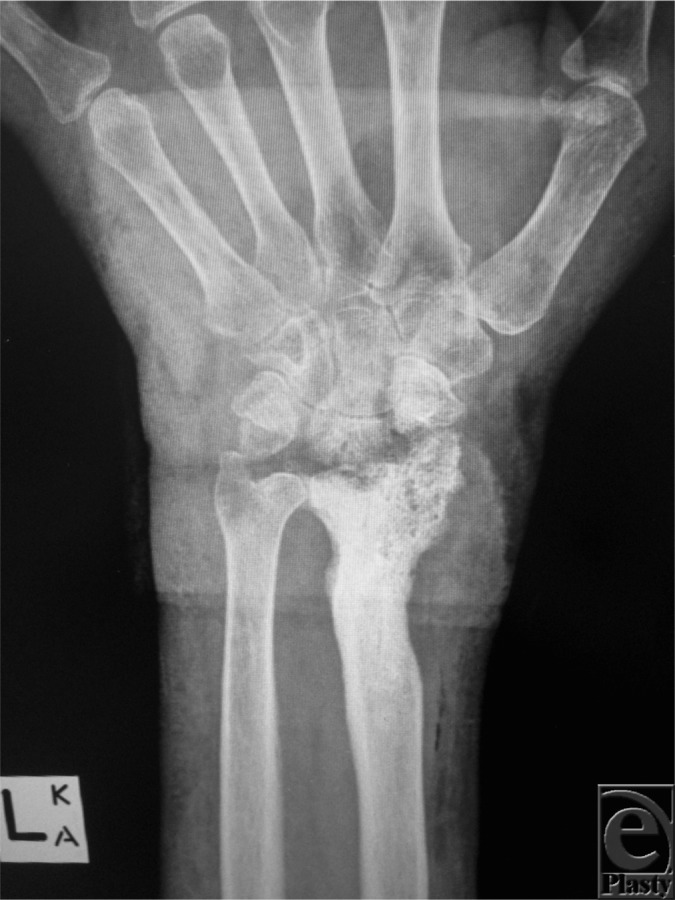
  • Raio-X:
    • Modalidade de imagem de 1ª linha
    • Pode não apresentar alterações nas primeiras 2 semanas da doença
    • Um raio-X normal não exclui osteomielite.
    • Exclui metástases ou fraturas
    • Achados:
      • Edema Edema Edema is a condition in which excess serous fluid accumulates in the body cavity or interstitial space of connective tissues. Edema is a symptom observed in several medical conditions. It can be categorized into 2 types, namely, peripheral (in the extremities) and internal (in an organ or body cavity). Edema dos tecidos moles Moles Primary Skin Lesions
      • Osteopenia Osteopenia Osteoporosis regional
      • Reação periosteal
      • Espessamento cortical
      • Esclerose periférica
      • Destruição óssea
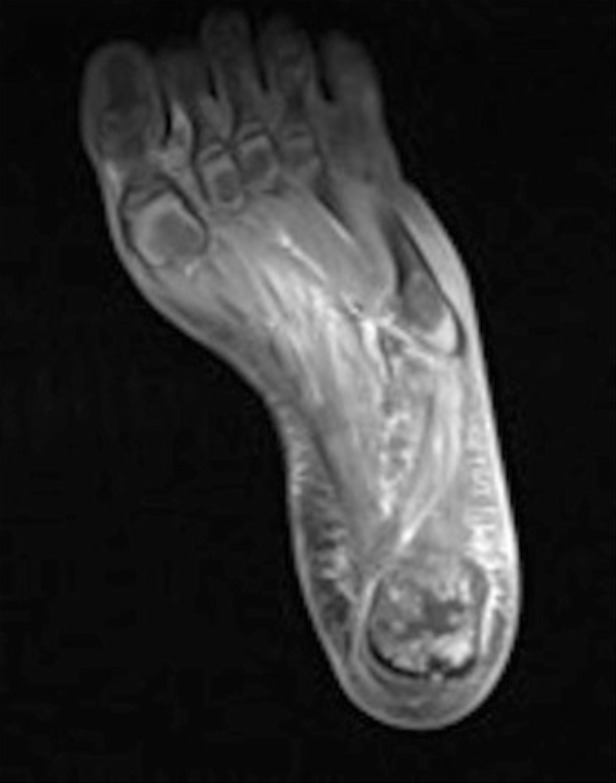
  • Ressonância magnética:
    • Modalidade mais MAIS Androgen Insensitivity Syndrome sensível e específica para osteomielite
    • Deteta infeção dentro de 3–5 dias do início
    • A utilização é limitada se houver dispositivos cirúrgicos.
    • Achados:
      • O edema Edema Edema is a condition in which excess serous fluid accumulates in the body cavity or interstitial space of connective tissues. Edema is a symptom observed in several medical conditions. It can be categorized into 2 types, namely, peripheral (in the extremities) and internal (in an organ or body cavity). Edema da medula óssea é a primeira manifestação.
      • Destruição cortical
      • Inflamação dos tecidos moles Moles Primary Skin Lesions
    • A utilização de contraste ajuda a distinguir as margens do abcesso e o periósteo adjacente ou envolvimento de tecidos moles Moles Primary Skin Lesions.
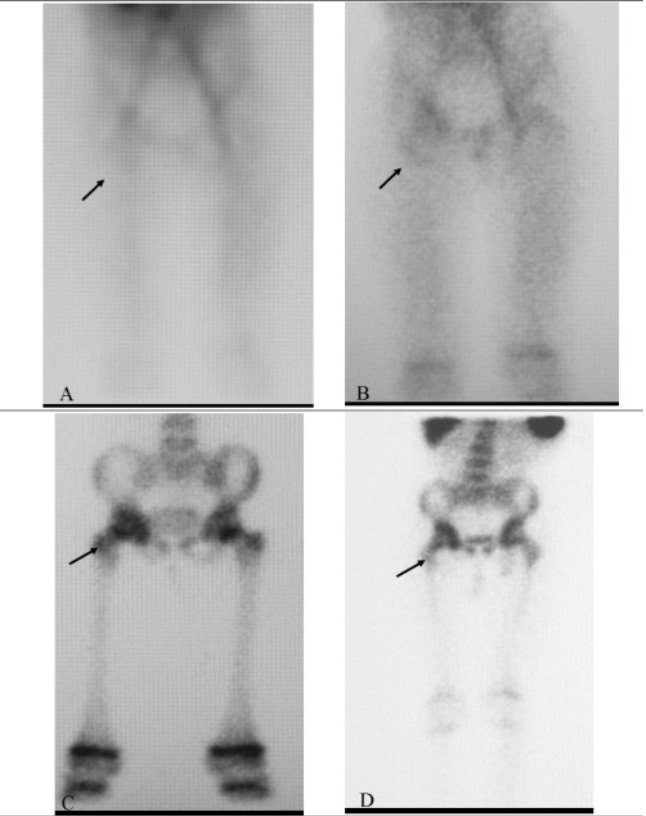
  • Cintigrafia óssea trifásica:
    • Utiliza um marcador de radionuclídeo, que se acumula nas áreas de atividade dos osteoblastos
    • 3 fases:
      • Corrente sanguínea
      • Pool de sangue
      • Ósseo
    • Captação significativa em todas as 3 fases da osteomielite
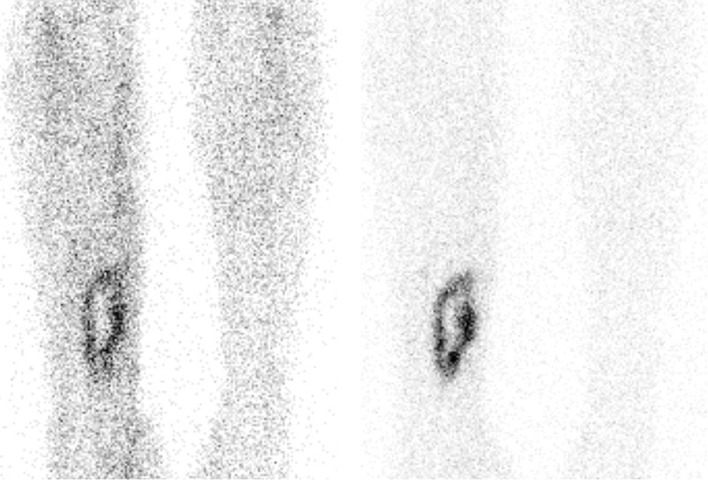
  • Scan com leucócitos marcados:
    • O sangue do paciente é colhido e os leucócitos autólogos são marcados com um marcador de radionuclídeo.
    • As células marcadas são então injetadas de volta no paciente e faz-se o scan.
    • Os leucócitos marcados acumulam-se no local da infeção.
    • Melhor para usar nas extremidades distais
    • Pode ser falsamente positivo se estiverem presentes outras condições inflamatórias naquela área (por exemplo, fratura)

Tratamento

Antibioterapia

  • Opções:
    • Terapia empírica inicial:
      • Vancomicina
      • Cefalosporina de 3ª ou 4ª geração
    • Se crescerem MSSA nas culturas:
      • Cefalosporinas de 1ª geração
      • Nafcilina ou oxacilina
    • Cobertura para MRSA MRSA A strain of Staphylococcus aureus that is non-susceptible to the action of methicillin. The mechanism of resistance usually involves modification of normal or the presence of acquired penicillin binding proteins. Staphylococcus:
      • Clindamicina
      • Vancomicina
      • Daptomicina
      • Linezolida
  • Pode ser suficiente em pacientes selecionados com:
    • Doença não complicada, especialmente em crianças
    • Osteomielite do pé diabético
    • Sem dispositivos ou próteses subjacentes

Desbridamento cirúrgico

  • Fequentemente necessário se a osteomielite estiver associada a:
    • Ferida necrótica purulenta
    • Coleções de fluidos infetados
    • Osso ferido ou morto
    • Dispositivos/próteses
  • Remoção de osso necrótico e doente:
    • A cultura da ferida e do osso deve ser obtida durante o desbridamento para reduzir o espectro de antibioticoterapia.
    • Pode permitir a colocação de antibióticos locais
  • Frequentemente é necessário a remoção dos dispositivos.

Duração do tratamento

  • A duração do tratamento varia muito e é influenciada por:
    • Presença ou ausência de dispositivos
    • Opções para desbridamento e capacidade de remover todo o osso infetado
  • A maioria dos regimes de tratamento dura em média 6 semanas.
  • A terapia supressiva oral de longo prazo deve ser considerada em:
    • Indivíduos com dispositivos retidos
    • Osso/tecido necrótico que não pode ser desbridado
  • A duração pode ser orientada pelos níveis de PCR PCR Polymerase chain reaction (PCR) is a technique that amplifies DNA fragments exponentially for analysis. The process is highly specific, allowing for the targeting of specific genomic sequences, even with minuscule sample amounts. The PCR cycles multiple times through 3 phases: denaturation of the template DNA, annealing of a specific primer to the individual DNA strands, and synthesis/elongation of new DNA molecules. Polymerase Chain Reaction (PCR), mas geralmente é clinicamente determinada pela resolução dos sintomas.

Diagnóstico Diferencial

  • Leucemia: a proliferação desregulada de leucócitos que provoca o aumento dos gânglios linfáticos e do baço, bem como falência da medula óssea e anemia Anemia Anemia is a condition in which individuals have low Hb levels, which can arise from various causes. Anemia is accompanied by a reduced number of RBCs and may manifest with fatigue, shortness of breath, pallor, and weakness. Subtypes are classified by the size of RBCs, chronicity, and etiology. Anemia: Overview and Types. A osteomielite e a leucemia podem manifestar-se com sintomas constitucionais semelhantes, como suores noturnos, febre e dores nos ossos (especialmente em crianças). Imagens em corte transversal, esfregaço de sangue periférico e hemograma completo com leucócitos marcadamente aumentados fazem o diagnóstico. O tratamento inclui quimioterapia.
  • Metástase de neoplasias: as neoplasias que metastatizam para o osso incluem as da próstata, da mama, do rim, da tiroide e do pulmão. A apresentação pode ser semelhante à da osteomielite, com dor nos ossos longos ou nas costas. No entanto, os sintomas constitucionais raramente são vistos. Nas imagens, as neoplasias do rim, da tiroide e do pulmão podem parecer lesões líticas. A biópsia é a forma mais MAIS Androgen Insensitivity Syndrome definitiva de distinguir as metástases da osteomielite. O tratamento depende do tipo de neoplasia primária.
  • Artropatia de Charcot: resulta da combinação das consequências mecânicas e vasculares da neuropatia periférica diabética. Este processo desencadeia uma resposta inflamatória local que causa dor, edema Edema Edema is a condition in which excess serous fluid accumulates in the body cavity or interstitial space of connective tissues. Edema is a symptom observed in several medical conditions. It can be categorized into 2 types, namely, peripheral (in the extremities) and internal (in an organ or body cavity). Edema e eritema na articulação afetada. Os pacientes também podem desenvolver feridas na pele devido à neuropatia e progredir para osteomielite secundária. As imagens de raio-X confirmarão o diagnóstico. O tratamento inclui estabilização da articulação.
  • Osteomielite multifocal Multifocal Retinoblastoma recorrente crónica: uma doença inflamatória estéril observada em crianças que pode causar danos nos ossos se não for tratada. A patologia é mal compreendida, mas presume-se que esteja relacionada com a disfunção dos osteoclastos. As crianças podem apresentar dor episódica ou crónica numa ou várias áreas. O diagnóstico é baseado em exames de imagem. Os valores laboratoriais serão normais, ao contrário da osteomielite. O tratamento primário envolve terapia com AINEs. Pode ser necessário imunossupressão, se o tratamento primário falhar.
  • Artrite sética: infeção da articulação que pode ser causada por bactérias ou outros microorganismos. Os pacientes apresentam uma articulação quente e com edema Edema Edema is a condition in which excess serous fluid accumulates in the body cavity or interstitial space of connective tissues. Edema is a symptom observed in several medical conditions. It can be categorized into 2 types, namely, peripheral (in the extremities) and internal (in an organ or body cavity). Edema agudo, com amplitude de movimento limitada. Em alguns pacientes há sintomas constitucionais. O diagnóstico é feito através da análise e da cultura do líquido sinovial. Ao contrário da osteomielite, raramente há alterações ósseas nas imagens. O tratamento envolve drenagem, desbridamento e antibioterapia.

Referências

  1. Momodu, I. I., Savaliya, V. (2023). Osteomyelitis. StatPearls. Retrieved May 13, 2025, from https://www.ncbi.nlm.nih.gov/books/NBK532250/
  2. Lalani, T. (2024, November 19). Osteomyelitis in the absence of hardware: Approach to diagnosis in adults. In S. Nelson (Ed.), UpToDate. Wolters Kluwer. Retrieved May 13, 2025, from https://www.uptodate.com/contents/osteomyelitis-in-the-absence-of-hardware-approach-to-diagnosis-in-adults
  3. Sopirala, M. M. (2022). Pathogenesis of osteomyelitis. In S. Nelson (Ed.), UpToDate. Wolters Kluwer. Retrieved May 13, 2025, from https://www.uptodate.com/contents/pathogenesis-of-osteomyelitis
  4. Tande, A. J. (2024). Osteomyelitis in the absence of hardware: Approach to treatment in adults. In S. Nelson (Ed.), UpToDate. Wolters Kluwer. Retrieved May 13, 2025, from https://www.uptodate.com/contents/osteomyelitis-in-the-absence-of-hardware-approach-to-treatment-in-adults
  5. Spritzer, C. E. (2025). Imaging studies for osteomyelitis. In S. Nelson (Ed.), UpToDate. Wolters Kluwer. Retrieved May 13, 2025, from https://www.uptodate.com/contents/imaging-studies-for-osteomyelitis
  6. Martin, E. A. (2025). Diabetic neuroarthropathy. In S. M. Helfgott & D. M. Nathan (Eds.), UpToDate. Wolters Kluwer. Retrieved May 13, 2025, from https://www.uptodate.com/contents/diabetic-neuroarthropathy
  7. Schmitt, S. (2024). Osteomyelitis. StatPearls. Retrieved March 13, 2025, from https://www.msdmanuals.com/professional/musculoskeletal-and-connective-tissue-disorders/infections-of-joints-and-bones/osteomyelitis
  8. Kishner, S., Hart, E. K., Nixon, G. C., and Laborde, J. M. (2022). Osteomyelitis. In Poduval, M. (Ed.), Medscape. Retrieved March 13, 2025, from https://emedicine.medscape.com/article/1348767-overview

Crie sua conta gratuita ou faça login para continuar lendo!

Cadastre-se agora e tenha acesso grátis ao Lecturio, com páginas de conceitos, vídeos de medicina e questões para sua educação médica.

Aprende mais com a Lecturio:

Multiple devices displaying human anatomy and health education content.

Complementa o teu estudo da faculdade com o companheiro de estudo tudo-em-um da Lecturio, através de métodos de ensino baseados em evidência.

Estuda onde quiseres

Two iPhones display medical education apps, one showing anatomy, the other Bookmatcher.

A Lecturio Medical complementa o teu estudo através de métodos de ensino baseados em evidência, vídeos de palestras, perguntas e muito mais – tudo combinado num só lugar e fácil de usar.

User Reviews

Have a holly, jolly study session 🎁 Save 50% on all plans now >>

Que tengas una sesión de estudio alegre y navideña 🎁 Ahorra 50% en todos los planes >>

Details