
Domina Conceptos Médicos

Estudia para la escuela de medicina y tus examenes con Lecturio.

Sistemas de Grupo Sanguíneo

Existen 47 sistemas de grupo sanguíneo, entre los LOS Neisseria cuales el grupo ABO es el más importante. Los LOS Neisseria grupos sanguíneos se determinan por medio de antígenos que son marcadores de superficie en EN Erythema nodosum is an immune-mediated panniculitis (inflammation of the subcutaneous fat) caused by a type IV (delayed-type) hypersensitivity reaction. It commonly manifests in young women as tender, erythematous nodules on the shins. Erythema Nodosum los LOS Neisseria eritrocitos y consisten en EN Erythema nodosum is an immune-mediated panniculitis (inflammation of the subcutaneous fat) caused by a type IV (delayed-type) hypersensitivity reaction. It commonly manifests in young women as tender, erythematous nodules on the shins. Erythema Nodosum proteínas y carbohidratos. Los LOS Neisseria antígenos también se encuentran en EN Erythema nodosum is an immune-mediated panniculitis (inflammation of the subcutaneous fat) caused by a type IV (delayed-type) hypersensitivity reaction. It commonly manifests in young women as tender, erythematous nodules on the shins. Erythema Nodosum plaquetas, leucocitos y células tisulares, y también existen en EN Erythema nodosum is an immune-mediated panniculitis (inflammation of the subcutaneous fat) caused by a type IV (delayed-type) hypersensitivity reaction. It commonly manifests in young women as tender, erythematous nodules on the shins. Erythema Nodosum forma soluble en EN Erythema nodosum is an immune-mediated panniculitis (inflammation of the subcutaneous fat) caused by a type IV (delayed-type) hypersensitivity reaction. It commonly manifests in young women as tender, erythematous nodules on the shins. Erythema Nodosum secreciones corporales como leche materna, líquido seminal, saliva Saliva The clear, viscous fluid secreted by the salivary glands and mucous glands of the mouth. It contains mucins, water, organic salts, and ptyalin. Salivary Glands: Anatomy, sudor, secreciones gástricas, orina y líquido amniótico. Los LOS Neisseria individuos desarrollarán naturalmente anticuerpos  contra los LOS Neisseria antígenos ABO que no tienen. Por esta razón, es importante determinar el grupo sanguíneo de un individuo antes de cualquier transfusión de hemoderivados y antes de donar o recibir un trasplante de órganos. Si no se produce el emparejamiento adecuado, se producirá una activación masiva del sistema inmunológico y de la cascada de coagulación, lo que provocará shock Shock Shock is a life-threatening condition associated with impaired circulation that results in tissue hypoxia. The different types of shock are based on the underlying cause: distributive (↑ cardiac output (CO), ↓ systemic vascular resistance (SVR)), cardiogenic (↓ CO, ↑ SVR), hypovolemic (↓ CO, ↑ SVR), obstructive (↓ CO), and mixed. Types of Shock, fallo orgánico e incluso la muerte.

Last updated: Dec 15, 2025

Editorial responsibility: Stanley Oiseth, Lindsay Jones, Evelin Maza

Grupo Sanguíneo ABO

Antígenos

Hay 4 grupos sanguíneos comunes en EN Erythema nodosum is an immune-mediated panniculitis (inflammation of the subcutaneous fat) caused by a type IV (delayed-type) hypersensitivity reaction. It commonly manifests in young women as tender, erythematous nodules on the shins. Erythema Nodosum el sistema ABO: A, B, AB y O.
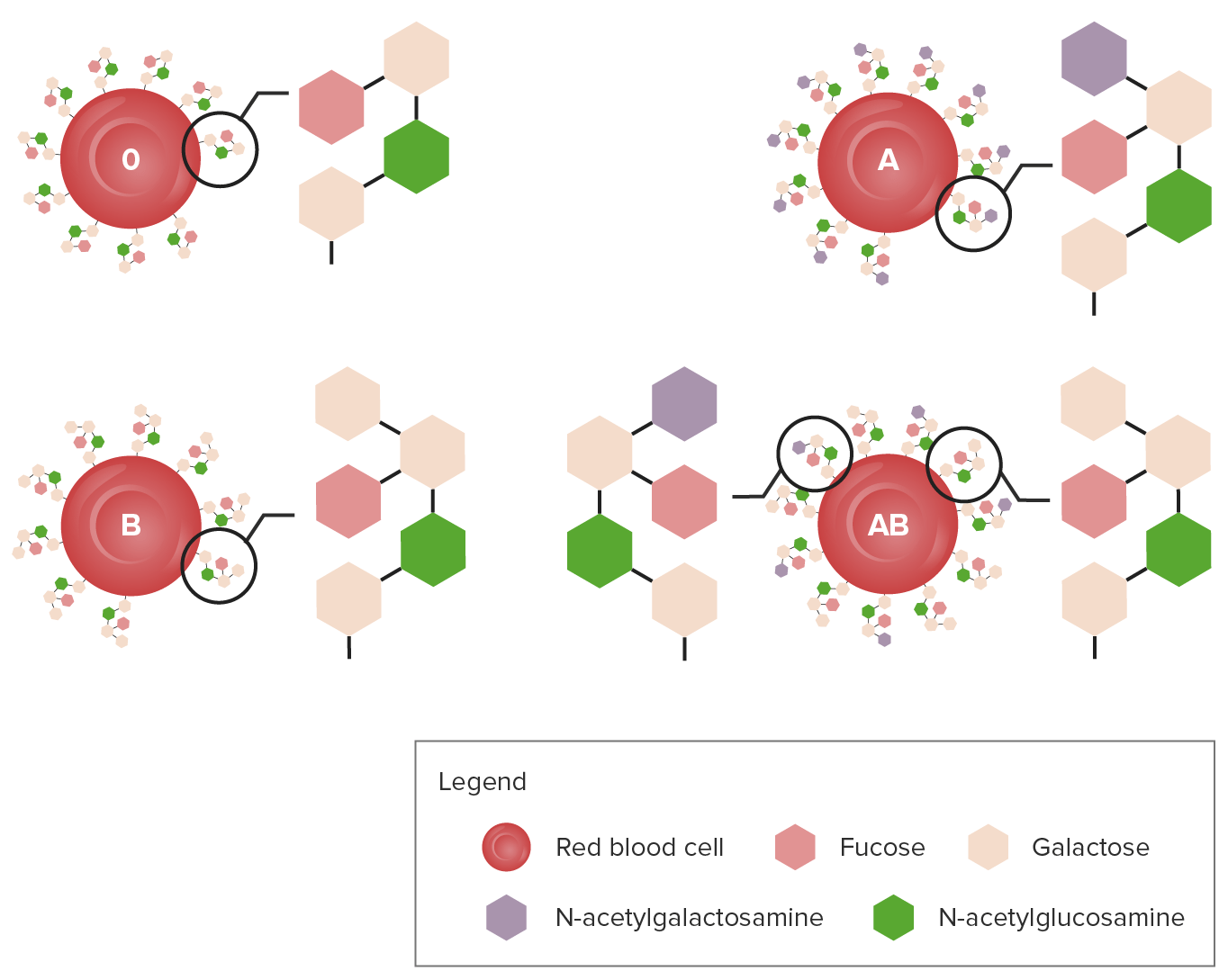
  • Estos grupos sanguíneos se definen por la presencia de antígenos específicos en EN Erythema nodosum is an immune-mediated panniculitis (inflammation of the subcutaneous fat) caused by a type IV (delayed-type) hypersensitivity reaction. It commonly manifests in young women as tender, erythematous nodules on the shins. Erythema Nodosum los LOS Neisseria eritrocitos.
    • Grupo sanguíneo A: antígeno A
    • Grupo sanguíneo B: antígeno B
    • Grupo sanguíneo AB: antígenos A y B
    • Grupo sanguíneo O: sin antígenos
  • Los LOS Neisseria antígenos A y B consisten en EN Erythema nodosum is an immune-mediated panniculitis (inflammation of the subcutaneous fat) caused by a type IV (delayed-type) hypersensitivity reaction. It commonly manifests in young women as tender, erythematous nodules on the shins. Erythema Nodosum azúcares de carbohidratos específicos:
    • N-acetilgalactosamina para el antígeno A
    • D-galactosa para el antígeno B
    • Ambos azúcares se unen y modifican el antígeno H de la superficie eritrocitaria.
    • Si el antígeno H se deja sin modificar, el grupo sanguíneo resultante es el O.
  • Existen cientos de alelos ABO. Los LOS Neisseria más comunes son A1, A2, B1, O1, O1v y O2.
Diagram showing the carbohydrate chains that determine the ABO blood group

Diagrama que muestra las cadenas de carbohidratos que determinan el grupo sanguíneo ABO

Imagen por Lecturio.

Herencia

Las frecuencias del tipo de sangre varían en EN Erythema nodosum is an immune-mediated panniculitis (inflammation of the subcutaneous fat) caused by a type IV (delayed-type) hypersensitivity reaction. It commonly manifests in young women as tender, erythematous nodules on the shins. Erythema Nodosum los LOS Neisseria diferentes grupos raciales/étnicos. El grupo sanguíneo ABO se hereda de forma autosómica codominante:

  • Los LOS Neisseria alelos A y B son codominantes.
  • El alelo O es recesivo.
Tabla: Patrón de herencia del grupo sanguíneo ABO
Madre A Madre B Madre O
Padre A AA AA Amyloidosis AB AO
Padre B BA BB BO
Padre O OA OA Osteoarthritis (OA) is the most common form of arthritis, and is due to cartilage destruction and changes of the subchondral bone. The risk of developing this disorder increases with age, obesity, and repetitive joint use or trauma. Patients develop gradual joint pain, stiffness lasting < 30 minutes, and decreased range of motion. Osteoarthritis OB OO
Tabla: Alelos y tipos de sangre
Alelos Tipo de sangre
A + A A
A + O A
A + B AB
B + B B
B + O B
O + O O
Los alelos dominantes son el A y el B; cuando ambos están presentes, el individuo tiene el tipo de sangre AB. El alelo recesivo es el O.

Anticuerpos

Los LOS Neisseria individuos desarrollarán naturalmente anticuerpos contra los LOS Neisseria antígenos ABO que no tienen:

  • Los LOS Neisseria individuos del grupo sanguíneo A tienen anticuerpos anti-B.
  • Los LOS Neisseria individuos del grupo sanguíneo B tienen anticuerpos anti-A.
  • Los LOS Neisseria individuos con el grupo sanguíneo O tendrán tanto anticuerpos anti-A como anti-B.

Estos anticuerpos pueden provocar una respuesta hemolítica al AL Amyloidosis encontrarse con su respectivo antígeno:

  • Una transfusión de sangre ABO incompatible puede ser mortal.
  • Un donante universal de eritrocitos tiene sangre del tipo O.
  • Un donante de plasma Plasma The residual portion of blood that is left after removal of blood cells by centrifugation without prior blood coagulation. Transfusion Products universal tiene sangre del tipo AB.

Riesgos asociados

Los LOS Neisseria grupos sanguíneos se asocian con un riesgo diferencial a ciertas enfermedades. El grupo sanguíneo O puede tener ↓ riesgo de:
  • Cáncer de páncreas
  • Enfermedad tromboembólica
  • Malaria Malaria Malaria is an infectious parasitic disease affecting humans and other animals. Most commonly transmitted via the bite of a female Anopheles mosquito infected with microorganisms of the Plasmodium genus. Patients present with fever, chills, myalgia, headache, and diaphoresis. Plasmodium/Malaria
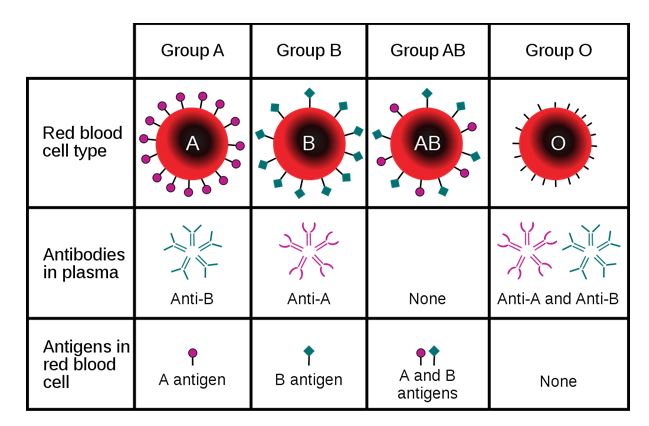
Antígenos de tipo sanguíneo

Diagrama que muestra que una persona puede expresar A, B, AB o ningún antígeno:
El diagrama también describe el tipo de anticuerpo producido por el portador.

Imagen: “ABO blood group antigens present on red blood cells and IgM antibodies present in the serum” por InvictaHOG. Licencia: Dominio Público

Factor Rh

Definición

El factor Rh (factor Rhesus) es un antígeno de superficie eritrocitario.

  • Codificado por los LOS Neisseria 2 genes Genes A category of nucleic acid sequences that function as units of heredity and which code for the basic instructions for the development, reproduction, and maintenance of organisms. DNA Types and Structure RHD y RHCE:
    • ↑ Polimorfismo: Numerosos reordenamientos genéticos producen antígenos Rh distintos.
    • 50 antígenos del grupo Rh (5 son importantes)
  • 85% de las personas son portadoras del alelo D: Son Rh+.
  • 15% no son portadoras: Son Rh-.
  • Las personas Rh- no son portadoras de anticuerpos anti-Rh a menos que estén expuestas a eritrocitos Rh+.

Incompatibilidad del Rh

Los LOS Neisseria anticuerpos Anti-Rh se producen cuando:

  • La sangre Rh+ se transfunde a una persona Rh-:
    • Provoca una reacción hemolítica aguda
    • Da como resultado una anemia Anemia Anemia is a condition in which individuals have low Hb levels, which can arise from various causes. Anemia is accompanied by a reduced number of RBCs and may manifest with fatigue, shortness of breath, pallor, and weakness. Subtypes are classified by the size of RBCs, chronicity, and etiology. Anemia: Overview and Types hemolítica leve
  • La madre embarazada Rh- está expuesta a eritrocitos fetales Rh+:
    • Secundario a una hemorragia feto materna por aborto, traumatismo, procedimientos obstétricos invasivos o parto normal
    • La madre produce anticuerpos contra los LOS Neisseria eritrocitos del bebé.
    • Los LOS Neisseria anticuerpos son IgG IgG The major immunoglobulin isotype class in normal human serum. There are several isotype subclasses of igg, for example, igg1, igg2a, and igg2b. Hypersensitivity Pneumonitis y atraviesan la placenta Placenta A highly vascularized mammalian fetal-maternal organ and major site of transport of oxygen, nutrients, and fetal waste products. It includes a fetal portion (chorionic villi) derived from trophoblasts and a maternal portion (decidua) derived from the uterine endometrium. The placenta produces an array of steroid, protein and peptide hormones (placental hormones). Placenta, Umbilical Cord, and Amniotic Cavity.
    • Los LOS Neisseria anticuerpos pueden causar hemólisis al AL Amyloidosis feto (también llamada enfermedad hemolítica del recién nacido o eritroblastosis fetal).
    • La inmunoglobulina anti-D se administra a mujeres sensibilizadas después del embarazo para evitar esta reacción.

Si el feto es Rh+ y la madre Rh-, es necesario realizar un control seriado durante el embarazo, que se lleva a cabo mediante:
  • Prueba de Coombs indirecta seriada en EN Erythema nodosum is an immune-mediated panniculitis (inflammation of the subcutaneous fat) caused by a type IV (delayed-type) hypersensitivity reaction. It commonly manifests in young women as tender, erythematous nodules on the shins. Erythema Nodosum la madre
  • Medición de la velocidad del flujo sanguíneo fetal en EN Erythema nodosum is an immune-mediated panniculitis (inflammation of the subcutaneous fat) caused by a type IV (delayed-type) hypersensitivity reaction. It commonly manifests in young women as tender, erythematous nodules on the shins. Erythema Nodosum la arteria cerebral media mediante Doppler Doppler Ultrasonography applying the doppler effect, with frequency-shifted ultrasound reflections produced by moving targets (usually red blood cells) in the bloodstream along the ultrasound axis in direct proportion to the velocity of movement of the targets, to determine both direction and velocity of blood flow. Ultrasound (Sonography)
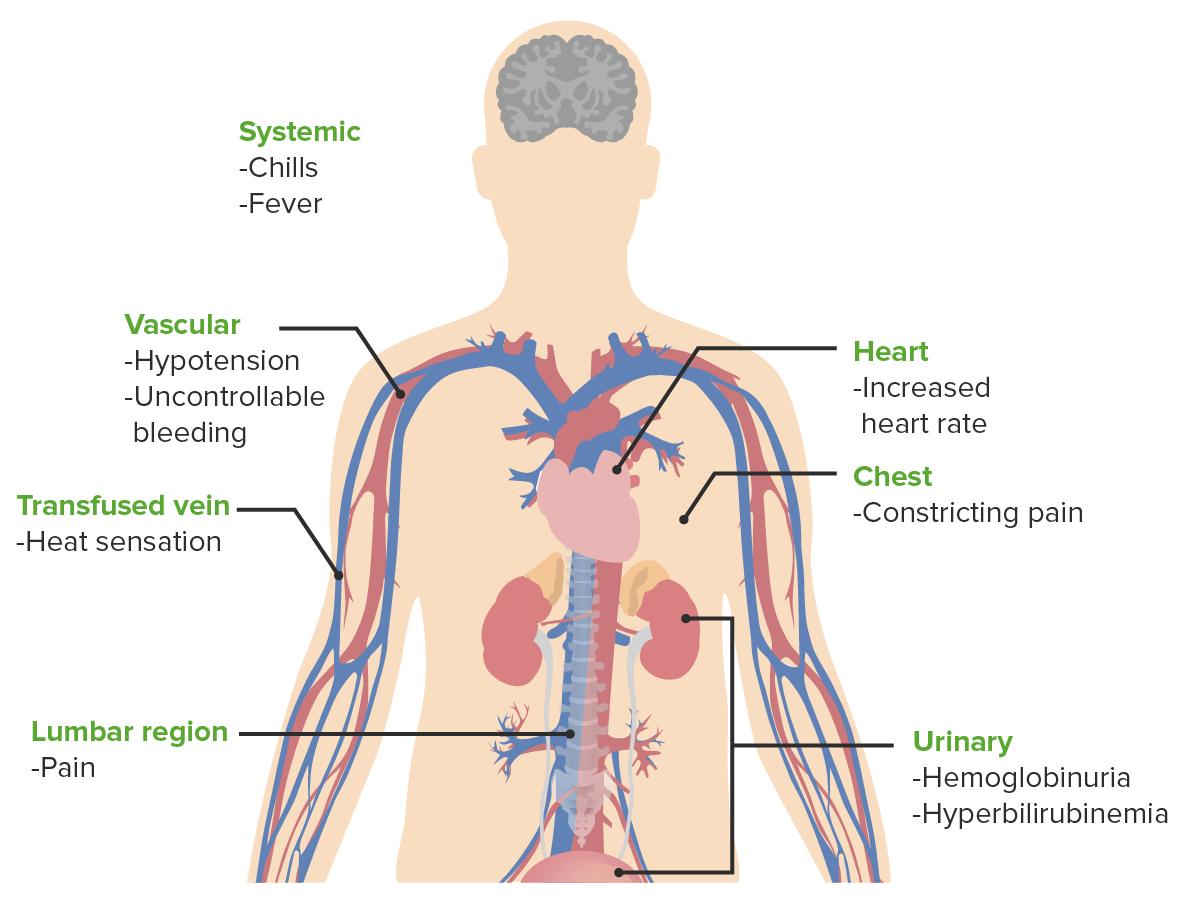
Signs and symptoms of acute hemolytic transfusion reactions

Signos y síntomas de las reacciones transfusionales hemolíticas agudas

Imagen por Lecturio.

Otros Grupos Sanguíneos

Sistema Kell

  • 3er antígeno inmunogénico más potente después de los LOS Neisseria sistemas ABO y Rh
  • Se han descubierto más de 30 antígenos Kell.
  • Definido por el anticuerpo inmune anti-K
  • El anticuerpo anti-K causa:
    • Enfermedad hemolítica severa del feto y del recién nacido
    • Reacciones transfusionales hemolíticas

Sistema Duffy

  • El antígeno Duffy recibió su nombre de un paciente con hemofilia que recibió muchas transfusiones y desarrolló anticuerpos contra el antígeno.
  • También conocido como glicoproteína Fy
  • Existen 2 alelos:
    • Fya
    • Fyb
  • Hay 4 fenotipos posibles:
    • Fy(a+b-)
    • Fy(a+b+)
    • Fy(a-b+)
    • Fy(a-b-)
  • Receptor Receptor Receptors are proteins located either on the surface of or within a cell that can bind to signaling molecules known as ligands (e.g., hormones) and cause some type of response within the cell. Receptors inespecífico para quimioquinas y para el parásito de malaria Malaria Malaria is an infectious parasitic disease affecting humans and other animals. Most commonly transmitted via the bite of a female Anopheles mosquito infected with microorganisms of the Plasmodium genus. Patients present with fever, chills, myalgia, headache, and diaphoresis. Plasmodium/Malaria, Plasmodium Plasmodium A genus of protozoa that comprise the malaria parasites of mammals. Four species infect humans (although occasional infections with primate malarias may occur). These are plasmodium falciparum; plasmodium malariae; plasmodium ovale, and plasmodium vivax. Species causing infection in vertebrates other than man include: plasmodium berghei; plasmodium chabaudi; p. Vinckei, and plasmodium yoelii in rodents; p. Brasilianum, plasmodium cynomolgi; and plasmodium knowlesi in monkeys; and plasmodium gallinaceum in chickens. Antimalarial Drugs vivax
  • Los LOS Neisseria anticuerpos asociados son IgG IgG The major immunoglobulin isotype class in normal human serum. There are several isotype subclasses of igg, for example, igg1, igg2a, and igg2b. Hypersensitivity Pneumonitis y pueden causar reacciones transfusionales hemolíticas.

Sistema Kidd

  • El antígeno Kidd (antígeno Jk) actúa como transportador de urea Urea A compound formed in the liver from ammonia produced by the deamination of amino acids. It is the principal end product of protein catabolism and constitutes about one half of the total urinary solids. Urea Cycle en EN Erythema nodosum is an immune-mediated panniculitis (inflammation of the subcutaneous fat) caused by a type IV (delayed-type) hypersensitivity reaction. It commonly manifests in young women as tender, erythematous nodules on the shins. Erythema Nodosum los LOS Neisseria eritrocitos y en EN Erythema nodosum is an immune-mediated panniculitis (inflammation of the subcutaneous fat) caused by a type IV (delayed-type) hypersensitivity reaction. It commonly manifests in young women as tender, erythematous nodules on the shins. Erythema Nodosum el endotelio renal.
  • Hasta la fecha se han identificado 3 antígenos:
    • Jka
    • Jkb
    • JK3
  • El Ac Kidd puede provocar reacciones transfusionales severas.

Complicaciones de las Transfusiones Sanguíneas

Las complicaciones de la transfusión de sangre pueden ser agudas (minutos a horas) o retardadas (días a meses).
Agudas

  • Reacción hemolítica:
    • Inmediata o dentro de 24 horas tras la transfusión:
      • Debido a anticuerpos IgM IgM A class of immunoglobulin bearing mu chains (immunoglobulin mu-chains). Igm can fix complement. The name comes from its high molecular weight and originally being called a macroglobulin. Immunoglobulins: Types and Functions contra los LOS Neisseria eritrocitos
      • Típicamente del grupo ABO
    • Retrasada: Los LOS Neisseria anticuerpos IgG IgG The major immunoglobulin isotype class in normal human serum. There are several isotype subclasses of igg, for example, igg1, igg2a, and igg2b. Hypersensitivity Pneumonitis no están presentes durante la transfusión, sino que se desarrollan posteriormente.
    • No inmune:
      • Debido al AL Amyloidosis envejecimiento eritrocitario
      • Almacenamiento inadecuado
      • Transfusión junto a medicamentos no compatibles
      • Transfusión a través de tubos IV de pequeño calibre
  • Infección:
    • Bacteriana
    • Viral: VIH, virus Virus Viruses are infectious, obligate intracellular parasites composed of a nucleic acid core surrounded by a protein capsid. Viruses can be either naked (non-enveloped) or enveloped. The classification of viruses is complex and based on many factors, including type and structure of the nucleoid and capsid, the presence of an envelope, the replication cycle, and the host range. Virology de la hepatitis C Hepatitis C Hepatitis C is an infection of the liver caused by the hepatitis C virus (HCV). The infection can be transmitted through infectious blood or body fluids and may be transmitted during childbirth or through IV drug use or sexual intercourse. Hepatitis C virus can cause both acute and chronic hepatitis, ranging from a mild to a serious, lifelong illness including liver cirrhosis and hepatocellular carcinoma (HCC). Hepatitis C Virus, virus Virus Viruses are infectious, obligate intracellular parasites composed of a nucleic acid core surrounded by a protein capsid. Viruses can be either naked (non-enveloped) or enveloped. The classification of viruses is complex and based on many factors, including type and structure of the nucleoid and capsid, the presence of an envelope, the replication cycle, and the host range. Virology de la hepatitis B Hepatitis B Hepatitis B virus (HBV) is a partially double-stranded DNA virus, which belongs to the Orthohepadnavirus genus and the Hepadnaviridae family. Most individuals with acute HBV infection are asymptomatic or have mild, self-limiting symptoms. Chronic infection can be asymptomatic or create hepatic inflammation, leading to liver cirrhosis and hepatocellular carcinoma (HCC). Hepatitis B Virus, virus Virus Viruses are infectious, obligate intracellular parasites composed of a nucleic acid core surrounded by a protein capsid. Viruses can be either naked (non-enveloped) or enveloped. The classification of viruses is complex and based on many factors, including type and structure of the nucleoid and capsid, the presence of an envelope, the replication cycle, and the host range. Virology linfotrópico T humano 1 o 2
    • Muy raras debido a los LOS Neisseria protocolos de tamizaje/ tratamiento de los LOS Neisseria productos sanguíneos donados.
  • Reacción alérgica:
    • Leve: urticaria Urticaria Urticaria is raised, well-circumscribed areas (wheals) of edema (swelling) and erythema (redness) involving the dermis and epidermis with associated pruritus (itch). Urticaria is not a single disease but rather is a reaction pattern representing cutaneous mast cell degranulation. Urticaria (Hives), prurito
    • Severa, que puede provocar anafilaxia:
      • Hipotensión
      • Broncoespasmo
      • Síntomas gastrointestinales (náuseas, dolor Dolor Inflammation abdominal)
      • Insuficiencia orgánica sistémica
    • Debido a la sensibilización a los LOS Neisseria antígenos de la unidad donante, especialmente a las proteínas plasmáticas
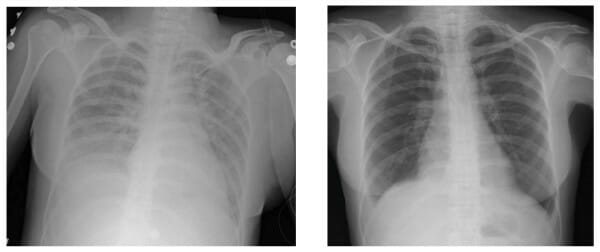
  • Lesión pulmonar aguda relacionada con la transfusión:
    • Dentro de las 6 horas siguientes a la transfusión
    • Causa edema Edema Edema is a condition in which excess serous fluid accumulates in the body cavity or interstitial space of connective tissues. Edema is a symptom observed in several medical conditions. It can be categorized into 2 types, namely, peripheral (in the extremities) and internal (in an organ or body cavity). Edema pulmonar no cardiogénico con hipoxemia severa
    • El diagnóstico no requiere otros factores de riesgo de lesión pulmonar aguda.
    • Debido a la activación del sistema inmunológico del receptor Receptor Receptors are proteins located either on the surface of or within a cell that can bind to signaling molecules known as ligands (e.g., hormones) and cause some type of response within the cell. Receptors por los LOS Neisseria anticuerpos anti-HLA o anti-neutrófilos
  • Reacción febril aguda no hemolítica:
    • ↑ Temperatura corporal de 1 °C (1,8 °F) en EN Erythema nodosum is an immune-mediated panniculitis (inflammation of the subcutaneous fat) caused by a type IV (delayed-type) hypersensitivity reaction. It commonly manifests in young women as tender, erythematous nodules on the shins. Erythema Nodosum las 24 horas posteriores a una transfusión de sangre
    • Más frecuente con:
      • Transfusiones repetidas
      • Embarazo
    • Debido a la liberación de pirógenos y citoquinas endógenas mediadas por anticuerpos
  • Sobrecarga circulatoria:
    • Debido a la rápida transfusión de un gran volumen de hemoderivados
    • ↑ Riesgo:
      • Enfermedad cardiopulmonar subyacente
      • Insuficiencia renal
      • Anemia Anemia Anemia is a condition in which individuals have low Hb levels, which can arise from various causes. Anemia is accompanied by a reduced number of RBCs and may manifest with fatigue, shortness of breath, pallor, and weakness. Subtypes are classified by the size of RBCs, chronicity, and etiology. Anemia: Overview and Types crónica
      • Pacientes de edad avanzada
    • Los LOS Neisseria signos y síntomas incluyen:
      • ↑ Frecuencia cardiaca, disnea, tos TOS Thoracic outlet syndrome (TOS) is a broad term used for a spectrum of syndromes related to the general region of the thoracic outlet, which involves the compression or irritation of elements of the brachial plexus, subclavian artery, or subclavian vein. Thoracic Outlet Syndrome
      • ↑ Presión venosa central, presión de pulso ampliada
      • La radiografía de tórax muestra cardiomegalia y edema Edema Edema is a condition in which excess serous fluid accumulates in the body cavity or interstitial space of connective tissues. Edema is a symptom observed in several medical conditions. It can be categorized into 2 types, namely, peripheral (in the extremities) and internal (in an organ or body cavity). Edema pulmonar.

Tardias

  • Sobrecarga de hierro:
    • En EN Erythema nodosum is an immune-mediated panniculitis (inflammation of the subcutaneous fat) caused by a type IV (delayed-type) hypersensitivity reaction. It commonly manifests in young women as tender, erythematous nodules on the shins. Erythema Nodosum los LOS Neisseria pacientes que reciben sangre a largo plazo y regularmente
    • 1 unidad de eritrocitos = 200 mg de hierro
    • Puede producirse una acumulación de hierro que es tóxica para los LOS Neisseria tejidos y órganos.
    • Tratamiento: quelación del hierro
  • Enfermedad de injerto contra huésped:
    • Debido a la proliferación de los LOS Neisseria linfocitos del donante, que atacan los LOS Neisseria tejidos y órganos del receptor Receptor Receptors are proteins located either on the surface of or within a cell that can bind to signaling molecules known as ligands (e.g., hormones) and cause some type of response within the cell. Receptors
    • Los LOS Neisseria síntomas incluyen:
      • Erupción, fiebre, diarrea, disfunción hepática y pancitopenia
      • Los LOS Neisseria síntomas aparecen entre 1–6 semanas después de la transfusión
    • Fatal en EN Erythema nodosum is an immune-mediated panniculitis (inflammation of the subcutaneous fat) caused by a type IV (delayed-type) hypersensitivity reaction. It commonly manifests in young women as tender, erythematous nodules on the shins. Erythema Nodosum > 90% de los LOS Neisseria casos
    • ↑ Riesgo en EN Erythema nodosum is an immune-mediated panniculitis (inflammation of the subcutaneous fat) caused by a type IV (delayed-type) hypersensitivity reaction. It commonly manifests in young women as tender, erythematous nodules on the shins. Erythema Nodosum:
      • Inmunocomprometidos
      • Antecedentes de enfermedad de Hodgkin
      • Antecedente de trasplante de células madre
      • Antecedente de tumores sólidos tratados con medicamentos citotóxicos
      • Quimioterapia intensiva
      • Transfusión de sangre de un familiar (haplotipos HLA compartidos)
Transfusion-related acute lung injury

Lesión pulmonar aguda relacionada con la transfusión:
Izquierda: hallazgo en la radiografía de tórax durante los síntomas agudos
Derecha: Radiografía de tórax después de desconectar al individuo del ventilador

Imagen: “F1: Chest X-ray findings” por Haji A. G. et al. Licencia: CC BY 2.0

Referencias

  1. Mitra, R., Mishra, N., & Rath, G. P. (2014). Blood groups systems. Indian journal of anaesthesia, 58(5), 524–528. Retrieved June 7, 2025, from https://pubmed.ncbi.nlm.nih.gov/25535412/
  2. Moise KJ. (2025). RhD alloimmunization in pregnancy: Management. UptoDate. Retrieved June 7, 2025, from https://www.uptodate.com/contents/rhd-alloimmunization-in-pregnancy-management
  3. Sharma, S., Sharma, P., & Tyler, L. N. (2011). Transfusion of blood and blood products: indications and complications. American family physician, 83(6), 719–724. Retrieved June 7, 2025, from https://pubmed.ncbi.nlm.nih.gov/21404983/
  4. Seltsam A., et al. (2003). The nature of diversity and diversification at the ABO locus. Blood 102(8), 3035–3042. Retrieved June 7, 2025, from https://pubmed.ncbi.nlm.nih.gov/12829588/
  5. Salem, L. (2022). Rh Incompatibility. Emedicine. Retrieved June 7, 2025, from https://emedicine.medscape.com/article/797150-overview
  6. Baur, A. (2023). Erythrocyte alloimmunization and pregnancy. Emedicine. Retrieved June 7, 2025, from https://emedicine.medscape.com/article/273995-overview
  7. Sandler, G. (2023). Transfusion reactions. Emedicine. Retrieved June 7, 2025, from https://emedicine.medscape.com/article/206885
  8. International Society of Blood Transfusion. (n.d.). Red Cell Immunogenetics and Blood Group Terminology. Retrieved June 7, 2025, from https://www.isbtweb.org/isbt-working-parties/rcibgt.html

¡Crea tu cuenta gratis o inicia una sesión para seguir leyendo!

Regístrate ahora y obtén acceso gratuito a Lecturio con páginas de concepto, videos médicos y cuestionarios para tu educación médica.

User Reviews

Que tengas una sesión de estudio alegre y navideña 🎁 Ahorra 50% en todos los planes >>

Details