Domina Conceptos Médicos

Estudia para la escuela de medicina y tus examenes con Lecturio.

Síndrome de Budd-Chiari

El síndrome de Budd-Chiari es una afección que resulta de la interrupción del drenaje normal de la sangre hepática. El tipo primario surge de un proceso venoso (que afecta a las venas hepáticas o a la vena cava inferior) como la trombosis, pero también puede deberse a una lesión que comprima o invada las venas (tipo secundario). El paciente típicamente se presenta con hepatomegalia, ascitis y molestias abdominales. El inicio suele ser subagudo o crónico. El diagnóstico se confirma mediante ultrasonido Doppler Doppler Ultrasonography applying the doppler effect, with frequency-shifted ultrasound reflections produced by moving targets (usually red blood cells) in the bloodstream along the ultrasound axis in direct proportion to the velocity of movement of the targets, to determine both direction and velocity of blood flow. Ultrasound (Sonography). El tratamiento consiste en EN Erythema nodosum is an immune-mediated panniculitis (inflammation of the subcutaneous fat) caused by a type IV (delayed-type) hypersensitivity reaction. It commonly manifests in young women as tender, erythematous nodules on the shins. Erythema Nodosum abordar la afección subyacente que causó la oclusión venosa. El tratamiento posterior implica la prevención de nuevos coágulos (anticoagulación), la restauración del flujo sanguíneo y la descompresión del hígado. Se considera el trasplante hepático si el tratamiento inicial falla y/o el paciente tiene cirrosis hepática descompensada.

Last updated: Dec 15, 2025
Editorial responsibility: Stanley Oiseth, Lindsay Jones, Evelin Maza

Descripción General

Definición

  • Obstrucción del drenaje venoso hepático
  • La interrupción del drenaje puede establecerse en EN Erythema nodosum is an immune-mediated panniculitis (inflammation of the subcutaneous fat) caused by a type IV (delayed-type) hypersensitivity reaction. It commonly manifests in young women as tender, erythematous nodules on the shins. Erythema Nodosum las venas hepáticas, la vena cava inferior o ambas.
  • Tipos:
    • Síndrome de Budd-Chiari primario: obstrucción por un proceso venoso o una lesión venosa endoluminal (trombosis o flebitis)
    • Síndrome de Budd-Chiari secundario: compresión o invasión de las venas hepáticas y/o de la vena cava inferior por una lesión que se origina fuera de la vena

Epidemiología

  • En EN Erythema nodosum is an immune-mediated panniculitis (inflammation of the subcutaneous fat) caused by a type IV (delayed-type) hypersensitivity reaction. It commonly manifests in young women as tender, erythematous nodules on the shins. Erythema Nodosum países no asiáticos:
    • Mujeres > hombres
    • Se observa con mayor frecuencia la oclusión de la vena hepática.
  • En EN Erythema nodosum is an immune-mediated panniculitis (inflammation of the subcutaneous fat) caused by a type IV (delayed-type) hypersensitivity reaction. It commonly manifests in young women as tender, erythematous nodules on the shins. Erythema Nodosum países asiáticos:
    • Afecta predominantemente a hombres
    • Obstrucción de la vena cava inferior solamente y de la vena hepática son más comunes

Etiología

  • Trastornos de hipercoagulabilidad (80%):
    • Policitemia vera y otros trastornos mieloproliferativos
    • Malignidad
    • Hemoglobinuria Hemoglobinuria The presence of free hemoglobin in the urine, indicating hemolysis of erythrocytes within the vascular system. After saturating the hemoglobin-binding proteins (haptoglobins), free hemoglobin begins to appear in the urine. Transfusion Reactions paroxística nocturna
    • Síndrome antifosfolípido
    • Mutación del factor V Factor V Heat- and storage-labile plasma glycoprotein which accelerates the conversion of prothrombin to thrombin in blood coagulation. Factor V accomplishes this by forming a complex with factor Xa, phospholipid, and calcium (prothrombinase complex). Hemostasis de Leiden
    • Deficiencia de antitrombina
    • Deficiencia de proteína C y S
    • Mutación del gen de la protrombina G20210A
    • Embarazo
    • Efecto secundario de medicamentos (e.g., anticoncepción hormonal que contiene estrógeno)
  • Malignidad (por invasión directa o compresión):
    • El carcinoma hepatocelular es el más frecuente.
    • Carcinoma renal
    • Cáncer de la glándula suprarrenal
  • Infecciones o lesiones hepáticas benignas (e.g., absceso, adenoma)
  • Afecciones misceláneas:
    • Enfermedad celíaca
    • Colitis Colitis Inflammation of the colon section of the large intestine, usually with symptoms such as diarrhea (often with blood and mucus), abdominal pain, and fever. Pseudomembranous Colitis ulcerosa
    • Síndrome de Behcet
    • Sarcoidosis Sarcoidosis Sarcoidosis is a multisystem inflammatory disease that causes noncaseating granulomas. The exact etiology is unknown. Sarcoidosis usually affects the lungs and thoracic lymph nodes, but it can also affect almost every system in the body, including the skin, heart, and eyes, most commonly. Sarcoidosis
    • Síndrome de Sjogren
    • Obstrucciones membranosas (venas hepáticas o vena cava inferior)
  • Idiopática

Fisiopatología

  • Generalmente, la oclusión de una vena hepática no produce patología.
  • Cuando se ocluyen 2 de 3 venas hepáticas, se produce congestión venosa hepática.
  • Congestión venosa hepática → dilatación sinusoidal e hipertensión postsinusoidal → aumento del líquido intersticial → aumento de la presión hepática y congestión:
    • La cápsula hepática se estira (se manifiesta como dolor Dolor Inflammation).
    • Agrandamiento del hígado (hepatomegalia)
    • El líquido filtrado excede la capacidad de drenaje linfático, lo que provoca la extravasación de líquido (ascitis).
    • Aumento de la presión y congestión → flujo sanguíneo reducido → lesión y daño hepatocelular (“hígado en EN Erythema nodosum is an immune-mediated panniculitis (inflammation of the subcutaneous fat) caused by a type IV (delayed-type) hypersensitivity reaction. It commonly manifests in young women as tender, erythematous nodules on the shins. Erythema Nodosum nuez moscada”: aspecto moteado del hígado)
    • La congestión y lesión hepáticas persistentes conducen a complicaciones:
      • Insuficiencia hepática
      • Cirrosis
      • Hipertensión portal
      • Carcinoma hepatocelular
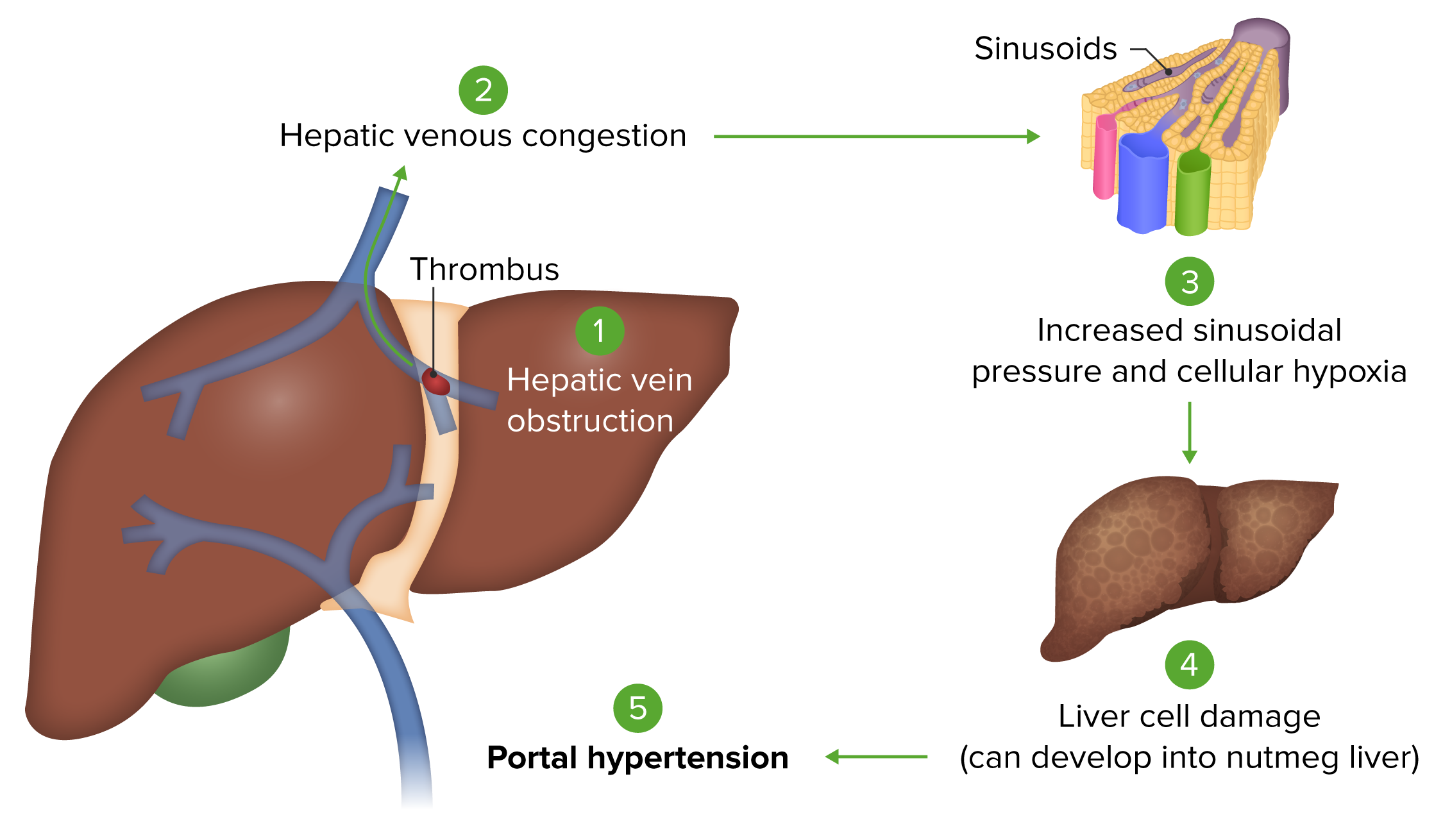
Fisiopatología Síndrome de Budd-Chiari

Síndrome de Budd-Chiari: la oclusión de las venas hepáticas provoca congestión venosa hepática. Esta congestión aumenta la presión sinusoidal dentro del hígado, lo que reduce el flujo sanguíneo hepático. Esto eventualmente produce lesión hepatocelular por hipoxia. El daño hepático resulta entonces en hipertensión portal.

Imagen por Lecturio.
Presentación Clínica

  • Tríada de síntomas comunes:
    1. Dolor Dolor Inflammation abdominal
    2. Hepatomegalia
    3. Ascitis
  • Puede incluir ictericia, edema Edema Edema is a condition in which excess serous fluid accumulates in the body cavity or interstitial space of connective tissues. Edema is a symptom observed in several medical conditions. It can be categorized into 2 types, namely, peripheral (in the extremities) and internal (in an organ or body cavity). Edema de las extremidades inferiores, encefalopatía y hemorragia digestiva según la gravedad
  • Los LOS Neisseria síntomas y los LOS Neisseria hallazgos anormales varían según la presentación:
    • Insuficiencia hepática fulminante:
      • Presentación menos común
      • Encefalopatía hepática observada dentro de las 8 semanas posteriores al AL Amyloidosis inicio de la ictericia
      • Elevación de las transaminasas y de la relación tiempo de protrombina (TP)/índice internacional normalizado (INR, por sus siglas en EN Erythema nodosum is an immune-mediated panniculitis (inflammation of the subcutaneous fat) caused by a type IV (delayed-type) hypersensitivity reaction. It commonly manifests in young women as tender, erythematous nodules on the shins. Erythema Nodosum inglés)
      • Sin colaterales venosos
    • Síndrome de Budd-Chiari agudo:
      • Los LOS Neisseria síntomas y signos se desarrollan en EN Erythema nodosum is an immune-mediated panniculitis (inflammation of the subcutaneous fat) caused by a type IV (delayed-type) hypersensitivity reaction. It commonly manifests in young women as tender, erythematous nodules on the shins. Erythema Nodosum un período de semanas, pero sin insuficiencia hepática.
      • Ictericia, dolor Dolor Inflammation abdominal, ascitis recurrente
      • Sin colaterales venosos
    • Síndrome de Budd-Chiari subagudo:
      • Presentación más común
      • Puede ser asintomático o los LOS Neisseria síntomas comunes se desarrollan gradualmente a lo largo de 3 meses o más
      • Presencia de colaterales venosas
    • Síndrome de Budd-Chiari crónico:
      • Los LOS Neisseria síntomas comunes se presentan ya cuando se ha HA Hemolytic anemia (HA) is the term given to a large group of anemias that are caused by the premature destruction/hemolysis of circulating red blood cells (RBCs). Hemolysis can occur within (intravascular hemolysis) or outside the blood vessels (extravascular hemolysis). Hemolytic Anemia desarrollado la cirrosis.
      • Se observan estigmas de cirrosis ( telangiectasias Telangiectasias Ataxia-telangiectasia, eritema palmar)
      • También se observan signos de hipertensión portal (várices esofágicas, ascitis, venas colaterales)
      • La encefalopatía hepática es poco frecuente.
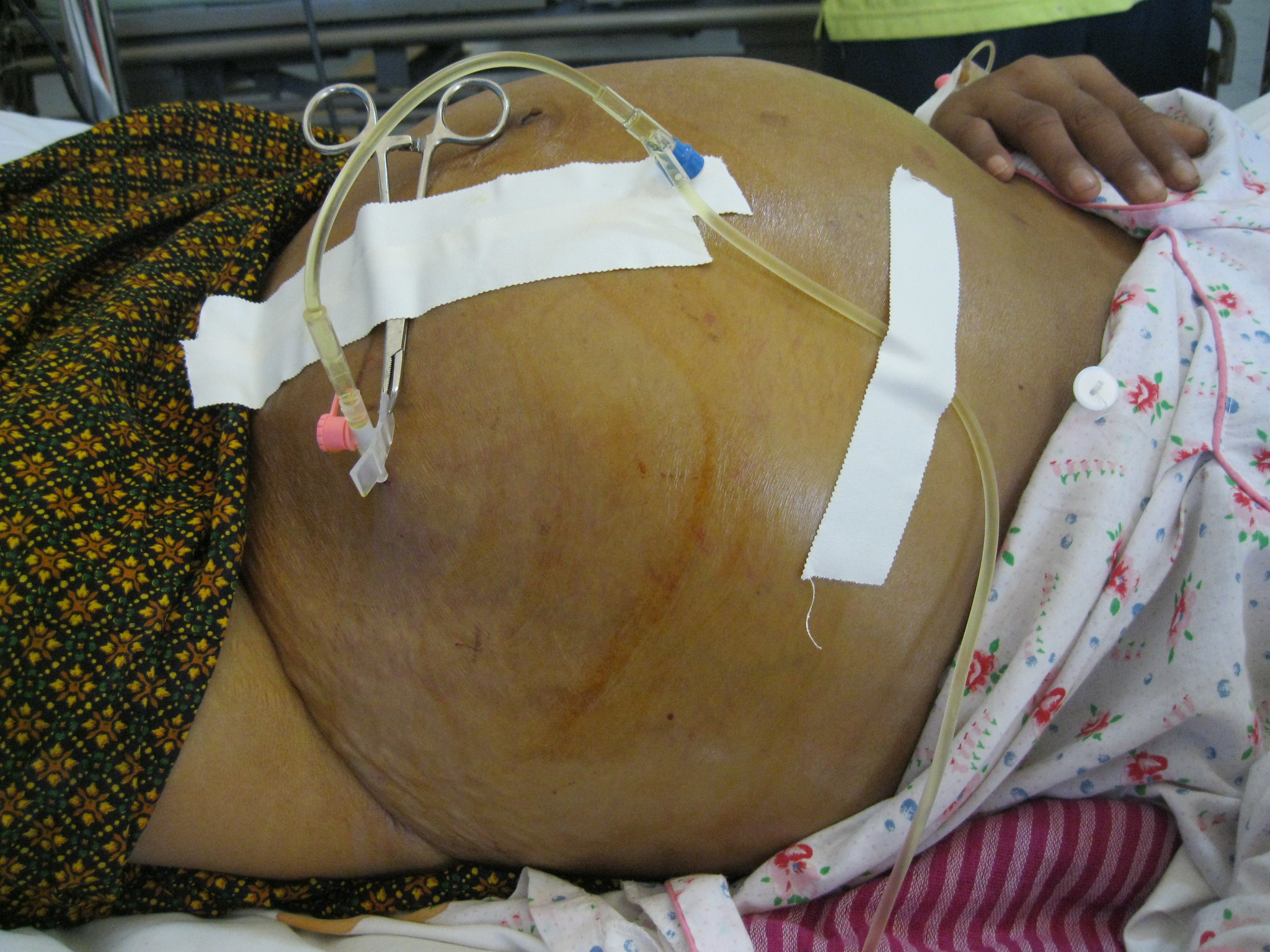
Drenaje de ascitis cirrosis

Imagen que muestra a un paciente con ascitis sometido a paracentesis

Imagen: “Draining ascites, secondary to hepatic cirrhosis” por John Campbell. Licencia: Dominio Público
Diagnóstico

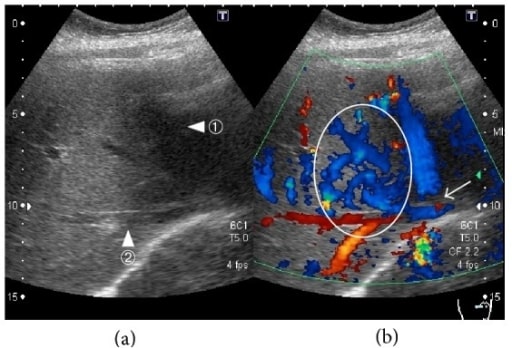
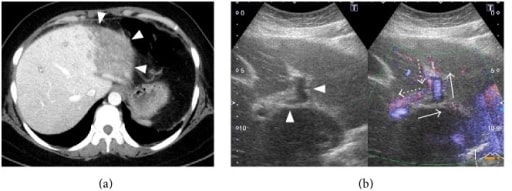
  • Ultrasonido Doppler Doppler Ultrasonography applying the doppler effect, with frequency-shifted ultrasound reflections produced by moving targets (usually red blood cells) in the bloodstream along the ultrasound axis in direct proportion to the velocity of movement of the targets, to determine both direction and velocity of blood flow. Ultrasound (Sonography):
    • Prueba diagnóstica de 1ra línea
    • Posibles hallazgos:
      • No se visualiza la unión de las principales venas hepáticas con la vena cava inferior
      • Paredes gruesas, irregulares o dilatadas de las venas hepáticas
      • Obstrucciones membranosas en EN Erythema nodosum is an immune-mediated panniculitis (inflammation of the subcutaneous fat) caused by a type IV (delayed-type) hypersensitivity reaction. It commonly manifests in young women as tender, erythematous nodules on the shins. Erythema Nodosum las venas hepáticas
      • Visualización de trombo; la trombosis de la vena porta o esplénica puede coincidir
    • Patrones de flujo anormales en EN Erythema nodosum is an immune-mediated panniculitis (inflammation of the subcutaneous fat) caused by a type IV (delayed-type) hypersensitivity reaction. It commonly manifests in young women as tender, erythematous nodules on the shins. Erythema Nodosum la vena hepática:
      • Vena hepática grande sin flujo o con flujo inverso/turbulento
      • Grandes colaterales intrahepáticos o subcapsulares con flujo continuo
  • Tomografía computarizada (TC):
    • Para confirmar el diagnóstico y ayudar en EN Erythema nodosum is an immune-mediated panniculitis (inflammation of the subcutaneous fat) caused by a type IV (delayed-type) hypersensitivity reaction. It commonly manifests in young women as tender, erythematous nodules on the shins. Erythema Nodosum la planificación del tratamiento
    • Hallazgos:
      • Llenado tardío o ausente de las principales venas hepáticas
      • Estrechamiento y/o ausencia de flujo en EN Erythema nodosum is an immune-mediated panniculitis (inflammation of the subcutaneous fat) caused by a type IV (delayed-type) hypersensitivity reaction. It commonly manifests in young women as tender, erythematous nodules on the shins. Erythema Nodosum la vena cava inferior
      • Aspecto moteado del hígado
      • Causas secundarias como tumores
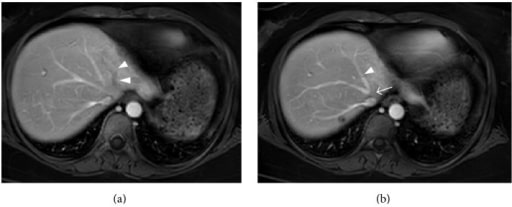
  • Resonancia magnética (RM):
    • Hallazgos similares a la TC
    • Puede demostrar anomalías de las venas hepáticas y colaterales intrahepáticas
  • Venografía:
    • Estándar de oro
    • Se realiza si las pruebas no invasivas no son concluyentes
    • La información obtenida puede dirigir la terapia, ya que define qué vasos están involucrados.
    • La venografía por RM también define la anatomía venosa.
  • Biopsia hepática:
    • Se realiza si el diagnóstico no está claro
    • Hallazgos: congestión de la zona central, necrosis Necrosis The death of cells in an organ or tissue due to disease, injury or failure of the blood supply. Ischemic Cell Damage y hemorragia
    • Ayuda a identificar pacientes para derivación portosistémica intrahepática transyugular cuando hay fibrosis Fibrosis Any pathological condition where fibrous connective tissue invades any organ, usually as a consequence of inflammation or other injury. Bronchiolitis Obliterans significativa o congestión severa
  • Exámenes adicionales:
    • Pruebas de laboratorio:
      • Insuficiencia hepática aguda o fulminante: ↑ aminotransferasas
      • Insuficiencia hepática fulminante: ↑ TP/INR
      • Subaguda o crónica: aminotransferasas en EN Erythema nodosum is an immune-mediated panniculitis (inflammation of the subcutaneous fat) caused by a type IV (delayed-type) hypersensitivity reaction. It commonly manifests in young women as tender, erythematous nodules on the shins. Erythema Nodosum niveles normales o levemente elevadas
    • Análisis de líquido ascítico:
      • Gradiente de albúmina sérica-ascitis > 1,1
      • Leucocitos < 500/μL
    • Como el 80% de los LOS Neisseria casos tiene una afección subyacente, se recomienda un estudio adicional dirigido a la etiología.

Tratamiento y Pronóstico

Tratamiento

  • Estabilizar y tratar la etiología subyacente.
  • Evitar la propagación del coágulo: anticoagulantes (heparina o warfarina)
  • Aliviar la obstrucción y restablecer el flujo sanguíneo:
    • Trombólisis localizada en EN Erythema nodosum is an immune-mediated panniculitis (inflammation of the subcutaneous fat) caused by a type IV (delayed-type) hypersensitivity reaction. It commonly manifests in young women as tender, erythematous nodules on the shins. Erythema Nodosum el síndrome de Budd-Chiari agudo
    • Angioplastia con globo +/- colocación de stent para enfermedad aguda o subaguda
  • Descomprimir el hígado congestionado con derivación portosistémica intrahepática transyugular o terapia quirúrgica:
    • Enfoque del tratamiento en EN Erythema nodosum is an immune-mediated panniculitis (inflammation of the subcutaneous fat) caused by a type IV (delayed-type) hypersensitivity reaction. It commonly manifests in young women as tender, erythematous nodules on the shins. Erythema Nodosum el síndrome de Budd-Chiari crónico
    • Una opción para los LOS Neisseria tipos agudos o subagudos si el tratamiento inicial no tiene éxito
    • La colocación de derivación portosistémica intrahepática transyugular crea un tracto de salida alternativo.
    • Derivación quirúrgica:
      • Un procedimiento menos común
      • Drena el sistema venoso portal en EN Erythema nodosum is an immune-mediated panniculitis (inflammation of the subcutaneous fat) caused by a type IV (delayed-type) hypersensitivity reaction. It commonly manifests in young women as tender, erythematous nodules on the shins. Erythema Nodosum la vena cava inferior u otra vena sistémica
  • Prevenir un mayor deterioro hepático y complicaciones:
    • Restricción dietética de sodio, diuréticos, paracentesis Paracentesis A procedure in which fluid is withdrawn from a body cavity or organ via a trocar and cannula, needle, or other hollow instrument. Portal Hypertension para controlar las complicaciones de la hipertensión portal
    • Trasplante hepático: si falla el tratamiento inicial/descompresión hepática o si hay cirrosis descompensada

Pronóstico

  • El pronóstico empeora con los LOS Neisseria siguientes factores:
    • Edad avanzada
    • Enfermedad crónica en EN Erythema nodosum is an immune-mediated panniculitis (inflammation of the subcutaneous fat) caused by a type IV (delayed-type) hypersensitivity reaction. It commonly manifests in young women as tender, erythematous nodules on the shins. Erythema Nodosum el momento del diagnóstico
    • Insuficiencia hepática grave
    • Ascitis refractaria
    • Presencia de trombosis de la vena porta
  • Supervivencia a los LOS Neisseria 3 años del 10% sin tratamiento
  • Supervivencia a los LOS Neisseria 5 años de hasta el 75% con tratamiento
  • Causas de muerte: ascitis recurrente, hemorragia digestiva e insuficiencia hepática

Diagnóstico Diferencial

  • Insuficiencia cardíaca: incapacidad del corazón para suministrar al AL Amyloidosis cuerpo un gasto cardíaco normal para satisfacer las necesidades metabólicas. La insuficiencia cardíaca del lado derecho causa enfermedad hepática congestiva. Puede presentarse con hígado en EN Erythema nodosum is an immune-mediated panniculitis (inflammation of the subcutaneous fat) caused by a type IV (delayed-type) hypersensitivity reaction. It commonly manifests in young women as tender, erythematous nodules on the shins. Erythema Nodosum nuez moscada y signos de hipertensión portal como ascitis, hepatomegalia sensible y edema Edema Edema is a condition in which excess serous fluid accumulates in the body cavity or interstitial space of connective tissues. Edema is a symptom observed in several medical conditions. It can be categorized into 2 types, namely, peripheral (in the extremities) and internal (in an organ or body cavity). Edema de las extremidades inferiores. La presencia de presión venosa yugular elevada en EN Erythema nodosum is an immune-mediated panniculitis (inflammation of the subcutaneous fat) caused by a type IV (delayed-type) hypersensitivity reaction. It commonly manifests in young women as tender, erythematous nodules on the shins. Erythema Nodosum el examen se observa en EN Erythema nodosum is an immune-mediated panniculitis (inflammation of the subcutaneous fat) caused by a type IV (delayed-type) hypersensitivity reaction. It commonly manifests in young women as tender, erythematous nodules on the shins. Erythema Nodosum la insuficiencia cardíaca. Se puede establecer una diferenciación adicional entre el síndrome de Budd-Chiari y la insuficiencia cardíaca mediante ultrasonido Doppler Doppler Ultrasonography applying the doppler effect, with frequency-shifted ultrasound reflections produced by moving targets (usually red blood cells) in the bloodstream along the ultrasound axis in direct proportion to the velocity of movement of the targets, to determine both direction and velocity of blood flow. Ultrasound (Sonography).
  • Síndrome de obstrucción sinusoidal hepática (enfermedad venooclusiva): una afección que puede desarrollarse en EN Erythema nodosum is an immune-mediated panniculitis (inflammation of the subcutaneous fat) caused by a type IV (delayed-type) hypersensitivity reaction. It commonly manifests in young women as tender, erythematous nodules on the shins. Erythema Nodosum adultos que se someten a un trasplante de células hematopoyéticas. La fisiopatología es la lesión de las células endoteliales sinusoidales que conducen a la necrosis Necrosis The death of cells in an organ or tissue due to disease, injury or failure of the blood supply. Ischemic Cell Damage hepática. Se presenta como edema Edema Edema is a condition in which excess serous fluid accumulates in the body cavity or interstitial space of connective tissues. Edema is a symptom observed in several medical conditions. It can be categorized into 2 types, namely, peripheral (in the extremities) and internal (in an organ or body cavity). Edema, hepatomegalia dolorosa, ascitis e ictericia como en EN Erythema nodosum is an immune-mediated panniculitis (inflammation of the subcutaneous fat) caused by a type IV (delayed-type) hypersensitivity reaction. It commonly manifests in young women as tender, erythematous nodules on the shins. Erythema Nodosum el síndrome de Budd-Chiari. Los LOS Neisseria antecedentes con las pruebas de laboratorio e imagenología conducen al AL Amyloidosis diagnóstico.
  • Otras causas de enfermedad hepática aguda o crónica (hepatitis viral, enfermedad hepática alcohólica, hepatitis inducida por medicamentos): diferentes tipos de enfermedad hepática también inician con una presentación similar (ictericia, ascitis, hepatomegalia). Estas afecciones pueden tener un inicio agudo y crónico. La progresión de la lesión hepática, independientemente de la causa, puede provocar cirrosis e hipertensión portal. Los LOS Neisseria antecedentes (medicamentos, alcohol, exposición), las pruebas de laboratorio y la imagenología ayudan a determinar la etiología de la enfermedad hepática.

Referencias

  1. Hitawala, A., Gupta, V. (2025). Budd-Chiari Syndrome. Retrieved on July 22, 2025, from https://www.ncbi.nlm.nih.gov/books/NBK558941/
  2. Lai, M. (2024). Budd-Chiari syndrome: Epidemiology, clinical manifestations, and diagnosis. UpToDate. Retrieved on July 22, 2025, from https://www.uptodate.com/contents/budd-chiari-syndrome-epidemiology-clinical-manifestations-and-diagnosis
  3. Lai, M. (2025). Etiology of the Budd-Chiari syndrome. UpToDate. Retrieved on July 22, 2025, from https://www.uptodate.com/contents/etiology-of-the-budd-chiari-syndrome
  4. Lai, M. (2025). Budd-Chiari syndrome: Management. UpToDate. Retrieved on July 22, 2025, from https://www.uptodate.com/contents/budd-chiari-syndrome-management
  5. Moore, C. M., & Van Thiel, D. H. (2013). Cirrhotic ascites review: Pathophysiology, diagnosis and management. World journal of hepatology5(5), 251–263. https://doi.org/10.4254/wjh.v5.i5.251

¡Crea tu cuenta gratis o inicia una sesión para seguir leyendo!

Regístrate ahora y obtén acceso gratuito a Lecturio con páginas de concepto, videos médicos y cuestionarios para tu educación médica.

User Reviews

Details