Domina Conceptos Médicos

Estudia para la escuela de medicina y tus examenes con Lecturio.

Ovarios: Anatomía

Los LOS Neisseria ovarios son las gónadas pares del sistema reproductor femenino que contienen gametos haploides conocidos como ovocitos. Los LOS Neisseria ovarios están situados intraperitonealmente en EN Erythema nodosum is an immune-mediated panniculitis (inflammation of the subcutaneous fat) caused by a type IV (delayed-type) hypersensitivity reaction. It commonly manifests in young women as tender, erythematous nodules on the shins. Erythema Nodosum la pelvis Pelvis The pelvis consists of the bony pelvic girdle, the muscular and ligamentous pelvic floor, and the pelvic cavity, which contains viscera, vessels, and multiple nerves and muscles. The pelvic girdle, composed of 2 "hip" bones and the sacrum, is a ring-like bony structure of the axial skeleton that links the vertebral column with the lower extremities. Pelvis: Anatomy, justo posterior al AL Amyloidosis ligamento ancho, y están conectados a la pared pélvica lateralmente por el ligamento suspensorio del ovario y al AL Amyloidosis útero medialmente por el ligamento útero-ovárico. Estos órganos funcionan secretando hormonas (estrógeno y progesterona) y producen las células germinales femeninas (ovocitos), que son expulsadas y luego “capturadas” por las trompas de Falopio. La principal irrigación al AL Amyloidosis ovario la proporciona la arteria ovárica, una rama directa de la aorta Aorta The main trunk of the systemic arteries. Mediastinum and Great Vessels: Anatomy abdominal; la arteria ovárica se anastomosa con la rama ascendente de la arteria uterina, proporcionando un excelente flujo sanguíneo colateral.

Last updated: Dec 15, 2025

Editorial responsibility: Stanley Oiseth, Lindsay Jones, Evelin Maza

Descripción General

Definición

Los LOS Neisseria ovarios son las gónadas femeninas, situados dentro de la pelvis Pelvis The pelvis consists of the bony pelvic girdle, the muscular and ligamentous pelvic floor, and the pelvic cavity, which contains viscera, vessels, and multiple nerves and muscles. The pelvic girdle, composed of 2 “hip” bones and the sacrum, is a ring-like bony structure of the axial skeleton that links the vertebral column with the lower extremities. Pelvis: Anatomy como estructuras pares. Los LOS Neisseria ovarios contienen gametos haploides conocidos como ovocitos.

Funciones

  • Producir y liberar células germinales femeninas (ovocitos)
  • Secretar hormonas sexuales:
    • Estrógeno
    • Progesterona
    • Testosterona (pequeñas cantidades)

Embriología

Desarrollo de los LOS Neisseria ovarios

Semanas 510:

  • Las gónadas surgen alrededor de la semana 5 a partir de la cresta gonadal:
    • El epitelio surge del epitelio celómico (mesodermo)
    • El estroma surge del mesodermo subcelómico
    • Las invaginaciones del epitelio en EN Erythema nodosum is an immune-mediated panniculitis (inflammation of the subcutaneous fat) caused by a type IV (delayed-type) hypersensitivity reaction. It commonly manifests in young women as tender, erythematous nodules on the shins. Erythema Nodosum la región de la corteza forman los LOS Neisseria cordones sexuales primarios (células pregranulosas) → red ovárica
  • Células germinales primordiales:
    • Se diferencian en EN Erythema nodosum is an immune-mediated panniculitis (inflammation of the subcutaneous fat) caused by a type IV (delayed-type) hypersensitivity reaction. It commonly manifests in young women as tender, erythematous nodules on the shins. Erythema Nodosum ovocitos en EN Erythema nodosum is an immune-mediated panniculitis (inflammation of the subcutaneous fat) caused by a type IV (delayed-type) hypersensitivity reaction. It commonly manifests in young women as tender, erythematous nodules on the shins. Erythema Nodosum las mujeres
    • Se originan en EN Erythema nodosum is an immune-mediated panniculitis (inflammation of the subcutaneous fat) caused by a type IV (delayed-type) hypersensitivity reaction. It commonly manifests in young women as tender, erythematous nodules on the shins. Erythema Nodosum el epiblasto
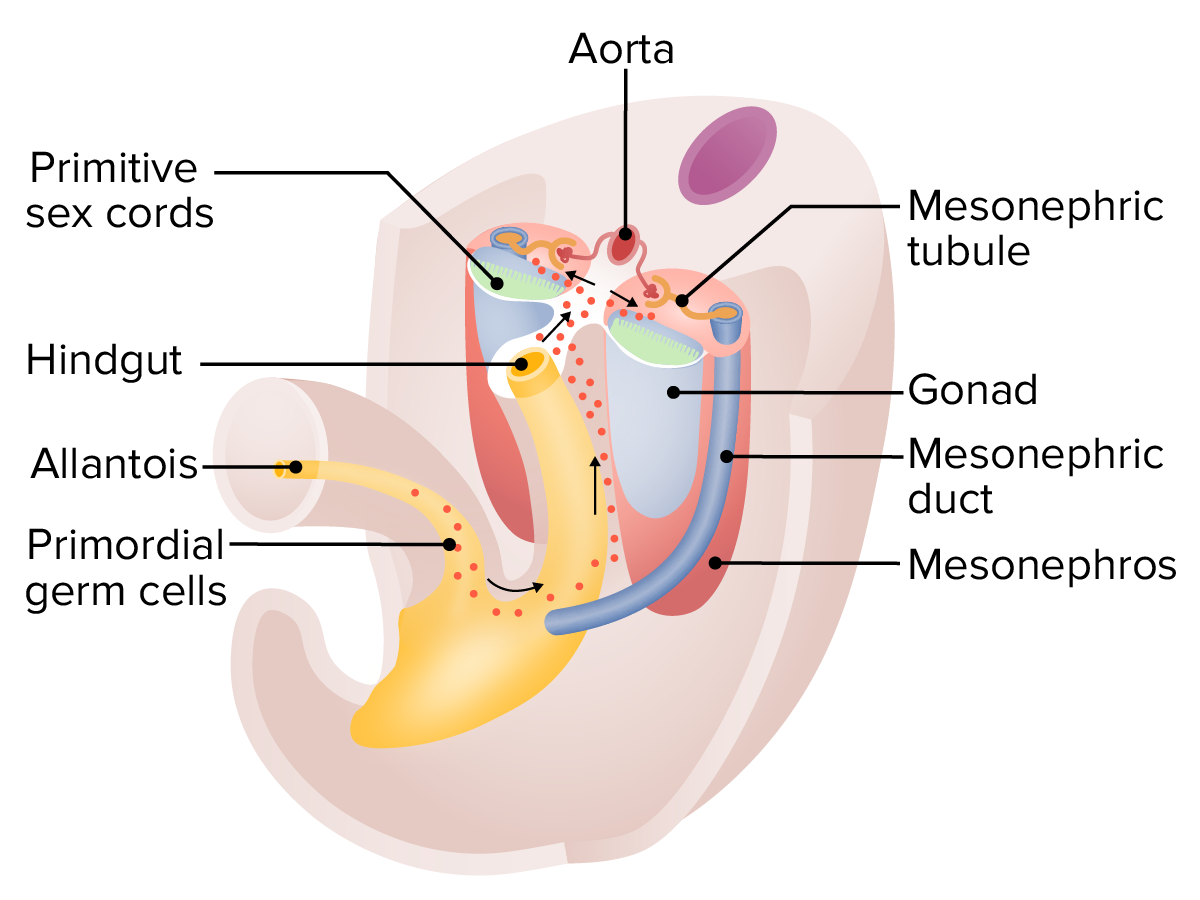
    • Migran al AL Amyloidosis saco vitelino → a través de la alantoides (cordón umbilical) → a lo largo del mesenterio dorsal del intestino posterior → crestas gonadales
    • Las células germinales invaden las crestas gonadales aproximadamente a las 6 semanas
  • Hasta las 6 semanas de gestación, el desarrollo del sexo es idéntico y no binario
  • El desarrollo del ovario a partir de la gónada bipotente requiere la ausencia del gen SRY (que normalmente se encuentra en EN Erythema nodosum is an immune-mediated panniculitis (inflammation of the subcutaneous fat) caused by a type IV (delayed-type) hypersensitivity reaction. It commonly manifests in young women as tender, erythematous nodules on the shins. Erythema Nodosum el cromosoma Y), lo que impide la diferenciación en EN Erythema nodosum is an immune-mediated panniculitis (inflammation of the subcutaneous fat) caused by a type IV (delayed-type) hypersensitivity reaction. It commonly manifests in young women as tender, erythematous nodules on the shins. Erythema Nodosum testículos
    • Si el gen SRY está presente, los LOS Neisseria testículos comenzarán a desarrollarse alrededor de la semana 6.
    • Si el gen SRY está ausente, los LOS Neisseria testículos no se desarrollaran.
    • Alrededor de la semana 10, si los LOS Neisseria testículos aún no se han desarrollado, comienza el desarrollo de los LOS Neisseria ovarios.
Migración de las células germinales primordiales alrededor de las 5 semanas

Migración de las células germinales primordiales en torno a las 5 semanas:
Estas células germinales comienzan como células del epiblasto y empiezan a desarrollarse dentro del saco vitelino. A continuación, las células migran por la alantoides, a lo largo del mesenterio dorsal del intestino posterior, y luego invaden las crestas gonadales, que comienzan a formar las gónadas tempranas.

Imagen por Lecturio.

Semanas 1020:

  • La formación de ovocitos se produce por:
    • Rápida multiplicación de las células germinales primordiales → oogonia
    • Las oogonias se diferencian en EN Erythema nodosum is an immune-mediated panniculitis (inflammation of the subcutaneous fat) caused by a type IV (delayed-type) hypersensitivity reaction. It commonly manifests in young women as tender, erythematous nodules on the shins. Erythema Nodosum ovocitos primarios y se detienen en EN Erythema nodosum is an immune-mediated panniculitis (inflammation of the subcutaneous fat) caused by a type IV (delayed-type) hypersensitivity reaction. It commonly manifests in young women as tender, erythematous nodules on the shins. Erythema Nodosum esta fase hasta la pubertad
  • La formación de folículos se produce cuando:
    • Las células pregranulosas rodean a las células germinales para formar los LOS Neisseria folículos primordiales
    • Y las células de la teca rodean los LOS Neisseria folículos primordiales
  • La producción de estrógenos por parte de las células foliculares estimula a los LOS Neisseria genitales externos indiferenciados a diferenciarse en EN Erythema nodosum is an immune-mediated panniculitis (inflammation of the subcutaneous fat) caused by a type IV (delayed-type) hypersensitivity reaction. It commonly manifests in young women as tender, erythematous nodules on the shins. Erythema Nodosum estructuras femeninas
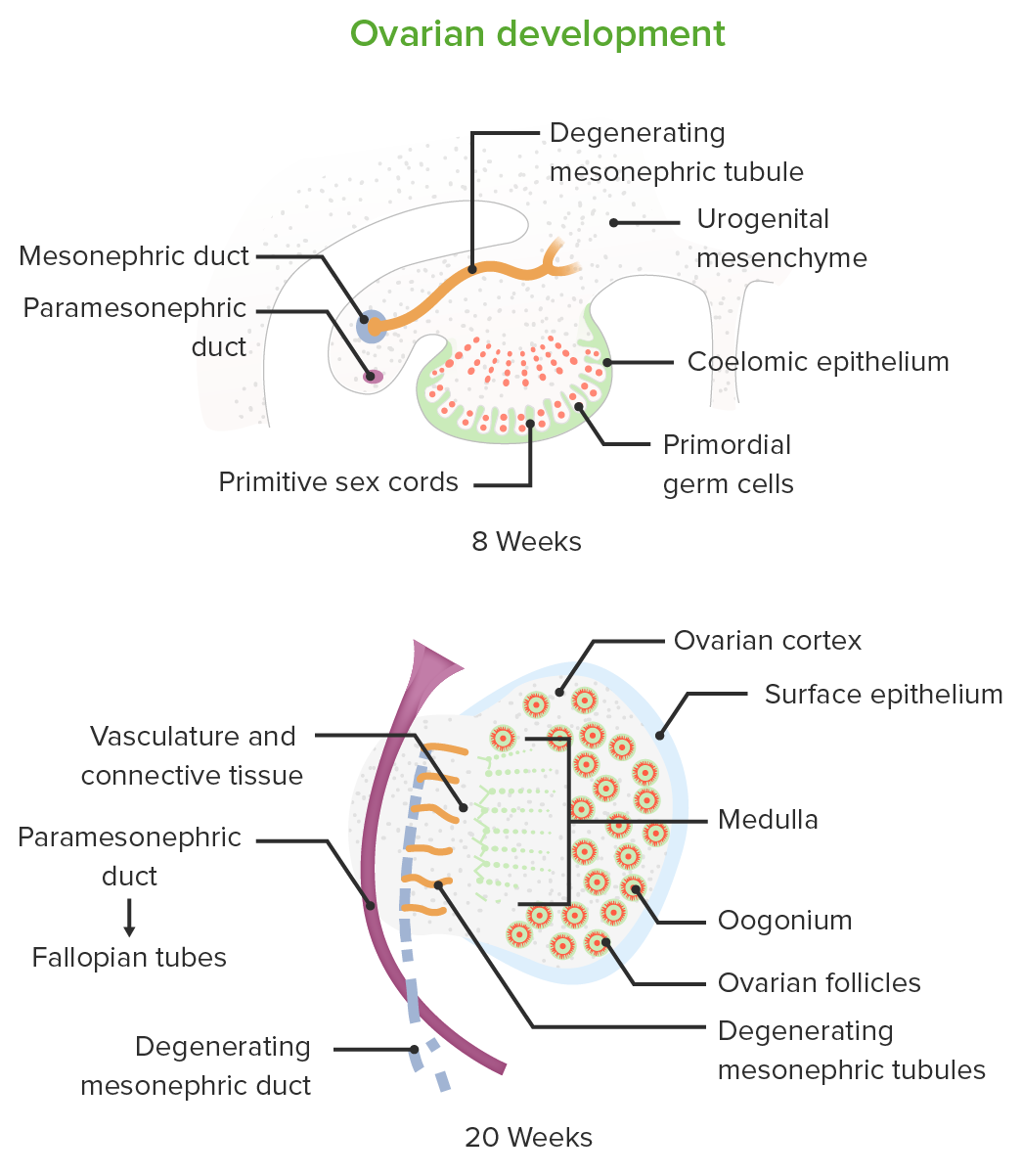
Desarrollo embriológico de los ovarios

Desarrollo embrionario de los ovarios

Imagen por Lecturio.
Descenso de los LOS Neisseria ovarios

  • Los LOS Neisseria ovarios se desarrollan en EN Erythema nodosum is an immune-mediated panniculitis (inflammation of the subcutaneous fat) caused by a type IV (delayed-type) hypersensitivity reaction. It commonly manifests in young women as tender, erythematous nodules on the shins. Erythema Nodosum el abdomen y descienden a la pelvis Pelvis The pelvis consists of the bony pelvic girdle, the muscular and ligamentous pelvic floor, and the pelvic cavity, which contains viscera, vessels, and multiple nerves and muscles. The pelvic girdle, composed of 2 “hip” bones and the sacrum, is a ring-like bony structure of the axial skeleton that links the vertebral column with the lower extremities. Pelvis: Anatomy
  • Guiado por el gubernáculo (una banda de tejido fibroso de la pared posterior)
  • El gubernáculo se convierte en EN Erythema nodosum is an immune-mediated panniculitis (inflammation of the subcutaneous fat) caused by a type IV (delayed-type) hypersensitivity reaction. It commonly manifests in young women as tender, erythematous nodules on the shins. Erythema Nodosum el ligamento ovárico luego del nacimiento

Anatomía Macroscópica

Tamaño

  • 2 órganos con forma de almendra (izquierdo y derecho)
  • Aproximadamente 4 x 2 x 1 cm durante la edad fértil
  • Peso: 5–10 g
  • El tamaño varía un poco a lo largo del ciclo y de la etapa reproductiva
  • Más pequeños después de la menopausia

Localización

  • Suspendidos por los LOS Neisseria ligamentos en EN Erythema nodosum is an immune-mediated panniculitis (inflammation of the subcutaneous fat) caused by a type IV (delayed-type) hypersensitivity reaction. It commonly manifests in young women as tender, erythematous nodules on the shins. Erythema Nodosum la pelvis Pelvis The pelvis consists of the bony pelvic girdle, the muscular and ligamentous pelvic floor, and the pelvic cavity, which contains viscera, vessels, and multiple nerves and muscles. The pelvic girdle, composed of 2 “hip” bones and the sacrum, is a ring-like bony structure of the axial skeleton that links the vertebral column with the lower extremities. Pelvis: Anatomy
  • Se encuentran en EN Erythema nodosum is an immune-mediated panniculitis (inflammation of the subcutaneous fat) caused by a type IV (delayed-type) hypersensitivity reaction. It commonly manifests in young women as tender, erythematous nodules on the shins. Erythema Nodosum la cavidad pélvica lateral, dentro de la fosa ovárica (depresiones en EN Erythema nodosum is an immune-mediated panniculitis (inflammation of the subcutaneous fat) caused by a type IV (delayed-type) hypersensitivity reaction. It commonly manifests in young women as tender, erythematous nodules on the shins. Erythema Nodosum la pared pélvica dorsal)
  • Estructuras intraperitoneales
  • Situados en EN Erythema nodosum is an immune-mediated panniculitis (inflammation of the subcutaneous fat) caused by a type IV (delayed-type) hypersensitivity reaction. It commonly manifests in young women as tender, erythematous nodules on the shins. Erythema Nodosum la cara posterior del ligamento ancho
  • Estructuras algo móviles:
    • A menudo se encuentran en EN Erythema nodosum is an immune-mediated panniculitis (inflammation of the subcutaneous fat) caused by a type IV (delayed-type) hypersensitivity reaction. It commonly manifests in young women as tender, erythematous nodules on the shins. Erythema Nodosum la parte posterior del útero en EN Erythema nodosum is an immune-mediated panniculitis (inflammation of the subcutaneous fat) caused by a type IV (delayed-type) hypersensitivity reaction. It commonly manifests in young women as tender, erythematous nodules on the shins. Erythema Nodosum la bolsa rectovaginal (i.e., bolsa de Douglas)
    • Pueden encontrarse lateral o incluso (raramente) anterior al AL Amyloidosis útero (e.g., útero retroflexionado)
    • Pueden encontrarse contra la pared lateral de la pelvis Pelvis The pelvis consists of the bony pelvic girdle, the muscular and ligamentous pelvic floor, and the pelvic cavity, which contains viscera, vessels, and multiple nerves and muscles. The pelvic girdle, composed of 2 “hip” bones and the sacrum, is a ring-like bony structure of the axial skeleton that links the vertebral column with the lower extremities. Pelvis: Anatomy

Ligamentos

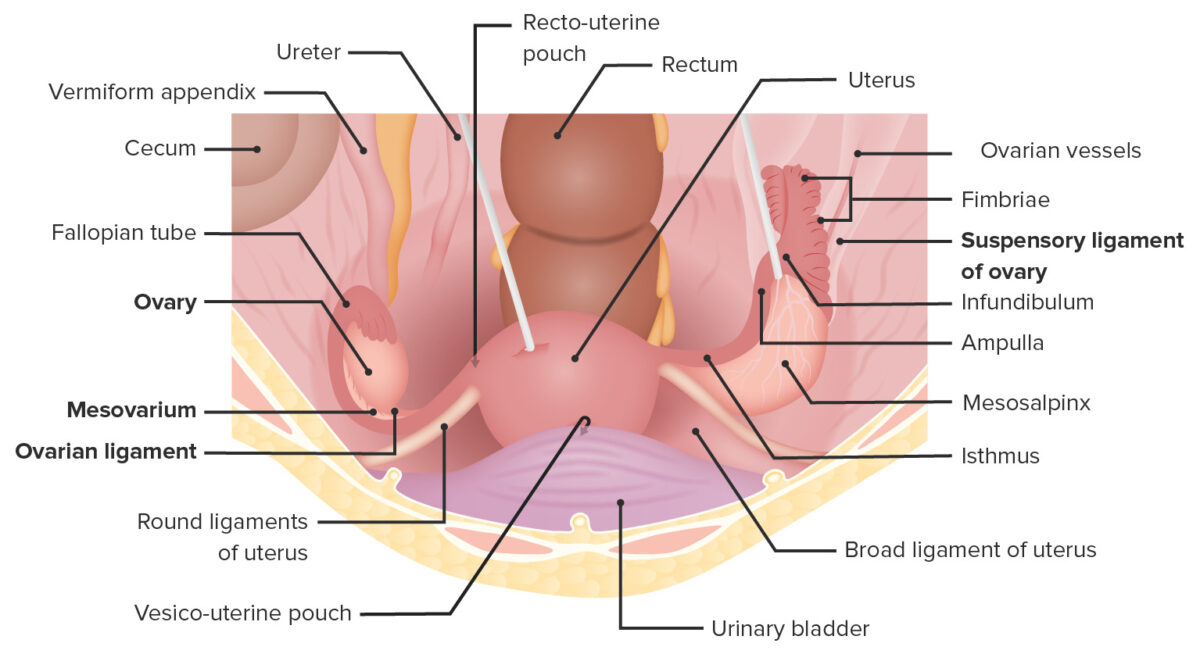
Los LOS Neisseria ovarios están suspendidos dentro de la cavidad peritoneal entre la pared lateral de la pelvis Pelvis The pelvis consists of the bony pelvic girdle, the muscular and ligamentous pelvic floor, and the pelvic cavity, which contains viscera, vessels, and multiple nerves and muscles. The pelvic girdle, composed of 2 “hip” bones and the sacrum, is a ring-like bony structure of the axial skeleton that links the vertebral column with the lower extremities. Pelvis: Anatomy y el útero a través de varios ligamentos importantes.
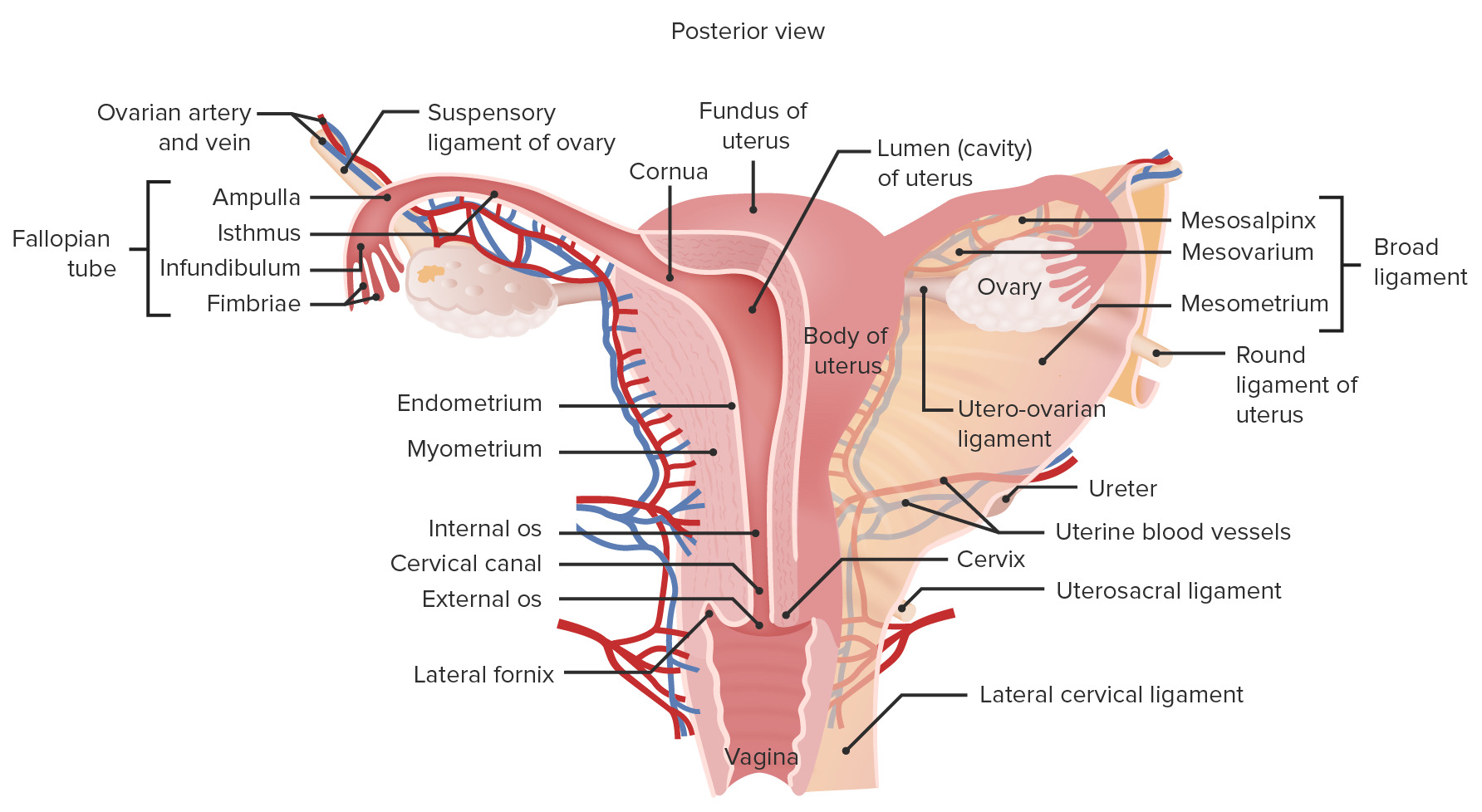
  • Ligamento suspensorio del ovario:
    • También conocido como ligamento infundibulopélvico
    • Conecta el ovario lateralmente a la pared pélvica
    • Contiene los LOS Neisseria vasos ováricos:
  • Ligamento útero-ovárico:
    • También conocido como ligamento ovárico
    • Conecta el ovario medialmente con el útero
    • Porción engrosada del ligamento ancho dentro del mesovario
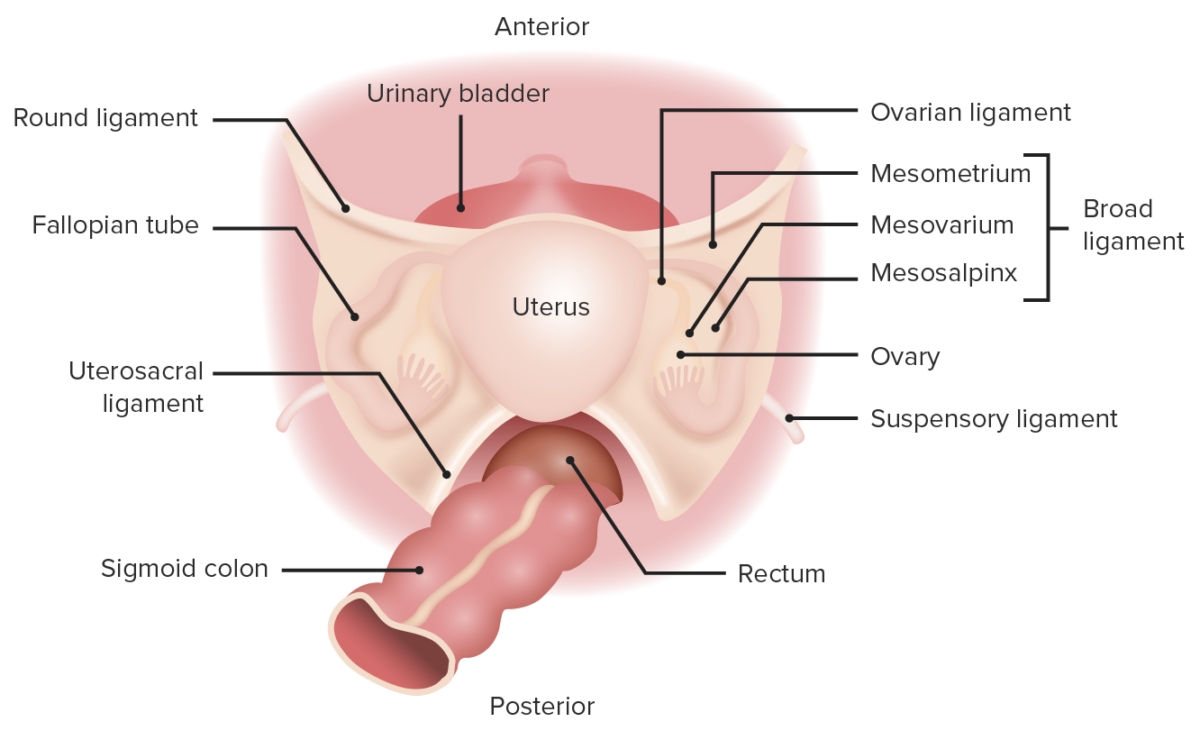
  • Ligamento ancho:
    • Fina lámina de peritoneo que cubre el útero y las trompas de Falopio como una sábana colgada en EN Erythema nodosum is an immune-mediated panniculitis (inflammation of the subcutaneous fat) caused by a type IV (delayed-type) hypersensitivity reaction. It commonly manifests in young women as tender, erythematous nodules on the shins. Erythema Nodosum un tendedero
    • Se divide en EN Erythema nodosum is an immune-mediated panniculitis (inflammation of the subcutaneous fat) caused by a type IV (delayed-type) hypersensitivity reaction. It commonly manifests in young women as tender, erythematous nodules on the shins. Erythema Nodosum 3 partes: mesosalpinx Mesosalpinx Uterus, Cervix, and Fallopian Tubes: Anatomy, mesovario y mesometrio
    • Mesosalpinx Mesosalpinx Uterus, Cervix, and Fallopian Tubes: Anatomy:
      • Zona adyacente a las trompas de Falopio
      • Contiene las ramas tubáricas de las arterias ováricas y uterinas ascendentes
    • Mesovario:
    • Mesometrio:
      • Zona por debajo del ligamento útero-ovárico
      • Superiormente, contiene el ligamento redondo (un engrosamiento del ligamento ancho de la superficie anterior del útero, que conecta el útero con la pared abdominal anterior antes de pasar por el canal inguinal, terminando en EN Erythema nodosum is an immune-mediated panniculitis (inflammation of the subcutaneous fat) caused by a type IV (delayed-type) hypersensitivity reaction. It commonly manifests in young women as tender, erythematous nodules on the shins. Erythema Nodosum los LOS Neisseria labios mayores)
      • En EN Erythema nodosum is an immune-mediated panniculitis (inflammation of the subcutaneous fat) caused by a type IV (delayed-type) hypersensitivity reaction. It commonly manifests in young women as tender, erythematous nodules on the shins. Erythema Nodosum la parte inferior, contiene los LOS Neisseria vasos uterinos, uréteres y ligamentos uterosacros
Anatomía macroscópica del aparato reproductor femenino

Anatomía macroscópica del aparato reproductor femenino

Imagen por Lecturio.
Anatomía Microscópica

Estructura microscópica de los LOS Neisseria ovarios

  • Los LOS Neisseria ovarios están cubiertos por un epitelio cuboidal simple llamado epitelio germinal.
  • Túnica albugínea:
    • Una cápsula que rodea el ovario situada bajo el epitelio
    • Compuesta por un tejido conectivo colágeno denso e irregular.
  • Corteza ovárica:
    • Región externa
    • Contiene los LOS Neisseria folículos en EN Erythema nodosum is an immune-mediated panniculitis (inflammation of the subcutaneous fat) caused by a type IV (delayed-type) hypersensitivity reaction. It commonly manifests in young women as tender, erythematous nodules on the shins. Erythema Nodosum desarrollo, que incluyen:
      • Ovocitos en EN Erythema nodosum is an immune-mediated panniculitis (inflammation of the subcutaneous fat) caused by a type IV (delayed-type) hypersensitivity reaction. It commonly manifests in young women as tender, erythematous nodules on the shins. Erythema Nodosum desarrollo
      • Las células de la granulosa (que rodean a los LOS Neisseria ovocitos en EN Erythema nodosum is an immune-mediated panniculitis (inflammation of the subcutaneous fat) caused by a type IV (delayed-type) hypersensitivity reaction. It commonly manifests in young women as tender, erythematous nodules on the shins. Erythema Nodosum desarrollo) → secretan estrógenos
      • Las células de la teca (fuera de las células de la granulosa) → producen testosterona que es convertida en EN Erythema nodosum is an immune-mediated panniculitis (inflammation of the subcutaneous fat) caused by a type IV (delayed-type) hypersensitivity reaction. It commonly manifests in young women as tender, erythematous nodules on the shins. Erythema Nodosum estrógeno por las células de la granulosa
  • Médula ovárica:
    • Región interna
    • Compuesta por:
      • Vasos sanguíneos y nervios
      • Tejido conectivo → proporciona estructura
      • Células intersticiales → se convierten en EN Erythema nodosum is an immune-mediated panniculitis (inflammation of the subcutaneous fat) caused by a type IV (delayed-type) hypersensitivity reaction. It commonly manifests in young women as tender, erythematous nodules on the shins. Erythema Nodosum células de la teca
      • Células miocontráctiles
  • Hilio ovárico: región donde la irrigación e inervación principal entran en EN Erythema nodosum is an immune-mediated panniculitis (inflammation of the subcutaneous fat) caused by a type IV (delayed-type) hypersensitivity reaction. It commonly manifests in young women as tender, erythematous nodules on the shins. Erythema Nodosum el ovario
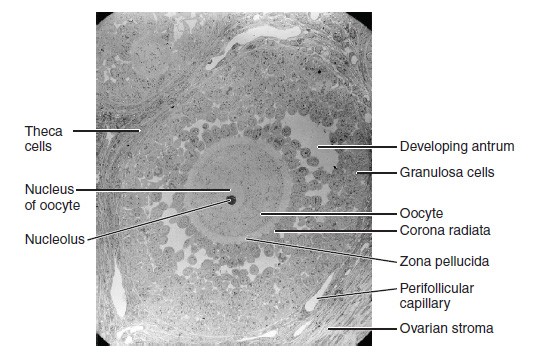
Micrografía electrónica de un folículo secundario

Micrografía electrónica (1100x) de un folículo secundario

Imagen: “Folliculogenesis” por Phil Schatz. Licencia: CC BY 4.0

Formación del óvulo

La ovogénesis es el proceso de producción de óvulos a partir de células germinales primordiales.
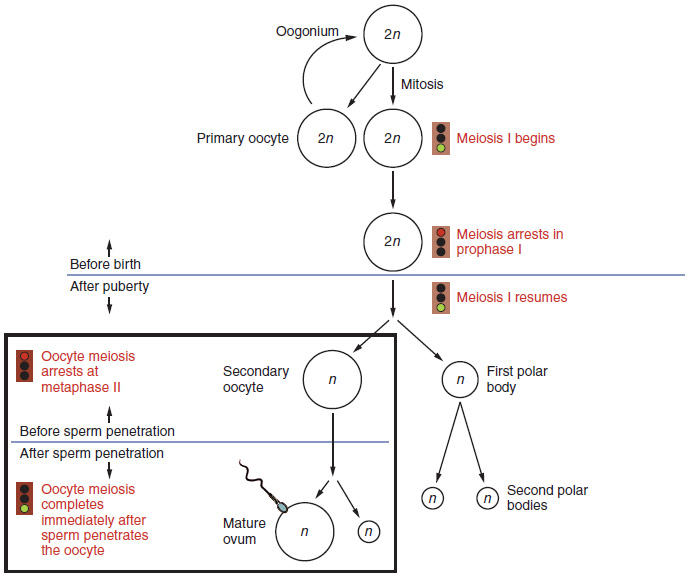
  • Mitosis Mitosis A type of cell nucleus division by means of which the two daughter nuclei normally receive identical complements of the number of chromosomes of the somatic cells of the species. Cell Cycle:
    • Se produce durante el periodo embrionario y fetal
    • El número máximo de oogonias (6 millones–7 millones) se produce alrededor de las 20 semanas de gestación
    • Oogonia → se diferencia en EN Erythema nodosum is an immune-mediated panniculitis (inflammation of the subcutaneous fat) caused by a type IV (delayed-type) hypersensitivity reaction. It commonly manifests in young women as tender, erythematous nodules on the shins. Erythema Nodosum ovocitos primarios o sufren atresia Atresia Hypoplastic Left Heart Syndrome (HLHS) (la gran mayoría)
    • Ploidía: diploide
    • 46 cromosomas
  • Meiosis I Meiosis I Following DNA replication, meiosis I creates 2 daughter cells containing half the genetic information of the mother cell (1n) but the same number of chromosomes (2c) by segregating sister chromatids into the same daughter cell Meiosis:
    • Los LOS Neisseria ovocitos primarios se detienen en EN Erythema nodosum is an immune-mediated panniculitis (inflammation of the subcutaneous fat) caused by a type IV (delayed-type) hypersensitivity reaction. It commonly manifests in young women as tender, erythematous nodules on the shins. Erythema Nodosum la profase I in utero y permanecen allí hasta la pubertad.
    • En EN Erythema nodosum is an immune-mediated panniculitis (inflammation of the subcutaneous fat) caused by a type IV (delayed-type) hypersensitivity reaction. It commonly manifests in young women as tender, erythematous nodules on the shins. Erythema Nodosum la pubertad, hay aproximadamente 400 000 ovocitos primarios.
    • Ovocito primario → se divide en EN Erythema nodosum is an immune-mediated panniculitis (inflammation of the subcutaneous fat) caused by a type IV (delayed-type) hypersensitivity reaction. It commonly manifests in young women as tender, erythematous nodules on the shins. Erythema Nodosum un ovocito secundario y un 1er cuerpo polar
    • Ploidía: diploide → haploide
    • 46 → 23 cromosomas
  • Meiosis II Meiosis II Meiosis II is a cellular division event wherein the number of chromosomes in the daughter cells is halved from that of the mother cell. Meiosis II: similar to meiosis I but not preceded by interphase (DNA replication) Meiosis:
    • En EN Erythema nodosum is an immune-mediated panniculitis (inflammation of the subcutaneous fat) caused by a type IV (delayed-type) hypersensitivity reaction. It commonly manifests in young women as tender, erythematous nodules on the shins. Erythema Nodosum la pubertad, la estimulación hormonal (hormona foliculoestimulante ( FSH FSH A major gonadotropin secreted by the adenohypophysis. Follicle-stimulating hormone stimulates gametogenesis and the supporting cells such as the ovarian granulosa cells, the testicular sertoli cells, and leydig cells. Fsh consists of two noncovalently linked subunits, alpha and beta. Within a species, the alpha subunit is common in the three pituitary glycoprotein hormones (TSH, LH, and FSH), but the beta subunit is unique and confers its biological specificity. Menstrual Cycle, por sus siglas en EN Erythema nodosum is an immune-mediated panniculitis (inflammation of the subcutaneous fat) caused by a type IV (delayed-type) hypersensitivity reaction. It commonly manifests in young women as tender, erythematous nodules on the shins. Erythema Nodosum inglés)) hace HACE Altitude Sickness que se reanude la meiosis Meiosis The creation of eukaryotic gametes involves a DNA replication phase followed by 2 cellular division stages: meiosis I and meiosis II. Meiosis I separates homologous chromosomes into separate cells (1n, 2c), while meiosis II separates sister chromatids into gametes (1n, 1c). Meiosis
    • Se detiene en EN Erythema nodosum is an immune-mediated panniculitis (inflammation of the subcutaneous fat) caused by a type IV (delayed-type) hypersensitivity reaction. It commonly manifests in young women as tender, erythematous nodules on the shins. Erythema Nodosum metafase II hasta que es fecundado por un espermatozoide
    • Tras la fecundación, el ovocito secundario se divide → óvulo maduro y 2do cuerpo polar
    • Ploidía: haploide
    • 23 cromosomas
El proceso de oogénesis

El proceso de ovogénesis

Imagen: “Oogenesis” por Phil Schatz. Licencia: CC BY 4.0

Desarrollo del folículo

La foliculogénesis es un proceso complejo en EN Erythema nodosum is an immune-mediated panniculitis (inflammation of the subcutaneous fat) caused by a type IV (delayed-type) hypersensitivity reaction. It commonly manifests in young women as tender, erythematous nodules on the shins. Erythema Nodosum el que un folículo ovárico, que contiene un ovocito, madura a través de varias etapas.
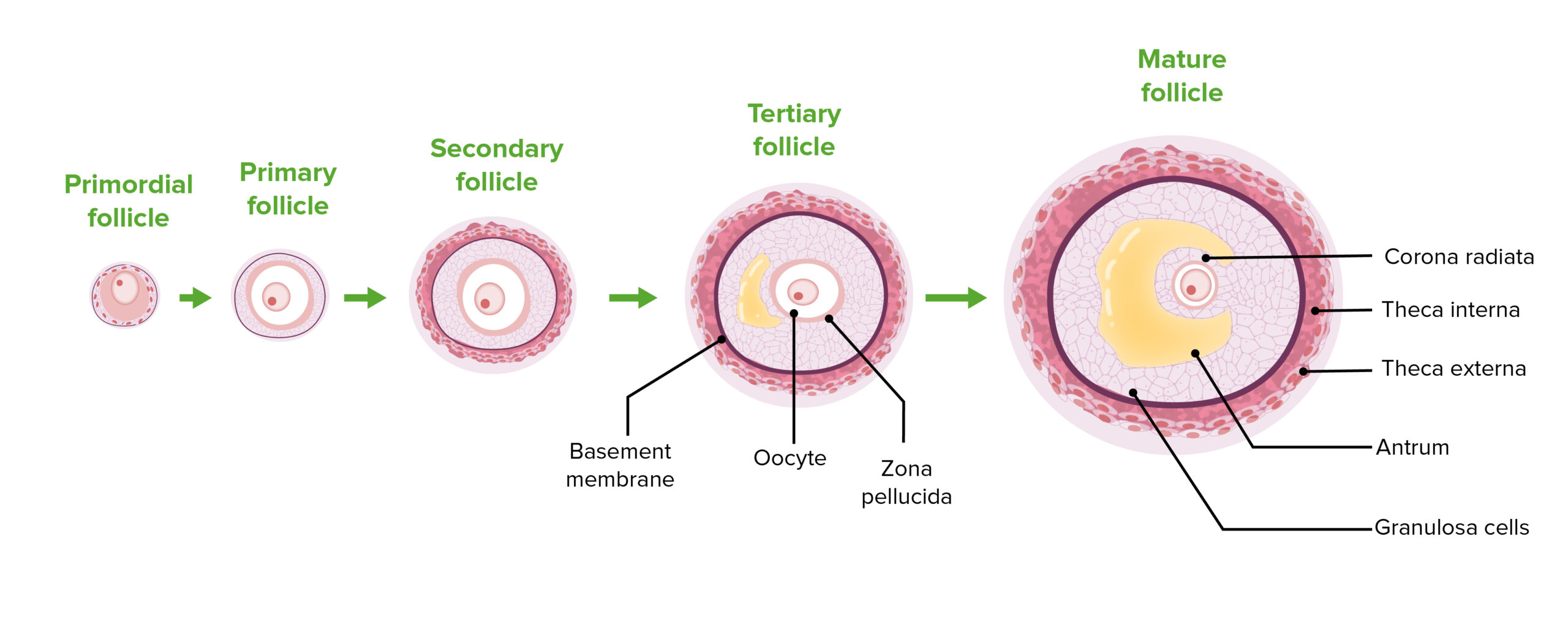
  • Folículo primordial:
    • Se desarrolla en EN Erythema nodosum is an immune-mediated panniculitis (inflammation of the subcutaneous fat) caused by a type IV (delayed-type) hypersensitivity reaction. It commonly manifests in young women as tender, erythematous nodules on the shins. Erythema Nodosum los LOS Neisseria ovarios durante el periodo fetal
    • Las oogonias se rodean de células epiteliales somáticas de la cresta gonadal.
  • Folículo primario:
    • Contiene un ovocito primario
    • Se crea una capa de glicoproteínas (zona pelúcida).
    • Las células foliculares proliferan y se diferencian para convertirse en EN Erythema nodosum is an immune-mediated panniculitis (inflammation of the subcutaneous fat) caused by a type IV (delayed-type) hypersensitivity reaction. It commonly manifests in young women as tender, erythematous nodules on the shins. Erythema Nodosum la capa de células de la granulosa (capa unicelular).
  • Folículo secundario (también conocido como folículos preantrales):
    • Esta etapa responde a las gonadotropinas (i.e., FSH FSH A major gonadotropin secreted by the adenohypophysis. Follicle-stimulating hormone stimulates gametogenesis and the supporting cells such as the ovarian granulosa cells, the testicular sertoli cells, and leydig cells. Fsh consists of two noncovalently linked subunits, alpha and beta. Within a species, the alpha subunit is common in the three pituitary glycoprotein hormones (TSH, LH, and FSH), but the beta subunit is unique and confers its biological specificity. Menstrual Cycle).
    • La capa de células de la granulosa crece.
    • Las células se transforman de escamosas → cuboidales
    • La producción de hormonas aumenta.
    • Reclutamiento de células de la teca → rodean la membrana basal
  • Folículo terciario (también conocido como folículos antrales):
    • Las células de la granulosa producen:
      • Fluido → crea un antro
      • Estrógeno y factores de crecimiento → críticos para la maduración de un ovocito sano
    • Las células de la granulosa que rodean al AL Amyloidosis ovocito se convierten en EN Erythema nodosum is an immune-mediated panniculitis (inflammation of the subcutaneous fat) caused by a type IV (delayed-type) hypersensitivity reaction. It commonly manifests in young women as tender, erythematous nodules on the shins. Erythema Nodosum el cúmulo oóforo
    • Las células de la teca se diferencian en EN Erythema nodosum is an immune-mediated panniculitis (inflammation of the subcutaneous fat) caused by a type IV (delayed-type) hypersensitivity reaction. It commonly manifests in young women as tender, erythematous nodules on the shins. Erythema Nodosum:
      • Teca interna: contiene pequeños vasos y células glandulares; produce testosterona que se convierte en EN Erythema nodosum is an immune-mediated panniculitis (inflammation of the subcutaneous fat) caused by a type IV (delayed-type) hypersensitivity reaction. It commonly manifests in young women as tender, erythematous nodules on the shins. Erythema Nodosum estrógeno en EN Erythema nodosum is an immune-mediated panniculitis (inflammation of the subcutaneous fat) caused by a type IV (delayed-type) hypersensitivity reaction. It commonly manifests in young women as tender, erythematous nodules on the shins. Erythema Nodosum las células de la granulosa
      • Teca externa: estabiliza los LOS Neisseria folículos; se deriva del tejido conectivo
  • Folículo maduro (también conocido como folículo graafiano):
    • Solo 1 folículo de cada ciclo alcanzará esta fase.
    • Ovocito primario → ovocito secundario justo antes de la ovulación
    • El antro se agranda (constituye la mayor parte del folículo)
    • Capa más interna del cúmulo oóforo → corona radiada
  • Cuerpo lúteo:
    • Se forma a partir del folículo tras la liberación del ovocito durante la ovulación
    • El centro contiene un coágulo de sangre formado tras la ovulación
    • Las células de la granulosa y de la teca producen estrógeno y progesterona
    • Se atrofia si no hay embarazo
Las etapas de la foliculogénesis

Las etapas de la foliculogénesis:
Obsérvese la progresión de la proliferación de las células foliculares, la diferenciación de las células de la teca y el agrandamiento del antro.
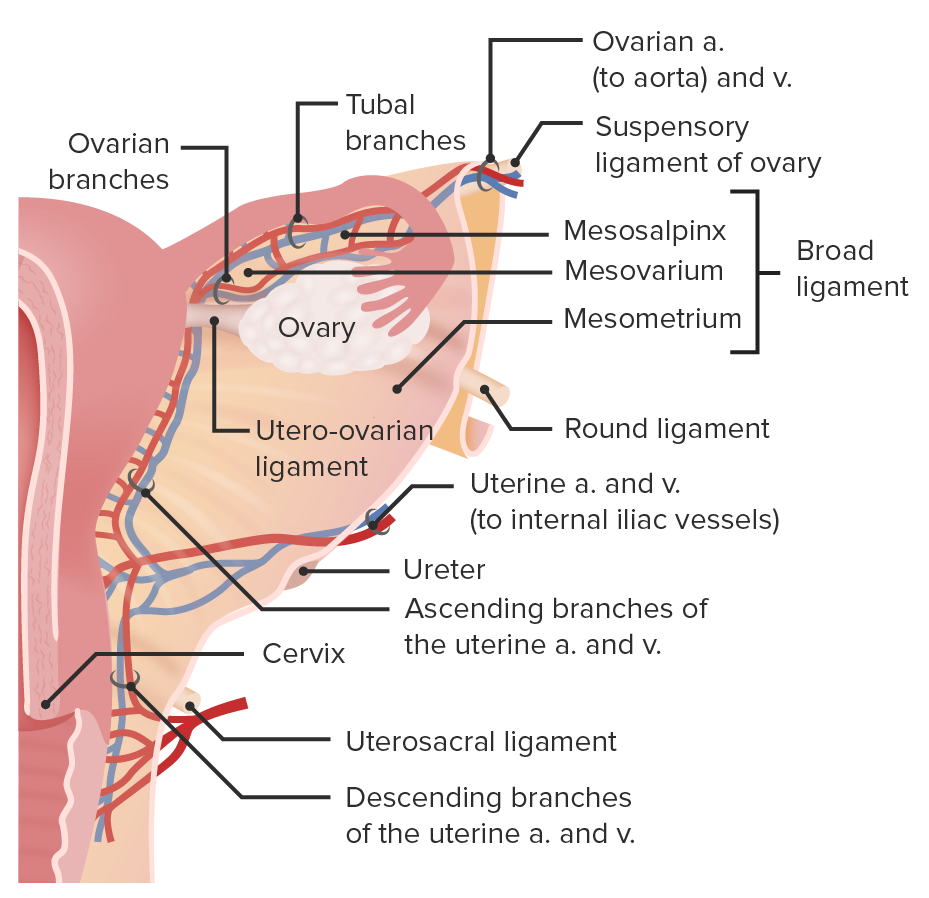
Imagen por Lecturio.

Irrigación e Inervación

  • Irrigación arterial: principalmente por la arteria ovárica
    • Rama directa de la aorta Aorta The main trunk of the systemic arteries. Mediastinum and Great Vessels: Anatomy abdominal (sale en EN Erythema nodosum is an immune-mediated panniculitis (inflammation of the subcutaneous fat) caused by a type IV (delayed-type) hypersensitivity reaction. It commonly manifests in young women as tender, erythematous nodules on the shins. Erythema Nodosum L2) justo debajo de las arterias renales
    • Contenida en EN Erythema nodosum is an immune-mediated panniculitis (inflammation of the subcutaneous fat) caused by a type IV (delayed-type) hypersensitivity reaction. It commonly manifests in young women as tender, erythematous nodules on the shins. Erythema Nodosum el ligamento suspensorio del ovario (ligamento infundibulopélvico)
    • Se divide en EN Erythema nodosum is an immune-mediated panniculitis (inflammation of the subcutaneous fat) caused by a type IV (delayed-type) hypersensitivity reaction. It commonly manifests in young women as tender, erythematous nodules on the shins. Erythema Nodosum:
      • Rama ovárica
      • Rama tubárica
    • Ambas ramas se anastomosan con la rama ascendente de la arteria uterina (que también se divide en EN Erythema nodosum is an immune-mediated panniculitis (inflammation of the subcutaneous fat) caused by a type IV (delayed-type) hypersensitivity reaction. It commonly manifests in young women as tender, erythematous nodules on the shins. Erythema Nodosum ramas ováricas y tubáricas).
    • La región anastomótica de las ramas ováricas suele denominarse arteria útero-ovárica.
  • Drenaje venoso: drenado por las venas ováricas
    • Plexo venoso situado dentro del mesosalpinx Mesosalpinx Uterus, Cervix, and Fallopian Tubes: Anatomy y el mesovario → convergen en EN Erythema nodosum is an immune-mediated panniculitis (inflammation of the subcutaneous fat) caused by a type IV (delayed-type) hypersensitivity reaction. It commonly manifests in young women as tender, erythematous nodules on the shins. Erythema Nodosum una única vena ovárica a cada lado
    • Las venas ováricas están contenidas en EN Erythema nodosum is an immune-mediated panniculitis (inflammation of the subcutaneous fat) caused by a type IV (delayed-type) hypersensitivity reaction. It commonly manifests in young women as tender, erythematous nodules on the shins. Erythema Nodosum los LOS Neisseria ligamentos infundibulopélvicos.
    • Vena ovárica derecha → vena cava inferior
    • Vena ovárica izquierda → vena renal izquierda → vena cava inferior
  • Drenaje linfático: drenaje a través de los LOS Neisseria vasos a lo largo de las venas ováricas hacia los LOS Neisseria ganglios paraaórticos
  • Inervación:
    • Derivado de los LOS Neisseria plexos autonómicos:
      • La parte superior del plexo ovárico está formada por los LOS Neisseria plexos renal y aórtico.
      • La parte inferior proviene de los LOS Neisseria plexos hipogástricos superior e inferior.
    • Fibras aferentes del dolor Dolor Inflammation visceral: corren con las fibras simpáticas de T11–L1
Irrigación y drenaje venoso del ovario

Irrigación y drenaje venoso del ovario

Imagen por Lecturio.

Relevancia Clínica

Estructuras anatómicas relacionadas

  • Pelvis Pelvis The pelvis consists of the bony pelvic girdle, the muscular and ligamentous pelvic floor, and the pelvic cavity, which contains viscera, vessels, and multiple nerves and muscles. The pelvic girdle, composed of 2 “hip” bones and the sacrum, is a ring-like bony structure of the axial skeleton that links the vertebral column with the lower extremities. Pelvis: Anatomy: formada por la cintura pélvica ósea, cavidad pélvica, piso pélvico (músculos y tejido conectivo) y todas las vísceras, vasos y músculos que contiene. La cavidad pélvica alberga varias estructuras gastrointestinales y urogenitales.
  • Útero: órgano hueco en EN Erythema nodosum is an immune-mediated panniculitis (inflammation of the subcutaneous fat) caused by a type IV (delayed-type) hypersensitivity reaction. It commonly manifests in young women as tender, erythematous nodules on the shins. Erythema Nodosum forma de pera, compuesto por músculo liso, que tiene la función de nutrir al AL Amyloidosis feto en EN Erythema nodosum is an immune-mediated panniculitis (inflammation of the subcutaneous fat) caused by a type IV (delayed-type) hypersensitivity reaction. It commonly manifests in young women as tender, erythematous nodules on the shins. Erythema Nodosum desarrollo hasta el final del embarazo. Al AL Amyloidosis final del embarazo, el útero también es responsable de la expulsión del recién nacido.
  • Trompas de Falopio: tubos delgados que actúan como conducto entre el ovario y el útero. Las trompas de Falopio recogen los LOS Neisseria ovocitos expulsados; si hay espermatozoides, la fecundación suele producirse en EN Erythema nodosum is an immune-mediated panniculitis (inflammation of the subcutaneous fat) caused by a type IV (delayed-type) hypersensitivity reaction. It commonly manifests in young women as tender, erythematous nodules on the shins. Erythema Nodosum las trompas de Falopio y el embrión es transportado a la cavidad uterina, donde se implanta.

Fisiología

  • Ciclo menstrual: patrón cíclico de actividad hormonal y tisular que prepara el ambiente uterino para la fecundación e implantación del embrión. El ciclo menstrual incluye los LOS Neisseria ciclos endometriales y ováricos.
  • Menopausia: proceso asociado al AL Amyloidosis envejecimiento que se presenta por una disminución gradual de la función ovárica a lo largo de varios años, hasta que se deja de producir la ovulación. La transición a la menopausia se caracteriza por la fluctuación de los LOS Neisseria niveles hormonales, tras lo cual los LOS Neisseria niveles de estrógeno y progesterona disminuyen de forma permanente.

Trastornos ováricos

  • Cáncer de ovario: principal neoplasia ginecológica causante de muerte. Los LOS Neisseria tumores de ovario pueden ser epiteliales, de células germinales, de cordón sexual o metastásicos.
  • Quistes ováricos: lesiones llenas de líquido dentro del ovario.
    • Quistes foliculares (también conocidos como quistes fisiológicos): cuando un ovocito se desarrolla en EN Erythema nodosum is an immune-mediated panniculitis (inflammation of the subcutaneous fat) caused by a type IV (delayed-type) hypersensitivity reaction. It commonly manifests in young women as tender, erythematous nodules on the shins. Erythema Nodosum la 1ra ½ del ciclo menstrual, el folículo se convierte en EN Erythema nodosum is an immune-mediated panniculitis (inflammation of the subcutaneous fat) caused by a type IV (delayed-type) hypersensitivity reaction. It commonly manifests in young women as tender, erythematous nodules on the shins. Erythema Nodosum un pequeño quiste, de aproximadamente 2–3 cm de tamaño, antes de la ovulación. En EN Erythema nodosum is an immune-mediated panniculitis (inflammation of the subcutaneous fat) caused by a type IV (delayed-type) hypersensitivity reaction. It commonly manifests in young women as tender, erythematous nodules on the shins. Erythema Nodosum ocasiones, un ovocito puede no ser expulsado y el folículo puede aumentar de tamaño (normalmente < 10 cm) y puede persistir. En EN Erythema nodosum is an immune-mediated panniculitis (inflammation of the subcutaneous fat) caused by a type IV (delayed-type) hypersensitivity reaction. It commonly manifests in young women as tender, erythematous nodules on the shins. Erythema Nodosum el ultrasonido, estos ovocitos son visibles como quistes simples con paredes lisas. Los LOS Neisseria quistes suelen resolverse espontáneamente, aunque los LOS Neisseria grandes quistes persistentes pueden tratarse quirúrgicamente.
    • Quistes del cuerpo lúteo: tras la ovulación, el folículo se transforma en EN Erythema nodosum is an immune-mediated panniculitis (inflammation of the subcutaneous fat) caused by a type IV (delayed-type) hypersensitivity reaction. It commonly manifests in young women as tender, erythematous nodules on the shins. Erythema Nodosum un quiste del cuerpo lúteo, que secreta tanto estrógenos como progesterona. En EN Erythema nodosum is an immune-mediated panniculitis (inflammation of the subcutaneous fat) caused by a type IV (delayed-type) hypersensitivity reaction. It commonly manifests in young women as tender, erythematous nodules on the shins. Erythema Nodosum el ultrasonido, estos quistes pueden tener paredes ligeramente más gruesas y contener algunos restos internos. Los LOS Neisseria quistes del cuerpo lúteo también pueden aumentar de tamaño (< 10 cm), pero suelen resolverse espontáneamente. El cuerpo lúteo es fundamental para mantener los LOS Neisseria estadios tempranos de un embarazo y no debe confundirse con un embarazo ectópico.
    • Quistes hemorrágicos: en EN Erythema nodosum is an immune-mediated panniculitis (inflammation of the subcutaneous fat) caused by a type IV (delayed-type) hypersensitivity reaction. It commonly manifests in young women as tender, erythematous nodules on the shins. Erythema Nodosum ocasiones, los LOS Neisseria quistes foliculares o del cuerpo lúteo sangran, lo que se conoce como quiste hemorrágico. Los LOS Neisseria quistes hemorrágicos suelen presentarse con dolor Dolor Inflammation pélvico de aparición repentina en EN Erythema nodosum is an immune-mediated panniculitis (inflammation of the subcutaneous fat) caused by a type IV (delayed-type) hypersensitivity reaction. It commonly manifests in young women as tender, erythematous nodules on the shins. Erythema Nodosum una mujer que está ovulando. En EN Erythema nodosum is an immune-mediated panniculitis (inflammation of the subcutaneous fat) caused by a type IV (delayed-type) hypersensitivity reaction. It commonly manifests in young women as tender, erythematous nodules on the shins. Erythema Nodosum el ultrasonido, estos quistes aparecen como quistes simples con ecos internos (que representan la sangre y el coágulo) y se resuelven espontáneamente a lo largo de 1–2 ciclos menstruales, aunque si la hemorragia es importante en EN Erythema nodosum is an immune-mediated panniculitis (inflammation of the subcutaneous fat) caused by a type IV (delayed-type) hypersensitivity reaction. It commonly manifests in young women as tender, erythematous nodules on the shins. Erythema Nodosum el momento de la presentación, puede estar justificada la cirugía de urgencia para detener la hemorragia.
    • Quistes neoplásicos: al AL Amyloidosis igual que el cáncer de ovario, estos quistes se clasifican según su célula de origen: células epiteliales, células germinales y células del cordón sexual. Cada clasificación tiene múltiples subtipos histológicos. Estos tumores son benignos (no invasivos) pero tienen una mayor probabilidad de torsión, irregularidades menstruales y otros síntomas relacionados con efecto de masa.
  • Síndrome de ovario poliquístico: endocrinopatía multisistémica heterogénea que se caracteriza por hiperandrogenismo, disfunción ovárica que provoca oligomenorrea y múltiples quistes en EN Erythema nodosum is an immune-mediated panniculitis (inflammation of the subcutaneous fat) caused by a type IV (delayed-type) hypersensitivity reaction. It commonly manifests in young women as tender, erythematous nodules on the shins. Erythema Nodosum los LOS Neisseria ovarios. Los LOS Neisseria problemas de fertilidad también son comunes.
  • Insuficiencia ovárica primaria: afección resultante del agotamiento o la disfunción de los LOS Neisseria folículos ováricos, que conduce al AL Amyloidosis cese de la ovulación y la menstruación a < 40 años de edad. Los LOS Neisseria síntomas incluyen oligomenorrea o amenorrea, sequedad vaginal (a menudo con dispareunia) e infertilidad. Los LOS Neisseria principales hallazgos de laboratorio incluyen un nivel elevado de FSH FSH A major gonadotropin secreted by the adenohypophysis. Follicle-stimulating hormone stimulates gametogenesis and the supporting cells such as the ovarian granulosa cells, the testicular sertoli cells, and leydig cells. Fsh consists of two noncovalently linked subunits, alpha and beta. Within a species, the alpha subunit is common in the three pituitary glycoprotein hormones (TSH, LH, and FSH), but the beta subunit is unique and confers its biological specificity. Menstrual Cycle y niveles bajos de estrógeno.
  • Torsión ovárica: emergencia clínica en EN Erythema nodosum is an immune-mediated panniculitis (inflammation of the subcutaneous fat) caused by a type IV (delayed-type) hypersensitivity reaction. It commonly manifests in young women as tender, erythematous nodules on the shins. Erythema Nodosum la que los LOS Neisseria ovarios se retuercen alrededor del ligamento suspensorio del ovario y del ligamento ovárico, cortando la irrigación al AL Amyloidosis ovario, lo que provoca un edema Edema Edema is a condition in which excess serous fluid accumulates in the body cavity or interstitial space of connective tissues. Edema is a symptom observed in several medical conditions. It can be categorized into 2 types, namely, peripheral (in the extremities) and internal (in an organ or body cavity). Edema ovárico y un dolor Dolor Inflammation intenso de aparición repentina. La torsión ovárica se produce en EN Erythema nodosum is an immune-mediated panniculitis (inflammation of the subcutaneous fat) caused by a type IV (delayed-type) hypersensitivity reaction. It commonly manifests in young women as tender, erythematous nodules on the shins. Erythema Nodosum mujeres en EN Erythema nodosum is an immune-mediated panniculitis (inflammation of the subcutaneous fat) caused by a type IV (delayed-type) hypersensitivity reaction. It commonly manifests in young women as tender, erythematous nodules on the shins. Erythema Nodosum edad reproductiva, normalmente en EN Erythema nodosum is an immune-mediated panniculitis (inflammation of the subcutaneous fat) caused by a type IV (delayed-type) hypersensitivity reaction. It commonly manifests in young women as tender, erythematous nodules on the shins. Erythema Nodosum un ovario agrandado (> 5 cm). El tratamiento es quirúrgico para evitar la necrosis Necrosis The death of cells in an organ or tissue due to disease, injury or failure of the blood supply. Ischemic Cell Damage del ovario.
  • Amenorrea: ausencia de menstruación en EN Erythema nodosum is an immune-mediated panniculitis (inflammation of the subcutaneous fat) caused by a type IV (delayed-type) hypersensitivity reaction. It commonly manifests in young women as tender, erythematous nodules on the shins. Erythema Nodosum una mujer en EN Erythema nodosum is an immune-mediated panniculitis (inflammation of the subcutaneous fat) caused by a type IV (delayed-type) hypersensitivity reaction. It commonly manifests in young women as tender, erythematous nodules on the shins. Erythema Nodosum edad reproductiva. Si no se produce la ovulación, no habrá menstruación. La amenorrea puede ser un síntoma de enfermedad ovárica.

Referencias

  1. Schorge J.O., Schaffer J.I., et al. (2008). Williams Gynecology, pp. 348–354. McGraw Hill.
  2. Saladin, K.S., & Miller, L. (2004). Anatomy and physiology, 3rd ed., pp. 1050–1052, 1061. McGraw Hill.
  3. Moore, K.L., & Dalley, A.F. (2006). Clinically oriented anatomy, 5th ed., pp. 427–429. Lippincott Williams & Wilkins.
  4. OpenStax College. (n.d.). Anatomy and physiology. OpenStax CNX. http://cnx.org/contents/14fb4ad7-39a1-4eee-ab6e-3ef2482e3e22@11.1.

¡Crea tu cuenta gratis o inicia una sesión para seguir leyendo!

Regístrate ahora y obtén acceso gratuito a Lecturio con páginas de concepto, videos médicos y cuestionarios para tu educación médica.

User Reviews

Que tengas una sesión de estudio alegre y navideña 🎁 Ahorra 50% en todos los planes >>

Details