
Domina Conceptos Médicos

Estudia para la escuela de medicina y tus examenes con Lecturio.

Hepatitis Autoinmune

La hepatitis autoinmune (HAI) es una enfermedad hepática inflamatoria crónica cada vez más reconocida, con una incidencia global en EN Erythema nodosum is an immune-mediated panniculitis (inflammation of the subcutaneous fat) caused by a type IV (delayed-type) hypersensitivity reaction. It commonly manifests in young women as tender, erythematous nodules on the shins. Erythema Nodosum aumento. La presentación clínica varía desde casos asintomáticos hasta síntomas de insuficiencia hepática aguda (ictericia, dolor Dolor Inflammation en EN Erythema nodosum is an immune-mediated panniculitis (inflammation of the subcutaneous fat) caused by a type IV (delayed-type) hypersensitivity reaction. It commonly manifests in young women as tender, erythematous nodules on the shins. Erythema Nodosum el cuadrante superior derecho del abdomen). El diagnóstico se basa en EN Erythema nodosum is an immune-mediated panniculitis (inflammation of the subcutaneous fat) caused by a type IV (delayed-type) hypersensitivity reaction. It commonly manifests in young women as tender, erythematous nodules on the shins. Erythema Nodosum hallazgos serológicos característicos, niveles elevados de IgG IgG The major immunoglobulin isotype class in normal human serum. There are several isotype subclasses of igg, for example, igg1, igg2a, and igg2b. Hypersensitivity Pneumonitis y evidencia histológica de hepatitis de interfase. El consenso reciente se aleja de marcadores tradicionales como la emperipolesis y las rosetas. El reconocimiento temprano es crucial dado el alto riesgo de mortalidad sin tratamiento. El tratamiento estándar con corticosteroides y azatioprina logra una respuesta bioquímica completa en EN Erythema nodosum is an immune-mediated panniculitis (inflammation of the subcutaneous fat) caused by a type IV (delayed-type) hypersensitivity reaction. It commonly manifests in young women as tender, erythematous nodules on the shins. Erythema Nodosum la mayoría de los LOS Neisseria pacientes. Los LOS Neisseria síndromes de solapamiento presentan desafíos diagnósticos y terapéuticos adicionales que requieren atención especializada.

Last updated: Jun 3, 2025

Editorial responsibility: Stanley Oiseth, Lindsay Jones, Evelin Maza

Epidemiología y Etiología

Epidemiología

  • Incidencia:
    • 0,9 a 2,0 por cada 100.000 habitantes/año en EN Erythema nodosum is an immune-mediated panniculitis (inflammation of the subcutaneous fat) caused by a type IV (delayed-type) hypersensitivity reaction. It commonly manifests in young women as tender, erythematous nodules on the shins. Erythema Nodosum Europa
    • 1,28 por 100.000 habitantes/año a nivel mundial, con una variación regional significativa
    • 31,2 por 100.000 habitantes/año en EN Erythema nodosum is an immune-mediated panniculitis (inflammation of the subcutaneous fat) caused by a type IV (delayed-type) hypersensitivity reaction. It commonly manifests in young women as tender, erythematous nodules on the shins. Erythema Nodosum Estados Unidos
    • Tanto la incidencia como la prevalencia han aumentado significativamente en EN Erythema nodosum is an immune-mediated panniculitis (inflammation of the subcutaneous fat) caused by a type IV (delayed-type) hypersensitivity reaction. It commonly manifests in young women as tender, erythematous nodules on the shins. Erythema Nodosum las últimas décadas
  • Más frecuente en EN Erythema nodosum is an immune-mediated panniculitis (inflammation of the subcutaneous fat) caused by a type IV (delayed-type) hypersensitivity reaction. It commonly manifests in young women as tender, erythematous nodules on the shins. Erythema Nodosum mujeres que en EN Erythema nodosum is an immune-mediated panniculitis (inflammation of the subcutaneous fat) caused by a type IV (delayed-type) hypersensitivity reaction. It commonly manifests in young women as tender, erythematous nodules on the shins. Erythema Nodosum hombres (4:1)
  • Distribución bimodal: 1 pico a los LOS Neisseria 10–20 años y otro a los LOS Neisseria 45–70 años

Etiología

Asociada con otras afecciones autoinmunes (e.g., tiroiditis de Hashimoto, enfermedad de Graves, diabetes Diabetes Diabetes mellitus (DM) is a metabolic disease characterized by hyperglycemia and dysfunction of the regulation of glucose metabolism by insulin. Type 1 DM is diagnosed mostly in children and young adults as the result of autoimmune destruction of β cells in the pancreas and the resulting lack of insulin. Type 2 DM has a significant association with obesity and is characterized by insulin resistance. Diabetes Mellitus mellitus, artritis reumatoide, enfermedad celíaca, síndrome de Sjogren)

Related videos

Presentación Clínica

  • Presentación heterogénea que va VA Ventilation: Mechanics of Breathing desde asintomática hasta insuficiencia hepática aguda y/o cirrosis
  • Primeros signos:
    • Fatiga, malestar general y letargo
    • Náuseas
    • Dolor Dolor Inflammation abdominal
    • Hepatomegalia
    • Pérdida de peso
    • Prurito
    • Erupción eritematosa transitoria
  • Signos de insuficiencia hepática aguda:
    • Ictericia
    • Dolor Dolor Inflammation en EN Erythema nodosum is an immune-mediated panniculitis (inflammation of the subcutaneous fat) caused by a type IV (delayed-type) hypersensitivity reaction. It commonly manifests in young women as tender, erythematous nodules on the shins. Erythema Nodosum el cuadrante superior derecho
    • Fiebre
    • Disminución del recuento de plaquetas

Diagnóstico y Tratamiento

Diagnóstico

La hepatitis autoinmune es un diagnóstico diferencial para cualquier paciente que presente al AL Amyloidosis menos uno de los LOS Neisseria siguientes:

  • Pruebas bioquímicas hepáticas anormales
  • Hepatitis aguda
  • Cirrosis
  • Insuficiencia hepática aguda

La hepatitis autoinmune es un diagnóstico de exclusión, por lo que el primer paso es descartar una infección viral, medicamentos, causas metabólicas o genéticas.
  • Transaminasas elevadas (de leves a >1 000 U/L)
  • Hipergammaglobulinemia (la IgG IgG The major immunoglobulin isotype class in normal human serum. There are several isotype subclasses of igg, for example, igg1, igg2a, and igg2b. Hypersensitivity Pneumonitis está elevada): la hepatitis autoinmune se clasifica en EN Erythema nodosum is an immune-mediated panniculitis (inflammation of the subcutaneous fat) caused by a type IV (delayed-type) hypersensitivity reaction. It commonly manifests in young women as tender, erythematous nodules on the shins. Erythema Nodosum tipo 1 y tipo 2 de acuerdo con los LOS Neisseria anticuerpos presentes:
    • Hepatitis autoinmune tipo 1:
      • Más común
      • Típicamente observada en EN Erythema nodosum is an immune-mediated panniculitis (inflammation of the subcutaneous fat) caused by a type IV (delayed-type) hypersensitivity reaction. It commonly manifests in young women as tender, erythematous nodules on the shins. Erythema Nodosum adultos
      • Caracterizada por anticuerpos anti músculo liso positivos y elevación de anticuerpos antinucleares (ANA)
      • También se observan antígeno soluble hepático/antígeno hígado páncreas (Anti-SLA/ LP) y anticuerpos citoplasmáticos antineutrófilos periféricos atípicos ( p-ANCA p-ANCA Antineutrophil Cytoplasmic Antibody (ANCA)-Associated Vasculitis).
      • En EN Erythema nodosum is an immune-mediated panniculitis (inflammation of the subcutaneous fat) caused by a type IV (delayed-type) hypersensitivity reaction. It commonly manifests in young women as tender, erythematous nodules on the shins. Erythema Nodosum un 12% aproximadamente, los LOS Neisseria anticuerpos antimitocondriales ( AMA AMA Primary Biliary Cholangitis) son positivos (se ven más en EN Erythema nodosum is an immune-mediated panniculitis (inflammation of the subcutaneous fat) caused by a type IV (delayed-type) hypersensitivity reaction. It commonly manifests in young women as tender, erythematous nodules on the shins. Erythema Nodosum la colangitis biliar primaria).
    • Hepatitis autoinmune de tipo 2:
      • Se observa en EN Erythema nodosum is an immune-mediated panniculitis (inflammation of the subcutaneous fat) caused by a type IV (delayed-type) hypersensitivity reaction. It commonly manifests in young women as tender, erythematous nodules on the shins. Erythema Nodosum niños.
      • Puede ser más grave que el tipo 1
      • Elevación de anticuerpos contra los LOS Neisseria microsomas hepato renales 1 (LKM1)
      • Elevación del anticuerpo anti-citosol hepático-1 (ALC-1)
    • Algunos individuos con hepatitis autoinmune no tienen autoanticuerpos circulantes (hepatitis autoinmune con autoanticuerpos negativos).
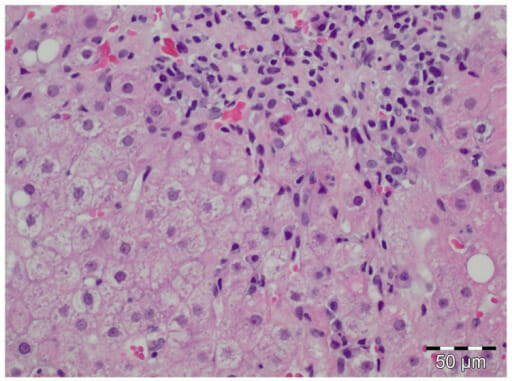
  • La biopsia hepática es el estándar de oro para el diagnóstico. Muestra:
    • Inflamación y necrosis Necrosis The death of cells in an organ or tissue due to disease, injury or failure of the blood supply. Ischemic Cell Damage en EN Erythema nodosum is an immune-mediated panniculitis (inflammation of the subcutaneous fat) caused by a type IV (delayed-type) hypersensitivity reaction. It commonly manifests in young women as tender, erythematous nodules on the shins. Erythema Nodosum las áreas periportales (zona 1) y de interfase (hepatitis de interfase)
    • Infiltración mayoritariamente linfoplasmocítica en EN Erythema nodosum is an immune-mediated panniculitis (inflammation of the subcutaneous fat) caused by a type IV (delayed-type) hypersensitivity reaction. It commonly manifests in young women as tender, erythematous nodules on the shins. Erythema Nodosum los LOS Neisseria tractos portales
    • Diversos grados de fibrosis Fibrosis Any pathological condition where fibrous connective tissue invades any organ, usually as a consequence of inflammation or other injury. Bronchiolitis Obliterans
    • La emperipolesis y la formación de rosetas hepáticas se consideraban históricamente rasgos característicos. Un consenso reciente (2022) los LOS Neisseria reconoce como marcadores inespecíficos de lesiones hepáticas graves, en EN Erythema nodosum is an immune-mediated panniculitis (inflammation of the subcutaneous fat) caused by a type IV (delayed-type) hypersensitivity reaction. It commonly manifests in young women as tender, erythematous nodules on the shins. Erythema Nodosum lugar de específicas de la hepatitis autoinmune.

Tratamiento

  • 40% de mortalidad en EN Erythema nodosum is an immune-mediated panniculitis (inflammation of the subcutaneous fat) caused by a type IV (delayed-type) hypersensitivity reaction. It commonly manifests in young women as tender, erythematous nodules on the shins. Erythema Nodosum 6 meses sin tratamiento
  • El tratamiento consiste principalmente en EN Erythema nodosum is an immune-mediated panniculitis (inflammation of the subcutaneous fat) caused by a type IV (delayed-type) hypersensitivity reaction. It commonly manifests in young women as tender, erythematous nodules on the shins. Erythema Nodosum medicamentos inmunosupresores:
    • Corticosteroides: para lograr la remisión (tasa de respuesta del 80%)
    • Agente ahorrador de esteroides: la azatioprina se usa como terapia de mantenimiento, puesto que la mayoría de los LOS Neisseria pacientes recae cuando se suspenden los LOS Neisseria corticosteroides.
    • La remisión con un tratamiento óptimo se logra en EN Erythema nodosum is an immune-mediated panniculitis (inflammation of the subcutaneous fat) caused by a type IV (delayed-type) hypersensitivity reaction. It commonly manifests in young women as tender, erythematous nodules on the shins. Erythema Nodosum hasta el 80% de los LOS Neisseria casos después de 18 a 24 meses de tratamiento
    • El trasplante hepático está indicado en EN Erythema nodosum is an immune-mediated panniculitis (inflammation of the subcutaneous fat) caused by a type IV (delayed-type) hypersensitivity reaction. It commonly manifests in young women as tender, erythematous nodules on the shins. Erythema Nodosum casos de cirrosis hepática descompensada, falla hepática aguda y carcinoma hepatocelular.
    • Se recomiendan seguimientos, puesto que estos pacientes tienen un mayor riesgo de desarrollar carcinoma hepatocelular.
    • Tratamientos emergentes en EN Erythema nodosum is an immune-mediated panniculitis (inflammation of the subcutaneous fat) caused by a type IV (delayed-type) hypersensitivity reaction. It commonly manifests in young women as tender, erythematous nodules on the shins. Erythema Nodosum investigación: agentes dirigidos a células B (VAY736) e inhibidores de JAK para variantes genéticas específicas
  • Criterios de respuesta al AL Amyloidosis tratamiento:
    • Un consenso reciente del Grupo Internacional de Hepatitis Autoinmune (IHA) ha HA Hemolytic anemia (HA) is the term given to a large group of anemias that are caused by the premature destruction/hemolysis of circulating red blood cells (RBCs). Hemolysis can occur within (intravascular hemolysis) or outside the blood vessels (extravascular hemolysis). Hemolytic Anemia establecido criterios de respuesta estandarizados:
      • Respuesta bioquímica completa (RBC): normalización de las transaminasas séricas e IgG IgG The major immunoglobulin isotype class in normal human serum. There are several isotype subclasses of igg, for example, igg1, igg2a, and igg2b. Hypersensitivity Pneumonitis dentro de 6 meses tras el inicio del tratamiento
      • Respuesta insuficiente: no se cumple la definición de RBC a los LOS Neisseria 6 meses
      • Falta de respuesta: disminución <50 % de las transaminasas séricas en EN Erythema nodosum is an immune-mediated panniculitis (inflammation of the subcutaneous fat) caused by a type IV (delayed-type) hypersensitivity reaction. It commonly manifests in young women as tender, erythematous nodules on the shins. Erythema Nodosum las 4 semanas posteriores al AL Amyloidosis inicio del tratamiento
      • Remisión: histología hepática con un Índice de Actividad de la Hepatitis <4/18
    • Alcanzar la RBC se asocia fuertemente con una mayor supervivencia hepática y sirve como un criterio de valoración importante del tratamiento.
Autoimmune Hepatitis

Histología de la hepatitis autoinmune en un individuo con infección aguda por virus de la hepatitis E

Imagen: “pone-0085330-g002” por Sven Pischke et al. Licencia: CC BY 4.0

Diagnóstico Diferencial

Las siguientes condiciones son diagnósticos diferenciales de la hepatitis autoinmune:

  • Colangitis biliar primaria: también se presenta con fatiga, ictericia, hepatomegalia y resultados de biopsia similares a la hepatitis autoinmune. La presencia característica de anticuerpos antimitocondriales ( AMA AMA Primary Biliary Cholangitis, por sus siglas en EN Erythema nodosum is an immune-mediated panniculitis (inflammation of the subcutaneous fat) caused by a type IV (delayed-type) hypersensitivity reaction. It commonly manifests in young women as tender, erythematous nodules on the shins. Erythema Nodosum inglés) ayuda a diferenciar esta enfermedad de la hepatitis autoinmune para la que son característicos los LOS Neisseria anticuerpos anti-músculo liso.
  • Colangitis esclerosante primaria: también se presenta con fatiga, ictericia, hepatomegalia. Una de las mejores maneras de diferenciar esta enfermedad de la hepatitis autoinmune es a través de modalidades de imagen como la colangiopancreatografía por resonancia magnética, que muestra una estructuración multifocal Multifocal Retinoblastoma característica y dilatación de los LOS Neisseria conductos biliares intrahepáticos y/o extrahepáticos y confirma el diagnóstico de colangitis esclerosante primaria.
  • Hepatitis viral: el método más utilizado es la detección de anticuerpos/antígenos en EN Erythema nodosum is an immune-mediated panniculitis (inflammation of the subcutaneous fat) caused by a type IV (delayed-type) hypersensitivity reaction. It commonly manifests in young women as tender, erythematous nodules on the shins. Erythema Nodosum el suero. Sin embargo, algunos pacientes con hepatitis autoinmune pueden dar un resultado positivo falso para el anticuerpo contra la hepatitis C Hepatitis C Hepatitis C is an infection of the liver caused by the hepatitis C virus (HCV). The infection can be transmitted through infectious blood or body fluids and may be transmitted during childbirth or through IV drug use or sexual intercourse. Hepatitis C virus can cause both acute and chronic hepatitis, ranging from a mild to a serious, lifelong illness including liver cirrhosis and hepatocellular carcinoma (HCC). Hepatitis C Virus; esto se puede confirmar mediante la obtención de un nivel de ARN del virus Virus Viruses are infectious, obligate intracellular parasites composed of a nucleic acid core surrounded by a protein capsid. Viruses can be either naked (non-enveloped) or enveloped. The classification of viruses is complex and based on many factors, including type and structure of the nucleoid and capsid, the presence of an envelope, the replication cycle, and the host range. Virology de la hepatitis C Hepatitis C Hepatitis C is an infection of the liver caused by the hepatitis C virus (HCV). The infection can be transmitted through infectious blood or body fluids and may be transmitted during childbirth or through IV drug use or sexual intercourse. Hepatitis C virus can cause both acute and chronic hepatitis, ranging from a mild to a serious, lifelong illness including liver cirrhosis and hepatocellular carcinoma (HCC). Hepatitis C Virus en EN Erythema nodosum is an immune-mediated panniculitis (inflammation of the subcutaneous fat) caused by a type IV (delayed-type) hypersensitivity reaction. It commonly manifests in young women as tender, erythematous nodules on the shins. Erythema Nodosum estos pacientes.
  • Otras causas de hepatitis (inducida por medicamentos, esteatohepatitis no alcohólica): también se presentan con fatiga, ictericia, hepatomegalia y dolor Dolor Inflammation en EN Erythema nodosum is an immune-mediated panniculitis (inflammation of the subcutaneous fat) caused by a type IV (delayed-type) hypersensitivity reaction. It commonly manifests in young women as tender, erythematous nodules on the shins. Erythema Nodosum el cuadrante superior derecho. Estas causas deben descartarse mediante los LOS Neisseria antecedentes y la evaluación de laboratorio. La presencia de anticuerpo anti-músculo liso es un fuerte indicador de hepatitis autoinmune.

La hepatitis autoinmune puede solaparse con otras enfermedades hepáticas autoinmunes, lo que genera desafíos diagnósticos y terapéuticos:

  • Solapamiento entre HAI y colangitis biliar primaria (CBP):
    • Se presenta en EN Erythema nodosum is an immune-mediated panniculitis (inflammation of the subcutaneous fat) caused by a type IV (delayed-type) hypersensitivity reaction. It commonly manifests in young women as tender, erythematous nodules on the shins. Erythema Nodosum el 1-14 % de los LOS Neisseria pacientes con CBP.
    • Puede presentarse con HAI positiva para AMA AMA Primary Biliary Cholangitis o colangiopatía positiva para ANA/SMA.
    • El tratamiento depende de las características predominantes: los LOS Neisseria casos con predominio de HAI responden a la inmunosupresión, mientras que los LOS Neisseria casos con predominio de CBP pueden requerir ácido ursodesoxicólico.
  • Solapamiento entre HAI y colangitis esclerosante primaria (CEP):
    • Más frecuente en EN Erythema nodosum is an immune-mediated panniculitis (inflammation of the subcutaneous fat) caused by a type IV (delayed-type) hypersensitivity reaction. It commonly manifests in young women as tender, erythematous nodules on the shins. Erythema Nodosum niños (30-50 %) que en EN Erythema nodosum is an immune-mediated panniculitis (inflammation of the subcutaneous fat) caused by a type IV (delayed-type) hypersensitivity reaction. It commonly manifests in young women as tender, erythematous nodules on the shins. Erythema Nodosum adultos. (1,7-10%)
    • Debe sospecharse en EN Erythema nodosum is an immune-mediated panniculitis (inflammation of the subcutaneous fat) caused by a type IV (delayed-type) hypersensitivity reaction. It commonly manifests in young women as tender, erythematous nodules on the shins. Erythema Nodosum pacientes con enfermedad inflamatoria intestinal, prurito, bioquímica colestásica o mala respuesta a los LOS Neisseria esteroides.
    • Requiere colangiografía (CPRM) para el diagnóstico.
    • La respuesta al AL Amyloidosis tratamiento suele ser mala en EN Erythema nodosum is an immune-mediated panniculitis (inflammation of the subcutaneous fat) caused by a type IV (delayed-type) hypersensitivity reaction. It commonly manifests in young women as tender, erythematous nodules on the shins. Erythema Nodosum comparación con la HAI clásica.

Referencias

  1. Heneghan, M.A. (2023, Sep. 19). Overview of autoimmune hepatitis. UpToDate. Retrieved June 3, 2025, from https://www.uptodate.com/contents/overview-of-autoimmune-hepatitis-in-adults
  2. Gill, R., Kakar, S. (2021) Liver and Gallbladder In Kumar, V., Abbas, A., Aster, J., Turner, J.  (Eds.), Robbins & Cotran Pathologic Basis of Disease (10th ed., pp. 839–841). Elsevier.
  3. Ahn, S., Jeong, S. H., Cho, E. J., Lee, K., Kim, G., & Kim, H. (2024). Comparison of four histological scoring systems for autoimmune hepatitis to improve diagnostic sensitivity. Clinical and Molecular Hepatology, 30(1), 37-48. https://doi.org/10.3350/cmh.2023.0325
  4. Boberg, K. M., Chapman, R. W., Hirschfield, G. M., Lohse, A. W., Manns, M. P., & Schrumpf, E. (2011). Overlap syndromes: The International Autoimmune Hepatitis Group (IAIHG) position statement on a controversial issue. Journal of Hepatology, 54(2), 374-385. https://doi.org/10.1016/j.jhep.2010.09.002
  5. Feldman, M., Friedman, L. S., & Brandt, L. J. (Eds.). (2021). Sleisenger and Fordtran’s gastrointestinal and liver disease: Pathophysiology, diagnosis, management (11th ed., Chapter 90: Autoimmune hepatitis). Elsevier.
  6. Hahn, J. W., Yang, H. R., Moon, J. S., Chang, J. Y., Lee, K., Kim, G. A., Rahmati, M., Koyanagi, A., Smith, L., Kim, M. S., López Sánchez, G. F., Elena, D., Shin, J. Y., Shin, J. I., Kwon, R., Kim, S., Kim, H. J., Lee, H., Ko, J. S., & Yon, D. K. (2023). Global incidence and prevalence of autoimmune hepatitis, 1970-2022: A systematic review and meta-analysis. EClinicalMedicine, 65, 102280. https://doi.org/10.1016/j.eclinm.2023.102280
  7. Heneghan, M.A. (2024, March 01). Autoimmune hepatitis variants: Definitions and treatment. UpToDate. Retrieved June 3, 2025, from https://www.uptodate.com/contents/autoimmune-hepatitis-variants-definitions-and-treatment
  8. Jameson, J. L., Fauci, A. S., Kasper, D. L., Hauser, S. L., Longo, D. L., & Loscalzo, J. (Eds.). (2022). Harrison’s principles of internal medicine (21st ed., Chapter 365: Autoimmune hepatitis). McGraw-Hill Education.
  9. Lohse, A. W., Sebode, M., Jørgensen, M. H., Taubert, R., Möller, P., Kleiner, D. E., Nakanuma, Y., Zen, Y., Hübscher, S. G., Burt, A. D., Bonder, A., Callea, F., Clouston, A. D., De Boer, Y. S., Dienes, H. P., Gill, R. M., Haga, H., Kakar, S., Kaul, A., … International AIH Pathology Group. (2022). Consensus recommendations for histological criteria of autoimmune hepatitis from the International AIH Pathology Group. Liver International, 42(5), 1058-1069. https://doi.org/10.1111/liv.15217
  10. Tunio, N. A., Mansoor, E., Cooper, G. S., Lapin, B., Faulx, A. L., & Brzezinski, A. (2021). Epidemiology of Autoimmune Hepatitis (AIH) in the United States between 2014 and 2019: A population based national study. Journal of Clinical Gastroenterology, 55(10), 903-910. https://doi.org/10.1097/MCG.0000000000001449

¡Crea tu cuenta gratis o inicia una sesión para seguir leyendo!

Regístrate ahora y obtén acceso gratuito a Lecturio con páginas de concepto, videos médicos y cuestionarios para tu educación médica.

User Reviews

Que tengas una sesión de estudio alegre y navideña 🎁 Ahorra 50% en todos los planes >>

Details