Domina Conceptos Médicos

Estudia para la escuela de medicina y tus examenes con Lecturio.

Enfermedad Hepática Alcohólica

La enfermedad hepática alcohólica es un espectro de trastornos que van desde el hígado graso hasta la cirrosis secundaria al AL Amyloidosis abuso crónico de alcohol. El consumo excesivo y prolongado de alcohol da como resultado el deterioro de la vía de la lipólisis, lo que provoca cambios inflamatorios dentro de los LOS Neisseria hepatocitos. Los LOS Neisseria pacientes típicamente se presentan durante la etapa de hepatitis con ictericia, fiebre y dolor Dolor Inflammation abdominal. El diagnóstico se basa en EN Erythema nodosum is an immune-mediated panniculitis (inflammation of the subcutaneous fat) caused by a type IV (delayed-type) hypersensitivity reaction. It commonly manifests in young women as tender, erythematous nodules on the shins. Erythema Nodosum antecedentes de abuso de alcohol y se confirma mediante un trastorno de laboratorio con una relación aspartato aminotransferasa/alanina aminotransferasa ( AST AST Enzymes of the transferase class that catalyze the conversion of l-aspartate and 2-ketoglutarate to oxaloacetate and l-glutamate. Liver Function Tests/ ALT ALT An enzyme that catalyzes the conversion of l-alanine and 2-oxoglutarate to pyruvate and l-glutamate. Liver Function Tests) > 2. La enfermedad hepática alcohólica conlleva una alta tasa de mortalidad si los LOS Neisseria pacientes presentan hepatitis grave. El tratamiento requiere la abstinencia de alcohol para revertirla ( en EN Erythema nodosum is an immune-mediated panniculitis (inflammation of the subcutaneous fat) caused by a type IV (delayed-type) hypersensitivity reaction. It commonly manifests in young women as tender, erythematous nodules on the shins. Erythema Nodosum ciertas etapas) y abordar los LOS Neisseria factores contribuyentes (como infecciones virales o medicamentos) para minimizar el daño a los LOS Neisseria hepatocitos. Aproximadamente el 10% de los LOS Neisseria casos revierten con la abstinencia de alcohol durante la etapa de hepatitis. La cirrosis es frecuentemente irreversible.

Last updated: Dec 15, 2025

Editorial responsibility: Stanley Oiseth, Lindsay Jones, Evelin Maza

Descripción General

Definición

La enfermedad hepática alcohólica abarca la esteatosis alcohólica (hígado graso, reversible), la esteatohepatitis (puede ser reversible) y la cirrosis (irreversible). Todas secundarias al AL Amyloidosis abuso de alcohol.
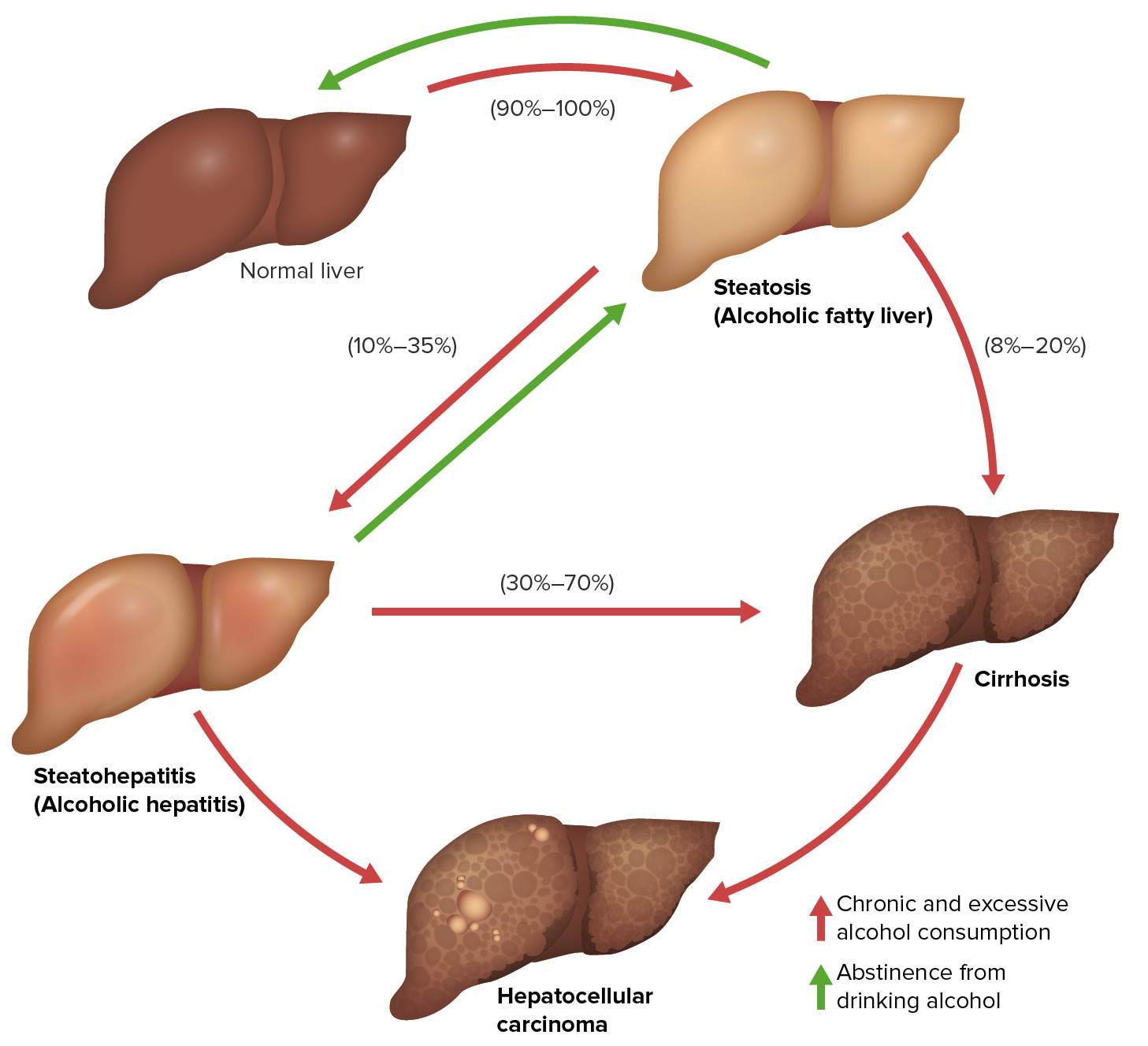
Tres etapas de la enfermedad hepática alcohólica

Las 3 etapas de la enfermedad hepática alcohólica:
Estas 3 etapas de la enfermedad hepática alcohólica pueden superponerse y no necesariamente ocurren en secuencia: hígado graso alcohólico (reversible), hepatitis alcohólica (reversible si se suspende el alcohol) y cirrosis relacionada con el alcohol (irreversible). También son factores de riesgo para desarrollar carcinoma hepatocelular.
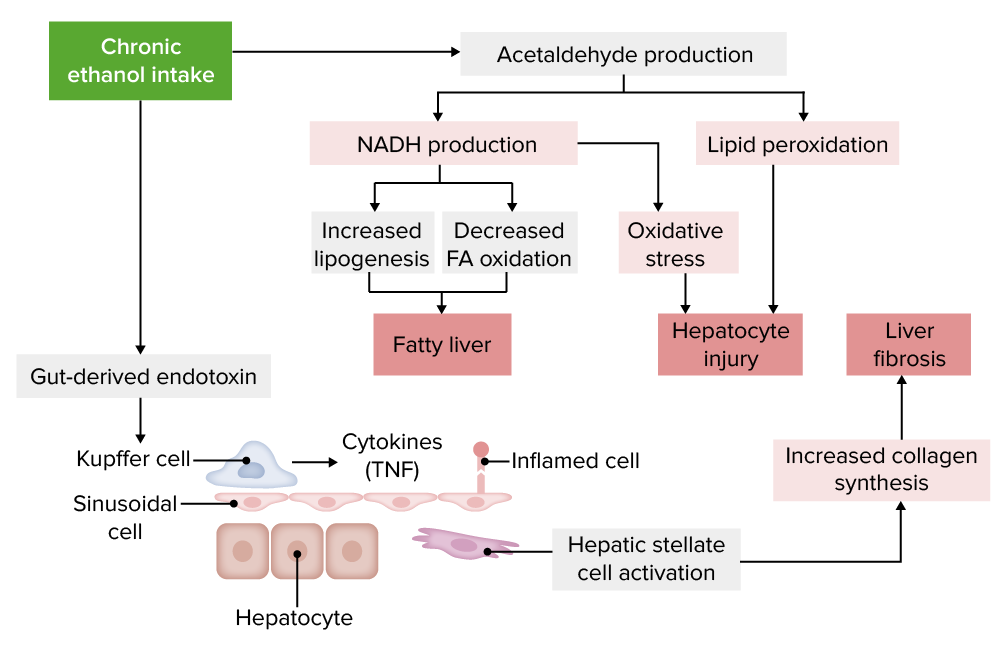
Imagen por Lecturio.

Epidemiología

  • La prevalencia del trastorno por consumo de alcohol en EN Erythema nodosum is an immune-mediated panniculitis (inflammation of the subcutaneous fat) caused by a type IV (delayed-type) hypersensitivity reaction. It commonly manifests in young women as tender, erythematous nodules on the shins. Erythema Nodosum los LOS Neisseria Estados Unidos es del 18%.
  • Es la 2da causa más común de cirrosis en EN Erythema nodosum is an immune-mediated panniculitis (inflammation of the subcutaneous fat) caused by a type IV (delayed-type) hypersensitivity reaction. It commonly manifests in young women as tender, erythematous nodules on the shins. Erythema Nodosum los LOS Neisseria Estados Unidos.
  • La prevalencia de la enfermedad del hígado graso alcohólico es del 4% en EN Erythema nodosum is an immune-mediated panniculitis (inflammation of the subcutaneous fat) caused by a type IV (delayed-type) hypersensitivity reaction. It commonly manifests in young women as tender, erythematous nodules on the shins. Erythema Nodosum los LOS Neisseria Estados Unidos.
  • La hepatitis alcohólica se desarrolla en EN Erythema nodosum is an immune-mediated panniculitis (inflammation of the subcutaneous fat) caused by a type IV (delayed-type) hypersensitivity reaction. It commonly manifests in young women as tender, erythematous nodules on the shins. Erythema Nodosum alrededor del 35% de los LOS Neisseria alcohólicos.
  • Alrededor de 15%–20% de los LOS Neisseria bebedores empedernidos desarrollarán cirrosis.
  • La edad de presentación suele ser antes de los LOS Neisseria 60 años.
  • Alta tasa de mortalidad en EN Erythema nodosum is an immune-mediated panniculitis (inflammation of the subcutaneous fat) caused by a type IV (delayed-type) hypersensitivity reaction. It commonly manifests in young women as tender, erythematous nodules on the shins. Erythema Nodosum la enfermedad hepática alcohólica grave: si no se trata → 45% en EN Erythema nodosum is an immune-mediated panniculitis (inflammation of the subcutaneous fat) caused by a type IV (delayed-type) hypersensitivity reaction. It commonly manifests in young women as tender, erythematous nodules on the shins. Erythema Nodosum 1 mes

Etiología

  • El principal factor causal es el consumo excesivo de alcohol:
    • Hombres: > 40 g/día
    • Mujeres: > 20 g/día
  • Los LOS Neisseria factores de riesgo para el desarrollo de la enfermedad hepática alcohólica incluyen:
    • Mujeres con mayor susceptibilidad
    • Infección por el virus Virus Viruses are infectious, obligate intracellular parasites composed of a nucleic acid core surrounded by a protein capsid. Viruses can be either naked (non-enveloped) or enveloped. The classification of viruses is complex and based on many factors, including type and structure of the nucleoid and capsid, the presence of an envelope, the replication cycle, and the host range. Virology de la hepatitis C Hepatitis C Hepatitis C is an infection of the liver caused by the hepatitis C virus (HCV). The infection can be transmitted through infectious blood or body fluids and may be transmitted during childbirth or through IV drug use or sexual intercourse. Hepatitis C virus can cause both acute and chronic hepatitis, ranging from a mild to a serious, lifelong illness including liver cirrhosis and hepatocellular carcinoma (HCC). Hepatitis C Virus ( HCV HCV Hepatitis C is an infection of the liver caused by the hepatitis C virus (HCV). Hepatitis C virus is an RNA virus and a member of the genus Hepacivirus and the family Flaviviridae. The infection can be transmitted through infectious blood or body fluids and may be transmitted during childbirth or through IV drug use or sexual intercourse. Hepatitis C Virus, por sus siglas en EN Erythema nodosum is an immune-mediated panniculitis (inflammation of the subcutaneous fat) caused by a type IV (delayed-type) hypersensitivity reaction. It commonly manifests in young women as tender, erythematous nodules on the shins. Erythema Nodosum inglés)
    • Obesidad y enfermedad del hígado graso no alcohólico
    • Dieta alta en EN Erythema nodosum is an immune-mediated panniculitis (inflammation of the subcutaneous fat) caused by a type IV (delayed-type) hypersensitivity reaction. It commonly manifests in young women as tender, erythematous nodules on the shins. Erythema Nodosum grasas
    • Tabaquismo
    • Diabetes Diabetes Diabetes mellitus (DM) is a metabolic disease characterized by hyperglycemia and dysfunction of the regulation of glucose metabolism by insulin. Type 1 DM is diagnosed mostly in children and young adults as the result of autoimmune destruction of β cells in the pancreas and the resulting lack of insulin. Type 2 DM has a significant association with obesity and is characterized by insulin resistance. Diabetes Mellitus

Fisiopatología

Metabolismo del etanol

  • Existen múltiples vías, pero la principal es la vía del acetaldehído:
    • Se generan acetaldehído y nicotinamida adenina dinucleótido reducida ( NAD NAD+ A coenzyme composed of ribosylnicotinamide 5′-diphosphate coupled to adenosine 5′-phosphate by pyrophosphate linkage. It is found widely in nature and is involved in numerous enzymatic reactions in which it serves as an electron carrier by being alternately oxidized (NAD+) and reduced (NADH). Pentose Phosphate Pathway+).
    • El acetaldehído se metaboliza a acetato por la acetaldehído deshidrogenasa.
    • La acetaldehído deshidrogenasa tiene múltiples isoformas con diferentes niveles de actividad.
    • La acumulación de acetaldehído es 1 factor responsable de la lesión hepática.
  • Con el consumo excesivo de alcohol, el citocromo P450 microsomal juega un papel en EN Erythema nodosum is an immune-mediated panniculitis (inflammation of the subcutaneous fat) caused by a type IV (delayed-type) hypersensitivity reaction. It commonly manifests in young women as tender, erythematous nodules on the shins. Erythema Nodosum el metabolismo:
    • Las especies reactivas de oxígeno se forman en EN Erythema nodosum is an immune-mediated panniculitis (inflammation of the subcutaneous fat) caused by a type IV (delayed-type) hypersensitivity reaction. It commonly manifests in young women as tender, erythematous nodules on the shins. Erythema Nodosum esta vía.
    • Contribuyen al AL Amyloidosis daño oxidativo en EN Erythema nodosum is an immune-mediated panniculitis (inflammation of the subcutaneous fat) caused by a type IV (delayed-type) hypersensitivity reaction. It commonly manifests in young women as tender, erythematous nodules on the shins. Erythema Nodosum la enfermedad hepática alcohólica
  • El metabolismo del alcohol provoca:
    • Hipoxia relativa en EN Erythema nodosum is an immune-mediated panniculitis (inflammation of the subcutaneous fat) caused by a type IV (delayed-type) hypersensitivity reaction. It commonly manifests in young women as tender, erythematous nodules on the shins. Erythema Nodosum la zona III del hígado (cerca de las venas centrales; poco oxigenada) > zona I (alrededor de los LOS Neisseria espacios porta por donde entra la sangre oxigenada)
    • Necrosis Necrosis The death of cells in an organ or tissue due to disease, injury or failure of the blood supply. Ischemic Cell Damage y esclerosis de la vena hepática
  • El alcohol aumenta la permeabilidad intestinal:
    • Translocación bacteriana
    • Niveles elevados de endotoxina en EN Erythema nodosum is an immune-mediated panniculitis (inflammation of the subcutaneous fat) caused by a type IV (delayed-type) hypersensitivity reaction. It commonly manifests in young women as tender, erythematous nodules on the shins. Erythema Nodosum la sangre
    • La endotoxina provoca la activación de citocinas inflamatorias y contribuye a la inflamación del parénquima hepático.

Cambios histopatológicos

  • Etapa de esteatosis:
    • El aumento de NAD NAD+ A coenzyme composed of ribosylnicotinamide 5′-diphosphate coupled to adenosine 5′-phosphate by pyrophosphate linkage. It is found widely in nature and is involved in numerous enzymatic reactions in which it serves as an electron carrier by being alternately oxidized (NAD+) and reduced (NADH). Pentose Phosphate Pathway+ disminuye el suministro de adenosin trifosfato (ATP, por sus siglas en EN Erythema nodosum is an immune-mediated panniculitis (inflammation of the subcutaneous fat) caused by a type IV (delayed-type) hypersensitivity reaction. It commonly manifests in young women as tender, erythematous nodules on the shins. Erythema Nodosum inglés) al AL Amyloidosis hígado, lo que afecta la lipólisis.
    • Los LOS Neisseria ácidos grasos y los LOS Neisseria triglicéridos se acumulan en EN Erythema nodosum is an immune-mediated panniculitis (inflammation of the subcutaneous fat) caused by a type IV (delayed-type) hypersensitivity reaction. It commonly manifests in young women as tender, erythematous nodules on the shins. Erythema Nodosum el hígado.
    • Hepatocitos inflamados (macrovesículas)
    • Infiltración grasa en EN Erythema nodosum is an immune-mediated panniculitis (inflammation of the subcutaneous fat) caused by a type IV (delayed-type) hypersensitivity reaction. It commonly manifests in young women as tender, erythematous nodules on the shins. Erythema Nodosum hepatocitos cercanos a las vénulas
    • Puede desarrollarse dentro de los LOS Neisseria 2 días posteriores al AL Amyloidosis consumo excesivo de etanol
    • Se resuelve dentro de las 2 semanas posteriores a la interrupción del alcohol
  • Etapa de hepatitis:
    • Generación de citoquinas inflamatorias
    • Infiltración lobulillar de polimorfonucleares
    • Degeneración balonizante de los LOS Neisseria hepatocitos
    • Cuerpos de Mallory (agregados eosinofílicos intracelulares que representan depósitos hialinos)
    • Necrosis Necrosis The death of cells in an organ or tissue due to disease, injury or failure of the blood supply. Ischemic Cell Damage hepatocelular
    • La inflamación conduce a la activación de las células estrelladas y fibrosis Fibrosis Any pathological condition where fibrous connective tissue invades any organ, usually as a consequence of inflammation or other injury. Bronchiolitis Obliterans pericelular.
  • Etapa de cirrosis:
    • Fibrosis Fibrosis Any pathological condition where fibrous connective tissue invades any organ, usually as a consequence of inflammation or other injury. Bronchiolitis Obliterans perivenular (depósito de colágeno cerca de la vena hepática y los LOS Neisseria sinusoides)
    • La lesión y la regeneración continuas conducen a la formación de nódulos regenerativos.
    • El daño generalmente es irreversible.
    • La fibrosis Fibrosis Any pathological condition where fibrous connective tissue invades any organ, usually as a consequence of inflammation or other injury. Bronchiolitis Obliterans progresiva conduce a la obstrucción del flujo sanguíneo portal normal y al AL Amyloidosis desarrollo de hipertensión portal.
Pathophysiology of alcoholic liver disease

Fisiopatología de la enfermedad hepática alcohólica:
AF: ácido graso; TNF: factor de necrosis tumoral
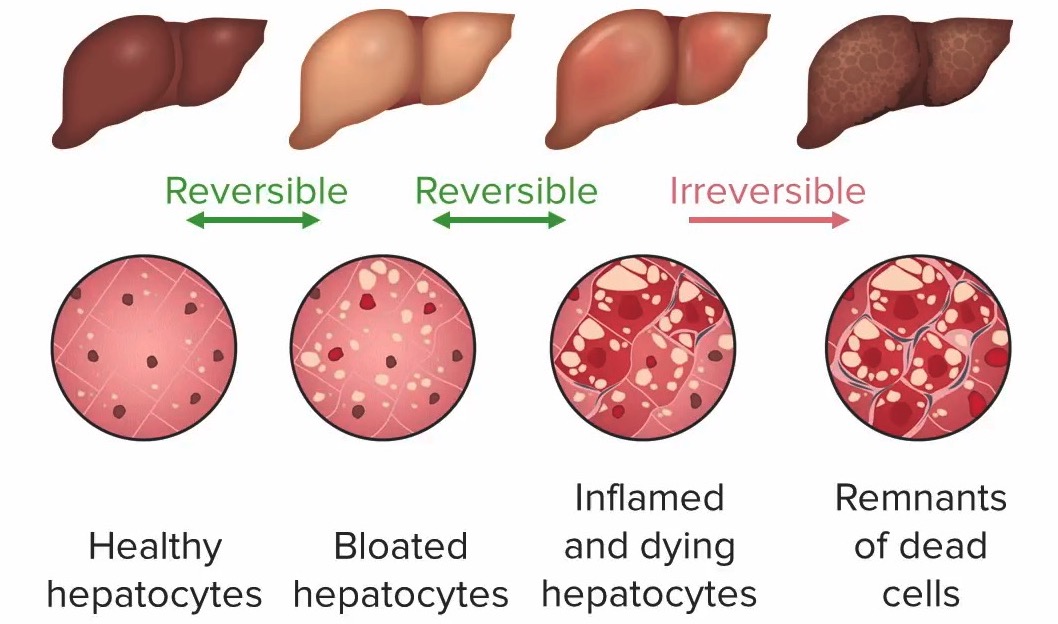
Imagen por Lecturio.
Progresión de la enfermedad hepática alcohólica

Progresión del daño hepático en la enfermedad hepática alcohólica (de izquierda a derecha):
1. Hepatocitos sanos (sin daño hepático)
2. Hepatocitos abultados con esteatosis (distendidos por gotas de grasa), sin inflamación: esteatosis (daño hepático aún reversible)
3. Hepatocitos inflamados y moribundos, posible fibrosis: hepatitis (daño hepático aún reversible)
4. Células muertas: cirrosis (daño hepático irreversible)
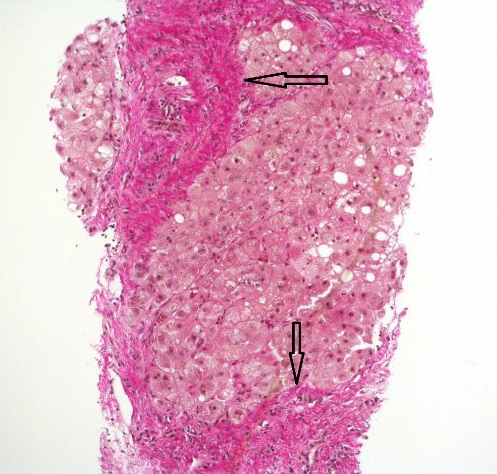
Imagen por Lecturio.
Histopathology of steatohepatitis with established cirrhosis

Esteatohepatitis con cirrosis establecida; bandas gruesas de fibrosis (flechas) que rodean un nódulo de hepatocitos

Imagen: “Hematoxylin and Van Gieson’s stain” por Alexander Boyd et al. Licencia: CC BY 4.0
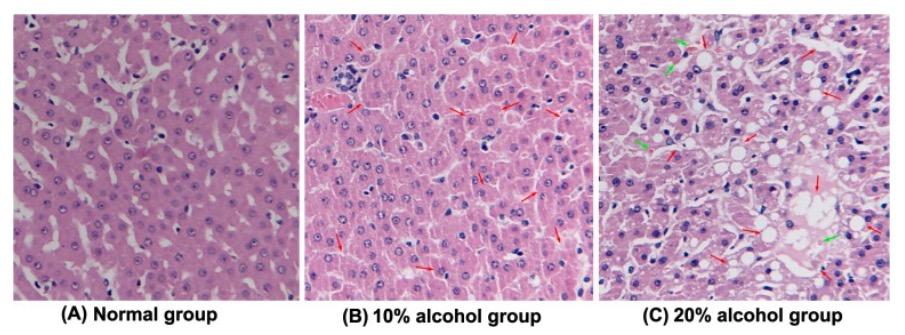
Representative histological feature of liver sections ALD

Esteatosis inducida por alcohol (características histológicas en secciones de hígado):
(A): grupo control normal
(B): hígado graso inducido por alcohol al 10% con macrovesículas (indicadas por una punta de flecha) de hepatocitos
(C): hígado graso inducido por alcohol al 20% con macrovesículas (indicadas por una flecha roja) de hepatocitos clasificados como altos en el grupo de enfermedad de hígado graso alcohólico. La flecha verde representa la formación de cuerpos de Mallory.
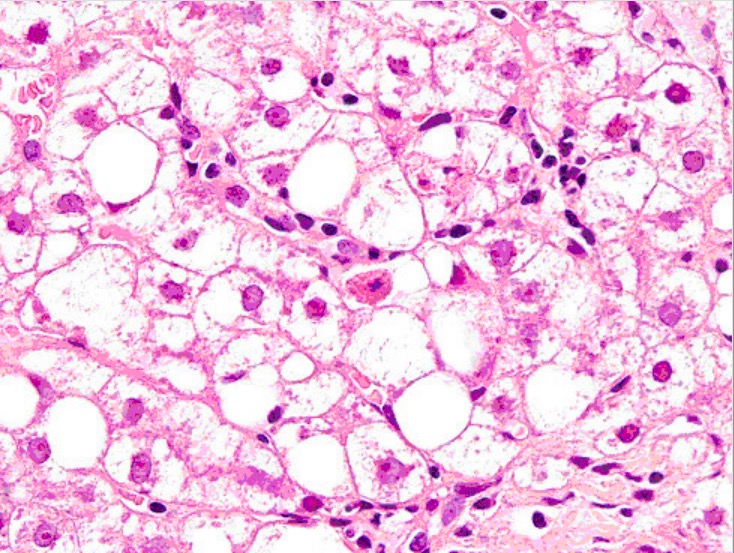
Imagen: “Representative histological feature of liver sections” por College of Veterinary Medicine, South China Agricultural University, Guangzhou, Guangdong Province, PR China. Licencia: CC BY 4.0
Liver biopsy showing signs of toxic-metabolic disorder

Biopsia hepática que muestra cuerpos de Mallory, esteatosis de gotas grandes y neutrófilos

Imagen: “Liver biopsy” por Institute of Infectious and Tropical Diseases, University of Brescia, Italy. Licencia: CC BY 2.0
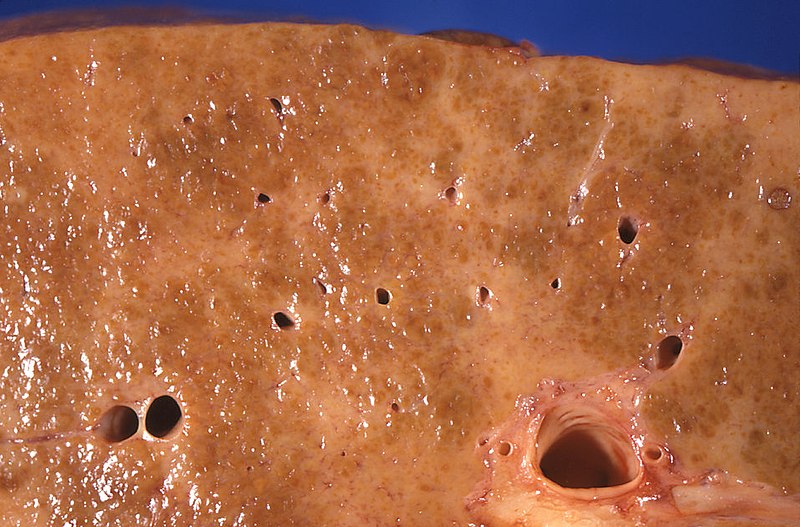
Pathology of alcoholic liver cirrhosis

Patología macroscópica de la cirrosis hepática alcohólica: la superficie de corte muestra áreas con palidez difusa debido a una densa red de tejido cicatricial.

Imagen: “Gross pathology of alcoholic liver cirrhosis” por Centers for Disease Control and Prevention/Dr. Edwin P. Ewing, Jr. Licencia: CC0 1.0
Presentación Clínica

Esteatosis alcohólica (hígado graso)

  • Asintomático
  • Puede tener molestias abdominales vagas
  • Hepatomegalia al AL Amyloidosis examen

Hepatitis alcohólica

  • Fiebre leve
  • Pérdida de apetito, náuseas
  • Molestias en EN Erythema nodosum is an immune-mediated panniculitis (inflammation of the subcutaneous fat) caused by a type IV (delayed-type) hypersensitivity reaction. It commonly manifests in young women as tender, erythematous nodules on the shins. Erythema Nodosum cuadrante superior derecho
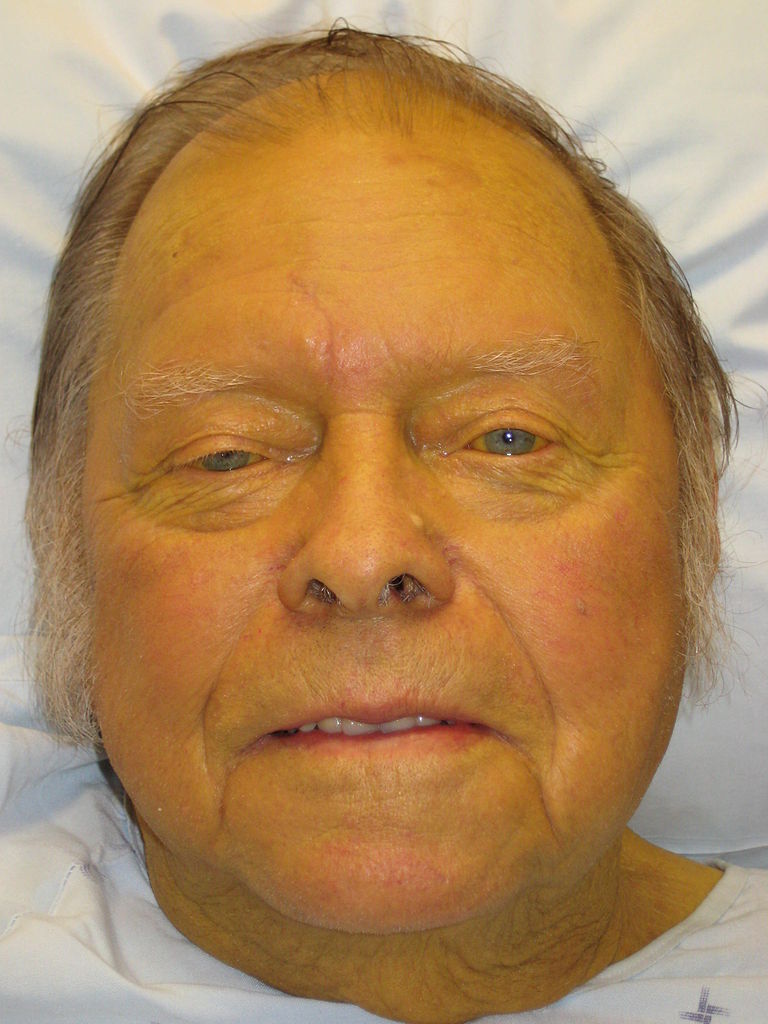
  • Ictericia
  • Hepatomegalia
  • Hipertensión portal → ascitis
  • Letargo, confusión (por encefalopatía hepática)

Cirrosis alcohólica

  • Fatiga, malestar
  • Pérdida de peso
  • Ictericia e ictericia escleral (por hiperbilirrubinemia)
  • Prurito (depósito de sales biliares en EN Erythema nodosum is an immune-mediated panniculitis (inflammation of the subcutaneous fat) caused by a type IV (delayed-type) hypersensitivity reaction. It commonly manifests in young women as tender, erythematous nodules on the shins. Erythema Nodosum la piel)
  • Encefalopatía hepática:
    • Asterixis Asterixis Hepatic Encephalopathy
    • Letargo
    • Confusión
    • Coma Coma Coma is defined as a deep state of unarousable unresponsiveness, characterized by a score of 3 points on the GCS. A comatose state can be caused by a multitude of conditions, making the precise epidemiology and prognosis of coma difficult to determine. Coma
  • Ascitis (debido a hipertensión portal y disminución de albúmina)
  • Hemorragia digestiva alta (várices esofágicas por hipertensión portal)
  • Cambios en EN Erythema nodosum is an immune-mediated panniculitis (inflammation of the subcutaneous fat) caused by a type IV (delayed-type) hypersensitivity reaction. It commonly manifests in young women as tender, erythematous nodules on the shins. Erythema Nodosum la piel:
    • Telangiectasias Telangiectasias Ataxia-telangiectasia
    • Cabeza de medusa (dilatación de las venas periumbilicales)
    • Eritema palmar periférico
    • Dedos en EN Erythema nodosum is an immune-mediated panniculitis (inflammation of the subcutaneous fat) caused by a type IV (delayed-type) hypersensitivity reaction. It commonly manifests in young women as tender, erythematous nodules on the shins. Erythema Nodosum palillo de tambor
  • Contractura de Dupuytren (deformidades en EN Erythema nodosum is an immune-mediated panniculitis (inflammation of the subcutaneous fat) caused by a type IV (delayed-type) hypersensitivity reaction. It commonly manifests in young women as tender, erythematous nodules on the shins. Erythema Nodosum flexión de los LOS Neisseria dedos por engrosamiento y acortamiento de la fascia Fascia Layers of connective tissue of variable thickness. The superficial fascia is found immediately below the skin; the deep fascia invests muscles, nerves, and other organs. Cellulitis palmar)
  • Hiperestrogenismo:
    • Ginecomastia
    • Hipogonadismo (atrofia testicular)
    • Líbido reducida
    • Disfunción eréctil
    • Esterilidad
    • Amenorrea
  • Alopecia Alopecia Alopecia is the loss of hair in areas anywhere on the body where hair normally grows. Alopecia may be defined as scarring or non-scarring, localized or diffuse, congenital or acquired, reversible or permanent, or confined to the scalp or universal; however, alopecia is usually classified using the 1st 3 factors. Alopecia
  • Lengua lisa debido a 1 o más deficiencias nutricionales (hierro, folato, vitamina B12)

Puntuaciones de Diagnóstico y Gravedad

Antecedentes

  • Consumo de alcohol (duración, cantidad y frecuencia)
  • Pregunte por otras posibles causas:
    • Trastornos hereditarios (hemocromatosis, enfermedad de Wilson, deficiencia de alfa-1 antitripsina)
    • Hepatitis viral (uso de drogas por vía intravenosa)
    • Medicamentos (e.g., uso excesivo de paracetamol paracetamol Acetaminophen is an over-the-counter nonopioid analgesic and antipyretic medication and the most commonly used analgesic worldwide. Despite the widespread use of acetaminophen, its mechanism of action is not entirely understood. Acetaminophen)
  • Síntomas constitucionales:
    • Fiebre, malestar
    • Pérdida de peso
    • Anorexia Anorexia The lack or loss of appetite accompanied by an aversion to food and the inability to eat. It is the defining characteristic of the disorder anorexia nervosa. Anorexia Nervosa
  • Síntomas gastrointestinales:
    • Dolor Dolor Inflammation en EN Erythema nodosum is an immune-mediated panniculitis (inflammation of the subcutaneous fat) caused by a type IV (delayed-type) hypersensitivity reaction. It commonly manifests in young women as tender, erythematous nodules on the shins. Erythema Nodosum cuadrante superior derecho
    • Náuseas/vómitos
    • Diarrea

Examen físico

  • General:
    • Ictericia, ictericia escleral
    • Cambios característicos de la piel cirrótica
  • Abdominal:
    • Hepato o esplenomegalia
    • Distensión abdominal (por ascitis)
    • Dolor Dolor Inflammation en EN Erythema nodosum is an immune-mediated panniculitis (inflammation of the subcutaneous fat) caused by a type IV (delayed-type) hypersensitivity reaction. It commonly manifests in young women as tender, erythematous nodules on the shins. Erythema Nodosum cuadrante superior derecho

Estudios de laboratorio

  • Enfermedad del hígado graso alcohólico:
    • AST AST Enzymes of the transferase class that catalyze the conversion of l-aspartate and 2-ketoglutarate to oxaloacetate and l-glutamate. Liver Function Tests > ↑ ALT ALT An enzyme that catalyzes the conversion of l-alanine and 2-oxoglutarate to pyruvate and l-glutamate. Liver Function Tests
    • GGT GGT An enzyme, sometimes called ggt, with a key role in the synthesis and degradation of glutathione; (gsh, a tripeptide that protects cells from many toxins). It catalyzes the transfer of the gamma-glutamyl moiety to an acceptor amino acid. Alcoholic Liver Disease (gamma glutamil transferasa)
  • Hepatitis alcohólica:
    • Relación AST AST Enzymes of the transferase class that catalyze the conversion of l-aspartate and 2-ketoglutarate to oxaloacetate and l-glutamate. Liver Function Tests/ ALT ALT An enzyme that catalyzes the conversion of l-alanine and 2-oxoglutarate to pyruvate and l-glutamate. Liver Function Tests 2: un marcador muy específico de la enfermedad hepática alcohólica
    • AST AST Enzymes of the transferase class that catalyze the conversion of l-aspartate and 2-ketoglutarate to oxaloacetate and l-glutamate. Liver Function Tests o ALT ALT An enzyme that catalyzes the conversion of l-alanine and 2-oxoglutarate to pyruvate and l-glutamate. Liver Function Tests moderadamente elevadas, pero rara vez superior a 500
    • ↑ Fosfatasa alcalina y GGT GGT An enzyme, sometimes called ggt, with a key role in the synthesis and degradation of glutathione; (gsh, a tripeptide that protects cells from many toxins). It catalyzes the transfer of the gamma-glutamyl moiety to an acceptor amino acid. Alcoholic Liver Disease
    • ↑ Bilirrubina
    • ↓ Albúmina
    • ↑ Tiempo de protrombina (TP), índice internacional normalizado (INR, por sus siglas en EN Erythema nodosum is an immune-mediated panniculitis (inflammation of the subcutaneous fat) caused by a type IV (delayed-type) hypersensitivity reaction. It commonly manifests in young women as tender, erythematous nodules on the shins. Erythema Nodosum inglés) y tiempo de tromboplastina parcial ( TTP TTP Thrombotic thrombocytopenic purpura (TTP) is a life-threatening condition due to either a congenital or an acquired deficiency of adamts-13, a metalloproteinase that cleaves multimers of von Willebrand factor (vWF). The large multimers then aggregate excessive platelets resulting in microvascular thrombosis and an increase in consumption of platelets. Thrombotic Thrombocytopenic Purpura)
    • Anemia Anemia Anemia is a condition in which individuals have low Hb levels, which can arise from various causes. Anemia is accompanied by a reduced number of RBCs and may manifest with fatigue, shortness of breath, pallor, and weakness. Subtypes are classified by the size of RBCs, chronicity, and etiology. Anemia: Overview and Types macrocítica
    • Leucocitosis neutrofílica
  • Cirrosis alcohólica:
    • AST AST Enzymes of the transferase class that catalyze the conversion of l-aspartate and 2-ketoglutarate to oxaloacetate and l-glutamate. Liver Function Tests > ALT ALT An enzyme that catalyzes the conversion of l-alanine and 2-oxoglutarate to pyruvate and l-glutamate. Liver Function Tests: generalmente elevación modesta
    • ↑ Bilirrubina
    • GGT GGT An enzyme, sometimes called ggt, with a key role in the synthesis and degradation of glutathione; (gsh, a tripeptide that protects cells from many toxins). It catalyzes the transfer of the gamma-glutamyl moiety to an acceptor amino acid. Alcoholic Liver Disease
    • ↑ Fosfatasa alcalina (< 2–3 veces el valor normal)
    • ↑ Amoníaco
    • ↓ Proteína total (↓ albúmina)
    • ↑ TP
    • ↓ Plaquetas
    • Anemia Anemia Anemia is a condition in which individuals have low Hb levels, which can arise from various causes. Anemia is accompanied by a reduced number of RBCs and may manifest with fatigue, shortness of breath, pallor, and weakness. Subtypes are classified by the size of RBCs, chronicity, and etiology. Anemia: Overview and Types
    • Hiponatremia

Imagenología

  • Ultrasonido:
    • Esteatosis:
      • Hepatomegalia
      • ↑ Ecogenicidad hepática
    • Hepatitis:
      • Ecogenicidad difusa debido al AL Amyloidosis aumento de la deposición de grasa
      • Hepatomegalia
      • Edema Edema Edema is a condition in which excess serous fluid accumulates in the body cavity or interstitial space of connective tissues. Edema is a symptom observed in several medical conditions. It can be categorized into 2 types, namely, peripheral (in the extremities) and internal (in an organ or body cavity). Edema cerca de la tríada portal
    • Cirrosis:
      • Ecogenicidad con áreas irregulares
      • Atrofia del lóbulo derecho
      • Hipertrofia de los LOS Neisseria lóbulos izquierdo y caudado
      • Hígado nodular encogido en EN Erythema nodosum is an immune-mediated panniculitis (inflammation of the subcutaneous fat) caused by a type IV (delayed-type) hypersensitivity reaction. It commonly manifests in young women as tender, erythematous nodules on the shins. Erythema Nodosum cirrosis avanzada
      • Ascitis
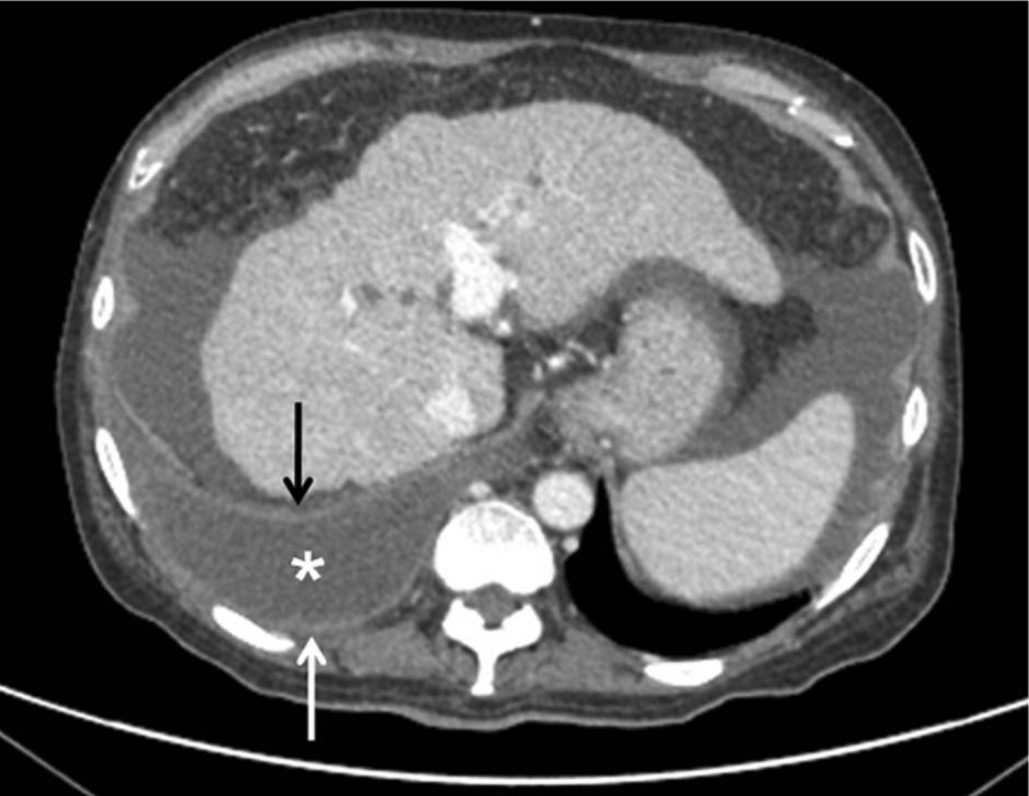
  • Tomografía computarizada (TC):
    • Proporciona la misma información que el ultrasonido
    • Puede mostrar hígado nodular, atrofia del lóbulo derecho, hipertrofia del lóbulo izquierdo, ascitis
    • Utilizada para descartar carcinoma hepatocelular
Empiema bacteriano subagudo Tomografía computarizada que muestra cirrosis

Cirrosis hepática con empiema concomitante (asterisco y flechas):
El hígado parece nodular, irregular y encogido (observe la ascitis abdominal).

Imagen: “Subacute bacterial empyema” por Department of Pulmonary Medicine, Institute of Liver and Biliary Sciences, New Delhi, India. Licencia: CC BY 4.0

Biopsia hepática

  • Estándar de oro para la cirrosis
  • No es necesaria si el cuadro clínico y los LOS Neisseria estudios de laboratorio son convincentes
  • Se puede realizar con abordaje percutáneo, transyugular o laparoscópico

Puntuaciones de gravedad de la enfermedad

Función discriminante de Maddrey:

  • Estima la gravedad de la enfermedad y el riesgo de mortalidad por hepatitis alcohólica
  • Calculado a partir de la bilirrubina sérica y el TP
  • Función discriminante ≥ 32:
    • Alta mortalidad a corto plazo
    • Puede beneficiarse de los LOS Neisseria glucocorticoides

Puntuación para hepatitis alcohólica de Glasgow:

  • Según la edad, bilirrubina sérica, nitrógeno de urea Urea A compound formed in the liver from ammonia produced by the deamination of amino acids. It is the principal end product of protein catabolism and constitutes about one half of the total urinary solids. Urea Cycle (BUN, por sus siglas en EN Erythema nodosum is an immune-mediated panniculitis (inflammation of the subcutaneous fat) caused by a type IV (delayed-type) hypersensitivity reaction. It commonly manifests in young women as tender, erythematous nodules on the shins. Erythema Nodosum inglés), TP y recuento de leucocitos
  • Una puntuación para hepatitis alcohólica de Glasgow ≥ 9 es predictiva de mortalidad.

Modelo para la puntuación de enfermedad hepática en EN Erythema nodosum is an immune-mediated panniculitis (inflammation of the subcutaneous fat) caused by a type IV (delayed-type) hypersensitivity reaction. It commonly manifests in young women as tender, erythematous nodules on the shins. Erythema Nodosum etapa terminal:

  • Predice la supervivencia en EN Erythema nodosum is an immune-mediated panniculitis (inflammation of the subcutaneous fat) caused by a type IV (delayed-type) hypersensitivity reaction. It commonly manifests in young women as tender, erythematous nodules on the shins. Erythema Nodosum la cirrosis, pero también puede usarse para la hepatitis alcohólica.
  • Basado en EN Erythema nodosum is an immune-mediated panniculitis (inflammation of the subcutaneous fat) caused by a type IV (delayed-type) hypersensitivity reaction. It commonly manifests in young women as tender, erythematous nodules on the shins. Erythema Nodosum bilirrubina sérica, creatinina, INR y sodio (Na+) sérico
  • Rango de escala: 6–40

Tratamiento

Esteatosis hepática

  • Abandonar el consumo de alcohol
  • Dieta saludable

Hepatitis alcohólica

Hepatitis leve a moderada:

  • Abandonar el consumo de alcohol:
    • Disulfiram, naltrexona, acamprosato
    • Remisión a Alcohólicos Anónimos
  • Hidratación y corrección de electrolitos
  • Suplementos nutricionales (especialmente tiamina)
  • Tratar cualquier infección concomitante de hepatitis B Hepatitis B Hepatitis B virus (HBV) is a partially double-stranded DNA virus, which belongs to the Orthohepadnavirus genus and the Hepadnaviridae family. Most individuals with acute HBV infection are asymptomatic or have mild, self-limiting symptoms. Chronic infection can be asymptomatic or create hepatic inflammation, leading to liver cirrhosis and hepatocellular carcinoma (HCC). Hepatitis B Virus ( HBV HBV Hepatitis B virus (HBV) is a partially double-stranded DNA virus, which belongs to the Orthohepadnavirus genus and the Hepadnaviridae family. Hepatitis B virus is transmitted by exposure to infectious blood or body fluids. Examples of types of exposure include sexual intercourse, IV drug use, and childbirth. Hepatitis B Virus, por sus siglas en EN Erythema nodosum is an immune-mediated panniculitis (inflammation of the subcutaneous fat) caused by a type IV (delayed-type) hypersensitivity reaction. It commonly manifests in young women as tender, erythematous nodules on the shins. Erythema Nodosum inglés) o HCV HCV Hepatitis C is an infection of the liver caused by the hepatitis C virus (HCV). Hepatitis C virus is an RNA virus and a member of the genus Hepacivirus and the family Flaviviridae. The infection can be transmitted through infectious blood or body fluids and may be transmitted during childbirth or through IV drug use or sexual intercourse. Hepatitis C Virus.

Hepatitis severa:

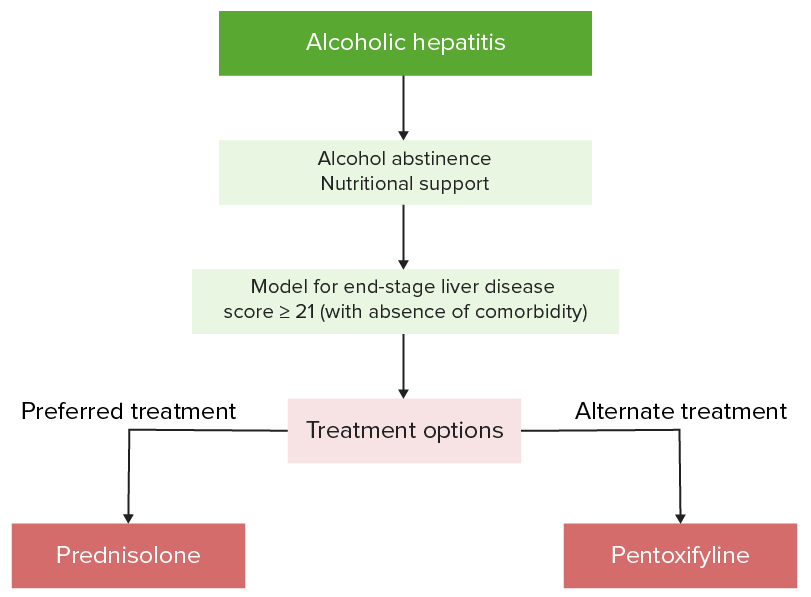
  • Modelo para puntuación de enfermedad hepática en EN Erythema nodosum is an immune-mediated panniculitis (inflammation of the subcutaneous fat) caused by a type IV (delayed-type) hypersensitivity reaction. It commonly manifests in young women as tender, erythematous nodules on the shins. Erythema Nodosum etapa terminal > 21
  • Medidas utilizadas para la hepatitis leve a moderada + terapia farmacológica:
    • Glucocorticoides:
      • Prednisolona
      • El objetivo es reducir los LOS Neisseria cambios inflamatorios en EN Erythema nodosum is an immune-mediated panniculitis (inflammation of the subcutaneous fat) caused by a type IV (delayed-type) hypersensitivity reaction. It commonly manifests in young women as tender, erythematous nodules on the shins. Erythema Nodosum los LOS Neisseria hepatocitos.
    • Pentoxifilina (para pacientes con contraindicaciones a los LOS Neisseria esteroides):
      • Hemorragia gastrointestinal activa
      • Pancreatitis Pancreatitis Inflammation of the pancreas. Pancreatitis is classified as acute unless there are computed tomographic or endoscopic retrograde cholangiopancreatographic findings of chronic pancreatitis. The two most common forms of acute pancreatitis are alcoholic pancreatitis and gallstone pancreatitis. Acute Pancreatitis severa
      • Infección activa
      • Insuficiencia renal
Algoritmo de abordaje y manejo de la hepatitis alcohólica

Algoritmo de manejo o hepatitis alcohólica

Imagen por Lecturio.

Cirrosis

  • Tratamiento de soporte similar a la hepatitis alcohólica
  • Varices esofágicas:
    • Los LOS Neisseria pacientes deben ser examinados con endoscopia digestiva superior.
    • La profilaxis de la hemorragia tiene como objetivo reducir la hipertensión portal:
      • Betabloqueadores
      • Derivaciones intrahepáticas transyugulares
  • Tratamiento sintomático de la ascitis:
    • Restricción de sal, restricción de agua
    • Diuréticos
    • Paracentesis Paracentesis A procedure in which fluid is withdrawn from a body cavity or organ via a trocar and cannula, needle, or other hollow instrument. Portal Hypertension terapéutica
  • Encefalopatía hepática:
    • Restringir la ingesta de proteínas.
    • Lactulosa oral
    • Neomicina oral
  • Vigilancia para carcinoma hepatocelular
  • El trasplante de hígado está indicado para:
    • Fracaso del tratamiento médico
    • Modelo para puntuación de enfermedad hepática en EN Erythema nodosum is an immune-mediated panniculitis (inflammation of the subcutaneous fat) caused by a type IV (delayed-type) hypersensitivity reaction. It commonly manifests in young women as tender, erythematous nodules on the shins. Erythema Nodosum etapa terminal > 20
    • Solo para pacientes que han estado en EN Erythema nodosum is an immune-mediated panniculitis (inflammation of the subcutaneous fat) caused by a type IV (delayed-type) hypersensitivity reaction. It commonly manifests in young women as tender, erythematous nodules on the shins. Erythema Nodosum abstinencia

Pronóstico

  • 10%–20% de los LOS Neisseria pacientes con hepatitis alcohólica progresan a cirrosis cada año.
  • El 10% de las personas con hepatitis alcohólica retroceden con la abstinencia.
  • La media de supervivencia para la cirrosis compensada (sin complicaciones) es > 12 años.
  • La media de supervivencia en EN Erythema nodosum is an immune-mediated panniculitis (inflammation of the subcutaneous fat) caused by a type IV (delayed-type) hypersensitivity reaction. It commonly manifests in young women as tender, erythematous nodules on the shins. Erythema Nodosum cirrosis con una puntuación del modelo para enfermedad hepática terminal ≥ 21 es ≤ 6 meses.

Diagnóstico Diferencial

  • Enfermedad del hígado graso no alcohólico: se presenta con hallazgos similares a la esteatohepatitis ( los LOS Neisseria mismos resultados de laboratorio y presentación clínica). Una distinción entre la enfermedad del hígado graso alcohólico y no alcohólico solo se puede establecer en EN Erythema nodosum is an immune-mediated panniculitis (inflammation of the subcutaneous fat) caused by a type IV (delayed-type) hypersensitivity reaction. It commonly manifests in young women as tender, erythematous nodules on the shins. Erythema Nodosum función de los LOS Neisseria antecedentes del paciente. El diagnóstico se establece con base en EN Erythema nodosum is an immune-mediated panniculitis (inflammation of the subcutaneous fat) caused by a type IV (delayed-type) hypersensitivity reaction. It commonly manifests in young women as tender, erythematous nodules on the shins. Erythema Nodosum la presentación clínica y los LOS Neisseria estudios de laboratorio. El tratamiento se centra en EN Erythema nodosum is an immune-mediated panniculitis (inflammation of the subcutaneous fat) caused by a type IV (delayed-type) hypersensitivity reaction. It commonly manifests in young women as tender, erythematous nodules on the shins. Erythema Nodosum las modificaciones del estilo de vida.
  • Hepatitis vírica: infección por un virus Virus Viruses are infectious, obligate intracellular parasites composed of a nucleic acid core surrounded by a protein capsid. Viruses can be either naked (non-enveloped) or enveloped. The classification of viruses is complex and based on many factors, including type and structure of the nucleoid and capsid, the presence of an envelope, the replication cycle, and the host range. Virology que provoca una enfermedad hepática aguda. La presentación incluye ictericia, fiebre con hepatomegalia y elevación de transaminasas a menudo > 500. Se puede establecer una mayor diferenciación mediante la detección de antígenos y anticuerpos virales en EN Erythema nodosum is an immune-mediated panniculitis (inflammation of the subcutaneous fat) caused by a type IV (delayed-type) hypersensitivity reaction. It commonly manifests in young women as tender, erythematous nodules on the shins. Erythema Nodosum el suero. El tratamiento se basa en EN Erythema nodosum is an immune-mediated panniculitis (inflammation of the subcutaneous fat) caused by a type IV (delayed-type) hypersensitivity reaction. It commonly manifests in young women as tender, erythematous nodules on the shins. Erythema Nodosum la causa; ciertos tipos se pueden prevenir mediante la vacunación.
  • Hepatitis autoinmune: insuficiencia hepática aguda que se presenta con fatiga, ictericia, hepatomegalia y dolor Dolor Inflammation en EN Erythema nodosum is an immune-mediated panniculitis (inflammation of the subcutaneous fat) caused by a type IV (delayed-type) hypersensitivity reaction. It commonly manifests in young women as tender, erythematous nodules on the shins. Erythema Nodosum el cuadrante superior derecho. La hepatitis inducida por medicamentos debe descartarse mediante los LOS Neisseria antecedentes y la evaluación de laboratorio. La presencia de un anticuerpo anti-músculo liso es un fuerte indicador de hepatitis autoinmune. El paciente es tratado con inmunosupresores.
  • Otras causas de hepatitis (inducida por medicamentos): ictericia, hepatomegalia y molestias en EN Erythema nodosum is an immune-mediated panniculitis (inflammation of the subcutaneous fat) caused by a type IV (delayed-type) hypersensitivity reaction. It commonly manifests in young women as tender, erythematous nodules on the shins. Erythema Nodosum el cuadrante superior derecho presentes después de la ingestión de un medicamento hepatotóxico. La lesión puede ser hepatocelular (transaminasas elevadas) y/o colestática (fosfatasa alcalina elevada). El tratamiento consiste en EN Erythema nodosum is an immune-mediated panniculitis (inflammation of the subcutaneous fat) caused by a type IV (delayed-type) hypersensitivity reaction. It commonly manifests in young women as tender, erythematous nodules on the shins. Erythema Nodosum la eliminación del medicamento causante.

Referencias

  1. Goldberg E., Chopra S. (2021). Cirrhosis in adults: Etiologies, clinical manifestations, and diagnosis. Retrieved February 23, 2021, from https://www.uptodate.com/contents/cirrhosis-in-adults-etiologies-clinical-manifestations-and-diagnosis
  2. Scott L Freidman. (2020). Alcoholic hepatitis: Clinical manifestations and diagnosis. UpToDate. Retrieved February 19, 2021, from https://www.uptodate.com/contents/alcoholic-hepatitis-clinical-manifestations-and-diagnosis
  3. Scott L Freidman. (2020). Management and prognosis of alcoholic hepatitis. UpToDate. Retrieved February 10, 2021, from https://www.uptodate.com/contents/management-and-prognosis-of-alcoholic-hepatitis
  4. Patel R, Mueller M. (2020). Alcoholic Liver Disease. StatPearls Publishing. https://www.ncbi.nlm.nih.gov/books/NBK546632/
  5. Woodley M, Whelan A. (1992). Manual of Medical Therapeutics. 27th Edition; p. 309–322.

¡Crea tu cuenta gratis o inicia una sesión para seguir leyendo!

Regístrate ahora y obtén acceso gratuito a Lecturio con páginas de concepto, videos médicos y cuestionarios para tu educación médica.

User Reviews

Que tengas una sesión de estudio alegre y navideña 🎁 Ahorra 50% en todos los planes >>

Details