Domina Conceptos Médicos

Estudia para la escuela de medicina y tus examenes con Lecturio.

Endoftalmitis

La endoftalmitis es un proceso inflamatorio de las capas internas del ojo, que puede ser infeccioso o estéril. La endoftalmitis infecciosa puede provocar una pérdida de visión irreversible si no se trata rápidamente. Según el modo de entrada de la fuente infecciosa, la endoftalmitis se divide en EN Erythema nodosum is an immune-mediated panniculitis (inflammation of the subcutaneous fat) caused by a type IV (delayed-type) hypersensitivity reaction. It commonly manifests in young women as tender, erythematous nodules on the shins. Erythema Nodosum tipos endógena y exógena. La endoftalmitis exógena se produce a través de la inoculación directa de organismos infecciosos durante la cirugía de cataratas, el traumatismo ocular o la inyección intravítrea. La endoftalmitis endógena es el resultado de una propagación hematógena. La endoftalmitis estéril puede ser el resultado de toxinas o de material del cristalino retenido después de una operación ocular. Las características clínicas varían según el tipo y la evolución de la enfermedad. Las características pueden incluir disminución de la visión, inyección conjuntival, dolor Dolor Inflammation ocular, hipopión y edema Edema Edema is a condition in which excess serous fluid accumulates in the body cavity or interstitial space of connective tissues. Edema is a symptom observed in several medical conditions. It can be categorized into 2 types, namely, peripheral (in the extremities) and internal (in an organ or body cavity). Edema corneal. El diagnóstico depende principalmente de los LOS Neisseria antecedentes y el examen oftalmológico, y el tratamiento se basa en EN Erythema nodosum is an immune-mediated panniculitis (inflammation of the subcutaneous fat) caused by a type IV (delayed-type) hypersensitivity reaction. It commonly manifests in young women as tender, erythematous nodules on the shins. Erythema Nodosum la causa subyacente. La endoftalmitis estéril suele resolverse espontáneamente, mientras que la infecciosa se trata con antimicrobianos (antibióticos o antifúngicos). La vitrectomía puede ser necesaria en EN Erythema nodosum is an immune-mediated panniculitis (inflammation of the subcutaneous fat) caused by a type IV (delayed-type) hypersensitivity reaction. It commonly manifests in young women as tender, erythematous nodules on the shins. Erythema Nodosum caso de enfermedad grave.

Last updated: Dec 15, 2025

Editorial responsibility: Stanley Oiseth, Lindsay Jones, Evelin Maza

Definición y Epidemiología

Definición

La endoftalmitis es un proceso inflamatorio de las cavidades intraoculares (e.g., humor Humor Defense Mechanisms acuoso y/o vítreo) causado generalmente por bacterias u hongos.

Epidemiología

  • La incidencia entre hombres y mujeres es igual.
  • Más común en EN Erythema nodosum is an immune-mediated panniculitis (inflammation of the subcutaneous fat) caused by a type IV (delayed-type) hypersensitivity reaction. It commonly manifests in young women as tender, erythematous nodules on the shins. Erythema Nodosum los LOS Neisseria ancianos y después de la cirugía de cataratas
  • La endoftalmitis exógena es la forma más común:
    • El 60% de los LOS Neisseria casos exógenos se producen después de una cirugía intraocular.
    • Ocurre en EN Erythema nodosum is an immune-mediated panniculitis (inflammation of the subcutaneous fat) caused by a type IV (delayed-type) hypersensitivity reaction. It commonly manifests in young women as tender, erythematous nodules on the shins. Erythema Nodosum el 0,02%-0,2% de las operaciones de cataratas
    • 25%–30% de los LOS Neisseria casos son postraumáticos.
  • Endoftalmitis endógena:
    • Más común en EN Erythema nodosum is an immune-mediated panniculitis (inflammation of the subcutaneous fat) caused by a type IV (delayed-type) hypersensitivity reaction. It commonly manifests in young women as tender, erythematous nodules on the shins. Erythema Nodosum individuos inmunocomprometidos
    • En EN Erythema nodosum is an immune-mediated panniculitis (inflammation of the subcutaneous fat) caused by a type IV (delayed-type) hypersensitivity reaction. It commonly manifests in young women as tender, erythematous nodules on the shins. Erythema Nodosum los LOS Neisseria casos unilaterales, el ojo derecho suele estar más afectado que el izquierdo debido al AL Amyloidosis flujo sanguíneo arterial preferente del lado derecho.
    • Las infecciones por cándida están aumentando en EN Erythema nodosum is an immune-mediated panniculitis (inflammation of the subcutaneous fat) caused by a type IV (delayed-type) hypersensitivity reaction. It commonly manifests in young women as tender, erythematous nodules on the shins. Erythema Nodosum los LOS Neisseria usuarios de drogas intravenosas.
    • Raro (2%–15% de todos los LOS Neisseria casos)

Etiología

Endoftalmitis estéril

  • Complicación de la inyección intravítrea (triamcinolona, anti-factor de crecimiento endotelial vascular, metotrexato)
  • Retención del cristalino nativo después de una operación

Endoftalmitis infecciosa

Exógena:

  • Endoftalmitis postoperatoria de inicio agudo:
    • Ocurre dentro de las 6 semanas posteriores a un procedimiento ocular
    • La cirugía de cataratas es la causa más común.
    • Organismo:
      • Staphylococcus Staphylococcus Staphylococcus is a medically important genera of Gram-positive, aerobic cocci. These bacteria form clusters resembling grapes on culture plates. Staphylococci are ubiquitous for humans, and many strains compose the normal skin flora. Staphylococcus coagulasa-negativo (más común)
      • Staphylococcus aureus Staphylococcus aureus Potentially pathogenic bacteria found in nasal membranes, skin, hair follicles, and perineum of warm-blooded animals. They may cause a wide range of infections and intoxications. Brain Abscess
      • Streptococcus Streptococcus Streptococcus is one of the two medically important genera of gram-positive cocci, the other being Staphylococcus. Streptococci are identified as different species on blood agar on the basis of their hemolytic pattern and sensitivity to optochin and bacitracin. There are many pathogenic species of streptococci, including S. pyogenes, S. agalactiae, S. pneumoniae, and the viridans streptococci. Streptococcus
  • Endoftalmitis postoperatoria de aparición tardía:
    • Menos común que la variedad de inicio agudo
    • Ocurre más de 6 semanas después de la cirugía
    • Organismos:
      • Cutibacterium acnes Cutibacterium acnes A bacteria isolated from normal skin, intestinal contents, wounds, blood, pus, and soft tissue abscesses. It is a common contaminant of clinical specimens, presumably from the skin of patients or attendants. Acne Vulgaris (predominante)
      • Staphylococcus Staphylococcus Staphylococcus is a medically important genera of Gram-positive, aerobic cocci. These bacteria form clusters resembling grapes on culture plates. Staphylococci are ubiquitous for humans, and many strains compose the normal skin flora. Staphylococcus coagulasa-negativo
      • Infecciones por hongos (16%–27% de los LOS Neisseria casos)
  • Endoftalmitis asociada al AL Amyloidosis sangrado:
    • Tras la trabeculectomía
    • Organismos:
      • Staphylococcus Staphylococcus Staphylococcus is a medically important genera of Gram-positive, aerobic cocci. These bacteria form clusters resembling grapes on culture plates. Staphylococci are ubiquitous for humans, and many strains compose the normal skin flora. Staphylococcus coagulasa-negativo
      • Haemophilus influenzae Haemophilus Influenzae A species of Haemophilus found on the mucous membranes of humans and a variety of animals. The species is further divided into biotypes I through viii. Haemophilus
      • Moraxella catarrhalis Moraxella catarrhalis Gram-negative aerobic cocci of low virulence that colonize the nasopharynx and occasionally cause meningitis; bacteremia; empyema; pericarditis; and pneumonia. Moraxella
      • Staphylococcus aureus Staphylococcus aureus Potentially pathogenic bacteria found in nasal membranes, skin, hair follicles, and perineum of warm-blooded animals. They may cause a wide range of infections and intoxications. Brain Abscess
  • Endoftalmitis post inyección intravítrea:
    • Se produce tras la inyección de medicamentos anti-factor de crecimiento endotelial vascular (e.g., bevacizumab Bevacizumab An anti-vegf humanized murine monoclonal antibody. It inhibits vegf receptors and helps to prevent pathologic angiogenesis. Targeted and Other Nontraditional Antineoplastic Therapy) o corticosteroides
    • Organismos:
      • Staphylococcus Staphylococcus Staphylococcus is a medically important genera of Gram-positive, aerobic cocci. These bacteria form clusters resembling grapes on culture plates. Staphylococci are ubiquitous for humans, and many strains compose the normal skin flora. Staphylococcus coagulasa-negativo
      • Streptococcus Streptococcus Streptococcus is one of the two medically important genera of gram-positive cocci, the other being Staphylococcus. Streptococci are identified as different species on blood agar on the basis of their hemolytic pattern and sensitivity to optochin and bacitracin. There are many pathogenic species of streptococci, including S. pyogenes, S. agalactiae, S. pneumoniae, and the viridans streptococci. Streptococcus
  • Endoftalmitis postraumática:
    • Se produce tras un traumatismo penetrante en EN Erythema nodosum is an immune-mediated panniculitis (inflammation of the subcutaneous fat) caused by a type IV (delayed-type) hypersensitivity reaction. It commonly manifests in young women as tender, erythematous nodules on the shins. Erythema Nodosum el ojo
    • Organismos:
      • Bacillus cereus Bacillus cereus A species of rod-shaped bacteria that is a common soil saprophyte. Its spores are widespread and multiplication has been observed chiefly in foods. Contamination may lead to food poisoning. Bacillus (uno de los LOS Neisseria organismos más comunes)
      • Cocos gram-positivos
      • Organismos gram-negativos

Endógena:

  • Propagación hematógena de bacterias/hongos desde una fuente distante (e.g., endocarditis Endocarditis Endocarditis is an inflammatory disease involving the inner lining (endometrium) of the heart, most commonly affecting the cardiac valves. Both infectious and noninfectious etiologies lead to vegetations on the valve leaflets. Patients may present with nonspecific symptoms such as fever and fatigue. Endocarditis, catéteres permanentes)
  • Causada por:
    • Organismos gram-positivos ( en EN Erythema nodosum is an immune-mediated panniculitis (inflammation of the subcutaneous fat) caused by a type IV (delayed-type) hypersensitivity reaction. It commonly manifests in young women as tender, erythematous nodules on the shins. Erythema Nodosum Estados Unidos)
    • Hongos: Candida albicans Candida albicans A unicellular budding fungus which is the principal pathogenic species causing candidiasis (moniliasis). Candida/Candidiasis es el más común, seguido de Aspergillus Aspergillus A genus of mitosporic fungi containing about 100 species and eleven different teleomorphs in the family trichocomaceae. Echinocandins y Fusarium.

Patogénesis

Normalmente, la barrera hemato-ocular resiste de forma natural a los LOS Neisseria organismos invasores.

Endoftalmitis exógena

Fisiopatología:

  • Alteración de la integridad del globo ocular:
    • Operaciones de cataratas
    • Queratotomía radial
    • Inyecciones intravítreas
    • Operaciones de retina Retina The ten-layered nervous tissue membrane of the eye. It is continuous with the optic nerve and receives images of external objects and transmits visual impulses to the brain. Its outer surface is in contact with the choroid and the inner surface with the vitreous body. The outermost layer is pigmented, whereas the inner nine layers are transparent. Eye: Anatomy o glaucoma Glaucoma Glaucoma is an optic neuropathy characterized by typical visual field defects and optic nerve atrophy seen as optic disc cupping on examination. The acute form of glaucoma is a medical emergency. Glaucoma is often, but not always, caused by increased intraocular pressure (IOP). Glaucoma
    • Cuerpos extraños penetrantes
  • Introducción de organismos causantes

Factores de riesgo:

  • Blefaritis
  • Diabetes Diabetes Diabetes mellitus (DM) is a metabolic disease characterized by hyperglycemia and dysfunction of the regulation of glucose metabolism by insulin. Type 1 DM is diagnosed mostly in children and young adults as the result of autoimmune destruction of β cells in the pancreas and the resulting lack of insulin. Type 2 DM has a significant association with obesity and is characterized by insulin resistance. Diabetes Mellitus mellitus
  • Edad avanzada
  • Contaminación de las heridas
  • Rotura traumática del cristalino
  • Retraso en EN Erythema nodosum is an immune-mediated panniculitis (inflammation of the subcutaneous fat) caused by a type IV (delayed-type) hypersensitivity reaction. It commonly manifests in young women as tender, erythematous nodules on the shins. Erythema Nodosum el cierre de la herida
  • Uso de medicamentos compuestos

Endoftalmitis endógena

Fisiopatología:

En EN Erythema nodosum is an immune-mediated panniculitis (inflammation of the subcutaneous fat) caused by a type IV (delayed-type) hypersensitivity reaction. It commonly manifests in young women as tender, erythematous nodules on the shins. Erythema Nodosum los LOS Neisseria casos unilaterales, el ojo derecho tiene el doble de probabilidades de infectarse que el izquierdo.

  • Propagación hematógena desde lugares distantes
  • Los LOS Neisseria organismos transmitidos por la sangre rompen la barrera hemato-ocular por:
    • Invasión directa
    • Cambios en EN Erythema nodosum is an immune-mediated panniculitis (inflammation of the subcutaneous fat) caused by a type IV (delayed-type) hypersensitivity reaction. It commonly manifests in young women as tender, erythematous nodules on the shins. Erythema Nodosum el endotelio vascular como resultado de los LOS Neisseria sustratos liberados durante una infección

Factores de riesgo:

  • Afecciones de inmunocompromiso
  • Diabetes Diabetes Diabetes mellitus (DM) is a metabolic disease characterized by hyperglycemia and dysfunction of the regulation of glucose metabolism by insulin. Type 1 DM is diagnosed mostly in children and young adults as the result of autoimmune destruction of β cells in the pancreas and the resulting lack of insulin. Type 2 DM has a significant association with obesity and is characterized by insulin resistance. Diabetes Mellitus mellitus
  • Enfermedades malignas
  • Consumo de drogas por vía intravenosa
  • Catéteres permanentes
  • Infecciones del tracto urinario
  • Trasplante de órganos
  • Enfermedad hepática o renal en EN Erythema nodosum is an immune-mediated panniculitis (inflammation of the subcutaneous fat) caused by a type IV (delayed-type) hypersensitivity reaction. It commonly manifests in young women as tender, erythematous nodules on the shins. Erythema Nodosum fase terminal

Presentación Clínica

Exógena

Aguda:

  • Generalmente bacteriana
  • Ocurre en EN Erythema nodosum is an immune-mediated panniculitis (inflammation of the subcutaneous fat) caused by a type IV (delayed-type) hypersensitivity reaction. It commonly manifests in young women as tender, erythematous nodules on the shins. Erythema Nodosum los LOS Neisseria días siguientes a un acontecimiento incitante
  • Se presenta con:
    • Disminución de la agudeza visual
    • Dolor Dolor Inflammation ocular
    • Edema Edema Edema is a condition in which excess serous fluid accumulates in the body cavity or interstitial space of connective tissues. Edema is a symptom observed in several medical conditions. It can be categorized into 2 types, namely, peripheral (in the extremities) and internal (in an organ or body cavity). Edema del párpado
    • Inyección conjuntival
    • Hipopión (leucocitos en EN Erythema nodosum is an immune-mediated panniculitis (inflammation of the subcutaneous fat) caused by a type IV (delayed-type) hypersensitivity reaction. It commonly manifests in young women as tender, erythematous nodules on the shins. Erythema Nodosum la cámara anterior)
    • Úlcera del anillo corneal (traumática)
    • Ausencia de reflejo rojo

Crónica:

  • Generalmente por hongos o bacterias menos virulentas
  • Inicio gradual
  • La agudeza visual puede conservarse hasta una fase tardía de la presentación
  • Infiltrados corneales con bordes difusos o plumosos
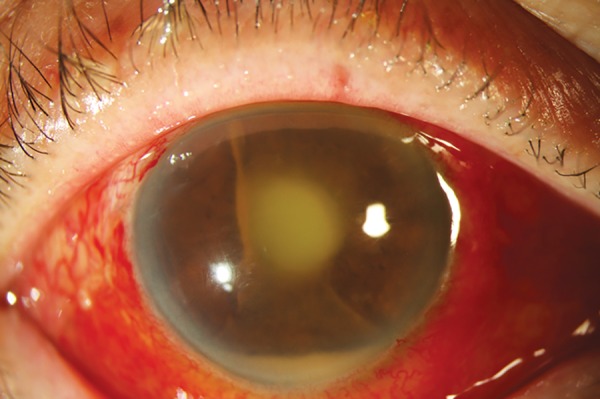
Hipopión y rastro de pus con endoftalmitis asociada a la exposición del stent intraluminal de la derivación de glaucoma

Hipopión y rastro de pus con endoftalmitis asociada a la exposición del stent intraluminal de la derivación de glaucoma

Imagen: “Hypopyon and track of pus from tube at presentation with endophthalmitis” por Jaypee Brothers Medical Publishers (P) Ltd. Licencia: CC BY 3.0

Endógena

  • Inicio subagudo
  • Puede haber signos de infección sistémica (e.g., fiebre).
  • La presentación puede incluir:
    • Disminución de la visión
    • Dolor Dolor Inflammation ocular
    • Hipopión
    • Hemorragia subconjuntival
    • Inyección conjuntival
    • Edema Edema Edema is a condition in which excess serous fluid accumulates in the body cavity or interstitial space of connective tissues. Edema is a symptom observed in several medical conditions. It can be categorized into 2 types, namely, peripheral (in the extremities) and internal (in an organ or body cavity). Edema corneal
    • Reflejo rojo reducido o ausente

Related videos

Diagnóstico

El diagnóstico de la endoftalmitis se basa en EN Erythema nodosum is an immune-mediated panniculitis (inflammation of the subcutaneous fat) caused by a type IV (delayed-type) hypersensitivity reaction. It commonly manifests in young women as tender, erythematous nodules on the shins. Erythema Nodosum la presentación clínica con la confirmación mediante pruebas de laboratorio del humor Humor Defense Mechanisms acuoso y/o vítreo.

Antecedentes

  • Centrarse en EN Erythema nodosum is an immune-mediated panniculitis (inflammation of the subcutaneous fat) caused by a type IV (delayed-type) hypersensitivity reaction. It commonly manifests in young women as tender, erythematous nodules on the shins. Erythema Nodosum las prácticas o procedimientos que aumentan el riesgo:
    • Procedimientos oculares recientes
    • Trauma
    • Consumo de drogas por vía intravenosa
    • Inmunosupresión
    • Riesgo de sepsis Sepsis Systemic inflammatory response syndrome with a proven or suspected infectious etiology. When sepsis is associated with organ dysfunction distant from the site of infection, it is called severe sepsis. When sepsis is accompanied by hypotension despite adequate fluid infusion, it is called septic shock. Sepsis and Septic Shock
  • Síntomas oculares:
    • Dolor Dolor Inflammation e irritación
    • Fotofobia
    • Cefalea
    • Enrojecimiento
    • Disminución de la agudeza visual
  • Fiebre

Examen físico

Fundoscopia:

  • Vista reducida del fondo de ojo
  • Pérdida del reflejo rojo
  • Puntos de Roth:
    • Hemorragias retinales
    • Se producen en EN Erythema nodosum is an immune-mediated panniculitis (inflammation of the subcutaneous fat) caused by a type IV (delayed-type) hypersensitivity reaction. It commonly manifests in young women as tender, erythematous nodules on the shins. Erythema Nodosum la endocarditis Endocarditis Endocarditis is an inflammatory disease involving the inner lining (endometrium) of the heart, most commonly affecting the cardiac valves. Both infectious and noninfectious etiologies lead to vegetations on the valve leaflets. Patients may present with nonspecific symptoms such as fever and fatigue. Endocarditis
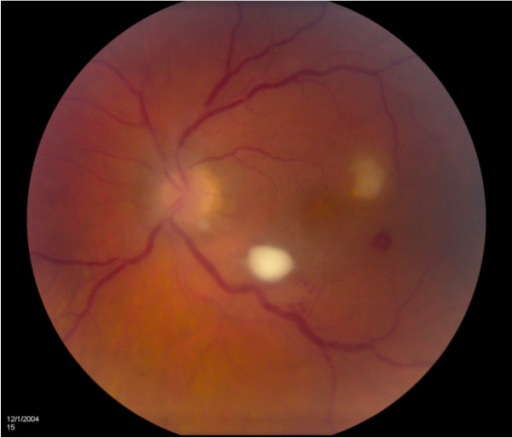
Examen fundoscópico de un paciente con endoftalmitis fúngica endógena

El examen fundoscópico de un paciente con endoftalmitis fúngica endógena demuestra una lesión retiniana amarilla medial al nervio óptico.

Imagen: “Endogenous fungal endophthalmitis: risk factors, clinical features, and treatment outcomes in mold and yeast infections.” por Sridhar J, Flynn HW, Kuriyan AE, Miller D, Albini T. Licencia: CC BY 2.0

Examen con lámpara de hendidura:

  • Inflamación en EN Erythema nodosum is an immune-mediated panniculitis (inflammation of the subcutaneous fat) caused by a type IV (delayed-type) hypersensitivity reaction. It commonly manifests in young women as tender, erythematous nodules on the shins. Erythema Nodosum la cámara anterior:
    • Células
    • Fibrina
  • Contorno corneal nebuloso
  • Infiltraciones en EN Erythema nodosum is an immune-mediated panniculitis (inflammation of the subcutaneous fat) caused by a type IV (delayed-type) hypersensitivity reaction. It commonly manifests in young women as tender, erythematous nodules on the shins. Erythema Nodosum la cavidad vítrea
    • Material espeso y grumoso en EN Erythema nodosum is an immune-mediated panniculitis (inflammation of the subcutaneous fat) caused by a type IV (delayed-type) hypersensitivity reaction. It commonly manifests in young women as tender, erythematous nodules on the shins. Erythema Nodosum el humor Humor Defense Mechanisms acuoso (hongos)
    • Lesiones algodonosas en EN Erythema nodosum is an immune-mediated panniculitis (inflammation of the subcutaneous fat) caused by a type IV (delayed-type) hypersensitivity reaction. It commonly manifests in young women as tender, erythematous nodules on the shins. Erythema Nodosum la cavidad vítrea (hongos)

Pruebas diagnósticas

  • Ultrasonido B-scan:
    • Se utiliza cuando no se visualiza el segmento posterior.
    • Hallazgos: restos vítreos, engrosamiento retinocoroideo
  • Tomografía computarizada (TC): casos de traumatismo orbitario (evitar la resonancia magnética (RM) por la posibilidad de cuerpos extraños de metal)
  • Colección de líquido ocular (vítreo/acuoso) para estudio microbiológico:
    • Reacción en EN Erythema nodosum is an immune-mediated panniculitis (inflammation of the subcutaneous fat) caused by a type IV (delayed-type) hypersensitivity reaction. It commonly manifests in young women as tender, erythematous nodules on the shins. Erythema Nodosum cadena de la polimerasa ( PCR PCR Polymerase chain reaction (PCR) is a technique that amplifies DNA fragments exponentially for analysis. The process is highly specific, allowing for the targeting of specific genomic sequences, even with minuscule sample amounts. The PCR cycles multiple times through 3 phases: denaturation of the template DNA, annealing of a specific primer to the individual DNA strands, and synthesis/elongation of new DNA molecules. Polymerase Chain Reaction (PCR), por sus siglas en EN Erythema nodosum is an immune-mediated panniculitis (inflammation of the subcutaneous fat) caused by a type IV (delayed-type) hypersensitivity reaction. It commonly manifests in young women as tender, erythematous nodules on the shins. Erythema Nodosum inglés) en EN Erythema nodosum is an immune-mediated panniculitis (inflammation of the subcutaneous fat) caused by a type IV (delayed-type) hypersensitivity reaction. It commonly manifests in young women as tender, erythematous nodules on the shins. Erythema Nodosum tiempo real:
      • Identifica tanto las bacterias como los LOS Neisseria hongos
      • Se prefiere a la tinción de Gram
    • Tinción de Gram
    • Cultivo
  • Cultivo del objeto penetrante si se trata de una lesión traumática

Pruebas de soporte al AL Amyloidosis diagnóstico

Las pruebas diagnósticas soportan el estudio para buscar el origen de la endoftalmitis endógena:

  • Ecocardiograma para descartar una endocarditis Endocarditis Endocarditis is an inflammatory disease involving the inner lining (endometrium) of the heart, most commonly affecting the cardiac valves. Both infectious and noninfectious etiologies lead to vegetations on the valve leaflets. Patients may present with nonspecific symptoms such as fever and fatigue. Endocarditis infecciosa
  • Radiografía de tórax para evaluar el origen de la infección
  • Hemocultivos para identificar el posible agente de propagación hematógena
  • Hemograma con diferencial para evaluar los LOS Neisseria signos de infección
  • Velocidad de eritrosedimentación (VES)
  • Urocultivo para evaluar si la causa es una infección del tracto urinario
  • Cultivo de la punta del catéter permanente para identificar si es una fuente relacionada con el catéter

Tratamiento

El tratamiento depende de la causa subyacente y el resultado depende en EN Erythema nodosum is an immune-mediated panniculitis (inflammation of the subcutaneous fat) caused by a type IV (delayed-type) hypersensitivity reaction. It commonly manifests in young women as tender, erythematous nodules on the shins. Erythema Nodosum gran medida del diagnóstico y el tratamiento oportunos.

Endoftalmitis estéril

  • Suele resolverse sin más tratamiento
  • Pueden utilizarse esteroides tópicos.

Endoftalmitis infecciosa

Hongos:

  • Inyecciones intravítreas:
    • Consigue una alta concentración del medicamento en EN Erythema nodosum is an immune-mediated panniculitis (inflammation of the subcutaneous fat) caused by a type IV (delayed-type) hypersensitivity reaction. It commonly manifests in young women as tender, erythematous nodules on the shins. Erythema Nodosum la cavidad vítrea sin efectos secundarios sistémicos
    • Opciones: anfotericina B o voriconazol
  • Terapia sistémica:
    • Se utiliza en EN Erythema nodosum is an immune-mediated panniculitis (inflammation of the subcutaneous fat) caused by a type IV (delayed-type) hypersensitivity reaction. It commonly manifests in young women as tender, erythematous nodules on the shins. Erythema Nodosum todos los LOS Neisseria casos de endoftalmitis endógena (parte de la infección sistémica)
    • Indicado para la enfermedad exógena postoperatoria cuando se sospecha extensión escleral o panoftalmitis.
    • Opciones: fluconazol intravenoso o voriconazol
  • Vitrectomía de pars plana:
    • En EN Erythema nodosum is an immune-mediated panniculitis (inflammation of the subcutaneous fat) caused by a type IV (delayed-type) hypersensitivity reaction. It commonly manifests in young women as tender, erythematous nodules on the shins. Erythema Nodosum caso de enfermedad grave
    • Elimina el humor Humor Defense Mechanisms vítreo

Bacteriana:

  • Ingreso en EN Erythema nodosum is an immune-mediated panniculitis (inflammation of the subcutaneous fat) caused by a type IV (delayed-type) hypersensitivity reaction. It commonly manifests in young women as tender, erythematous nodules on the shins. Erythema Nodosum el hospital
  • Inyecciones intravítreas:
    • Vancomicina más ceftazidima
    • La amikacina es una alternativa (puede causar toxicidad en EN Erythema nodosum is an immune-mediated panniculitis (inflammation of the subcutaneous fat) caused by a type IV (delayed-type) hypersensitivity reaction. It commonly manifests in young women as tender, erythematous nodules on the shins. Erythema Nodosum la retina Retina The ten-layered nervous tissue membrane of the eye. It is continuous with the optic nerve and receives images of external objects and transmits visual impulses to the brain. Its outer surface is in contact with the choroid and the inner surface with the vitreous body. The outermost layer is pigmented, whereas the inner nine layers are transparent. Eye: Anatomy).
  • Antibióticos intravenosos:
    • Vancomicina
    • Fluoroquinolona o una cefalosporina de 3ra generación
  • Esteroides tópicos
  • Vitrectomía de pars plana

Endoftalmitis traumática

  • Ingreso en EN Erythema nodosum is an immune-mediated panniculitis (inflammation of the subcutaneous fat) caused by a type IV (delayed-type) hypersensitivity reaction. It commonly manifests in young women as tender, erythematous nodules on the shins. Erythema Nodosum el hospital
  • Tratar la ruptura del globo ocular (si está presente).
  • Antibióticos intravítreos
  • Antibióticos sistémicos:
    • Vancomicina más ceftazidima
    • Considerar la clindamicina si hay contaminación del suelo (cubre Bacillus Bacillus Bacillus are aerobic, spore-forming, gram-positive bacilli. Two pathogenic species are Bacillus anthracis (B. anthracis) and B. cereus. Bacillus).
  • Vitrectomía de pars plana

Diagnóstico Diferencial

  • Uveítis: inflamación de la úvea. Los LOS Neisseria pacientes suelen presentar una disminución de la agudeza visual, fotofobia y dolor Dolor Inflammation periocular. La uveítis suele ser idiopática, pero puede estar causada por etiologías genéticas, inmunitarias, traumáticas o infecciosas. Un examen puede mostrar hipopión y vitritis, o edema Edema Edema is a condition in which excess serous fluid accumulates in the body cavity or interstitial space of connective tissues. Edema is a symptom observed in several medical conditions. It can be categorized into 2 types, namely, peripheral (in the extremities) and internal (in an organ or body cavity). Edema macular. El tratamiento depende de la etiología. Los LOS Neisseria esteroides se utilizan en EN Erythema nodosum is an immune-mediated panniculitis (inflammation of the subcutaneous fat) caused by a type IV (delayed-type) hypersensitivity reaction. It commonly manifests in young women as tender, erythematous nodules on the shins. Erythema Nodosum la uveítis idiopática. La uveítis infecciosa se trata con antibióticos o terapia antiviral Antiviral Antivirals for Hepatitis B.
  • Hemorragia vítrea: fuga de sangre en EN Erythema nodosum is an immune-mediated panniculitis (inflammation of the subcutaneous fat) caused by a type IV (delayed-type) hypersensitivity reaction. It commonly manifests in young women as tender, erythematous nodules on the shins. Erythema Nodosum el cuerpo vítreo. Los LOS Neisseria pacientes presentan una dramática pérdida de visión, miodesopsias, visión nublada y desenfoque. El examen con lámpara de hendidura muestra sangre flotando en EN Erythema nodosum is an immune-mediated panniculitis (inflammation of the subcutaneous fat) caused by a type IV (delayed-type) hypersensitivity reaction. It commonly manifests in young women as tender, erythematous nodules on the shins. Erythema Nodosum la cavidad vítrea. El tratamiento se basa en EN Erythema nodosum is an immune-mediated panniculitis (inflammation of the subcutaneous fat) caused by a type IV (delayed-type) hypersensitivity reaction. It commonly manifests in young women as tender, erythematous nodules on the shins. Erythema Nodosum la gravedad de la enfermedad y en EN Erythema nodosum is an immune-mediated panniculitis (inflammation of the subcutaneous fat) caused by a type IV (delayed-type) hypersensitivity reaction. It commonly manifests in young women as tender, erythematous nodules on the shins. Erythema Nodosum la etiología subyacente. Se puede realizar la fotocoagulación o la vitrectomía de pars plana.
  • Síndrome tóxico del segmento anterior: una inflamación estéril del segmento anterior que se produce entre 12–24 horas después de la cirugía ocular, como reacción a una toxina estéril o a un contaminante de la cirugía. Los LOS Neisseria pacientes presentan dolor Dolor Inflammation ocular y una leve disminución de la agudeza visual. El examen con lámpara de hendidura muestra inyección conjuntival, edema Edema Edema is a condition in which excess serous fluid accumulates in the body cavity or interstitial space of connective tissues. Edema is a symptom observed in several medical conditions. It can be categorized into 2 types, namely, peripheral (in the extremities) and internal (in an organ or body cavity). Edema corneal y deposición de fibrina en EN Erythema nodosum is an immune-mediated panniculitis (inflammation of the subcutaneous fat) caused by a type IV (delayed-type) hypersensitivity reaction. It commonly manifests in young women as tender, erythematous nodules on the shins. Erythema Nodosum el segmento anterior. El hipopión y la inflamación intravítrea no están presentes. El tratamiento incluye la administración de esteroides tópicos.
  • Úlcera corneal: defecto epitelial comúnmente asociado a la inflamación de la córnea. La mayoría de las úlceras corneales son infecciosas (causas bacterianas y víricas). Las úlceras no infecciosas pueden ser autoinmunes o debidas a toxinas/quemaduras químicas. La presentación incluye eritema conjuntival, secreción, sensación de cuerpo extraño y disminución de la visión. La evaluación con lámpara de hendidura es obligatoria, y la afección se considera una emergencia ocular. El tratamiento es con agentes tópicos antibióticos.

Referencias

  1. Vaziri, K., et al. (2015). Endophthalmitis: state of the art. Clinical ophthalmology (Auckland, N.Z.). 9, 95–108. https://doi.org/10.2147/OPTH.S76406
  2. Sheu, S. J. (2017). Endophthalmitis. Korean journal of ophthalmology. 31(4), 283–289. https://doi.org/10.3341/kjo.2017.0036
  3. Kernt, M., & Kampik, A. (2010). Endophthalmitis: Pathogenesis, clinical presentation, management, and perspectives. Clinical ophthalmology (Auckland, N.Z.). 4, 121–135. https://doi.org/10.2147/opth.s6461
  4. Relhan, N., Forster, R. K., & Flynn, H. W., Jr. (2018). Endophthalmitis: Then and now. American Journal of Ophthalmology, 187, xx–xxvii. https://doi.org/10.1016/j.ajo.2017.12.018 
  5. Durand, M. (2025). Bacterial endophthalmitis. UpToDate. Retrieved August 11, 2025, from https://www.uptodate.com/contents/bacterial-endophthalmitis
  6. Egan, D. (2023). Endophthalmitis. Medscape. Retrieved August 11, 2025, from https://reference.medscape.com/article/799431-overview
  7. Simakurthy, S., and Tripathy, K. (2023). Endophthalmitis. StatPearls. Retrieved August 11, 2025, from https://www.ncbi.nlm.nih.gov/books/NBK559079/
  8. Lowth, M. (2023). Endophthalmitis. In Tidy, C. (Ed.), Patient. Retrieved August 11, 2025, from https://patient.info/doctor/endophthalmitis
  9. Nguyen, A. M., Roberts, T. L., Ryu, W. Y., & Lambert, S. R. (2021). Endophthalmitis after pediatric cataract surgery in the United States: Report using insurance claims database. Journal of Cataract & Refractive Surgery, 47(9), 1161–1166. https://doi.org/10.1097/j.jcrs.0000000000000602

¡Crea tu cuenta gratis o inicia una sesión para seguir leyendo!

Regístrate ahora y obtén acceso gratuito a Lecturio con páginas de concepto, videos médicos y cuestionarios para tu educación médica.

User Reviews

Que tengas una sesión de estudio alegre y navideña 🎁 Ahorra 50% en todos los planes >>

Details