Domina Conceptos Médicos

Estudia para la escuela de medicina y tus examenes con Lecturio.

Carcinoma Hepatocelular y Metástasis Hepáticas

El carcinoma hepatocelular (CHC) surge típicamente en EN Erythema nodosum is an immune-mediated panniculitis (inflammation of the subcutaneous fat) caused by a type IV (delayed-type) hypersensitivity reaction. It commonly manifests in young women as tender, erythematous nodules on the shins. Erythema Nodosum un hígado con enfermedad crónica o cirrótico y es el cáncer de hígado primario más común. El diagnóstico puede incluir ecografía, tomografía computarizada, resonancia magnética, biopsia (si la imagen no es concluyente) y/o biomarcadores. Las opciones de tratamiento incluyen resección y quimioterapia/radioterapia, y trasplante de hígado en EN Erythema nodosum is an immune-mediated panniculitis (inflammation of the subcutaneous fat) caused by a type IV (delayed-type) hypersensitivity reaction. It commonly manifests in young women as tender, erythematous nodules on the shins. Erythema Nodosum casos seleccionados. Las metástasis hepáticas son mucho más comunes que los LOS Neisseria cánceres hepáticos primarios y generalmente se originan en EN Erythema nodosum is an immune-mediated panniculitis (inflammation of the subcutaneous fat) caused by a type IV (delayed-type) hypersensitivity reaction. It commonly manifests in young women as tender, erythematous nodules on the shins. Erythema Nodosum sitios primarios colorrectales, pulmonares, mamarios y pancreáticos. Las metástasis se diagnostican con mayor frecuencia mediante tomografías computarizadas o tomografías por emisión de positrones ( PET PET An imaging technique that combines a positron-emission tomography (PET) scanner and a ct X ray scanner. This establishes a precise anatomic localization in the same session. Nuclear Imaging). El manejo depende del tipo y estadio del cáncer primario.

Last updated: Dec 15, 2025

Editorial responsibility: Stanley Oiseth, Lindsay Jones, Evelin Maza

Epidemiología y Etiología

Epidemiología

  • El carcinoma hepatocelular representa el 80% de los LOS Neisseria cánceres primarios de hígado en EN Erythema nodosum is an immune-mediated panniculitis (inflammation of the subcutaneous fat) caused by a type IV (delayed-type) hypersensitivity reaction. It commonly manifests in young women as tender, erythematous nodules on the shins. Erythema Nodosum adultos.
  • Tasa de mortalidad/incidencia: 0,95 (la 2da peor tasa de supervivencia después del cáncer de páncreas)
  • A nivel mundial:
    • 5,4% de todos los LOS Neisseria cánceres
    • 4ta causa más común de todas las muertes por cáncer
    • El 85% de los LOS Neisseria casos ocurren en EN Erythema nodosum is an immune-mediated panniculitis (inflammation of the subcutaneous fat) caused by a type IV (delayed-type) hypersensitivity reaction. It commonly manifests in young women as tender, erythematous nodules on the shins. Erythema Nodosum Asia ASIA Spinal Cord Injuries y África Subsahariana:
      • Asociado con una alta tasa de transmisión materno-fetal del virus Virus Viruses are infectious, obligate intracellular parasites composed of a nucleic acid core surrounded by a protein capsid. Viruses can be either naked (non-enveloped) or enveloped. The classification of viruses is complex and based on many factors, including type and structure of the nucleoid and capsid, the presence of an envelope, the replication cycle, and the host range. Virology de la hepatitis B Hepatitis B Hepatitis B virus (HBV) is a partially double-stranded DNA virus, which belongs to the Orthohepadnavirus genus and the Hepadnaviridae family. Most individuals with acute HBV infection are asymptomatic or have mild, self-limiting symptoms. Chronic infection can be asymptomatic or create hepatic inflammation, leading to liver cirrhosis and hepatocellular carcinoma (HCC). Hepatitis B Virus
      • Las tasas de incidencia han disminuido en EN Erythema nodosum is an immune-mediated panniculitis (inflammation of the subcutaneous fat) caused by a type IV (delayed-type) hypersensitivity reaction. It commonly manifests in young women as tender, erythematous nodules on the shins. Erythema Nodosum áreas con mayores tasas de vacunación contra el virus Virus Viruses are infectious, obligate intracellular parasites composed of a nucleic acid core surrounded by a protein capsid. Viruses can be either naked (non-enveloped) or enveloped. The classification of viruses is complex and based on many factors, including type and structure of the nucleoid and capsid, the presence of an envelope, the replication cycle, and the host range. Virology de la hepatitis B Hepatitis B Hepatitis B virus (HBV) is a partially double-stranded DNA virus, which belongs to the Orthohepadnavirus genus and the Hepadnaviridae family. Most individuals with acute HBV infection are asymptomatic or have mild, self-limiting symptoms. Chronic infection can be asymptomatic or create hepatic inflammation, leading to liver cirrhosis and hepatocellular carcinoma (HCC). Hepatitis B Virus.
      • Edad al AL Amyloidosis diagnóstico: 20-40 años
      • Proporción hombre-mujer: 8:1
  • Estados Unidos:
    • < 2,5% de todos los LOS Neisseria cánceres
    • 5ta causa más común de todas las muertes por cáncer
    • La incidencia está aumentando (principalmente debido a la hepatopatía grasa no alcohólica).
    • Variaciones étnicas: asiáticos/isleños del Pacífico > negros > nativos americanos/nativos de Alaska > blancos
    • Edad mediana al AL Amyloidosis diagnóstico: 65 años
    • Proporción hombre-mujer: 3:1

Factores de riesgo

Cirrosis:

Un tercio de los LOS Neisseria pacientes con cirrosis desarrollarán carcinoma hepatocelular durante su vida, incluidos los LOS Neisseria causados por:

  • Virus Virus Viruses are infectious, obligate intracellular parasites composed of a nucleic acid core surrounded by a protein capsid. Viruses can be either naked (non-enveloped) or enveloped. The classification of viruses is complex and based on many factors, including type and structure of the nucleoid and capsid, the presence of an envelope, the replication cycle, and the host range. Virology de hepatitis B Hepatitis B Hepatitis B virus (HBV) is a partially double-stranded DNA virus, which belongs to the Orthohepadnavirus genus and the Hepadnaviridae family. Most individuals with acute HBV infection are asymptomatic or have mild, self-limiting symptoms. Chronic infection can be asymptomatic or create hepatic inflammation, leading to liver cirrhosis and hepatocellular carcinoma (HCC). Hepatitis B Virus crónico
  • Infección crónica por el virus Virus Viruses are infectious, obligate intracellular parasites composed of a nucleic acid core surrounded by a protein capsid. Viruses can be either naked (non-enveloped) or enveloped. The classification of viruses is complex and based on many factors, including type and structure of the nucleoid and capsid, the presence of an envelope, the replication cycle, and the host range. Virology de la hepatitis C Hepatitis C Hepatitis C is an infection of the liver caused by the hepatitis C virus (HCV). The infection can be transmitted through infectious blood or body fluids and may be transmitted during childbirth or through IV drug use or sexual intercourse. Hepatitis C virus can cause both acute and chronic hepatitis, ranging from a mild to a serious, lifelong illness including liver cirrhosis and hepatocellular carcinoma (HCC). Hepatitis C Virus
  • Hepatopatía grasa no alcohólica (aumento del riesgo incluso sin cirrosis)
  • Hepatopatía alcohólica
  • Hemocromatosis
  • Deficiencia de α-1 antitripsina

Otros:

  • Aflatoxina B1:
    • Toxina de hongos Aspergillus Aspergillus A genus of mitosporic fungi containing about 100 species and eleven different teleomorphs in the family trichocomaceae. Echinocandins flavus y A. parasiticus
    • Contamina los LOS Neisseria productos alimenticios almacenados (e.g., maní, maíz)
    • Actúa sinérgicamente con la infección por virus Virus Viruses are infectious, obligate intracellular parasites composed of a nucleic acid core surrounded by a protein capsid. Viruses can be either naked (non-enveloped) or enveloped. The classification of viruses is complex and based on many factors, including type and structure of the nucleoid and capsid, the presence of an envelope, the replication cycle, and the host range. Virology de hepatitis B Hepatitis B Hepatitis B virus (HBV) is a partially double-stranded DNA virus, which belongs to the Orthohepadnavirus genus and the Hepadnaviridae family. Most individuals with acute HBV infection are asymptomatic or have mild, self-limiting symptoms. Chronic infection can be asymptomatic or create hepatic inflammation, leading to liver cirrhosis and hepatocellular carcinoma (HCC). Hepatitis B Virus y la ingestión de alcohol.
  • Tabaquismo
  • Alcohol
  • Obesidad
  • Enfermedad de Wilson
  • Enfermedad biliar crónica
  • Hepatitis autoinmune

Patogenia y Patología

Patogénesis

  • Carcinoma hepatocelular que surge en EN Erythema nodosum is an immune-mediated panniculitis (inflammation of the subcutaneous fat) caused by a type IV (delayed-type) hypersensitivity reaction. It commonly manifests in young women as tender, erythematous nodules on the shins. Erythema Nodosum la enfermedad hepática crónica con cirrosis (80% de los LOS Neisseria casos):
    • Lesión crónica → inflamación → regeneración de hepatocitos → mutaciones conductoras a carcinoma hepatocelular
    • Mutaciones y frecuencias del controlador:
      • Gen de la β-catenina (40%)
      • Promotor del gen TERT → aumenta la actividad de la telomerasa (50-60%)
      • TP53: mutaciones de inactivación (60%)
  • Carcinoma hepatocelular que surge en EN Erythema nodosum is an immune-mediated panniculitis (inflammation of the subcutaneous fat) caused by a type IV (delayed-type) hypersensitivity reaction. It commonly manifests in young women as tender, erythematous nodules on the shins. Erythema Nodosum hígados no cirróticos con enfermedad hepática crónica preexistente:
    • Aflatoxina B1 → convertida en EN Erythema nodosum is an immune-mediated panniculitis (inflammation of the subcutaneous fat) caused by a type IV (delayed-type) hypersensitivity reaction. It commonly manifests in young women as tender, erythematous nodules on the shins. Erythema Nodosum epóxido tóxico → daño al AL Amyloidosis ADN (incluyendo p53)
    • Adenoma hepatocelular con mutaciones activadoras de β-catenina
    • Carcinoma hepatocelular tipo fibrolamelar: formas de genes Genes A category of nucleic acid sequences that function as units of heredity and which code for the basic instructions for the development, reproduction, and maintenance of organisms. DNA Types and Structure de fusión → actividad aberrante de la proteína quinasa A → actividad anormal de cAMP cAMP An adenine nucleotide containing one phosphate group which is esterified to both the 3′- and 5′-positions of the sugar moiety. It is a second messenger and a key intracellular regulator, functioning as a mediator of activity for a number of hormones, including epinephrine, glucagon, and acth. Phosphodiesterase Inhibitors

Lesiones precursoras (premalignas)

Los hepatocitos muestran “cambio de células grandes” y “cambio de células pequeñas” con una arquitectura anormal (trabéculas gruesas) al AL Amyloidosis microscopio.

  • Cambio de células grandes: hepatocitos agrandados con núcleos grandes, multinucleados y pleomórficos
  • Cambio de células pequeñas: hepatocitos con una proporción nuclear a citoplasmática alta, pero un cambio nuclear leve
  • Nódulos displásicos: a menudo asociados con cambios de células pequeñas

Carcinoma hepatocelular

Apariencia macroscópica:

  • Por lo general, en EN Erythema nodosum is an immune-mediated panniculitis (inflammation of the subcutaneous fat) caused by a type IV (delayed-type) hypersensitivity reaction. It commonly manifests in young women as tender, erythematous nodules on the shins. Erythema Nodosum un hígado cirrótico
  • Masas únicas o múltiples (discretas o infiltrantes)
  • Las metástasis intrahepáticas extensas son comunes.
  • Color:
    • Blanco
    • Amarillo (debido al AL Amyloidosis cambio graso)
    • Verde (presencia de colestasis)
  • Invasión de la vena porta: común con extensión a la vena cava inferior y al AL Amyloidosis lado derecho del corazón
  • Invasión de la vena cava: el carcinoma hepatocelular y el carcinoma de células renales son los LOS Neisseria 2 carcinomas con tendencia a invadir la vena cava como un trombo en EN Erythema nodosum is an immune-mediated panniculitis (inflammation of the subcutaneous fat) caused by a type IV (delayed-type) hypersensitivity reaction. It commonly manifests in young women as tender, erythematous nodules on the shins. Erythema Nodosum crecimiento.

Aspecto microscópico:

  • Tumores bien diferenciados:
    • Se parecen a los LOS Neisseria hepatocitos normales
    • Trabéculas engrosadas
    • Canalículos dilatados e irregulares
    • Espacios pseudoglandulares
  • Tumores pobremente diferenciados:
    • Compuesto por láminas de células indiferenciadas con marcada atipia citológica
    • Necrosis Necrosis The death of cells in an organ or tissue due to disease, injury or failure of the blood supply. Ischemic Cell Damage y hemorragia

Presentación Clínica

Cuatro posibles presentaciones clínicas para carcinoma hepatocelular:

  1. Asintomático: la masa hepática del carcinoma hepatocelular se encuentra de forma incidental en EN Erythema nodosum is an immune-mediated panniculitis (inflammation of the subcutaneous fat) caused by a type IV (delayed-type) hypersensitivity reaction. It commonly manifests in young women as tender, erythematous nodules on the shins. Erythema Nodosum los LOS Neisseria estudios de imagen.
  2. Cirrosis 1ro:
    • Los LOS Neisseria síntomas y signos de cirrosis aparecen 1ro
    • Luego se descubre el carcinoma hepatocelular
  3. Cirrosis descompensada en EN Erythema nodosum is an immune-mediated panniculitis (inflammation of the subcutaneous fat) caused by a type IV (delayed-type) hypersensitivity reaction. It commonly manifests in young women as tender, erythematous nodules on the shins. Erythema Nodosum presencia de cirrosis conocida:
    • Sangrado por várices
    • Ascitis
    • Extensión de carcinoma hepatocelular a las venas hepáticas o porta
  4. Carcinoma hepatocelular 1ro:
    • Los LOS Neisseria síntomas y signos del carcinoma hepatocelular aparecen primero
    • Dolor Dolor Inflammation abdominal/molestia en EN Erythema nodosum is an immune-mediated panniculitis (inflammation of the subcutaneous fat) caused by a type IV (delayed-type) hypersensitivity reaction. It commonly manifests in young women as tender, erythematous nodules on the shins. Erythema Nodosum el cuadrante superior derecho
    • Malestar, fatiga, pérdida de peso
    • Hepatomegalia, esplenomegalia, masa palpable
    • Rotura tumoral con hemorragia intraperitoneal Intraperitoneal Peritoneum: Anatomy (evento potencialmente mortal)
    • Fiebre por necrosis Necrosis The death of cells in an organ or tissue due to disease, injury or failure of the blood supply. Ischemic Cell Damage tumoral
    • Ictericia obstructiva
    • Metástasis extrahepáticas (10%–15% de los LOS Neisseria casos): pulmón > ganglios linfáticos regionales > peritoneo > hueso > glándula suprarrenal

Diagnóstico

Ultrasonido

Se recomienda realizar un tamizaje de vigilancia mediante ultrasonido cada 6 meses a los LOS Neisseria pacientes de los LOS Neisseria siguientes grupos de alto riesgo:
  • Pacientes con cirrosis (incidencia anual de carcinoma hepatocelular > 1,5%):
    • Menos grave y moderadamente grave (clasificación A y B de Child-Pugh)
    • Más grave (clasificación C de Child-Pugh) si espera un trasplante de hígado
  • Pacientes sin cirrosis (incidencia anual de carcinoma hepatocelular > 0,2 %) con infección por virus Virus Viruses are infectious, obligate intracellular parasites composed of a nucleic acid core surrounded by a protein capsid. Viruses can be either naked (non-enveloped) or enveloped. The classification of viruses is complex and based on many factors, including type and structure of the nucleoid and capsid, the presence of an envelope, the replication cycle, and the host range. Virology de hepatitis B Hepatitis B Hepatitis B virus (HBV) is a partially double-stranded DNA virus, which belongs to the Orthohepadnavirus genus and the Hepadnaviridae family. Most individuals with acute HBV infection are asymptomatic or have mild, self-limiting symptoms. Chronic infection can be asymptomatic or create hepatic inflammation, leading to liver cirrhosis and hepatocellular carcinoma (HCC). Hepatitis B Virus, que se presenten en EN Erythema nodosum is an immune-mediated panniculitis (inflammation of the subcutaneous fat) caused by a type IV (delayed-type) hypersensitivity reaction. It commonly manifests in young women as tender, erythematous nodules on the shins. Erythema Nodosum cualquiera de los LOS Neisseria siguientes entornos o tipos de pacientes:
    • Hepatitis activa (alanina aminotransferasa sérica elevada y/o carga viral alta)
    • Antecedentes familiares de carcinoma hepatocelular
    • Africanos y afroamericanos
    • Hombres asiáticos > 40 años de edad
    • Mujeres asiáticas > 50 años
  • Virus Virus Viruses are infectious, obligate intracellular parasites composed of a nucleic acid core surrounded by a protein capsid. Viruses can be either naked (non-enveloped) or enveloped. The classification of viruses is complex and based on many factors, including type and structure of the nucleoid and capsid, the presence of an envelope, the replication cycle, and the host range. Virology de hepatitis C Hepatitis C Hepatitis C is an infection of the liver caused by the hepatitis C virus (HCV). The infection can be transmitted through infectious blood or body fluids and may be transmitted during childbirth or through IV drug use or sexual intercourse. Hepatitis C virus can cause both acute and chronic hepatitis, ranging from a mild to a serious, lifelong illness including liver cirrhosis and hepatocellular carcinoma (HCC). Hepatitis C Virus crónico y fibrosis Fibrosis Any pathological condition where fibrous connective tissue invades any organ, usually as a consequence of inflammation or other injury. Bronchiolitis Obliterans hepática avanzada (no incluidos para el tamizaje de vigilancia por parte de todos los LOS Neisseria expertos)
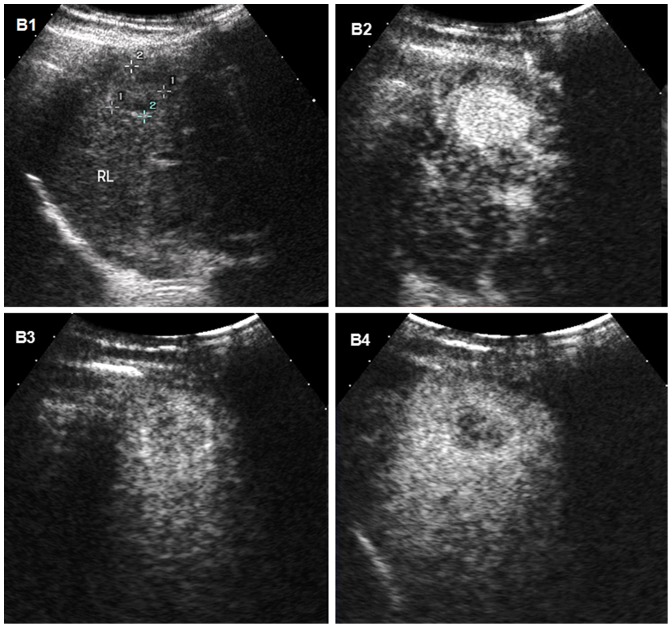
  • Hallazgos por ultrasonido:
    • Bordes de masa irregulares
    • Ecogenicidad que varía de homogéneo a no homogéneo y de hipoecoico a hiperecoico (indicando diferentes densidades)
CHC en ultrasonido

Carcinoma hepatocelular en ultrasonido: imágenes de ultrasonido de carcinoma hepatocelular en el hígado de un hombre de 31 años con cirrosis
B1: ultrasonido convencional que muestra la masa como un nódulo hipoecoico mal delimitado
B2, B3, B4: imágenes de ultrasonido mejorado con contraste secuenciadas en el tiempo (CEUS) después de la inyección de un agente de contraste de microburbujas
B2: hipervascularización típica (realce) de carcinoma hepatocelular durante la fase arterial a los 95 segundos después de la inyección del agente de contraste
B3, B4: masa que se vuelve hipoecogénica en fase portal y tardía
B4: imagen de fase tardía que muestra un ligero lavado del medio de contraste a los 179 s, lo que ayuda a diferenciar el carcinoma hepatocelular de un colangiocarcinoma o un tumor metastásico (tiempos de lavado más rápidos)

Imagen: “Hepatocellular carcinoma with moderately atypical hepatocytes with multifocal bile formation” por Li R, Yuan MX, Ma KS, Li XW, Tang CL, Zhang XH, Guo DY, Yan XC. Licencia: CC BY 4.0

Tomografía computarizada o resonancia magnética

Si el ultrasonido muestra una lesión > 1 cm, se realiza una imagen de contraste dinámico por TC o RM.
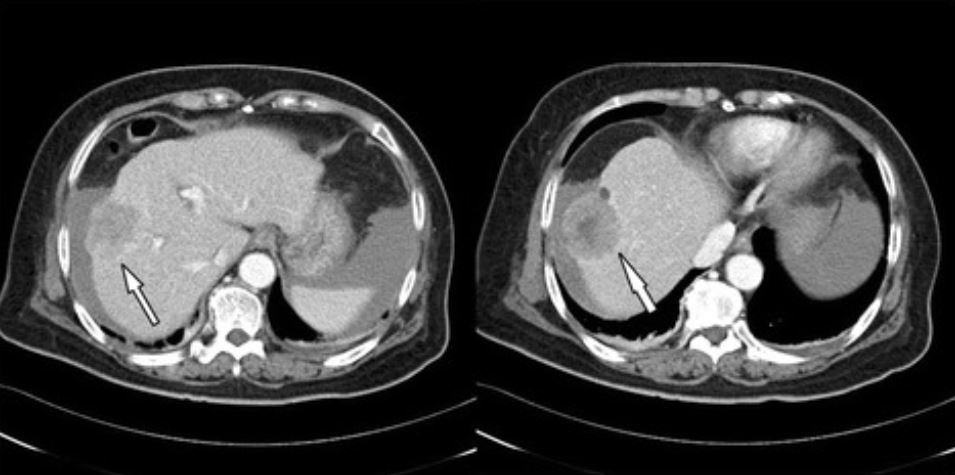
  • TC trifásico de abdomen: prueba confirmatoria que muestra realce en EN Erythema nodosum is an immune-mediated panniculitis (inflammation of the subcutaneous fat) caused by a type IV (delayed-type) hypersensitivity reaction. It commonly manifests in young women as tender, erythematous nodules on the shins. Erythema Nodosum la fase arterial y lavado en EN Erythema nodosum is an immune-mediated panniculitis (inflammation of the subcutaneous fat) caused by a type IV (delayed-type) hypersensitivity reaction. It commonly manifests in young women as tender, erythematous nodules on the shins. Erythema Nodosum la fase venosa portal con posible invasión local
  • RM (con contraste): lesiones hipodensas e irregulares

Biopsia

Si los LOS Neisseria resultados de las imágenes son inequívocos, no siempre se necesita una biopsia.
  • Realizar si la lesión es > 1 cm y la confirmación del tejido cambiaría el manejo.
  • Riesgo de sangrado y diseminación tumoral (< 3% casos)

Marcadores séricos

  • No se utilizan como pruebas independientes
  • Alfafetoproteína sérica ( AFP AFP The first alpha-globulins to appear in mammalian sera during fetal development and the dominant serum proteins in early embryonic life. Hepatocellular Carcinoma (HCC) and Liver Metastases): sensibilidad y especificidad insuficientes
  • MicroARN de plasma Plasma The residual portion of blood that is left after removal of blood cells by centrifugation without prior blood coagulation. Transfusion Products (miARN): se muestra prometedor como herramientas de diagnóstico y pronóstico, pero aún no se ha HA Hemolytic anemia (HA) is the term given to a large group of anemias that are caused by the premature destruction/hemolysis of circulating red blood cells (RBCs). Hemolysis can occur within (intravascular hemolysis) or outside the blood vessels (extravascular hemolysis). Hemolytic Anemia estudiado lo suficiente

Tratamiento y Complicaciones

Opciones no quirúrgicas

  • Ablación por radiofrecuencia, ablación por microondas y crioablación
  • Electroporación irreversible (electropermeabilización con pulsos eléctricos de alta corriente)
  • Quimioembolización transarterial y embolización blanda
  • Radioembolización transarterial
  • Ablación percutánea con etanol o ácido acético
  • Radioterapia estereotáctica
  • Quimioterapia y radioterapia sistémica
  • Inmunoterapia y terapias dirigidas

Resección quirúrgica del tumor Tumor Inflammation

  • Solo el 10% de los LOS Neisseria pacientes tienen tumores resecables.
  • Elegibilidad limitada por:
    • Cirrosis por disminución de la reserva hepática (limita la resección)
    • Tumor Tumor Inflammation extenso presente dentro del hígado.

Trasplante hepático

  • Contraindicaciones absolutas: enfermedad extrahepática, invasión vascular
  • Métodos puente (generalmente con ablación por radiofrecuencia o quimioembolización transarterial) para prevenir la progresión del tumor Tumor Inflammation mientras se espera un donante y para reducir el tamaño del tumor Tumor Inflammation para que se ajuste a los LOS Neisseria criterios de elegibilidad.

Complicaciones

  • Síndromes paraneoplásicos (20%):
    • Hipoglucemia: debido al AL Amyloidosis alto metabolismo del tumor Tumor Inflammation o secreción tumoral del factor de crecimiento similar a la insulina-2
    • Hipercalcemia: debido a lesiones osteolíticas o secreción tumoral de proteína relacionada con la hormona paratiroidea
    • Eritrocitosis: probablemente debido a la secreción tumoral de eritropoyetina
    • Diarrea (puede ser intratable): probablemente debido a la secreción de péptidos que causan la secreción intestinal (e.g., polipéptido intestinal vasoactivo, gastrina, eicosanoides similares a las prostaglandinas)
    • Lesiones cutáneas (raras): dermatomiositis, pénfigo foliáceo, signo de Leser-Trélat (aparición súbita de múltiples queratosis seborreicas, papilomas cutáneos y acantosis nigricans)
  • Rotura del tumor Tumor Inflammation con hemorragia intraperitoneal Intraperitoneal Peritoneum: Anatomy (un evento emergente que amenaza la vida)
  • Síndrome de Budd-Chiari: el tumor Tumor Inflammation comprime y obstruye las venas hepáticas

Pronóstico y Prevención

Pronóstico

  • 4 determinantes importantes de la supervivencia:
    • La gravedad de la enfermedad hepática subyacente.
    • Tamaño del tumor Tumor Inflammation
    • Extensión del tumor Tumor Inflammation a estructuras adyacentes.
    • Presencia o ausencia de metástasis
  • El tratamiento debe ser individualizado: algunos pacientes con determinantes de mal pronóstico evolucionan bien con una terapia agresiva (incluido el trasplante hepático).
  • Supervivencia:
    • Debido a la presentación tardía, la tasa de supervivencia a 5 años es baja (10%–12%).
    • La 2da peor tasa de supervivencia después del cáncer de páncreas
    • Supervivencia a 5 años por determinantes:
    • Supervivencia mediana:
      • < 3 meses en EN Erythema nodosum is an immune-mediated panniculitis (inflammation of the subcutaneous fat) caused by a type IV (delayed-type) hypersensitivity reaction. It commonly manifests in young women as tender, erythematous nodules on the shins. Erythema Nodosum partes de África
      • > 3 años en EN Erythema nodosum is an immune-mediated panniculitis (inflammation of the subcutaneous fat) caused by a type IV (delayed-type) hypersensitivity reaction. It commonly manifests in young women as tender, erythematous nodules on the shins. Erythema Nodosum Taiwán y Japón

Prevención

  • Vacunación contra el virus Virus Viruses are infectious, obligate intracellular parasites composed of a nucleic acid core surrounded by a protein capsid. Viruses can be either naked (non-enveloped) or enveloped. The classification of viruses is complex and based on many factors, including type and structure of the nucleoid and capsid, the presence of an envelope, the replication cycle, and the host range. Virology de la hepatitis B Hepatitis B Hepatitis B virus (HBV) is a partially double-stranded DNA virus, which belongs to the Orthohepadnavirus genus and the Hepadnaviridae family. Most individuals with acute HBV infection are asymptomatic or have mild, self-limiting symptoms. Chronic infection can be asymptomatic or create hepatic inflammation, leading to liver cirrhosis and hepatocellular carcinoma (HCC). Hepatitis B Virus
  • Tratamiento para la hepatitis viral:
    • Virus Virus Viruses are infectious, obligate intracellular parasites composed of a nucleic acid core surrounded by a protein capsid. Viruses can be either naked (non-enveloped) or enveloped. The classification of viruses is complex and based on many factors, including type and structure of the nucleoid and capsid, the presence of an envelope, the replication cycle, and the host range. Virology de la hepatitis B Hepatitis B Hepatitis B virus (HBV) is a partially double-stranded DNA virus, which belongs to the Orthohepadnavirus genus and the Hepadnaviridae family. Most individuals with acute HBV infection are asymptomatic or have mild, self-limiting symptoms. Chronic infection can be asymptomatic or create hepatic inflammation, leading to liver cirrhosis and hepatocellular carcinoma (HCC). Hepatitis B Virus: el riesgo relativo se reduce en EN Erythema nodosum is an immune-mediated panniculitis (inflammation of the subcutaneous fat) caused by a type IV (delayed-type) hypersensitivity reaction. It commonly manifests in young women as tender, erythematous nodules on the shins. Erythema Nodosum un 50%–60% con interferón o derivados de nucleósidos.
    • Virus Virus Viruses are infectious, obligate intracellular parasites composed of a nucleic acid core surrounded by a protein capsid. Viruses can be either naked (non-enveloped) or enveloped. The classification of viruses is complex and based on many factors, including type and structure of the nucleoid and capsid, the presence of an envelope, the replication cycle, and the host range. Virology de la hepatitis C Hepatitis C Hepatitis C is an infection of the liver caused by the hepatitis C virus (HCV). The infection can be transmitted through infectious blood or body fluids and may be transmitted during childbirth or through IV drug use or sexual intercourse. Hepatitis C virus can cause both acute and chronic hepatitis, ranging from a mild to a serious, lifelong illness including liver cirrhosis and hepatocellular carcinoma (HCC). Hepatitis C Virus: la terapia antiviral Antiviral Antivirals for Hepatitis B disminuye, pero no elimina el riesgo.
  • Medicamentos:
    • Estatinas (inhibidores de HMGR):
      • Efecto más profundo en EN Erythema nodosum is an immune-mediated panniculitis (inflammation of the subcutaneous fat) caused by a type IV (delayed-type) hypersensitivity reaction. It commonly manifests in young women as tender, erythematous nodules on the shins. Erythema Nodosum hombres de Asia ASIA Spinal Cord Injuries oriental con hepatitis crónica
      • Las estatinas pueden reducir indirectamente el carcinoma hepatocelular al AL Amyloidosis retardar la progresión de la cirrosis.
    • Aspirina: el uso regular Regular Insulin a largo plazo reduce el riesgo de carcinoma hepatocelular.
    • Metformina: asociado con un menor riesgo general de cáncer, incluido el carcinoma hepatocelular
  • Factores de riesgo en EN Erythema nodosum is an immune-mediated panniculitis (inflammation of the subcutaneous fat) caused by a type IV (delayed-type) hypersensitivity reaction. It commonly manifests in young women as tender, erythematous nodules on the shins. Erythema Nodosum el estilo de vida:
    • Actividad física: asociada con un menor riesgo de cáncer hepático en EN Erythema nodosum is an immune-mediated panniculitis (inflammation of the subcutaneous fat) caused by a type IV (delayed-type) hypersensitivity reaction. It commonly manifests in young women as tender, erythematous nodules on the shins. Erythema Nodosum comparación con un estilo de vida sedentario
    • Consumo dietético: Las carnes blancas, el pescado, los LOS Neisseria ácidos grasos omega-3, las verduras y la vitamina E son protectores.
    • Consumo de café: factor protector contra el carcinoma hepatocelular (contiene abundantes cantidades de antioxidantes)

Metástasis Hepáticas

  • 30 veces más común que los LOS Neisseria cánceres primarios de hígado
  • 40%–50% de las personas que mueren por malignidad tienen un tumor Tumor Inflammation metastásico en EN Erythema nodosum is an immune-mediated panniculitis (inflammation of the subcutaneous fat) caused by a type IV (delayed-type) hypersensitivity reaction. It commonly manifests in young women as tender, erythematous nodules on the shins. Erythema Nodosum el hígado.
  • Los LOS Neisseria tipos más comunes de cáncer que se diseminan al AL Amyloidosis hígado son:
    • Colorrectal
    • Pulmón
    • Mamas
    • Pancreático
    • Estómago
    • Melanoma Melanoma Melanoma is a malignant tumor arising from melanocytes, the melanin-producing cells of the epidermis. These tumors are most common in fair-skinned individuals with a history of excessive sun exposure and sunburns. Melanoma
    • Neuroendocrino
  • Diagnóstico:
    • TC/ PET PET An imaging technique that combines a positron-emission tomography (PET) scanner and a ct X ray scanner. This establishes a precise anatomic localization in the same session. Nuclear Imaging durante la estadificación del tumor Tumor Inflammation primario
    • Las imágenes por lo general muestran múltiples tumores con bordes bien definidos (no infiltrantes).
    • A menudo con umbilicación central debido a necrosis Necrosis The death of cells in an organ or tissue due to disease, injury or failure of the blood supply. Ischemic Cell Damage central
  • Tratamiento:
    • Depende del sitio del cáncer primario
    • Modalidades comunes de tratamiento:
      • Quimioterapia
      • Terapia dirigida con anticuerpos monoclonales
      • Inmunoterapia
    • Metastasectomía:
      • Puede ser apropiado para algunos tipos de cáncer:
        • Para intentos curativos
        • Para reducir la carga tumoral y prolongar la supervivencia en EN Erythema nodosum is an immune-mediated panniculitis (inflammation of the subcutaneous fat) caused by a type IV (delayed-type) hypersensitivity reaction. It commonly manifests in young women as tender, erythematous nodules on the shins. Erythema Nodosum tumores seleccionados
      • Cáncer colorrectal: el estándar de atención en EN Erythema nodosum is an immune-mediated panniculitis (inflammation of the subcutaneous fat) caused by a type IV (delayed-type) hypersensitivity reaction. It commonly manifests in young women as tender, erythematous nodules on the shins. Erythema Nodosum pacientes seleccionados es la resección o ablación de metástasis hepáticas colorrectales.
      • La tasa de supervivencia a 5 años para pacientes con metástasis hepáticas colorrectales resecable se ha HA Hemolytic anemia (HA) is the term given to a large group of anemias that are caused by the premature destruction/hemolysis of circulating red blood cells (RBCs). Hemolysis can occur within (intravascular hemolysis) or outside the blood vessels (extravascular hemolysis). Hemolytic Anemia duplicado del 30 % al AL Amyloidosis 60 % en EN Erythema nodosum is an immune-mediated panniculitis (inflammation of the subcutaneous fat) caused by a type IV (delayed-type) hypersensitivity reaction. It commonly manifests in young women as tender, erythematous nodules on the shins. Erythema Nodosum las últimas 2 décadas.
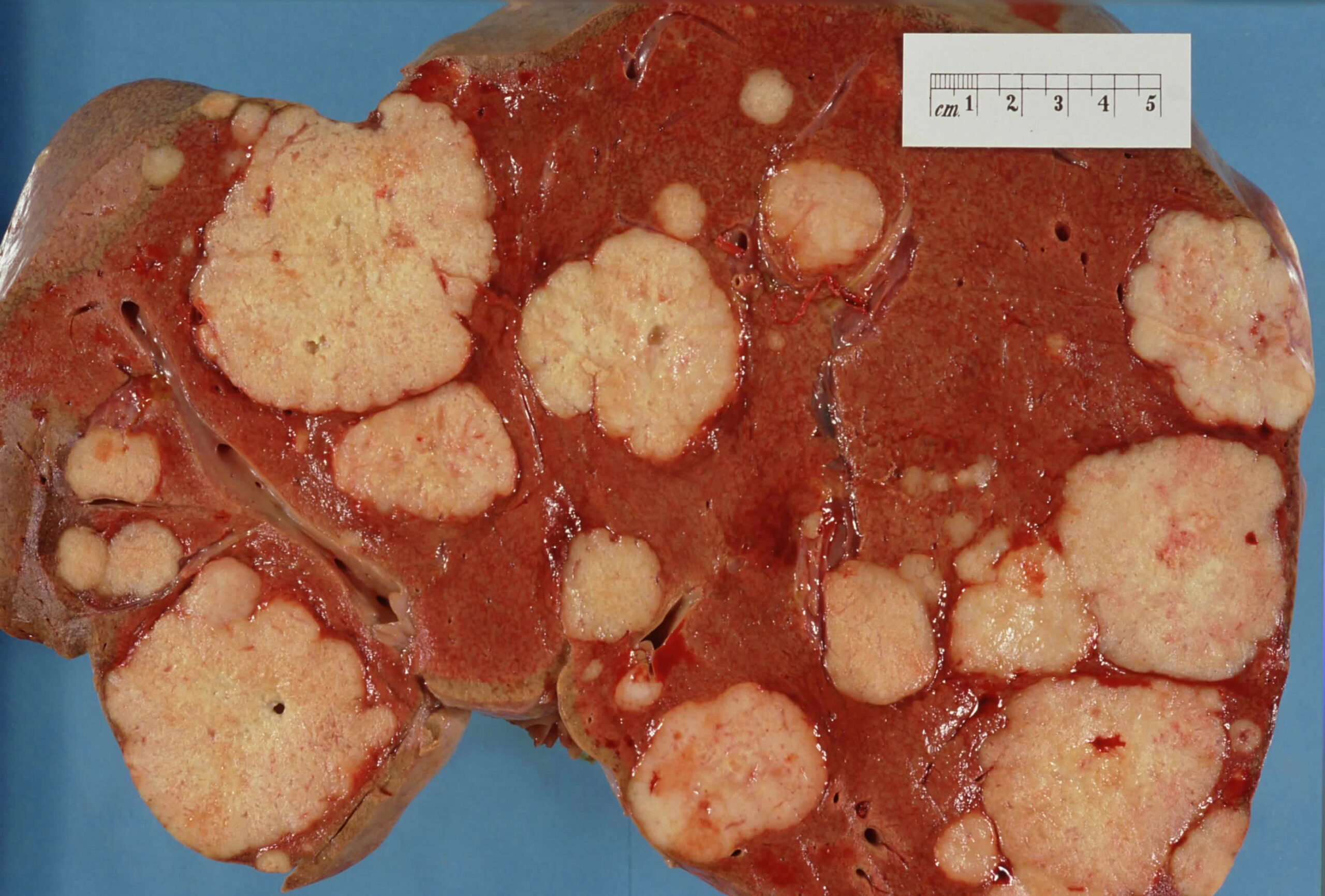
Metástasis en el hígado

Muestra macroscópica del hígado que muestra múltiples tumores metastásicos

Imagen: “Secondary tumor deposits in the liver from a primary cancer of the pancreas” por John Hayman. Licencia: Dominio Público

Diagnóstico Diferencial

Los LOS Neisseria siguientes son diagnósticos diferenciales importantes de una masa sólida en EN Erythema nodosum is an immune-mediated panniculitis (inflammation of the subcutaneous fat) caused by a type IV (delayed-type) hypersensitivity reaction. It commonly manifests in young women as tender, erythematous nodules on the shins. Erythema Nodosum el hígado:

Lesiones benignas:

  • Hemangioma Hemangioma A vascular anomaly due to proliferation of blood vessels that forms a tumor-like mass. The common types involve capillaries and veins. It can occur anywhere in the body but is most frequently noticed in the skin and subcutaneous tissue. Imaging of the Liver and Biliary Tract hepático (también conocido como “ hemangioma Hemangioma A vascular anomaly due to proliferation of blood vessels that forms a tumor-like mass. The common types involve capillaries and veins. It can occur anywhere in the body but is most frequently noticed in the skin and subcutaneous tissue. Imaging of the Liver and Biliary Tract cavernoso”): la lesión hepática benigna más común. La incidencia es mayor en EN Erythema nodosum is an immune-mediated panniculitis (inflammation of the subcutaneous fat) caused by a type IV (delayed-type) hypersensitivity reaction. It commonly manifests in young women as tender, erythematous nodules on the shins. Erythema Nodosum mujeres que en EN Erythema nodosum is an immune-mediated panniculitis (inflammation of the subcutaneous fat) caused by a type IV (delayed-type) hypersensitivity reaction. It commonly manifests in young women as tender, erythematous nodules on the shins. Erythema Nodosum hombres. La presentación suele ser asintomática y el pronóstico es excelente.
  • Hiperplasia nodular focal: una proliferación de hepatocitos hiperplásicos que rodean una cicatriz central estrellada. La incidencia es mayor en EN Erythema nodosum is an immune-mediated panniculitis (inflammation of the subcutaneous fat) caused by a type IV (delayed-type) hypersensitivity reaction. It commonly manifests in young women as tender, erythematous nodules on the shins. Erythema Nodosum mujeres que en EN Erythema nodosum is an immune-mediated panniculitis (inflammation of the subcutaneous fat) caused by a type IV (delayed-type) hypersensitivity reaction. It commonly manifests in young women as tender, erythematous nodules on the shins. Erythema Nodosum hombres.
  • Adenoma hepatocelular (adenoma hepático): lesiones solitarias que se desarrollan en EN Erythema nodosum is an immune-mediated panniculitis (inflammation of the subcutaneous fat) caused by a type IV (delayed-type) hypersensitivity reaction. It commonly manifests in young women as tender, erythematous nodules on the shins. Erythema Nodosum el hígado normal de mujeres jóvenes que usan medicamentos con estrógenos y pacientes con enfermedad por almacenamiento de glucógeno o síndrome metabólico.
  • Nódulos regenerativos: proliferaciones de hepatocitos y estroma que generalmente se observan en EN Erythema nodosum is an immune-mediated panniculitis (inflammation of the subcutaneous fat) caused by a type IV (delayed-type) hypersensitivity reaction. It commonly manifests in young women as tender, erythematous nodules on the shins. Erythema Nodosum la cirrosis como respuesta a una lesión hepática.

Lesiones malignas:

Colangiocarcinoma (cáncer de las vías biliares): surge de las células epiteliales de las vías biliares intrahepáticas y extrahepáticas. Los LOS Neisseria factores de riesgo en EN Erythema nodosum is an immune-mediated panniculitis (inflammation of the subcutaneous fat) caused by a type IV (delayed-type) hypersensitivity reaction. It commonly manifests in young women as tender, erythematous nodules on the shins. Erythema Nodosum los LOS Neisseria Estados Unidos incluyen colangitis esclerosante primaria y enfermedad hepática fibropoliquística (e.g., quistes de colédoco). La hepatolitiasis (colangitis piógena recurrente) es el mayor factor de riesgo de colangiocarcinoma en EN Erythema nodosum is an immune-mediated panniculitis (inflammation of the subcutaneous fat) caused by a type IV (delayed-type) hypersensitivity reaction. It commonly manifests in young women as tender, erythematous nodules on the shins. Erythema Nodosum Asia ASIA Spinal Cord Injuries.

Referencias

  1. Gill, R.M., Kakar S. (2020). Liver and Gallbladder. In Kumar, V., Abbas, A. K., Aster, J.C., (Eds.), Robbins & Cotran Pathologic Basis of Disease. 10th ed. pp. 868–872. Elsevier, Inc.
  2. Schwartz, J.M., Carithers, R.L. (2020). Epidemiology and risk factors for hepatocellular carcinoma. UpToDate. Retrieved November 8, 2020, from https://www.uptodate.com/contents/epidemiology-and-risk-factors-for-hepatocellular-carcinoma
  3. Schwartz, J.M., Carithers, R.L., Sirlin, C.B. (2019). Clinical features and diagnosis of hepatocellular carcinoma. UpToDate. Retrieved November 9, 2020, from https://www.uptodate.com/contents/clinical-features-and-diagnosis-of-hepatocellular-carcinoma
  4. The Global Cancer Observatory. (2020). Number of new cases of cancer in the U.S.A. Globoscan 2018. International Agency of Research on Cancer, World Health Organization. Retrieved on November 8, 2020, from https://gco.iarc.fr/today/data/factsheets/populations/840-united-states-of-america-fact-sheets.pdf
  5. Sempokuya, T., Wong, L.L. (2019). Ten-year survival and recurrence of hepatocellular cancer. Hepatoma Research. 5, 38. https://doi.org/10.20517/2394-5079.2019.013

¡Crea tu cuenta gratis o inicia una sesión para seguir leyendo!

Regístrate ahora y obtén acceso gratuito a Lecturio con páginas de concepto, videos médicos y cuestionarios para tu educación médica.

User Reviews

Que tengas una sesión de estudio alegre y navideña 🎁 Ahorra 50% en todos los planes >>

Details