
How Does NCLEX Scoring Work?
The NCLEX is a pass or fail exam that uses something called computerized adaptive testing, or CAT. This means that the test questions adapt to how well you answer the questions.
NCLEX uses adaptive testing. Under the 2026 RN and PN plans, an exam contains 85 to 150 items, and either result can occur at either limit.
There are three pass or fail rules for the NCLEX:
- 95% rule: if the computer determines that you passed 95% of the questions answered at the minimum questions mark, then your test will end.
- Maximum length rule: if your answers are right on the cusp, meaning you’re getting some correct and some incorrect, you may have to go to the maximum length before the computer can determine whether you’ve passed or failed. This means the test will shut off once you’ve reached the 145-question maximum.
- The maximum time rule: Once you hit the maximum time limit of five hours, your test will shut off and the computer will look at all of the questions you answered in that time frame to determine whether you passed or failed.
The NCLEX scoring system aims to assess the candidate’s ability to safely practice nursing at an entry level. The computer uses an ability estimate to determine whether each candidate meets the passing standard.
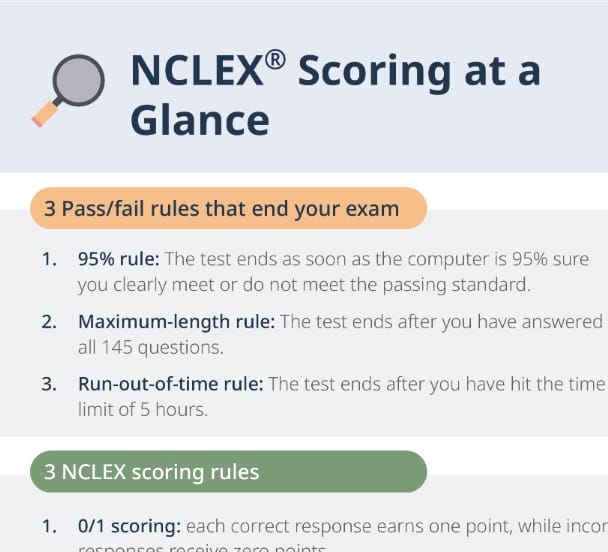
FREE Download: NCLEX scoring at a glance!
What Is “Partial Scoring?”
As part of the latest changes to the NCLEX exam, “partial credit scoring” was introduced. Previously, a response could be only fully correct or incorrect, resulting in either 1 or 0 points. In the new NCLEX, test takers can now also receive points for partially correct answers.
The three NCLEX scoring rules:
- 0/1 scoring: Each correct response earns one point, while incorrect responses receive zero points. The maximum achievable score per question equals the number of correct responses.
- +/- scoring: This scoring mode rewards correct responses with one point and deducts one point for each incorrect selection. Scores per question cannot dip below zero.
- Rationale scoring: assesses a student’s ability to identify cause–effect relationships, awarding one point for each pair of connected answer options.
Make sure to read up on the different ways partial scoring can be applied in the exam so you know how to strategically answer questions you are unsure about.
Tip: To get a realistic assessment of your exam-readiness, it is best to study with practice exams that also have partial scoring. Lecturio’s NCLEX question bank will track your performance like the real exam, so you know exactly where you stand!
What Is an NCLEX Passing Score?
The NCLEX is a pass or fail exam.
You’ll want to do everything you can to prepare by taking practice tests to get used to answering NCLEX-style questions. The NCLEX scoring system uses a unit of measurement called logits to score questions and determine whether candidates pass or fail. Logits report the differences between the candidate’s ability estimates and the question difficulty. The current passing standard of the NCLEX is -0.18 logits.
What Is the NCLEX Pass Rate?
NCSBN’s 2025 statistics report an 86.7% pass rate for first-time, U.S.-educated NCLEX-RN candidates. Label group and year whenever quoting a rate.
Get Ready for the NCLEX in Time
with Lecturio’s Next Gen NCLEX Preparation Package
How Soon Will You Know Your NCLEX Score?
Although it will take six weeks to receive your official NCLEX results, you should be able to access your “unofficial” results only two business days after taking it to find out whether you passed. Basically, this means that you can learn quickly whether you passed or failed but you won’t be able to officially practice as an RN until you’ve received your official results six weeks later.
Keep in mind, if you take your exam on a Friday or around the time of a holiday, it will prolong the amount of time required to find out your scores. You do have to pay an additional fee of $7.95 to access your quick results as well.
I remember being in nursing school and hearing some students talk about a method to use to know your scores immediately. They’d attempt to register for the exam a second time and it was said that if you weren’t able to sign up for it, that meant you passed. I’d like to advise readers against this method because it isn’t guaranteed to work and it could cause you to pay the exam fees a second time.
Is the NCLEX Timed?
NCLEX allows up to five hours including breaks. If time expires after at least 85 items, the final ability estimate determines the result; fewer than the minimum results in failure.
The test will look at all the questions you answered to determine whether you passed or not. So, if you reach the time limit, it’s not exactly a bad thing. It just means that the computer will calculate whether you passed or failed based on the questions you answered within the time frame.
How Many Questions Are on the NCLEX?
The adaptive algorithm stops under defined rules. The 2026 minimum is 85 items and maximum is 150; either result is possible at either endpoint.
What Happens If You Don’t Pass the NCLEX on Your First Try?
If you don’t pass the NCLEX on your first try, you will have the opportunity to take it again. You’ll receive a Candidate Performance Report, which is an individualized document showing how you performed in each content area. You can use this report as guidance to help you prepare for retaking the exam. You’ll have to reregister to retake the NCLEX and pay a fee. It is required that you wait a minimum of 45 days before retaking the NCLEX®.
2023 NCLEX Changes
In order to keep up with advancements in healthcare, the NCLEX is regularly updated to fit current nursing standards. The last big update to NCLEX occurred in 2023. The scoring system generally remained the same; however, there were some changes in the questions themselves. Rather than only having multiple choice questions, the new version of the NCLEX also includes questions that are answered with multiple responses, highlighting, drag-and-drop, drop down menus, and matrix/grid. For more information on the changes and their effects, read this article.
How to Prepare for the NCLEX
Obviously, nursing school is designed to help prepare you for NCLEX. However, it doesn’t stop there. There are additional steps that you can (and should) take to prepare for NCLEX, other than just attending and graduating from nursing school.
For me, taking an NCLEX prep course was incredibly helpful. The course I took was three days long and was composed of classroom time with a trained instructor who knew all about NCLEX testing strategy. She taught about the different types of questions and gave advice on what to think about when answering NCLEX questions. I thought the training course was super helpful, so I would recommend it to anyone else who is preparing to take the NCLEX.
Take the all-in-one online NCLEX Pharmacology review course
Get ready to crush Pharm on the NCLEX with Prof. Rhonda Laws.
My Experience Taking the NCLEX
I’ll be honest, after I took the NCLEX I definitely thought I had failed. In hindsight, I think I was just having test anxiety. The questions felt really difficult, and back when I took it, the question limit was 265, so I answered close to 200 questions before the test shut off. A lot of my classmates passed within the minimum 75 questions. I took the NCLEX on a Friday, so I had to wait until after the weekend to get my score back. I paid extra to get the quick results so that I could learn my score as soon as possible. I was happy to find out that I did in fact pass the NCLEX on my first try (despite my previous doubts). All this is to say, if I can do it, you can too! Try not to let the test anxiety get the best of you.
Final Thoughts
The moment you sit down to take the NCLEX exam is what you’ve been working toward the whole time you’ve been in nursing school–no pressure though! It’s natural to be pretty nervous for the exam, but try your best to stay focused and apply all of that great test-taking knowledge you acquired in nursing school. The scoring system for the NCLEX is complicated, and no one test will look the same. Luckily, if you pay to view your quick results you should find out whether you passed the exam or not within a few days of taking it.
Frequently Asked Questions (FAQs)
1. How is the NCLEX scored — pass or fail, or a numerical grade?
The NCLEX is a pure pass/fail exam with no numerical grade. It uses computerized adaptive testing (CAT), meaning question difficulty adjusts in real time based on how well you’re answering. Under the current test plans, exams contain between 85 and 150 items, and either a pass or fail result can occur at either the minimum or maximum length.
2. What is the NCLEX passing standard?
Rather than a simple percentage, the NCLEX uses a unit called logits to compare a candidate’s estimated ability against question difficulty. The current passing standard is set at -0.18 logits. Your result is determined the moment the computer is statistically confident you’re either above or below that threshold, or once you hit the maximum questions or time limit.
3. What is “partial credit scoring” on the NCLEX?
Partial credit scoring, introduced in recent NCLEX updates, allows test-takers to earn points for partially correct answers rather than only full credit or zero. It’s applied through three methods: 0/1 scoring (full point or none), +/- scoring (a point for each correct choice, minus a point for each incorrect one, never going below zero), and rationale scoring (which rewards correctly identifying cause-and-effect relationships between answer options).
4. How soon can I find out my NCLEX results?
Official results take about six weeks to arrive, but many candidates check “unofficial” quick results as early as two business days after testing for a $7.95 fee. Testing on a Friday or near a holiday can extend that wait. Until you receive your official results, you can’t practice as a licensed RN.
5. What happens if I don’t pass the NCLEX on my first attempt?
If you don’t pass, you’ll receive a Candidate Performance Report breaking down how you did in each content area, which you can use to guide your restudying. You’ll need to reregister and pay the exam fee again, and current policy requires waiting a minimum of 45 days before your next attempt.