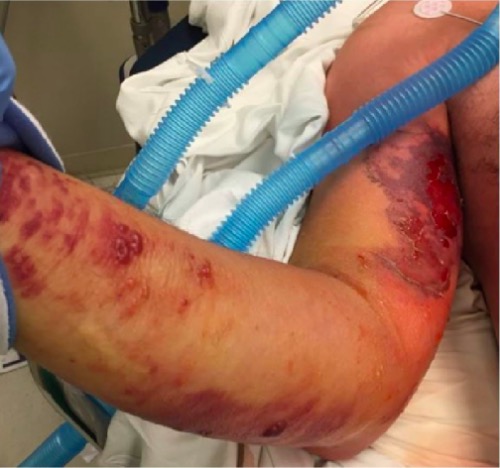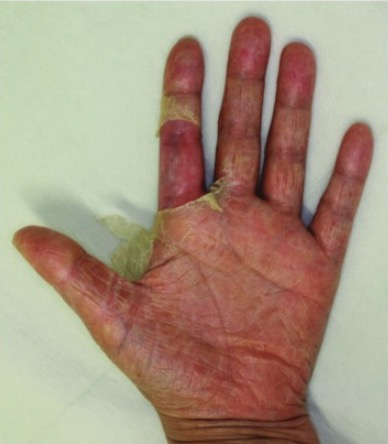



Síndrome do Choque Tóxico

A síndrome do choque tóxico (TSS) é uma doença aguda e multissistémica causada pelas bactérias produtoras de toxinas, Staphylococcus aureus e Streptococcus pyogenes. O TSS estafilocócico é mais comum e associado a tampões e "packing" nasal. O TSS TSS Toxic shock syndrome (TSS) is an acute, multi-systemic disease caused by the toxin-producing bacteria, Staphylococcus aureus and Streptococcus pyogenes. Staphylococcal TSS is more common and associated with tampons and nasal packing. Toxic Shock Syndrome estreptocócico é geralmente devido a infeções por estreptococos do grupo A invasivo (GAS), como bacteriémia e fasceíte necrotizante, e tem uma taxa de mortalidade mais MAIS Androgen Insensitivity Syndrome elevada. Pacientes com febre, taquicardia, hipotensão, erupção eritematosa e evidência de disfunção orgânica multi-sistémica. O diagnóstico é baseado em dados clínicos, laboratoriais e de cultura. A abordagem envolve a ressuscitação com fluidos intravenosos (IVF), antibióticos, suporte vasopressor Vasopressor Acute Cholangitis e identificação e manejo da potencial fonte infecciosa.

Last updated: Dec 15, 2025

Editorial responsibility: Stanley Oiseth, Lindsay Jones, Evelin Maza

Epidemiologia e Etiologia

Epidemiologia

  • Síndrome do choque tóxico estafilocócico ( TSS TSS Toxic shock syndrome (TSS) is an acute, multi-systemic disease caused by the toxin-producing bacteria, Staphylococcus aureus and Streptococcus pyogenes. Staphylococcal TSS is more common and associated with tampons and nasal packing. Toxic Shock Syndrome):
    • Mais MAIS Androgen Insensitivity Syndrome comum que o TSS TSS Toxic shock syndrome (TSS) is an acute, multi-systemic disease caused by the toxin-producing bacteria, Staphylococcus aureus and Streptococcus pyogenes. Staphylococcal TSS is more common and associated with tampons and nasal packing. Toxic Shock Syndrome estreptococócico
    • Incidência: 6-7 casos por 100.000 pessoas anualmente
      • Metade está associada à menstruação.
      • A incidência diminuiu com a retirada de tampões altamente absorventes.
    • Mais MAIS Androgen Insensitivity Syndrome comum em mulheres
    • Mortalidade: 1.8%
  • TSS TSS Toxic shock syndrome (TSS) is an acute, multi-systemic disease caused by the toxin-producing bacteria, Staphylococcus aureus and Streptococcus pyogenes. Staphylococcal TSS is more common and associated with tampons and nasal packing. Toxic Shock Syndrome estreptococócico:
    • Incidência: 4 casos por 100,000 pessoas anualmente
    • Desenvolve-se em até ⅓ de pacientes com infecções por Streptococcus Streptococcus Streptococcus is one of the two medically important genera of gram-positive cocci, the other being Staphylococcus. Streptococci are identified as different species on blood agar on the basis of their hemolytic pattern and sensitivity to optochin and bacitracin. There are many pathogenic species of streptococci, including S. pyogenes, S. agalactiae, S. pneumoniae, and the viridans streptococci. Streptococcus do grupo invasivo A (GAS)
      • bacteriémia porS. pyogenes
      • Fasceíte necrotizante
    • Mortalidade: 30%–79%

Etiologia

A síndrome do choque tóxico ( TSS TSS Toxic shock syndrome (TSS) is an acute, multi-systemic disease caused by the toxin-producing bacteria, Staphylococcus aureus and Streptococcus pyogenes. Staphylococcal TSS is more common and associated with tampons and nasal packing. Toxic Shock Syndrome) é uma doença aguda e multissistémica causada por bactérias produtoras de toxinas:

  • Staphylococcus aureus Staphylococcus aureus Potentially pathogenic bacteria found in nasal membranes, skin, hair follicles, and perineum of warm-blooded animals. They may cause a wide range of infections and intoxications. Brain Abscess
  • Streptococcus Streptococcus Streptococcus is one of the two medically important genera of gram-positive cocci, the other being Staphylococcus. Streptococci are identified as different species on blood agar on the basis of their hemolytic pattern and sensitivity to optochin and bacitracin. There are many pathogenic species of streptococci, including S. pyogenes, S. agalactiae, S. pneumoniae, and the viridans streptococci. Streptococcus pyogenes (GAS)

Fatores de risco:

  • TSS TSS Toxic shock syndrome (TSS) is an acute, multi-systemic disease caused by the toxin-producing bacteria, Staphylococcus aureus and Streptococcus pyogenes. Staphylococcal TSS is more common and associated with tampons and nasal packing. Toxic Shock Syndrome estafilocócica:
    • Uso prolongado de tampões e tampões altamente absorventes
    • Colonização vaginal com S. aureus S. aureus Potentially pathogenic bacteria found in nasal membranes, skin, hair follicles, and perineum of warm-blooded animals. They may cause a wide range of infections and intoxications. Staphylococcusprodutor de toxinas
    • “Packing” nasal
    • Infeções de feridas cirúrgicas e pós-parto
  • TSS TSS Toxic shock syndrome (TSS) is an acute, multi-systemic disease caused by the toxin-producing bacteria, Staphylococcus aureus and Streptococcus pyogenes. Staphylococcal TSS is more common and associated with tampons and nasal packing. Toxic Shock Syndrome estreptococócico:
    • Nenhum local de entrada é encontrado em 45% dos pacientes.
    • Trauma minor
    • Procedimentos Cirúrgicos
    • Infecções virais (por exemplo, varicela, gripe)

Patofisiologia

  • O TSS TSS Toxic shock syndrome (TSS) is an acute, multi-systemic disease caused by the toxin-producing bacteria, Staphylococcus aureus and Streptococcus pyogenes. Staphylococcal TSS is more common and associated with tampons and nasal packing. Toxic Shock Syndrome é um distúrbio imuno-mediado causado por um superantigénio (SAg):
    • S. aureus S. aureus Potentially pathogenic bacteria found in nasal membranes, skin, hair follicles, and perineum of warm-blooded animals. They may cause a wide range of infections and intoxications. Staphylococcus:
      • TSS TSS Toxic shock syndrome (TSS) is an acute, multi-systemic disease caused by the toxin-producing bacteria, Staphylococcus aureus and Streptococcus pyogenes. Staphylococcal TSS is more common and associated with tampons and nasal packing. Toxic Shock Syndrome toxina tipo 1 ( TSST-1 TSST-1 Toxic Shock Syndrome)
      • Enterotoxina B
    • GAS: exotoxinas estreptocócicas pirogénicas (Spe) A e C
  • O SAg liga-se ao complexo de histocompatibilidade principal (MHC) classe II em células apresentadoras de antígeno (APCs).
  • MHC nas APCs estabelece cross-link com a região β do receptor Receptor Receptors are proteins located either on the surface of or within a cell that can bind to signaling molecules known as ligands (e.g., hormones) and cause some type of response within the cell. Receptors da célula T ( TCR TCR Molecules on the surface of T-lymphocytes that recognize and combine with antigens. The receptors are non-covalently associated with a complex of several polypeptides collectively called CD3 antigens. Recognition of foreign antigen and the major histocompatibility complex is accomplished by a single heterodimeric antigen-receptor structure, composed of either alpha-beta or gamma-delta chains. Adaptive Cell-mediated Immunity).
  • Estimula a activação das células T e uma libertação exagerada de citocinas
  • Resulta numa resposta inflamatória excessiva com extravazamento capilar sistémico (choque) e lesão de órgãos

Apresentação Clínica

Tanto o TSS TSS Toxic shock syndrome (TSS) is an acute, multi-systemic disease caused by the toxin-producing bacteria, Staphylococcus aureus and Streptococcus pyogenes. Staphylococcal TSS is more common and associated with tampons and nasal packing. Toxic Shock Syndrome estafilocócico como o estreptococócico apresentam-se de forma semelhante, com um início rápido de sinais e sintomas (em horas).
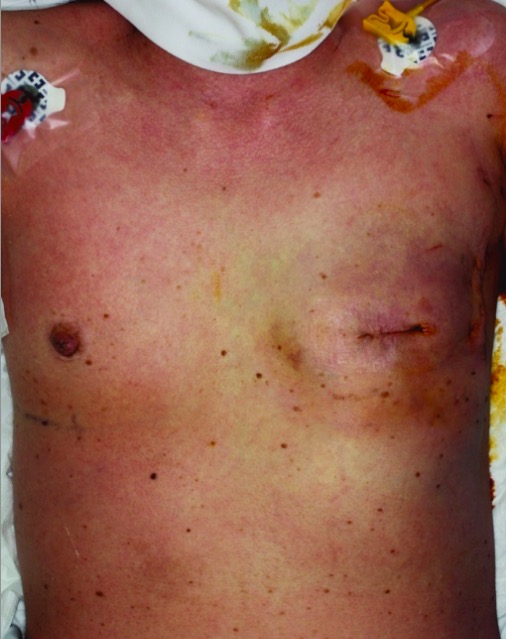
Sinais e sintomas gerais

  • Sintomas:
    • Febre e calafrios
    • Ortostase
    • Síncope
    • Náuseas e vómitos
    • Dor abdominal
    • Diarreia aquosa
    • Mialgias
  • Sinais vitais:
    • Temperatura:
      • ≥ 38,9°C (102°F)
      • A hipotermia também pode ser vista.
    • Hipotensão (pressão arterial sistólica ≤ 90 mm Hg): geralmente não reage à reanimação com líquido intravenoso (IVF)

Envolvimento de múltiplos órgãos

  • Cutâneo:
    • Eritroderma macular difuso (assemelha-se a uma queimadura solar)
    • Desquamação 1-2 semanas depois
    • Cianose
    • Edema Edema Edema is a condition in which excess serous fluid accumulates in the body cavity or interstitial space of connective tissues. Edema is a symptom observed in several medical conditions. It can be categorized into 2 types, namely, peripheral (in the extremities) and internal (in an organ or body cavity). Edema não depressível das extremidades
    • TSS TSS Toxic shock syndrome (TSS) is an acute, multi-systemic disease caused by the toxin-producing bacteria, Staphylococcus aureus and Streptococcus pyogenes. Staphylococcal TSS is more common and associated with tampons and nasal packing. Toxic Shock Syndrome estreptococócico:
      • Dor localizada e tumefacção numa área de trauma ou infeção
      • Deve avaliar-se para fasceíte necrotizante (eritema rapidamente progressivo, edema Edema Edema is a condition in which excess serous fluid accumulates in the body cavity or interstitial space of connective tissues. Edema is a symptom observed in several medical conditions. It can be categorized into 2 types, namely, peripheral (in the extremities) and internal (in an organ or body cavity). Edema, dor, crepitação, bolhas de pele, necrose ou equimose).
  • Membranas mucosas:
    • Hemorragia conjuntival ou esclerótica
    • Hiperémia vaginal
    • Hiperémia da mucosa orofaríngea
    • Úlceras superficiais ou de bolhas
  • Respiratório:
    • Síndrome do desconforto respiratório agudo (SDRA)
    • Derrames pleurais
    • Edema Edema Edema is a condition in which excess serous fluid accumulates in the body cavity or interstitial space of connective tissues. Edema is a symptom observed in several medical conditions. It can be categorized into 2 types, namely, peripheral (in the extremities) and internal (in an organ or body cavity). Edema pulmonar
  • Hepático: disfunção hepática
  • Hematologia: coagulopatia intravascular disseminada ( DIC DIC Disseminated intravascular coagulation (DIC) is a condition characterized by systemic bodywide activation of the coagulation cascade. This cascade results in both widespread microvascular thrombi contributing to multiple organ dysfunction and consumption of clotting factors and platelets, leading to hemorrhage. Disseminated Intravascular Coagulation)
  • Renal: insuficiência renal
  • Neurológico:
    • Dor de cabeça
    • Encefalopatia:
      • Sonolência
      • Confusão
      • Irritabilidade
      • Alucinações

Diagnóstico

Laboratory evaluation

  • Sangue e culturas de feridas:
    • O isolamento de S. aureus S. aureus Potentially pathogenic bacteria found in nasal membranes, skin, hair follicles, and perineum of warm-blooded animals. They may cause a wide range of infections and intoxications. Staphylococcus não é necessário para um diagnóstico de TSS TSS Toxic shock syndrome (TSS) is an acute, multi-systemic disease caused by the toxin-producing bacteria, Staphylococcus aureus and Streptococcus pyogenes. Staphylococcal TSS is more common and associated with tampons and nasal packing. Toxic Shock Syndrome estafilocócico.
    • O isolamento de GAS é utilizado para confirmar o diagnóstico do TSS TSS Toxic shock syndrome (TSS) is an acute, multi-systemic disease caused by the toxin-producing bacteria, Staphylococcus aureus and Streptococcus pyogenes. Staphylococcal TSS is more common and associated with tampons and nasal packing. Toxic Shock Syndrome estreptocócico.
  • Contagem completa de células sanguíneas (hemograma):
    • Leucopénia ou leucocitose com desvio esquerdo
    • Anemia Anemia Anemia is a condition in which individuals have low Hb levels, which can arise from various causes. Anemia is accompanied by a reduced number of RBCs and may manifest with fatigue, shortness of breath, pallor, and weakness. Subtypes are classified by the size of RBCs, chronicity, and etiology. Anemia: Overview and Types
    • Trombocitopénia
  • Painel metabólico básico:
    • ↑ nitrogénio ureico no sangue (BUN) e creatinina
    • ↓ Sódio, cálcio e fósforo
  • Testes Testes Gonadal Hormones de função hepática:
    • ↑ Aspartato e alanina aminotransferases ( AST AST Enzymes of the transferase class that catalyze the conversion of l-aspartate and 2-ketoglutarate to oxaloacetate and l-glutamate. Liver Function Tests e ALT ALT An enzyme that catalyzes the conversion of l-alanine and 2-oxoglutarate to pyruvate and l-glutamate. Liver Function Tests), bilirrubina total
    • ↓ Albumina
  • ↑ Fosfoquinase de creatina (CPK)
  • Estudos de coagulação a avaliar para CDI

Testes Testes Gonadal Hormones adicionais

  • Punção lombar em pacientes com febre e alteração do estado mental para descartar meningite
  • Radiografia de tórax para avaliar para SDRA em pacientes com angústia respiratória
  • Tomografia computorizada (TC) ou ressonância magnética (RM) de tecidos moles Moles Primary Skin Lesions para localizar locais de infecção

Critérios clínicos

Os seguintes critérios são usados para definir o TSS TSS Toxic shock syndrome (TSS) is an acute, multi-systemic disease caused by the toxin-producing bacteria, Staphylococcus aureus and Streptococcus pyogenes. Staphylococcal TSS is more common and associated with tampons and nasal packing. Toxic Shock Syndrome, segundo o Centro de Controle e Prevenção de Doenças (CDC):

TSS TSS Toxic shock syndrome (TSS) is an acute, multi-systemic disease caused by the toxin-producing bacteria, Staphylococcus aureus and Streptococcus pyogenes. Staphylococcal TSS is more common and associated with tampons and nasal packing. Toxic Shock Syndrome estafilocócica:

  • Febre ≥ 38,9°C (102°F)
  • Erupção macular difusa
  • Descamação 1-2 semanas após o início da erupção
  • Hipotensão grave
  • Disfunção de múltiplos órgãos (≥ 3 dos seguintes):
    • Renal: ↑ BUN ou creatinina
    • Hepática: ↑ AST AST Enzymes of the transferase class that catalyze the conversion of l-aspartate and 2-ketoglutarate to oxaloacetate and l-glutamate. Liver Function Tests, ALT ALT An enzyme that catalyzes the conversion of l-alanine and 2-oxoglutarate to pyruvate and l-glutamate. Liver Function Tests, ou bilirrubina total
    • Gastrointestinal: vómitos ou diarréia
    • Muscular: mialgia severa ou ↑ CPK
    • Membrana mucosa: hiperémia vaginal, orofaríngea ou conjuntival
    • Hematologia: trombocitopénia
    • Sistema nervoso central: alterado, confuso, desorientado ou não-responsivo
  • Culturas de sangue e líquido cefalorraquidiano negativas (excepto S. aureus S. aureus Potentially pathogenic bacteria found in nasal membranes, skin, hair follicles, and perineum of warm-blooded animals. They may cause a wide range of infections and intoxications. Staphylococcus)
  • Testes Testes Gonadal Hormones negativos para febre maculosa das Montanhas Rochosas, sarampo ou leptospirose

TSS TSS Toxic shock syndrome (TSS) is an acute, multi-systemic disease caused by the toxin-producing bacteria, Staphylococcus aureus and Streptococcus pyogenes. Staphylococcal TSS is more common and associated with tampons and nasal packing. Toxic Shock Syndrome estreptococócico:

  • Hipotensão
  • Disfunção de múltiplos órgãos (≥ 2 dos seguintes):
    • Respiratório: SDRA ou derrames pleurais com hipoalbuminémia
    • Cutâneo: uma erupção cutânea eritematosa que pode descamar, necrose de tecidos moles Moles Primary Skin Lesions, gangrena ou fasceíte necrosante.
    • Renal: ↑ creatinina
    • Hepática: ↑ AST AST Enzymes of the transferase class that catalyze the conversion of l-aspartate and 2-ketoglutarate to oxaloacetate and l-glutamate. Liver Function Tests, ALT ALT An enzyme that catalyzes the conversion of l-alanine and 2-oxoglutarate to pyruvate and l-glutamate. Liver Function Tests, ou bilirrubina total
    • Hematológica: trombocitopénia ou CID
  • Isolamento de GAS de um local normalmente estéril

Tratamento

  • Abordagem de cuidados intensivos:
    • Reanimação IVF
    • Antibióticos:
      • Clindamicina (suprime a produção de toxinas)
      • Mais MAIS Androgen Insensitivity Syndrome vancomicina
      • Mais MAIS Androgen Insensitivity Syndrome piperacilina-tazobactam, cefepime Cefepime A fourth-generation cephalosporin antibacterial agent that is used in the treatment of infections, including those of the abdomen, urinary tract, respiratory tract, and skin. It is effective against pseudomonas aeruginosa and may also be used in the empiric treatment of febrile neutropenia. Cephalosporins, ou meropenemo
      • O regime deve ser ajustado assim que os dados de cultura estiverem disponíveis.
    • Suporte Vasopressor Vasopressor Acute Cholangitis
    • Suporte ventilatório para pacientes com SDRA
    • A hemodiálise pode ser necessária para a insuficiência renal.
    • Imunoglobulina intravenosa ( IVIG IVIG Dermatomyositis):
      • Pode ser usada em casos graves
      • Favorecido no TSS TSS Toxic shock syndrome (TSS) is an acute, multi-systemic disease caused by the toxin-producing bacteria, Staphylococcus aureus and Streptococcus pyogenes. Staphylococcal TSS is more common and associated with tampons and nasal packing. Toxic Shock Syndrome estreptococócico
  • Examine para causa:
  • Controlo da fonte:
    • Irrigação de feridas cirúrgicas
    • Desbridação de tecido desvitalizado
    • Irrigação de locais potencialmente colonizados (por exemplo, seios nasais, vagina Vagina The vagina is the female genital canal, extending from the vulva externally to the cervix uteri internally. The structures have sexual, reproductive, and urinary functions and a rich blood supply, mainly arising from the internal iliac artery. Vagina, Vulva, and Pelvic Floor: Anatomy)

Diagnóstico Diferencial

  • Choque séptico: disfunção orgânica resultante de uma resposta sistémica desregulada do hospedeiro a uma infeção (geralmente bacteriana), resultando em vasodilatação, vazamento vascular e depleção de volume. Os pacientes comumente apresentam febre, taquicardia, taquipneia, hipotensão hidro-responsiva e alteração do estado mental. O reconhecimento imediato é essencial e combina a apresentação clínica com dados infeciosos de suporte. O manejo requer ressuscitação agressiva de IVF, vasopressores e antibióticos.
  • Síndrome de Stevens-Johnsons: uma reacção de hipersensibilidade cutânea, imuno-mediada que é normalmente desencadeada por medicamentos, incluindo antiepiléticos e antibióticos. A síndrome de Stevens-Johnson corre num espectro com necrólise epidérmica tóxica (TEN) com base na quantidade de área de superfície corporal (BSA) envolvida. Os pacientes apresentarão um pródromo tipo gripe, seguido de bulla Bulla Blister filled with fluid, > 1 cm diameter Generalized and Localized Rashes cutânea e descamação na face, tórax e membranas mucosas. O diagnóstico é clínico. A retirada imediata do agente causador é necessária e a abordagem é largamente de suporte.
  • Meningite meningocócica: uma infeção bacteriana das meninges Meninges The brain and the spinal cord are enveloped by 3 overlapping layers of connective tissue called the meninges. The layers are, from the most external layer to the most internal layer, the dura mater, arachnoid mater, and pia mater. Between these layers are 3 potential spaces called the epidural, subdural, and subarachnoid spaces. Meninges: Anatomy e do espaço subaracnoideo, devido à Neisseria meningitidis Neisseria meningitidis A species of gram-negative, aerobic bacteria. It is a commensal and pathogen only of humans, and can be carried asymptomatically in the nasopharynx. When found in cerebrospinal fluid it is the causative agent of cerebrospinal meningitis. It is also found in venereal discharges and blood. There are at least 13 serogroups based on antigenic differences in the capsular polysaccharides; the ones causing most meningitis infections being a, b, c, y, and w-135. Each serogroup can be further classified by serotype, serosubtype, and immunotype. Neisseria. Os pacientes apresentam sintomas insidiosamente progressivos, incluindo febre, dor de cabeça, fotofobia, mal-estar, rigidez nucal e uma erupção cutânea petequial ou purpúrica. O diagnóstico é baseado na análise do líquido cefalorraquidiano e culturas. A abordagem inclui antibióticos e corticosteróides.
  • Febre maculosa das Montanhas Rochosas: doença causada pelo Rickettsia rickettsii Rickettsia rickettsii A species of gram-negative, aerobic bacteria that is the etiologic agent of rocky mountain spotted fever. Its cells are slightly smaller and more uniform in size than those of rickettsia prowazekii. Rickettsia que se apresenta com febre, fadiga, dor de cabeça e uma erupção cutânea após uma picada de carraça. A erupção começa nas extremidades distais e se espalha de forma centralizada. O diagnóstico é feito com base nas características clínicas, biópsia da erupção cutânea e testes Testes Gonadal Hormones serológicos. O tratamento envolve antibióticos, incluindo a doxiciclina.
  • Leptospirose: uma doença zoonótica causada pela Leptospira Leptospira Leptospira is a spiral or question mark-shaped, gram-negative spirochete with hook-shaped ends. The disease, leptospirosis, is a zoonosis, infecting animals. Rodents are the most important reservoir. Bacteria shed in the urine of rodents and other animals can be transmitted to humans via contaminated water. Leptospira/Leptospirosis. Os roedores são o reservatório mais MAIS Androgen Insensitivity Syndrome importante. Os sintomas podem incluir uma doença tipo gripe e erupção cutânea. A doença sistémica ocorre em uma minoria de pacientes e inclui hemorragia, insuficiência renal e icterícia. O diagnóstico é feito com serologia e microscopia de campo escuro. A abordagem é feita principalmente com penicilina.
  • Sarampo: uma infeção viral altamente contagiosa causada por um paramixovírus que apresenta febre, tosse, coriza, conjuntivite e uma erupção cutânea maculopapular Maculopapular Dermatologic Examination que acabará por descamar. O diagnóstico é clínico e apoiado por testes Testes Gonadal Hormones serológicos. A abordagem envolve isolamento e tratamento de suporte.

Referências

  1. Chu, V.H. (2025). Staphylococcal toxic shock syndrome. In Baron, E.L. (Ed.), Uptodate. Retrieved April 11, 2025, from https://www.uptodate.com/contents/staphylococcal-toxic-shock-syndrome
  2. Stevens, D.L. (2025). Invasive group A streptococcal infection and toxic shock syndrome. Epidemiology, clinical manifestations, and diagnosis. In Baron, E.L. (Ed.), Uptodate. Retrieved April 11, 2025, from https://www.uptodate.com/contents/invasive-group-a-streptococcal-infection-and-toxic-shock-syndrome-epidemiology-clinical-manifestations-and-diagnosis
  3. Stevens, D.L. (2025). Invasive group A streptococcal infection and toxic shock syndrome: Treatment and prevention. In Baron, E.L. (Ed.), Uptodate. Retrieved April 11, 2025, from https://www.uptodate.com/contents/invasive-group-a-streptococcal-infection-and-toxic-shock-syndrome-treatment-and-prevention
  4. Centers for Disease Control and Prevention. (2021). Toxic shock syndrome (other than streptococcal) (TSS) 2011 case definition. https://ndc.services.cdc.gov/case-definitions/toxic-shock-syndrome-2011/
  5. Centers for Disease Control and Prevention. (2021). Streptococcal toxic shock syndrome (STSS) (Streptococcus pyogenes) 2010 case definition. https://ndc.services.cdc.gov/case-definitions/streptococcal-toxic-shock-syndrome-2010/
  6. DeVries, A.S., Lesher, L., Schlievert, P.M., Rogers, T., Villaume, L.G., Danila, R., & Lynfield, R. (2011). Staphylococcal toxic shock syndrome 2000-2006: Epidemiology, clinical features, and molecular characteristics. PloS one, 6(8), e22997. https://doi.org/10.1371/journal.pone.0022997
  7. Bush, L.M., & Vazquez-Pertejo, M.T. (2023). Toxic shock syndrome (TSS). [online] MSD Manual Professional Version. Retrieved April 11, 2025, from https://www.merckmanuals.com/professional/infectious-diseases/gram-positive-cocci/toxic-shock-syndrome-tss
  8. Venkataraman, R., & Sharma, S. (2025). Toxic shock syndrome. In Pinsky, M.R. (Ed.), Medscape. Retrieved April 11, 2025, from https://emedicine.medscape.com/article/169177-overview
  9. Ameda, K., Yamada, Y., Uehara, Y., Ohno, T., Hoya, M., Oda, H., & Mishima, M. (2021). Group A streptococcal toxic shock syndrome after a routine gynecological procedure. Case Reports in Obstetrics and Gynecology, 2021, Article 9980015. https://doi.org/10.1155/2021/9980015

Crie sua conta gratuita ou faça login para continuar lendo!

Cadastre-se agora e tenha acesso grátis ao Lecturio, com páginas de conceitos, vídeos de medicina e questões para sua educação médica.

Aprende mais com a Lecturio:

Multiple devices displaying human anatomy and health education content.

Complementa o teu estudo da faculdade com o companheiro de estudo tudo-em-um da Lecturio, através de métodos de ensino baseados em evidência.

Estuda onde quiseres

Two iPhones display medical education apps, one showing anatomy, the other Bookmatcher.

A Lecturio Medical complementa o teu estudo através de métodos de ensino baseados em evidência, vídeos de palestras, perguntas e muito mais – tudo combinado num só lugar e fácil de usar.

User Reviews

Have a holly, jolly study session 🎁 Save 50% on all plans now >>

Que tengas una sesión de estudio alegre y navideña 🎁 Ahorra 50% en todos los planes >>

Details