


Células T

As células T, também conhecidas como linfócitos T, são componentes importantes do sistema imunológico adaptativo. A sua  produção inicia-se a partir das células-tronco hematopoiéticas na medula óssea, das quais surgem as células progenitoras de células T. Estas células migram para o timo para posterior maturação. Uma célula T madura funcional desenvolve-se a partir de um processo gradual: é formado um recetor de célula T ( TCR TCR Molecules on the surface of T-lymphocytes that recognize and combine with antigens. The receptors are non-covalently associated with a complex of several polypeptides collectively called CD3 antigens. Recognition of foreign antigen and the major histocompatibility complex is accomplished by a single heterodimeric antigen-receptor structure, composed of either alpha-beta or gamma-delta chains. Adaptive Cell-mediated Immunity, pela sigla em inglês), que seleciona células T com determinada afinidade para autoantigénios associados a moléculas de maior histocompatibilidade (seleção positiva) e que expressam CD4 ou CD8. Nesta fase, as células predispostas à autoimunidade sofrem apoptose (seleção negativa). De seguida as células T naive maduras são libertadas no timo e circulam até aos órgãos linfoides secundários para serem ativadas. A ativação ocorre quando estão presentes dois sinais (responsáveis por desencadear uma resposta imune): ligação específica do antigénio ao TCR TCR Molecules on the surface of T-lymphocytes that recognize and combine with antigens. The receptors are non-covalently associated with a complex of several polypeptides collectively called CD3 antigens. Recognition of foreign antigen and the major histocompatibility complex is accomplished by a single heterodimeric antigen-receptor structure, composed of either alpha-beta or gamma-delta chains. Adaptive Cell-mediated Immunity e co-estimulação. Nas células T CD8+ é necessária estimulação adicional de citocinas. A célula T madura indiferenciada (Th0) desenvolve-se em células com diferentes funções, dependendo das citocinas a que são expostas durante a estimulação antigénica: As células CD4+ tornam-se células T auxiliares (Th) e as células CD8+ tornam-se células citotóxicas ou citolíticas. As células Th diferenciam-se noutros subtipos; os mais MAIS Androgen Insensitivity Syndrome conhecidos são Th1 Th1 A subset of helper-inducer T-lymphocytes which synthesize and secrete interleukin-2; interferon-gamma; and interleukin-12. Due to their ability to kill antigen-presenting cells and their lymphokine-mediated effector activity, th1 cells are associated with vigorous delayed-type hypersensitivity reactions. T cells: Types and Functions, Th2 Th2 A subset of helper-inducer T-lymphocytes which synthesize and secrete the interleukins il-4; il-5; il-6; and il-10. These cytokines influence b-cell development and antibody production as well as augmenting humoral responses. T cells: Types and Functions, Th17 Th17 A subset of helper-effector T-lymphocytes which synthesize and secrete interleukins il-17; il-17f; and il-22. These cytokines are involved in host defenses and tissue inflammation in autoimmune diseases. T cells: Types and Functions, células Th foliculares e células T reguladoras. Outros tipos incluem células T natural killer e células T de memória. As células T diferenciadas maduras garantem uma resposta imediata e eficaz a agentes patogénicos, células tumorais e tecidos estranhos e fornecem memória imunológica.

Last updated: Aug 1, 2022

Editorial responsibility: Stanley Oiseth, Lindsay Jones, Evelin Maza

Desenvolvimento das Células T

Introdução

  • Células T (derivadas do timo): responsáveis pela imunidade mediada por células
  • Produção: células-tronco hematopoiéticas (na medula óssea) → progenitor linfoide comum → células progenitoras tímicas precoces → timo
  • No timo:
    • São observadas células progenitoras de células T por volta das 9 semanas de gestação.
    • As células T em desenvolvimento no timo são também conhecidas como timócitos.
    • Ocorrem rearranjos entre genes Genes A category of nucleic acid sequences that function as units of heredity and which code for the basic instructions for the development, reproduction, and maintenance of organisms. DNA Types and Structure para formar o recetor de células T ( TCR TCR Molecules on the surface of T-lymphocytes that recognize and combine with antigens. The receptors are non-covalently associated with a complex of several polypeptides collectively called CD3 antigens. Recognition of foreign antigen and the major histocompatibility complex is accomplished by a single heterodimeric antigen-receptor structure, composed of either alpha-beta or gamma-delta chains. Adaptive Cell-mediated Immunity, pela sigla em inglês):
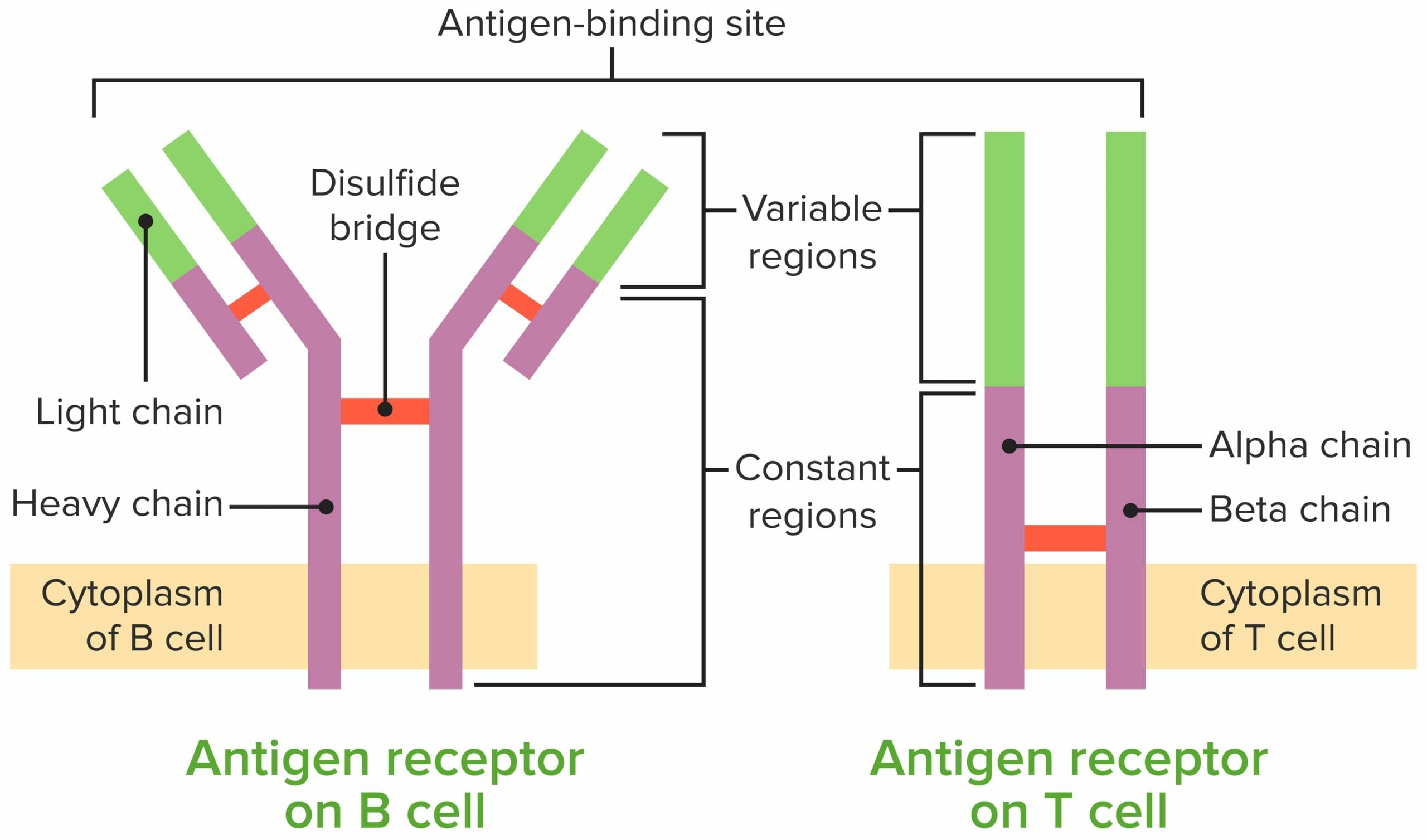
      • A maioria (> 85%) das células T contém cadeias ɑ e β, bem como 1 dos co-recetores CD4 ou CD8.
      • As restantes células T contêm cadeias ɣ e δ.
      • TCR TCR Molecules on the surface of T-lymphocytes that recognize and combine with antigens. The receptors are non-covalently associated with a complex of several polypeptides collectively called CD3 antigens. Recognition of foreign antigen and the major histocompatibility complex is accomplished by a single heterodimeric antigen-receptor structure, composed of either alpha-beta or gamma-delta chains. Adaptive Cell-mediated Immunity + CD3 CD3 Complex of at least five membrane-bound polypeptides in mature T-lymphocytes that are non-covalently associated with one another and with the T-cell receptor. The CD3 complex includes the gamma, delta, epsilon, zeta, and eta chains (subunits). When antigen binds to the T-cell receptor, the CD3 complex transduces the activating signals to the cytoplasm of the T-cell. The CD3 gamma and delta chains (subunits) are separate from and not related to the gamma/delta chains of the T-cell receptor. T cells: Types and Functions formam o complexo TCR TCR Molecules on the surface of T-lymphocytes that recognize and combine with antigens. The receptors are non-covalently associated with a complex of several polypeptides collectively called CD3 antigens. Recognition of foreign antigen and the major histocompatibility complex is accomplished by a single heterodimeric antigen-receptor structure, composed of either alpha-beta or gamma-delta chains. Adaptive Cell-mediated Immunity.
      • CD3 CD3 Complex of at least five membrane-bound polypeptides in mature T-lymphocytes that are non-covalently associated with one another and with the T-cell receptor. The CD3 complex includes the gamma, delta, epsilon, zeta, and eta chains (subunits). When antigen binds to the T-cell receptor, the CD3 complex transduces the activating signals to the cytoplasm of the T-cell. The CD3 gamma and delta chains (subunits) are separate from and not related to the gamma/delta chains of the T-cell receptor. T cells: Types and Functions: marcador mais MAIS Androgen Insensitivity Syndrome frequentemente usado para identificar células T

Desenvolvimento

O processo inicial ocorre no córtex externo do timo e as células movem-se para o córtex mais MAIS Androgen Insensitivity Syndrome profundo à medida que amadurecem.
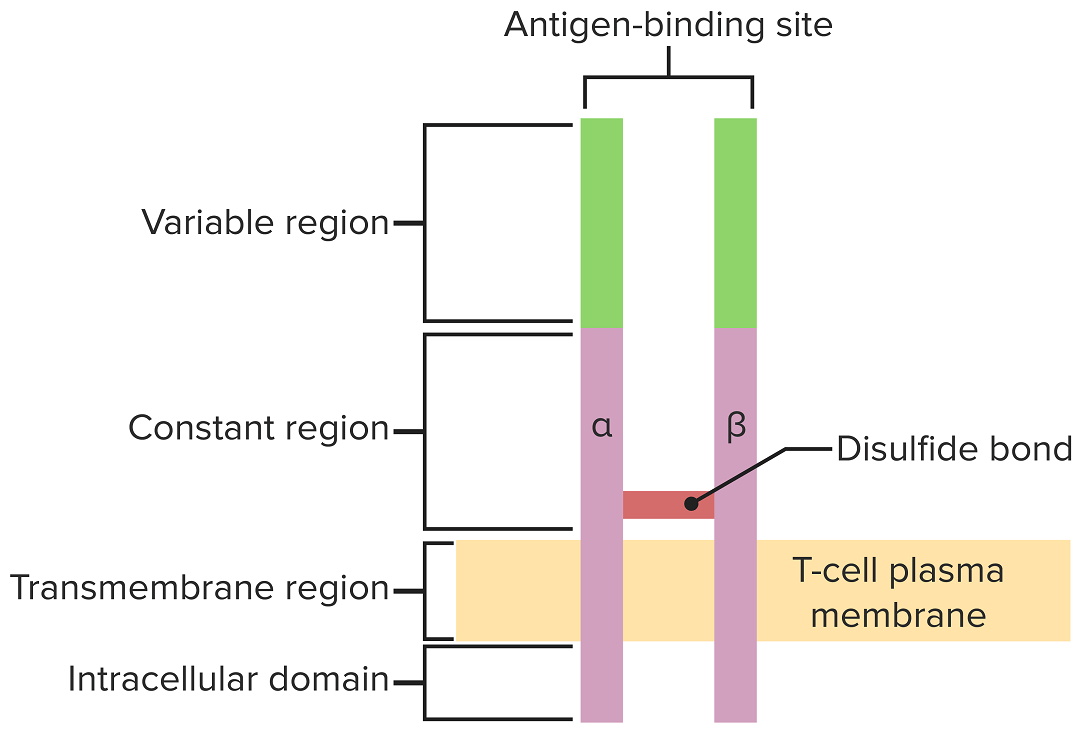
  • No timo, as células progenitoras expressam CD3 CD3 Complex of at least five membrane-bound polypeptides in mature T-lymphocytes that are non-covalently associated with one another and with the T-cell receptor. The CD3 complex includes the gamma, delta, epsilon, zeta, and eta chains (subunits). When antigen binds to the T-cell receptor, the CD3 complex transduces the activating signals to the cytoplasm of the T-cell. The CD3 gamma and delta chains (subunits) are separate from and not related to the gamma/delta chains of the T-cell receptor. T cells: Types and Functions, mas carecem de expressão na superfície celular de moléculas CD4 e CD8 e, portanto, são apelidades de células/timócitos duplo-negativos (DN).
  • Posteriormente ocorre o rearranjo dos genes Genes A category of nucleic acid sequences that function as units of heredity and which code for the basic instructions for the development, reproduction, and maintenance of organisms. DNA Types and Structure TCR TCR Molecules on the surface of T-lymphocytes that recognize and combine with antigens. The receptors are non-covalently associated with a complex of several polypeptides collectively called CD3 antigens. Recognition of foreign antigen and the major histocompatibility complex is accomplished by a single heterodimeric antigen-receptor structure, composed of either alpha-beta or gamma-delta chains. Adaptive Cell-mediated Immunity das células DN.
    • Assim como as imunoglobulinas, as proteínas TCR TCR Molecules on the surface of T-lymphocytes that recognize and combine with antigens. The receptors are non-covalently associated with a complex of several polypeptides collectively called CD3 antigens. Recognition of foreign antigen and the major histocompatibility complex is accomplished by a single heterodimeric antigen-receptor structure, composed of either alpha-beta or gamma-delta chains. Adaptive Cell-mediated Immunity são codificadas nas seguintes regiões de genes Genes A category of nucleic acid sequences that function as units of heredity and which code for the basic instructions for the development, reproduction, and maintenance of organisms. DNA Types and Structure:
      • Variável (V)
      • Diversidade (D)
      • Juntando-se (J)
      • Constante (C)
    • A cadeia β sofre rearranjos VDJ, que envolvem o local de ligação ao antigénio.
    • A cadeia ɑ envolve rearranjos VJ no local de ligação ao antigénio.
    • Ocorre ainda rearranjos numa minoria de células T com cadeias δ e ɣ.
    • Este processo contribui para uma maior diversidade de TCR TCR Molecules on the surface of T-lymphocytes that recognize and combine with antigens. The receptors are non-covalently associated with a complex of several polypeptides collectively called CD3 antigens. Recognition of foreign antigen and the major histocompatibility complex is accomplished by a single heterodimeric antigen-receptor structure, composed of either alpha-beta or gamma-delta chains. Adaptive Cell-mediated Immunity.
  • Existem 4 estadios DN, e estes podem ser distinguidos pela expressão de CD44 CD44 T cells: Types and Functions e CD25:
  • No estadio DN3 ocorrem rearranjos da cadeia β (pré-TCR); um erro nesta fase resultará em apoptose.
  • No estadio DN4 os rearranjos da cadeia ɑ são concluídos:
    • São produzidos sinais para avançar com a maturação.
    • O rearranjo dos genes Genes A category of nucleic acid sequences that function as units of heredity and which code for the basic instructions for the development, reproduction, and maintenance of organisms. DNA Types and Structure da cadeia α do TCR TCR Molecules on the surface of T-lymphocytes that recognize and combine with antigens. The receptors are non-covalently associated with a complex of several polypeptides collectively called CD3 antigens. Recognition of foreign antigen and the major histocompatibility complex is accomplished by a single heterodimeric antigen-receptor structure, composed of either alpha-beta or gamma-delta chains. Adaptive Cell-mediated Immunity corresponde à regulação positiva da expressão de CD4 e CD8 (tornando-se células duplamente positivas (DP)).
    • Se os rearranjos do gene Gene A category of nucleic acid sequences that function as units of heredity and which code for the basic instructions for the development, reproduction, and maintenance of organisms. Basic Terms of Genetics da cadeia ɑ não ocorrerem, a célula morre.
  • O complexo recetor α–β TCR TCR Molecules on the surface of T-lymphocytes that recognize and combine with antigens. The receptors are non-covalently associated with a complex of several polypeptides collectively called CD3 antigens. Recognition of foreign antigen and the major histocompatibility complex is accomplished by a single heterodimeric antigen-receptor structure, composed of either alpha-beta or gamma-delta chains. Adaptive Cell-mediated Immunity CD3 CD3 Complex of at least five membrane-bound polypeptides in mature T-lymphocytes that are non-covalently associated with one another and with the T-cell receptor. The CD3 complex includes the gamma, delta, epsilon, zeta, and eta chains (subunits). When antigen binds to the T-cell receptor, the CD3 complex transduces the activating signals to the cytoplasm of the T-cell. The CD3 gamma and delta chains (subunits) are separate from and not related to the gamma/delta chains of the T-cell receptor. T cells: Types and Functions é completado quando as cadeias ɑ se unem com as cadeias β.
  • Estadios de maturação subsequentes:
    • Seleção positiva:
      • No córtex do timo
      • São selecionadas as células T com TCR TCR Molecules on the surface of T-lymphocytes that recognize and combine with antigens. The receptors are non-covalently associated with a complex of several polypeptides collectively called CD3 antigens. Recognition of foreign antigen and the major histocompatibility complex is accomplished by a single heterodimeric antigen-receptor structure, composed of either alpha-beta or gamma-delta chains. Adaptive Cell-mediated Immunity com interação moderada (afinidade suficiente) com autoantigénios (no contexto de moléculas de MHC).
    • Seleção negativa:
      • Na medula
      • Células T com TCR TCR Molecules on the surface of T-lymphocytes that recognize and combine with antigens. The receptors are non-covalently associated with a complex of several polypeptides collectively called CD3 antigens. Recognition of foreign antigen and the major histocompatibility complex is accomplished by a single heterodimeric antigen-receptor structure, composed of either alpha-beta or gamma-delta chains. Adaptive Cell-mediated Immunity com alta afinidade ou forte interação com autoantigénios → apoptose
      • Este mecanismo de tolerância central (no timo) promove a remoção de células T que reagem fortemente aos auto-antigénios identificados.
      • Previne a libertação de células T disfuncionais (que reconhecem autoantigénios e podem ativar a autoimunidade)
      • Mecanismo facilitado pela proteína reguladora autoimune (AIRE)

Estadios

Para atingir a funcionalidade, as células T passam por diversas etapas, desde que são libertadas da medula óssea como células progenitoras até ao seu desenvolvimento no timo. A tabela abaixo resume as principais etapas do processo.

  • Nos estadios iniciais, o objetivo é formar o recetor (não requer a presença do antigénio).
  • As outras etapas envolvem a interação da célula T com autoantigénios e a sua diferenciação em células T auxiliares ou células T citotóxicas.
Tabela: Estadios de maturação de células T
Estadio de maturação Recetor de células T Eventos associados
Célula progenitora Nenhum
  • Da medula óssea → ao timo para maior maturação
  • Tornam-se células DN (ainda sem CD4 e CD8)
Células DN Rearranjo da cadeia β (pré-TCR): a falha no rearranjo leva à apoptose
  • Expresso CD3 CD3 Complex of at least five membrane-bound polypeptides in mature T-lymphocytes that are non-covalently associated with one another and with the T-cell receptor. The CD3 complex includes the gamma, delta, epsilon, zeta, and eta chains (subunits). When antigen binds to the T-cell receptor, the CD3 complex transduces the activating signals to the cytoplasm of the T-cell. The CD3 gamma and delta chains (subunits) are separate from and not related to the gamma/delta chains of the T-cell receptor. T cells: Types and Functions
  • CD4–, CD8– (sem CD4 e CD8)
Células DP Rearranjo da cadeia ɑ → as cadeias ɑ montam com cadeias β → complexo recetor ɑ–β TCR TCR Molecules on the surface of T-lymphocytes that recognize and combine with antigens. The receptors are non-covalently associated with a complex of several polypeptides collectively called CD3 antigens. Recognition of foreign antigen and the major histocompatibility complex is accomplished by a single heterodimeric antigen-receptor structure, composed of either alpha-beta or gamma-delta chains. Adaptive Cell-mediated Immunity CD3 CD3 Complex of at least five membrane-bound polypeptides in mature T-lymphocytes that are non-covalently associated with one another and with the T-cell receptor. The CD3 complex includes the gamma, delta, epsilon, zeta, and eta chains (subunits). When antigen binds to the T-cell receptor, the CD3 complex transduces the activating signals to the cytoplasm of the T-cell. The CD3 gamma and delta chains (subunits) are separate from and not related to the gamma/delta chains of the T-cell receptor. T cells: Types and Functions completo (expresso na superfície)
  • CD4+, CD8+
  • As células DP interagem com autoantigénios (no contexto das moléculas do MHC).
  • Algumas células sofrem seleção positiva no córtex do timo com a apresentação do MHC:
    • Ocorre interação intermediária ou moderada entre o MHC e o TCR TCR Molecules on the surface of T-lymphocytes that recognize and combine with antigens. The receptors are non-covalently associated with a complex of several polypeptides collectively called CD3 antigens. Recognition of foreign antigen and the major histocompatibility complex is accomplished by a single heterodimeric antigen-receptor structure, composed of either alpha-beta or gamma-delta chains. Adaptive Cell-mediated Immunity.
    • Produz as células funcionais
  • Algumas células sofrem seleção negativa na medula do timo:
    • Ocorre alta afinidade ou forte interação entre o MHC e o TCR TCR Molecules on the surface of T-lymphocytes that recognize and combine with antigens. The receptors are non-covalently associated with a complex of several polypeptides collectively called CD3 antigens. Recognition of foreign antigen and the major histocompatibility complex is accomplished by a single heterodimeric antigen-receptor structure, composed of either alpha-beta or gamma-delta chains. Adaptive Cell-mediated Immunity.
    • As células morrem (apoptose).
    • Previne a libertação de células T disfuncionais (pode ativar a autoimunidade)
  • Alguns não interagem → apoptose
Células T positivas únicas
  • Os sinais celulares acionam as células para expressar CD4 ou CD8, não ambos:
    • Th: com CD4 e interagem com células que expressam MHC classe II
    • Tc: com CD8 e interage com células que expressam MHC classe I
  • As células Th e Tc naive circulam (dos tecidos linfoides para a linfa) e aguardam ativação por células apresentadoras de antigénios, que carregam um complexo peptídeo complementar-MHC.
Tc: células T citotóxicas
Th: células T auxiliares
Estágios de diferenciação de células T

Estadios de diferenciação da célula T:
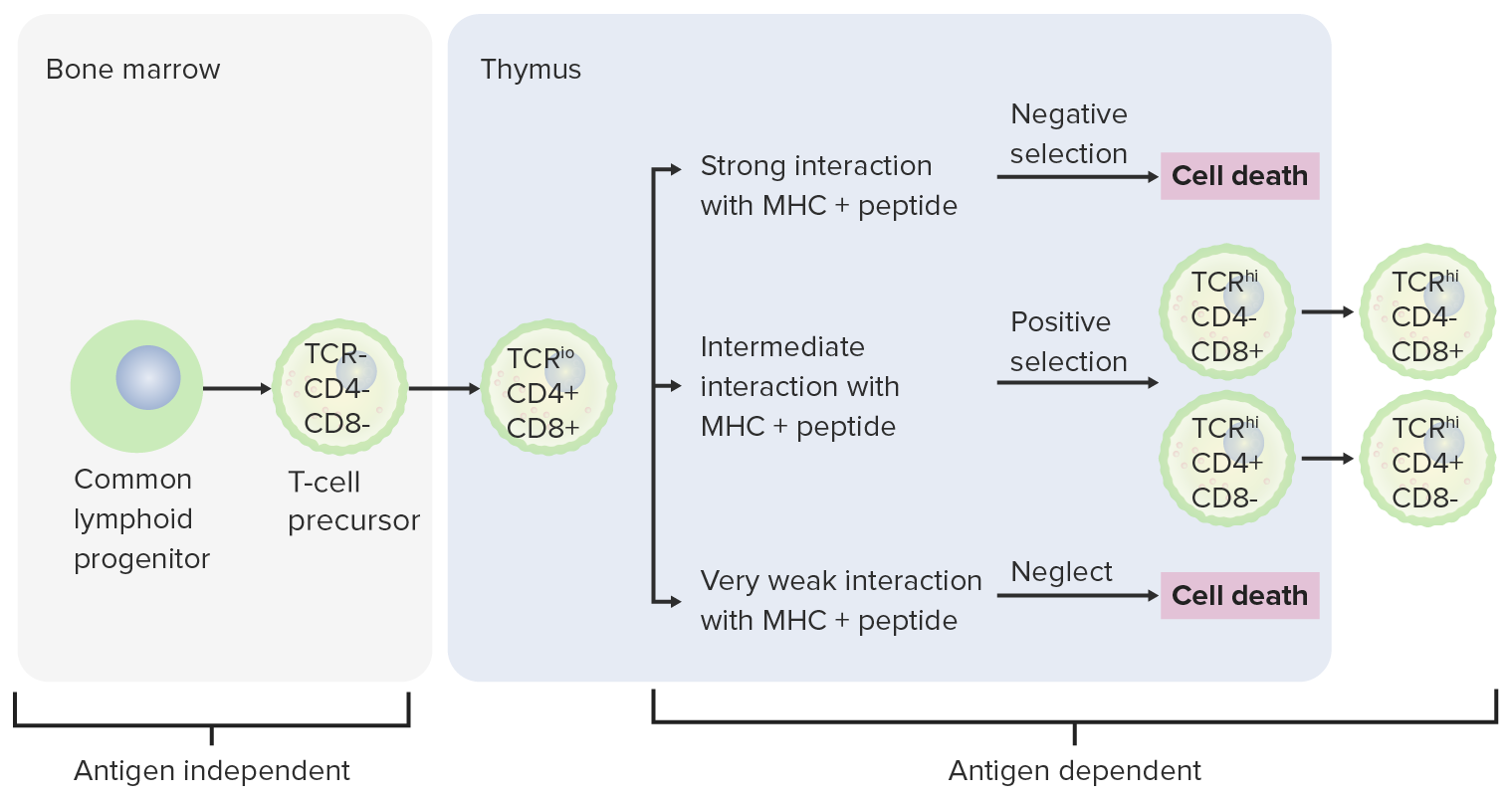
As células progenitoras vão da medula óssea para o timo para posterior maturação. As células DN (sem expressão de CD4/CD8 ou CD4–/CD8–) tornam-se células pró-T e, mais tarde, células pré-T, após o rearranjo do gene TCR. Durante os vários estadios, as células expressam CD4 ou CD8 e o TCR é adquirido através de rearranjos de genes (células DP). O timo apresenta moléculas de MHC para as células T em desenvolvimento. Algumas células sofrem seleção positiva (interação intermediária entre MHC e TCR) e produzem células funcionais. Algumas células sofrem seleção negativa (forte interação entre MHC e TCR), resultando em morte celular. A libertação de células T disfuncionais, que podem ativar a autoimunidade, é, então, evitada. As células T que não interagem sofrem apoptose. As células T maduras ou expressam CD4 (células T auxiliares) ou CD8 (células T citotóxicas), não ambos.

Imagem por Lecturio. Licença: CC BY-NC-SA 4.0

Mnemónica

Recorde-se da “regra dos 8” :

  • Restrição do MHC: A célula T só se consegue ligar a um antigénio apenas quando ele é apresentado pela classe correta de proteína do MHC.
  • As células T CD4-positivas reconhecem o antigénio associado às proteínas do MHC de classe II (4 × 2 = 8).
  • As células T CD8-positivas reconhecem o antigénio associado às proteínas do MHC de classe I (8 × 1 = 8).

Ativação e Diferenciação de Células T

Libertação do timo

  • Quando as células T são libertadas do timo, já interagiram previamente com o autoantigénio, sofreram restrição do MHC e obtiveram expressão de CD4 ou CD8.
  • As células T libertadas que expressam o complexo α–β TCR TCR Molecules on the surface of T-lymphocytes that recognize and combine with antigens. The receptors are non-covalently associated with a complex of several polypeptides collectively called CD3 antigens. Recognition of foreign antigen and the major histocompatibility complex is accomplished by a single heterodimeric antigen-receptor structure, composed of either alpha-beta or gamma-delta chains. Adaptive Cell-mediated Immunity CD3 CD3 Complex of at least five membrane-bound polypeptides in mature T-lymphocytes that are non-covalently associated with one another and with the T-cell receptor. The CD3 complex includes the gamma, delta, epsilon, zeta, and eta chains (subunits). When antigen binds to the T-cell receptor, the CD3 complex transduces the activating signals to the cytoplasm of the T-cell. The CD3 gamma and delta chains (subunits) are separate from and not related to the gamma/delta chains of the T-cell receptor. T cells: Types and Functions de superfície com os co-recetores CD4 ou CD8 são consideradas células T naive maduras:
    • No entanto, ainda não passaram pela ativação e proliferação, uma vez que ainda não interagiram com nenhum antigénio estranho.
    • As células T circulam no sangue e vão para os tecidos linfoides secundários.
    • Os órgãos linfoides secundários (por exemplo, nódulos linfáticos) filtram o material antigénico, permitindo que as células T naive maduras:
      • Interajam com células apresentadoras de antigénios, como macrófagos ou células dendríticas
      • Selecionem os antigénios para serem ativadas
    • Se não ocorrer nenhuma ativação, as células T retornam à circulação.
Estrutura e regiões funcionais de um linfonodo

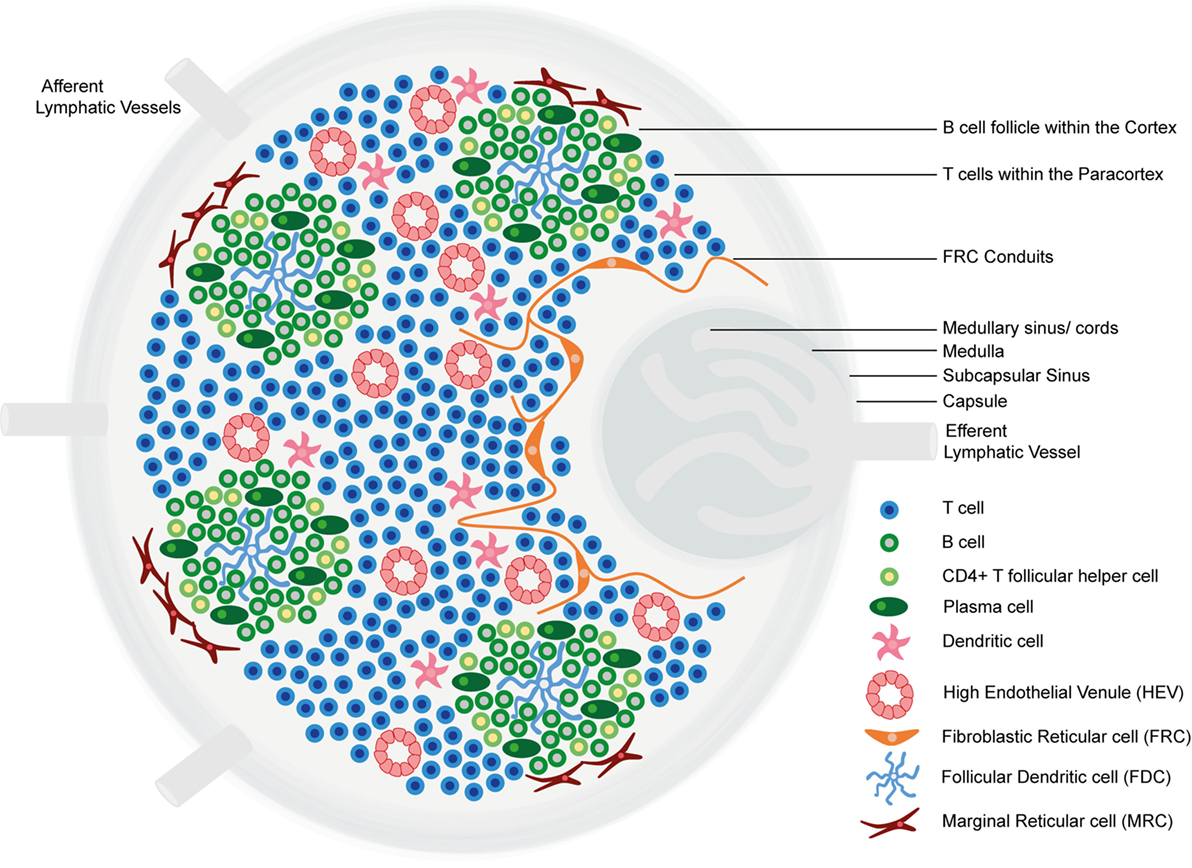
Estrutura e regiões funcionais de um nódulo linfático: formado por uma cápsula fibrosa rica em colagénio e um seio subcapsular (SCS, pela sigla em inglês) subjacente.
As células são secretadas no (1) córtex (constituído por células B, células T auxiliares foliculares e células dendríticas foliculares [FDCs, pela sigla em inglês], dispostos em folículos primários, nos quais as células B pesquisam os antigénios presentes na rede estromal da FDC); e (2) no paracórtex (que contém células T, células dendríticas [DCs, pela sigla em inglês] e células reticulares fibroblásticas [FRCs, pela sigla em inglês], que formam redes de células estromais e fibras reticulares).
A medula interna é composta por tecidos linfáticos (cordões medulares) separados por seios medulares constituídos por linfa.
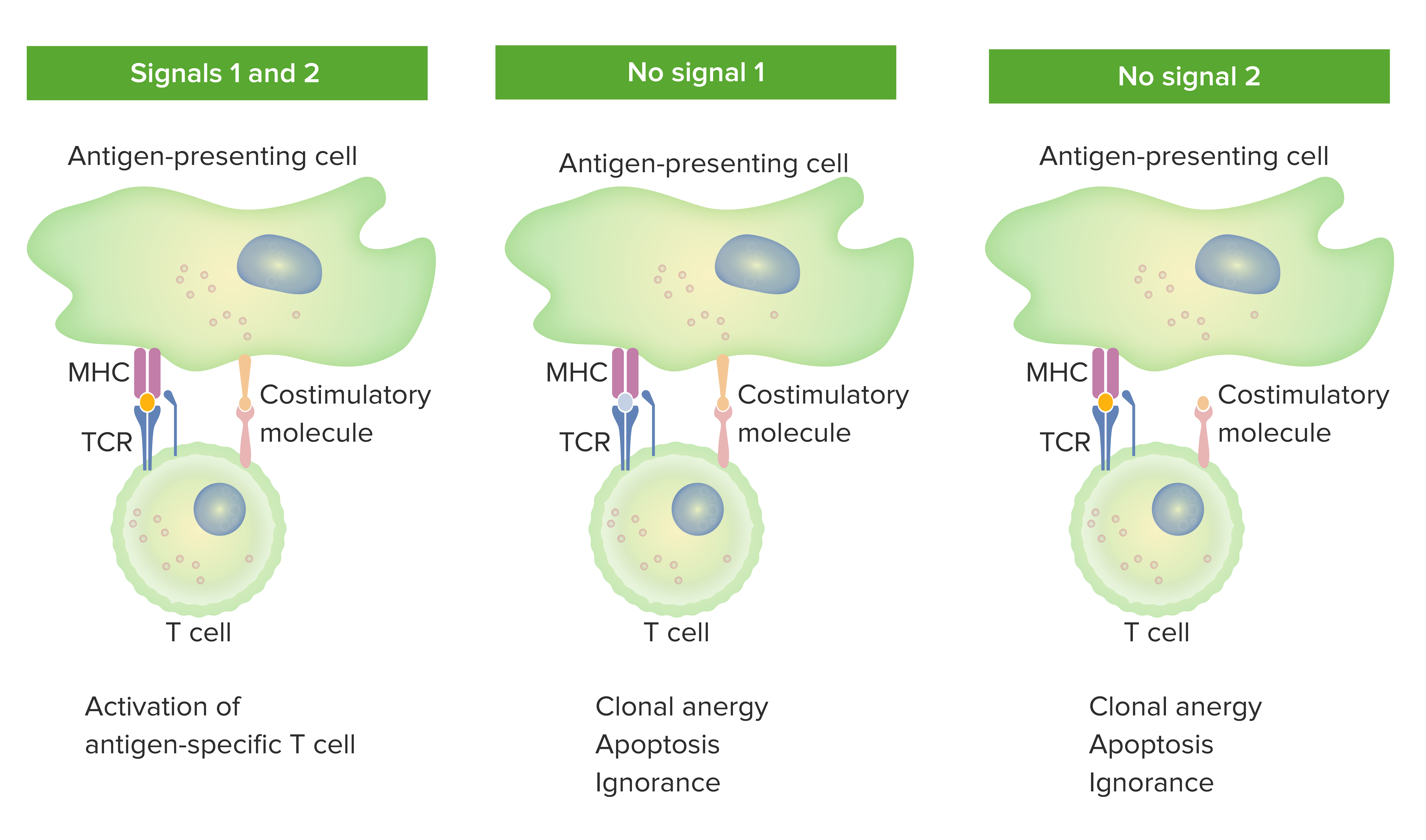
Imagem: “The structure of the lymph node” por Colbeck, Ager, Gallimore e Jones. Licença: CC BY 4.0

Ativação

  • A ativação completa de uma célula T desenvolvida para desencadear uma resposta imune requer 2 sinais;
    1. O TCR TCR Molecules on the surface of T-lymphocytes that recognize and combine with antigens. The receptors are non-covalently associated with a complex of several polypeptides collectively called CD3 antigens. Recognition of foreign antigen and the major histocompatibility complex is accomplished by a single heterodimeric antigen-receptor structure, composed of either alpha-beta or gamma-delta chains. Adaptive Cell-mediated Immunity reconhece o antigénio apresentado pela célula apresentadora de antigénio (por exemplo, uma célula dendrítica).
    2. Coestimulação:
      • Desempenhado por uma molécula coestimuladora (por exemplo, CD28 CD28 Costimulatory t-lymphocyte receptors that have specificity for CD80 antigen and CD86 antigen. Activation of this receptor results in increased t-cell proliferation, cytokine production and promotion of t-cell survival. T cells: Types and Functions)
      • Interação de uma proteína B7 na célula apresentadora de antigénio com o CD28 CD28 Costimulatory t-lymphocyte receptors that have specificity for CD80 antigen and CD86 antigen. Activation of this receptor results in increased t-cell proliferation, cytokine production and promotion of t-cell survival. T cells: Types and Functions da célula T
      • Sinal necessário para a sobrevivência e proliferação da célula
      • Sinal necessário para induzir a diferenciação (estado efetor ou memória)
      • Permite a cooperação célula a célula
  • Sem o sinal coestimulatório, a célula T pode adotar um estado de anergia (a célula está viva, mas sem resposta parcial ou total devido à ativação parcial).
  • Efeitos:
    • A coestimulação ajuda a evitar a ativação de células T por antigénios benignos.
    • Para além disso, as células T CD8+, que são citotóxicas, requerem um “sinal” adicional dado pelas citocinas das células T CD4+ (evitando a sua ativação inadvertida).
  • Os mecanismos inibitórios ou “pontos de verificação” nas células T impedem a ativação descontrolada das células T:
    • Antigénio-4 de linfócitos T citotóxicos (CTLA-4)
    • PD-1 PD-1 An inhibitory t-lymphocyte receptor that has specificity for CD274 antigen and programmed cell death 1 ligand 2 protein. Signaling by the receptor limits T cell proliferation and interferon gamma synthesis. The receptor also may play an essential role in the regulatory pathway that induces peripheral tolerance. T cells: Types and Functions (morte celular programada-1)
Modelo de 2 sinais - dependência de células T na coestimulação

Sinais de dependência de células T na coestimulação:
Quando o sinal 1 (ligação do TCR ao antigénio apresentado pela molécula do MHC da célula apresentadora de antigénios) e o sinal 2 (interação da molécula coestimuladora entre a célula apresentadora de antigénios e a célula T) estão presentes, a célula T madura é totalmente ativada.
O ponto laranja na imagem da esquerda exemplifica a ligação adequada entre o antigénio e o TCR. No entanto, quando tanto o sinal 1 (a imagem do meio não apresenta a ligação do antigénio com o TCR) como o sinal 2 (a imagem da direita não mostra a coestimulação) estão ausentes, a célula T não é totalmente ativada.
O resultado esperado seria a anergia (estado de ausência de resposta), apoptose (morte celular) ou desconhecimento (a célula T não percebe ou não é afetada pelo antigénio).
TCR: recetor de células T

Imagem por Lecturio. Licença: CC BY-NC-SA 4.0

Proliferação e diferenciação

  • Proliferação clonal:
    • Fim da ativação
    • A libertação de IL-2 (fator de crescimento de células T) das células T leva à sua multiplicação.
  • Dependendo das citocinas às quais são expostas durante a estimulação do antigénio, as células T maduras indiferenciadas (Th0) desenvolve-se em células com diferentes funções:
    • As células T CD4+ tornam-se:
      • Células auxiliares foliculares (Tfh)
      • Células T (Th) efetoras/auxiliares
      • Células T reguladoras (Treg) ou supressoras
    • As células T CD8+ tornam-se células T citotóxicas.
  • Algumas células T ativadas permanecem nos órgãos linfoides secundários e outras prosseguem para áreas de inflamação tecidual para desempenhar funções efetoras.

Células T CD4+

Descrição geral da diferenciação de células T auxiliares

As células T auxiliares apresentam diferentes perfis de citocinas e papéis na resposta imune.

Tabela: Descrição geral da diferenciação de células Th
Células T CD4+ Diferenciação estimulada por Funções Citocinas produzidas
Th1 Th1 A subset of helper-inducer T-lymphocytes which synthesize and secrete interleukin-2; interferon-gamma; and interleukin-12. Due to their ability to kill antigen-presenting cells and their lymphokine-mediated effector activity, th1 cells are associated with vigorous delayed-type hypersensitivity reactions. T cells: Types and Functions
  • IL-12
  • IFN-γ
  • Ativação de macrófagos
  • Ativação de células T citotóxicas
  • IFN-γ
  • TNF TNF Tumor necrosis factor (TNF) is a major cytokine, released primarily by macrophages in response to stimuli. The presence of microbial products and dead cells and injury are among the stimulating factors. This protein belongs to the TNF superfamily, a group of ligands and receptors performing functions in inflammatory response, morphogenesis, and cell proliferation. Tumor Necrosis Factor (TNF)
  • IL-2
Th2 Th2 A subset of helper-inducer T-lymphocytes which synthesize and secrete the interleukins il-4; il-5; il-6; and il-10. These cytokines influence b-cell development and antibody production as well as augmenting humoral responses. T cells: Types and Functions
  • IL-2
  • IL-4
  • Ativação e eosinófilos, ↑ IgE IgE An immunoglobulin associated with mast cells. Overexpression has been associated with allergic hypersensitivity. Immunoglobulins: Types and Functions
  • Ativação de mastócitos
  • IL-4
  • IL-5
  • IL-6
  • IL-9
  • IL-10
  • IL-13
Th17 Th17 A subset of helper-effector T-lymphocytes which synthesize and secrete interleukins il-17; il-17f; and il-22. These cytokines are involved in host defenses and tissue inflammation in autoimmune diseases. T cells: Types and Functions
  • IL-1
  • IL-6
  • IL-23
  • TGF-β
Promovem a inflamação neutrofílica
  • IL-17
  • IL-21
  • IL-22
Tfh IL-6 Facilitam a ativação e maturação das células B
  • IL-4
  • IL-21
Treg
  • TGF-β
  • IL-2
  • Suprimem a resposta imune
  • Promovem a autotolerância
  • TGF-β
  • IL-10
  • IL-35
IFN: interferão
TGF: fator de transformação do crescimento
TNF: fator de necrose tumoral
Subconjuntos de células T auxiliares CD4-+

Subconjuntos de células T auxiliares CD4-positivas:
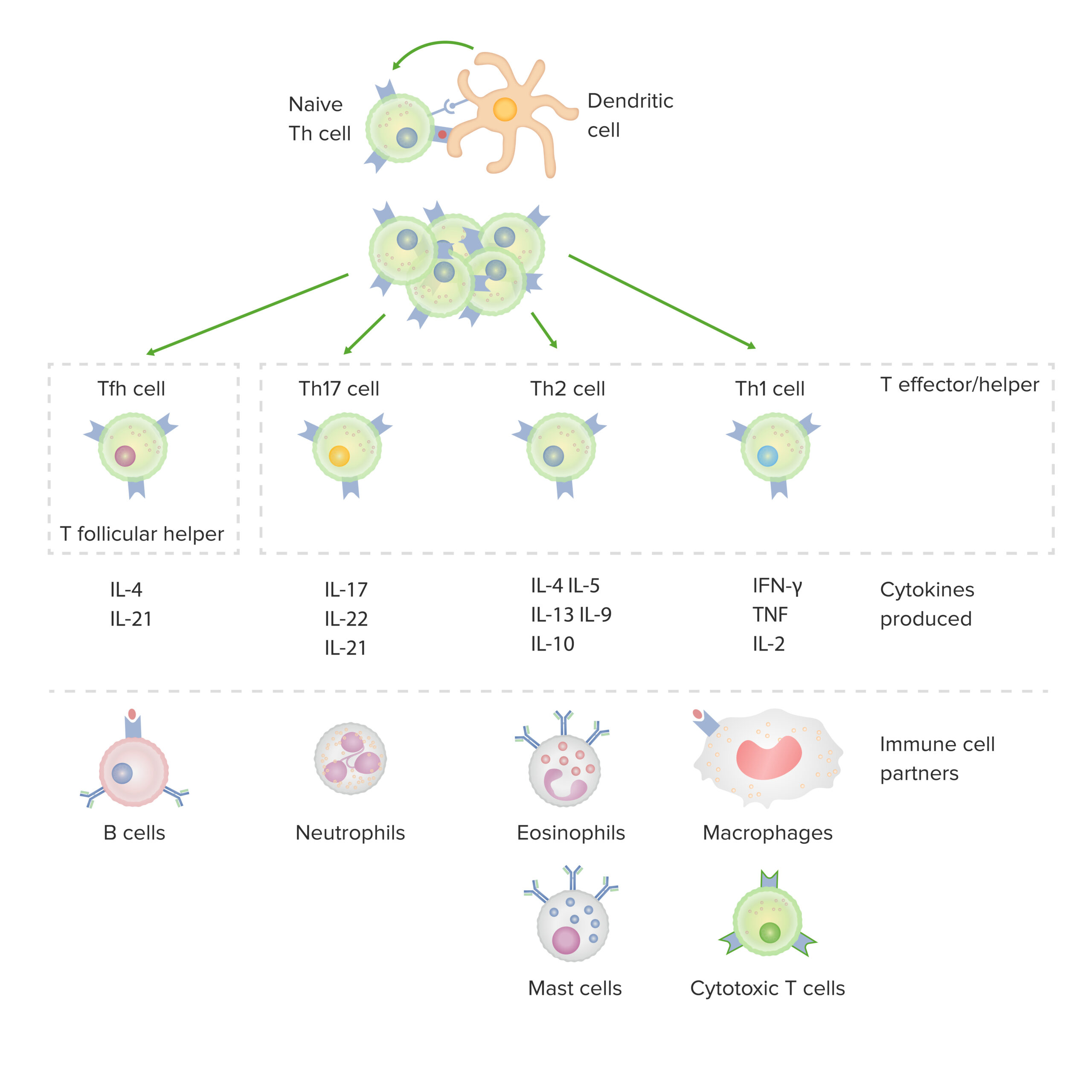
Após a ativação por uma célula dendrítica, na presença de citocinas específicas, uma célula T CD4 positiva “naive” divide-se e diferencia-se em subconjuntos efetores/auxiliares (Th1, Th2 ou Th17) ou auxiliares foliculares (Tfh). Cada tipo de célula produz citocinas que facilitam a ativação de outras células imunes.
IFN: interferão
TNF: fator de necrose tumoral
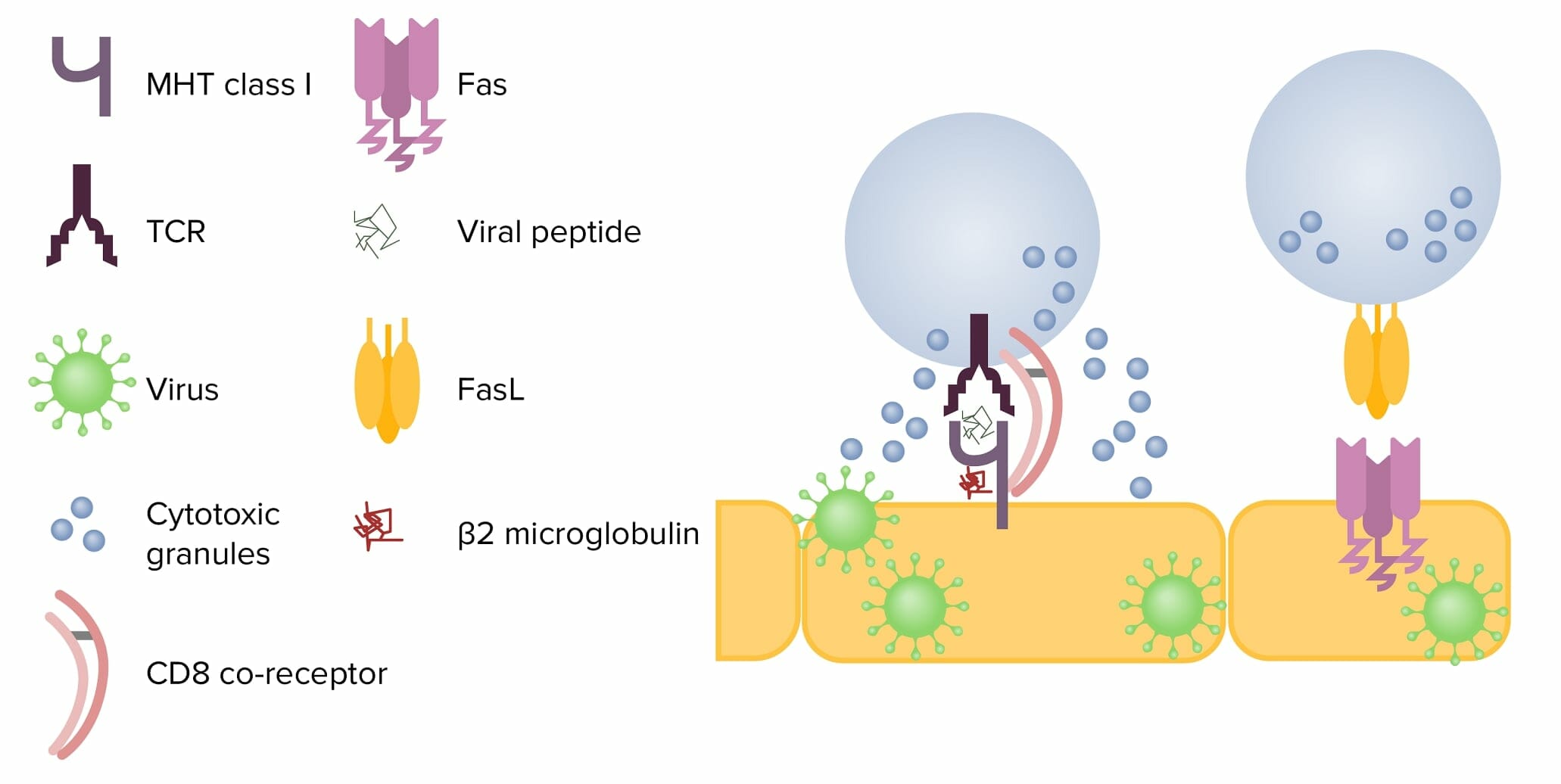
Imagem por Lecturio. Licença: CC BY-NC-SA 4.0

Th1 Th1 A subset of helper-inducer T-lymphocytes which synthesize and secrete interleukin-2; interferon-gamma; and interleukin-12. Due to their ability to kill antigen-presenting cells and their lymphokine-mediated effector activity, th1 cells are associated with vigorous delayed-type hypersensitivity reactions. T cells: Types and Functions

  • Diferenciação estimulada por: IL-12 e IFN-γ
  • Inibidas por: IL-4 e IL-10 (de Th2 Th2 A subset of helper-inducer T-lymphocytes which synthesize and secrete the interleukins il-4; il-5; il-6; and il-10. These cytokines influence b-cell development and antibody production as well as augmenting humoral responses. T cells: Types and Functions)
  • Produzem as citocinas IFN-γ, IL-2 e fator de necrose tumoral ( TNF TNF Tumor necrosis factor (TNF) is a major cytokine, released primarily by macrophages in response to stimuli. The presence of microbial products and dead cells and injury are among the stimulating factors. This protein belongs to the TNF superfamily, a group of ligands and receptors performing functions in inflammatory response, morphogenesis, and cell proliferation. Tumor Necrosis Factor (TNF))
  • Expressam fatores de transcrição T-BET e transdutor de sinal e ativador de transcrição 4 (STAT4)
  • Funções:
    • Ativam os macrófagos → aumento da fagocitose e formação de granulomas Granulomas A relatively small nodular inflammatory lesion containing grouped mononuclear phagocytes, caused by infectious and noninfectious agents. Sarcoidosis
    • Ativam os linfócitos citotóxicos
    • Ajudam as células B a produzir anticorpos
    • Inibem células Th2 Th2 A subset of helper-inducer T-lymphocytes which synthesize and secrete the interleukins il-4; il-5; il-6; and il-10. These cytokines influence b-cell development and antibody production as well as augmenting humoral responses. T cells: Types and Functions
    • Contribuem para a defesa contra bactérias, fungos e vírus
  • Relevância clínica:
    • Envolvidas em reações de hipersensibilidade tardia
    • O défice de IL-12 ou IFN-γ predispõe a infeções micobacterianas, em particular tuberculose.
    • Hiperatividade das células Th1 Th1 A subset of helper-inducer T-lymphocytes which synthesize and secrete interleukin-2; interferon-gamma; and interleukin-12. Due to their ability to kill antigen-presenting cells and their lymphokine-mediated effector activity, th1 cells are associated with vigorous delayed-type hypersensitivity reactions. T cells: Types and Functions: doenças autoimunes e inflamatórias interligadas (por exemplo, doença de Crohn, Artrite reumatoide)

Th2 Th2 A subset of helper-inducer T-lymphocytes which synthesize and secrete the interleukins il-4; il-5; il-6; and il-10. These cytokines influence b-cell development and antibody production as well as augmenting humoral responses. T cells: Types and Functions

  • Diferenciação estimulada por: IL-2 e IL-4
  • Inibidas por: IFN-γ (de Th1 Th1 A subset of helper-inducer T-lymphocytes which synthesize and secrete interleukin-2; interferon-gamma; and interleukin-12. Due to their ability to kill antigen-presenting cells and their lymphokine-mediated effector activity, th1 cells are associated with vigorous delayed-type hypersensitivity reactions. T cells: Types and Functions)
  • Produzem as citocinas IL-4, IL-5, IL-6, IL-9, IL-10 e IL-13
  • Expressam fatores de transcrição GATA3 e STAT6.
  • Funções:
    • Ativam os eosinófilos e mastócitos
    • Inibem células Th1 Th1 A subset of helper-inducer T-lymphocytes which synthesize and secrete interleukin-2; interferon-gamma; and interleukin-12. Due to their ability to kill antigen-presenting cells and their lymphokine-mediated effector activity, th1 cells are associated with vigorous delayed-type hypersensitivity reactions. T cells: Types and Functions
    • Ajudam as células B
  • Relevância clínica:
    • A desregulação das células Th2 Th2 A subset of helper-inducer T-lymphocytes which synthesize and secrete the interleukins il-4; il-5; il-6; and il-10. These cytokines influence b-cell development and antibody production as well as augmenting humoral responses. T cells: Types and Functions leva à doença alérgica (por exemplo, asma ASMA Autoimmune Hepatitis alérgica, dermatite atópica).
    • Respondem à infeção por alguns vermes helmintas, como Schistosoma Schistosoma Schistosomiasis is an infection caused by Schistosoma, a trematode. Schistosomiasis occurs in developing countries with poor sanitation. Freshwater snails are the intermediate host and are transmitted to humans through skin contact with contaminated fresh water. The clinical presentation occurs as a result of the host’s immune response to antigens from the eggs. Schistosoma/Schistosomiasis e Strongyloides.

Th17 Th17 A subset of helper-effector T-lymphocytes which synthesize and secrete interleukins il-17; il-17f; and il-22. These cytokines are involved in host defenses and tissue inflammation in autoimmune diseases. T cells: Types and Functions

  • Diferenciação estimulada por: IL-1, IL-6, IL-23 e TGF-β
  • Inibidas por: IL-4 e IFN-γ
  • Produzem as citocinas IL-17, IL-21 e IL-22
  • Expressam fatores de transcrição RORC e STAT3.
  • Funções:
    • Ativam a resposta neutrofílica
    • Defesa do tecido barreira
  • Relevância clínica:
    • Aumento da suscetibilidade de infeções mucocutâneas pela levedura Candida albicans Candida albicans A unicellular budding fungus which is the principal pathogenic species causing candidiasis (moniliasis). Candida/Candidiasis nos casos de défice de IL-17
    • A hiperatividade está associada à doença autoimune.

Tfh

  • Diferenciação estimulada por: IL-6
  • Inibidas por: IL-2
  • Produzem as citocinas IL-4 e IL-21
  • Expressam o fator de transcrição Bcl-6.
  • Outros marcadores: CXCR5, CXCL13, PD-1 PD-1 An inhibitory t-lymphocyte receptor that has specificity for CD274 antigen and programmed cell death 1 ligand 2 protein. Signaling by the receptor limits T cell proliferation and interferon gamma synthesis. The receptor also may play an essential role in the regulatory pathway that induces peripheral tolerance. T cells: Types and Functions e ICOS
  • Funções:
    • Células encontradas em centros germinativos de tecidos linfoides secundários, que auxiliam na ativação de células B.
    • A expressão do ligante CD40 CD40 Members of the tumor necrosis factor receptor superfamily with specificity for CD40 ligand. They are found on mature B-lymphocytes, some epithelial cells; and lymphoid dendritic cells. Evidence suggests that CD40-dependent activation of B-cells is important for generation of memory B-cells within the germinal centers. Mutations in the CD40 antigen gene result in hyper-igm immunodeficiency syndrome, type 3. Signaling of the receptor occurs through its association with tnf receptor-associated factors. Hyper-IgM Syndrome (CD40L) interage com o CD40 CD40 Members of the tumor necrosis factor receptor superfamily with specificity for CD40 ligand. They are found on mature B-lymphocytes, some epithelial cells; and lymphoid dendritic cells. Evidence suggests that CD40-dependent activation of B-cells is important for generation of memory B-cells within the germinal centers. Mutations in the CD40 antigen gene result in hyper-igm immunodeficiency syndrome, type 3. Signaling of the receptor occurs through its association with tnf receptor-associated factors. Hyper-IgM Syndrome da célula B.
  • Relevância clínica:
    • A mutação do gene Gene A category of nucleic acid sequences that function as units of heredity and which code for the basic instructions for the development, reproduction, and maintenance of organisms. Basic Terms of Genetics que codifica o CD40L leva à síndrome de hiper-IgM.
    • A hiperatividade leva à doença autoimune.

Tregs

  • Diferenciação estimulada por: TGF-β e IL-2
  • Inibidas por: IL-6
  • Produzem as citocinas TGF-β, IL-10 e IL-35
  • Expressam o fator de transcrição FOXP3.
  • Funções:
    • A resposta irrestrita das células T pode tornar-se patológica, sendo o papel das células Tregs evitar a inflamação excessiva e danos teciduais.
    • Parte do mecanismo de tolerância periférica
    • Podem regular Regular Insulin negativamente a atividade de muitas células imunes, incluindo:
      • Células CD4+
      • Células T CD8+
      • Células dendríticas (via CTLA-4 de superfície celular e gene Gene A category of nucleic acid sequences that function as units of heredity and which code for the basic instructions for the development, reproduction, and maintenance of organisms. Basic Terms of Genetics de ativação de linfócitos (LAG-3))
      • Células B
      • Células assassinas naturais
      • Eosinófilos, basófilos, mastócitos
  • Relevância clínica:
    • O aumento da atividade das Tregs (ou ↓ resposta imune) pode ajudar na rejeição de transplantes e doenças autoimunes.
    • A redução da atividade das Tregs (ou ↑ resposta imune) é útil na imunoterapia no cancro e infeções crónicas.
    • Papel significativo na prevenção da rejeição do enxerto e da doença do enxerto contra o hospedeiro (GVHD, pela sigla em inglês)
    • A mutação do gene Gene A category of nucleic acid sequences that function as units of heredity and which code for the basic instructions for the development, reproduction, and maintenance of organisms. Basic Terms of Genetics que codifica o FOXP3 leva à síndrome IPEX (Imunodesregulação Poliendocrinopatia E nteropatia ligada ao X).

Células T CD8+

  • Células T citotóxicas ou citolíticas
  • Dependentes da estimulação de citocinas (IL-2) (das células Th1 Th1 A subset of helper-inducer T-lymphocytes which synthesize and secrete interleukin-2; interferon-gamma; and interleukin-12. Due to their ability to kill antigen-presenting cells and their lymphokine-mediated effector activity, th1 cells are associated with vigorous delayed-type hypersensitivity reactions. T cells: Types and Functions) para serem ativadas e, posteriormente, saírem dos órgãos linfoides secundários e circularem em busca de alvos
  • Produzem as citocinas IFNγ, TNF-α e TNF-β
  • Fator de transcrição: RUNX3
  • Desempenham funções como a morte de:
    • Agentes patogénicos
    • Células infetadas
    • Células tumorais
    • Aloenxertos
  • A citotoxicidade ocorre através da:
    • Exocitose de grânulos:
      • Após o contacto com a célula-alvo, os grânulos líticos agrupam-se perto da sinapse imunológica.
      • As membranas dos grânulos fundem-se com a membrana celular.
      • O conteúdo dos grânulos, incluindo granzimas e perforinas, entra na célula-alvo.
      • A via das caspases Caspases A family of intracellular cysteine endopeptidases that play a role in regulating inflammation and apoptosis. They specifically cleave peptides at a cysteine amino acid that follows an aspartic acid residue. Caspases are activated by proteolytic cleavage of a precursor form to yield large and small subunits that form the enzyme. Since the cleavage site within precursors matches the specificity of caspases, sequential activation of precursors by activated caspases can occur. Cell Injury and Death é ativada, levando à apoptose.
    • Expressão do ligante Fas (FasL):
      • O Fas é expresso na superfície de muitas células.
      • O FasL, expresso na superfície da célula T CD8+, é induzido quando um antigénio é reconhecido.
      • A interação Fas-FasL ativa a via das caspases Caspases A family of intracellular cysteine endopeptidases that play a role in regulating inflammation and apoptosis. They specifically cleave peptides at a cysteine amino acid that follows an aspartic acid residue. Caspases are activated by proteolytic cleavage of a precursor form to yield large and small subunits that form the enzyme. Since the cleavage site within precursors matches the specificity of caspases, sequential activation of precursors by activated caspases can occur. Cell Injury and Death, levando à morte celular.
    • Recrutamento e modulação de células efetoras inflamatórias adicionais, como macrófagos
  • Relevância clínica:
    • Papel proeminente em agentes patogénicos intracelulares (por exemplo, Listeria Listeria Listeria spp. are motile, flagellated, gram-positive, facultative intracellular bacilli. The major pathogenic species is Listeria monocytogenes. Listeria are part of the normal gastrointestinal flora of domestic mammals and poultry and are transmitted to humans through the ingestion of contaminated food, especially unpasteurized dairy products. Listeria Monocytogenes/Listeriosis monocytogenes), que passam pouco tempo em circulação (menos suscetibilidade a anticorpos)
    • Importância semelhante na defesa imunológica contra vírus (por exemplo, VIH)
Mechanisms of cytotoxicity by CD8+ T cells

Mecanismos de citotoxicidade por células T CD8+:
À esquerda: Após contacto com uma célula infetada, a célula T liberta grânulos citotóxicos, perforina e granzimas. A perforina cria um poro na membrana da célula alvo, permitindo que as granzimas entrem na célula. Estas clivam proteínas no interior da mesma, levando à apoptose.
À direita: Quando o FasL interage com o Fas numa célula alvo, a cascata da caspase é ativada e termina em apoptose.

FasL, pela sigla em inglês: ligando Fas
TCR, pela sigla em inglês: recetor de células T
MHC, pela sigla em inglês: complexo principal de histocompatibilidade
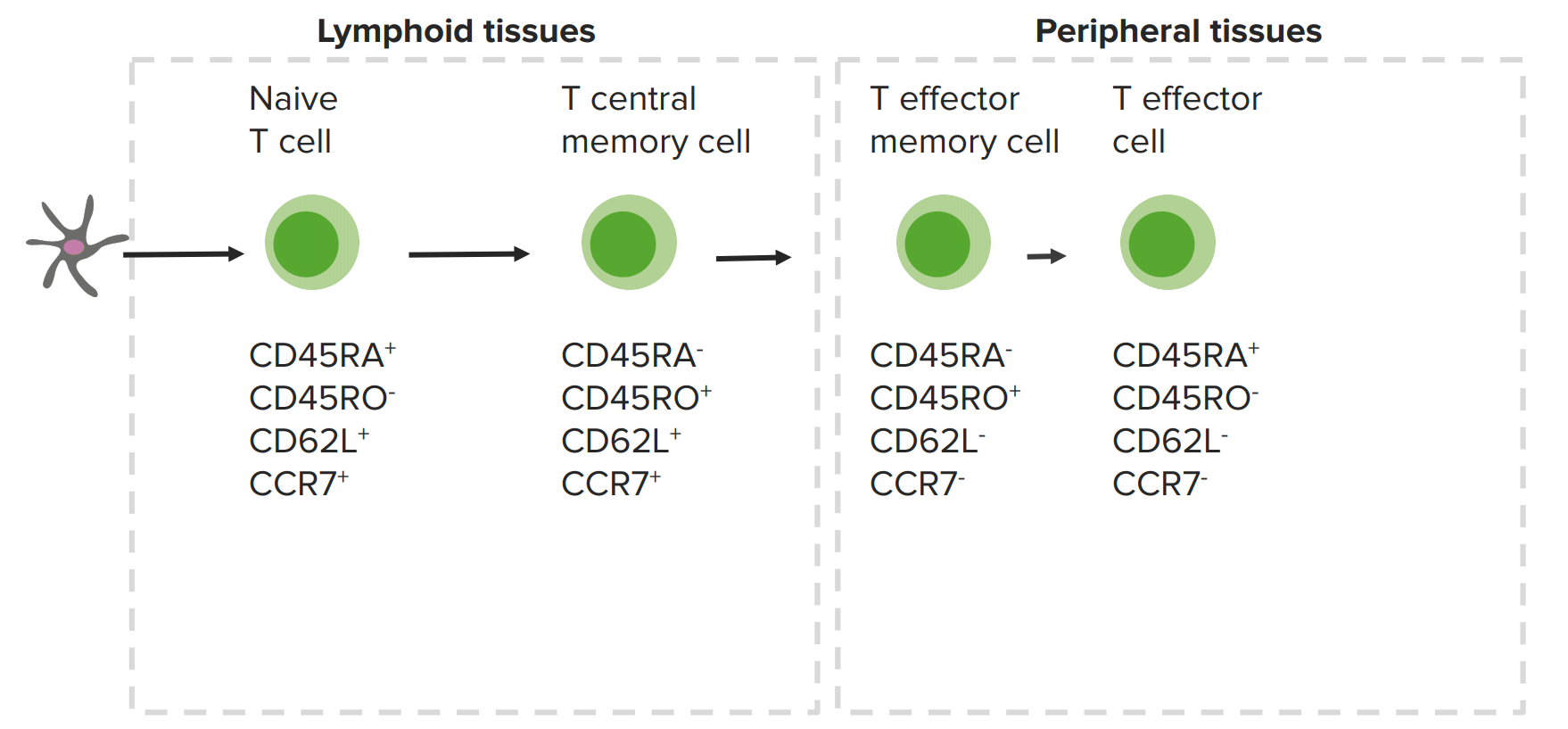
Image by Lecturio.

Outros Tipos de Células T

Células T gama-delta

  • Os TCRs consistem em cadeias γ e δ.
  • Não passam pelo estadio duplamente positivo, mas desempenham um papel distinto complementar ao das células T αβ
  • Representam < 5% das células T
  • Encontradas na mucosa intestinal, pele, pulmões e útero
  • Podem ligar-se a moléculas não-MHC para ativação
  • Reconhecem fosfoantigénios de:
    • Mycobacterium tuberculosis Mycobacterium tuberculosis Tuberculosis (TB) is an infectious disease caused by Mycobacterium tuberculosis complex bacteria. The bacteria usually attack the lungs but can also damage other parts of the body. Approximately 30% of people around the world are infected with this pathogen, with the majority harboring a latent infection. Tuberculosis spreads through the air when a person with active pulmonary infection coughs or sneezes. Tuberculosis
    • Plasmodium Plasmodium A genus of protozoa that comprise the malaria parasites of mammals. Four species infect humans (although occasional infections with primate malarias may occur). These are plasmodium falciparum; plasmodium malariae; plasmodium ovale, and plasmodium vivax. Species causing infection in vertebrates other than man include: plasmodium berghei; plasmodium chabaudi; p. Vinckei, and plasmodium yoelii in rodents; p. Brasilianum, plasmodium cynomolgi; and plasmodium knowlesi in monkeys; and plasmodium gallinaceum in chickens. Antimalarial Drugs sp.

Células T natural killer (NK)

  • Ramificam-se das células T no estadio de desenvolvimento duplamente positivo (CD4+, CD8+).
  • Possuem características morfológicas e funcionais de células T e células NK
  • Reconhecem o antigénio apresentado por moléculas CD1d semelhantes ao MHC classe I
  • Produzem citocinas Th1 Th1 A subset of helper-inducer T-lymphocytes which synthesize and secrete interleukin-2; interferon-gamma; and interleukin-12. Due to their ability to kill antigen-presenting cells and their lymphokine-mediated effector activity, th1 cells are associated with vigorous delayed-type hypersensitivity reactions. T cells: Types and Functions e Th2 Th2 A subset of helper-inducer T-lymphocytes which synthesize and secrete the interleukins il-4; il-5; il-6; and il-10. These cytokines influence b-cell development and antibody production as well as augmenting humoral responses. T cells: Types and Functions quando ativadas

Células T de memória

  • Podem ser CD4+ ou CD8+
  • Desencadeiam uma resposta imune anos após a exposição inicial
  • As células T naive não expostas a células dendríticas apresentadoras de antigénios expressam os seguintes marcadores:
    • Positivo para CD45RA
    • Negativo para CD45RO
    • Expressam CD62L e CCR7
  • Após a exposição a antigénios, algumas células T desenvolvem-se em células de memória:
    • Inicialmente residem nos tecidos linfoides (células T de memória central).
    • Tornam-se CD45RO+ e CD45RA–
    • CD62L+ e CCR7+
  • As células de memória T que residem em tecidos periféricos (células de memória efetoras):
    • CD45RO+ e CD45RA–
    • CD62L– e CCR7–
  • Após a reinfeção pelo mesmo antigénio, tornam-se células T efetoras:
    • CD45RA+, CD45RO–, CD62L– e CCR7–
    • Componentes essenciais da imunidade secundária.
    • Podem ser ativadas imediatamente após a invasão do agente patogénico.
Células T de memória e marcadores celulares expressos

Células T de memória e marcadores celulares expressos:
As células T de memória central estão nos órgãos linfoides, enquanto as células T de memória periféricas estão nos tecidos periféricos.

Imagem por Lecturio. Licença: CC BY-NC-SA 4.0

Relevância Clínica

  • Candidíase mucocutânea crónica (CMCC): síndrome autoimune que envolve infeções crónicas e não invasivas por Candida Candida Candida is a genus of dimorphic, opportunistic fungi. Candida albicans is part of the normal human flora and is the most common cause of candidiasis. The clinical presentation varies and can include localized mucocutaneous infections (e.g., oropharyngeal, esophageal, intertriginous, and vulvovaginal candidiasis) and invasive disease (e.g., candidemia, intraabdominal abscess, pericarditis, and meningitis). Candida/Candidiasis da pele, unhas e membranas mucosas. A condição clínica está associada a manifestações autoimunes (frequentemente doenças endócrinas). O hipoparatiroidismo é a patologia endócrina mais MAIS Androgen Insensitivity Syndrome comum e ocorre em 30% dos pacientes. A insuficiência adrenal (IA) ocorre em > 60% dos casos aos 15 anos. A candidíase mucocutânea crónica decorre de defeitos genéticos no sistema imunológico, incluindo aqueles que afetam o regulador autoimune (AIRE, pela sigla em inglês), importante na seleção negativa de células T, e a via da interleucina (IL) 17, entre outros.
  • Desregulação imune, poliendocrinopatia, enteropatia, síndrome ligada ao X (IPEX, pela sigla em inglês): doença causada por mutações no gene Gene A category of nucleic acid sequences that function as units of heredity and which code for the basic instructions for the development, reproduction, and maintenance of organisms. Basic Terms of Genetics para o fator de transcrição FOXP3. Caracteriza-se pelo comprometimento das células T reguladoras, manifestando-se como doença autoimune com inflamação alérgica. A doença manifesta-se habitualmente em lactentes do sexo masculino com uma tríade de enteropatia, dermatite e doença endócrina autoimune (frequentemente diabetes Diabetes Diabetes mellitus (DM) is a metabolic disease characterized by hyperglycemia and dysfunction of the regulation of glucose metabolism by insulin. Type 1 DM is diagnosed mostly in children and young adults as the result of autoimmune destruction of β cells in the pancreas and the resulting lack of insulin. Type 2 DM has a significant association with obesity and is characterized by insulin resistance. Diabetes Mellitus tipo 1 ou tiroidite). A diarreia pode ser profusa e associada à desidratação, má absorção, acidose metabólica, insuficiência renal e atraso de crescimento. Podem estar presentes outras manifestações como alergia alimentar grave, hepatite autoimune crónica, citopenias autoimunes, nefrite intersticial e atrasos do desenvolvimento. O diagnóstico é obtido por pesquisa da mutação do gene Gene A category of nucleic acid sequences that function as units of heredity and which code for the basic instructions for the development, reproduction, and maintenance of organisms. Basic Terms of Genetics FOXP3. O único tratamento curativo disponível é o transplante de células hematopoiéticas.
  • Leucemia/linfoma de células T adultas: neoplasia de células T maduras rara, mas frequentemente agressiva, causada por uma infeção crónica das células T CD4+ pelo vírus linfotrópico T humano, tipo I (HTLV-I). A infeção é endémica no Japão, Caraíbas e África Central. É comum o envolvimento dos gânglios linfáticos, sangue periférico e/ou pele. As características mais observadas no sangue periférico são as células em “folha de trevo” ou “flor” (células com núcleos hiperlobulados bizarros). O diagnóstico é baseado na apresentação clínica, alterações morfológicas e imunofenotípicas das células malignas e infeção por HTLV-I HTLV-I Acute Lymphoblastic Leukemia confirmada. O tratamento inclui agentes antivirais, terapêutica com anticorpos monoclonais, quimioterapia e transplante alogénico de células-tronco.

Referências

  1. Braskett, M.J., Chatila T. (2021). IPEX: immune dysregulation, polyendocrinopathy, enteropathy, X-linked. UpToDate. Retrieved July 10, 2021, from https://www.uptodate.com/contents/ipex-immune-dysregulation-polyendocrinopathy-enteropathy-x-linked
  2. Frauwirth, K., Thompson, C. (2002). Activation and inhibition of lymphocytes by costimuation. J Clin Invest 109:295–299. https://doi.org/10.1172/JCI14941
  3. Freedman, A.S., Aster, J.C., Suzuki, R. (2021). Clinical manifestations, pathologic features, and diagnosis of adult T cell leukemia-lymphoma. UpToDate. Retrieved July 10, 2021, from https://www.uptodate.com/contents/clinical-manifestations-pathologic-features-and-diagnosis-of-adult-T cell-leukemia-lymphoma
  4. Kumar, B.V., Connors, T.J., Farber, D.L. (2018). Human T cell development, localization, and function throughout life. Immunity 48: 202–213. https://pubmed.ncbi.nlm.nih.gov/29466753/
  5. Lechler, R., Chai, J. G., Marelli-Berg, F., & Lombardi, G. (2001). The contributions of T cell anergy to peripheral T cell tolerance. Immunology 103:262–269. https://doi.org/10.1046/j.1365-2567.2001.01250.x
  6. Levinson, W., et al. (Eds.). (2020). Adaptive immunity: T cell–mediated immunity. In: Review of Medical Microbiology & Immunology: A Guide to Clinical Infectious Diseases, 16th ed. McGraw-Hill. https://accessmedicine.mhmedical.com/content.aspx?bookid=2867&sectionid=24276830
  7. Lucas, F., Gribben, J. (2021). Functions of T lymphocytes: T cell receptors for antigen. In Kaushansky, K., et al. (Eds.), Williams Hematology, 10e. McGraw Hill. https://accessmedicine.mhmedical.com/content.aspx?bookid=2962&sectionid=252540548
  8. Martin, M.D., Badovinac, V.P. (2018). Defining memory CD8 T cell. Front Immunol 9:2692. https://doi.org/10.3389/fimmu.2018.02692
  9. Shah, K., Al-Haidari, A., Sun, J. et al. T cell receptor (TCR) signaling in health and disease. Sig Transduct Target Ther 6, 412 (2021). https://doi.org/10.1038/s41392-021-00823-w
  10. Raphael, I., Nalawade, S., Eagar, T. N., & Forsthuber, T. G. (2015). T cell subsets and their signature cytokines in autoimmune and inflammatory diseases. Cytokine. 74(1), 5–17. https://doi.org/10.1016/j.cyto.2014.09.011
  11. Roifman, C.M. (2019). Chronic mucocutaneous candidiasis. UpToDate. Retrieved July 10, 2021, from https://www.uptodate.com/contents/chronic-mucocutaneous-candidiasis
  12. Salaman, M., Gould, K. (2020). Breakdown of T cell ignorance: the tolerance failure responsible for mainstream autoimmune diseases? In: Gershwin, E., et al. (Eds.), Journal of Translational Autoimmunity. https://doi.org/10.1016/j.jtauto.2020.100070

Crie sua conta gratuita ou faça login para continuar lendo!

Cadastre-se agora e tenha acesso grátis ao Lecturio, com páginas de conceitos, vídeos de medicina e questões para sua educação médica.

Aprende mais com a Lecturio:

Multiple devices displaying human anatomy and health education content.

Complementa o teu estudo da faculdade com o companheiro de estudo tudo-em-um da Lecturio, através de métodos de ensino baseados em evidência.

Estuda onde quiseres

Two iPhones display medical education apps, one showing anatomy, the other Bookmatcher.

A Lecturio Medical complementa o teu estudo através de métodos de ensino baseados em evidência, vídeos de palestras, perguntas e muito mais – tudo combinado num só lugar e fácil de usar.

User Reviews

Have a holly, jolly study session 🎁 Save 50% on all plans now >>

Que tengas una sesión de estudio alegre y navideña 🎁 Ahorra 50% en todos los planes >>

Details