

Nursing Knowledge
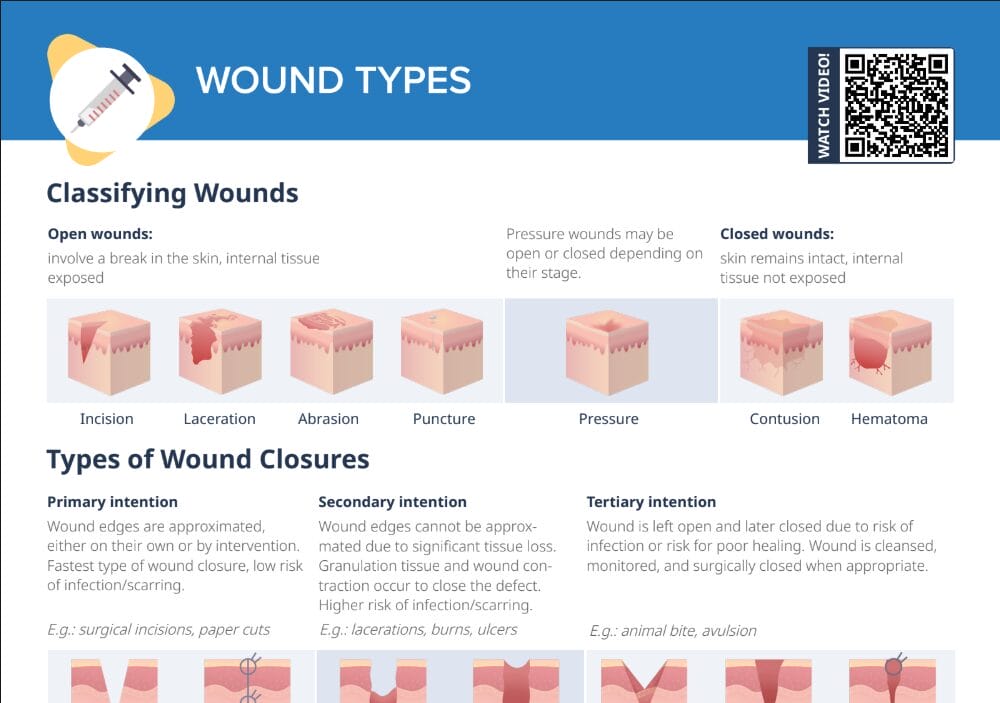
Wound edges are approximated, either on their own or by intervention. This is the fastest type of wound closure, carrying only a low risk of infection/scarring. Examples are surgical incisions and paper cuts.
Wound edges cannot be approximated due to significant tissue loss. Granulation tissue and wound contraction occur to close the defect. A higher risk of infection and scarring is present. Examples are lacerations, burns, and ulcers.
The wound is left open and later closed to reduce the risk of infection and risk for poor healing. The wound is cleansed, monitored, and surgically closed when appropriate. Examples are animal bites and avulsions.
Options include sutures (stitches), staples, adhesive strips (Steri-Strips), tissue adhesives (skin glue), and adhesive closures (zip-type).
Acute wounds follow the normal stages of wound healing and are expected to heal within a predictable timeframe. Chronic wounds take a longer period of healing/care, often due to underlying conditions like diabetes or poor circulation.
The choice depends on the wound type, size, location, and stage of healing, as well as the amount and type of exudate. Some dressings are designed to maintain a moist environment, some to absorb exudate, and others to protect from external contaminants.
RELATED TOPIC:
Free Download
Master the topic with a unique study combination of a concise summary paired with video lectures.
Your free account gives you access to:
or