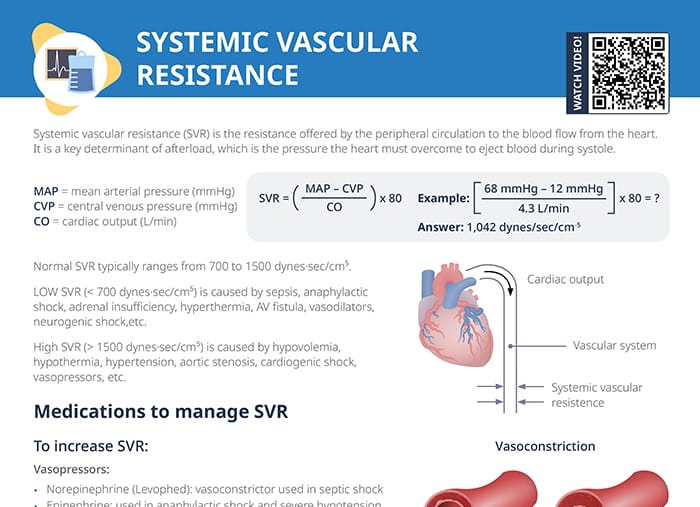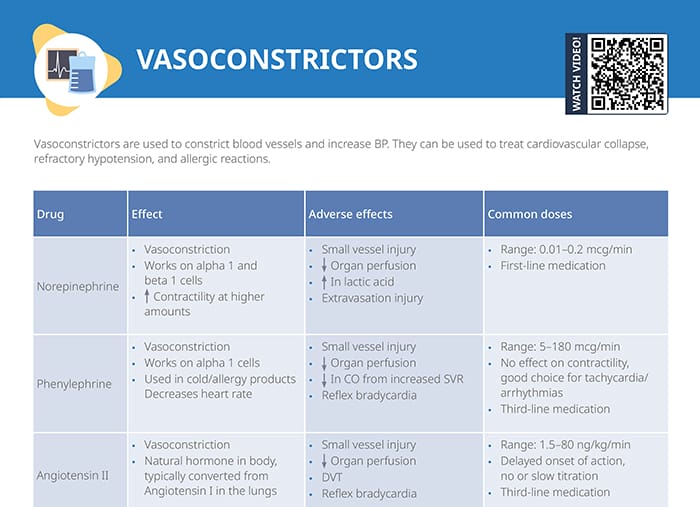


Systemic vascular resistance (SVR) is the resistance offered by the peripheral circulation to the blood flow from the heart.
SVR is a key determinant of afterload (= the pressure the heart must overcome to eject blood during systole).
Normal SVR typically ranges from 700 to 1500 dynes x sec/cm5.
Low SVR (< 700 dynes x sec/cm5) is caused by sepsis, anaphylactic shock, adrenal insufficiency, hyperthermia, AV fistula, vasodilators, neurogenic shock, etc. Low SVR can lead to inadequate perfusion of vital organs, so increasing the systemic vascular resistance to restore adequate blood pressure and perfusion is important for stabilization.
High SVR (> 1500 dynes x sec/cm5) is caused by hypovolemia, hypothermia, hypertension, aortic stenosis, cardiogenic shock, vasopressors, etc. Systemic vascular resistance that is too high can strain the heart and increases the risk for stroke, heart attacks, and kidney damage. Reducing the SVR is important to reduce the workload on the heart.
The systemic vascular resistance is calculated using the mean arterial pressure, the central venous pressure, and the cardiac output.
$$ SVR = (\frac{MAP – CVP}{CO}) \times 80 $$MAP = mean arterial pressure (mmHg)
CVP = central venous pressure (mmHg)
CO = cardiac output (L/min)
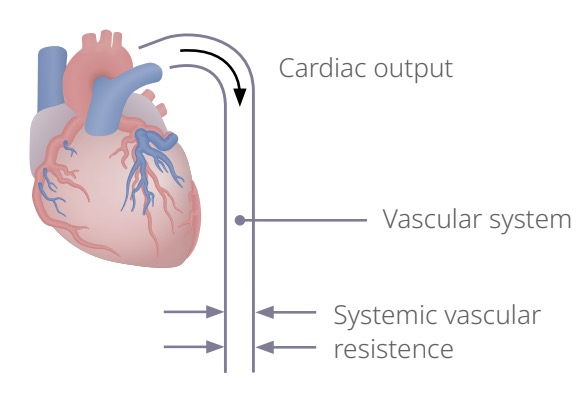
If the mean arterial pressure is 80 mmHg, the central venous pressure is 12 mmHg, and the cardiac output is 4.3 L/min, what is the systemic arterial pressure?
$$ [\frac{68 mmHg – 12 mmHg}{4.3 L/min}] \times 80 = ? $$Answer: 1042 dynes/sec/cm-5
Vasopressors are used to increase SVR that is too low:
Vasopressors constrict blood vessels, which raises blood pressure and systemic vascular resistance.
Nursing implications:
Vasodilators are used to decrease SVR that is too high:
Vasodilators lower SVR by causing vasodilation, which is important to lower blood pressure and reducing the risk of cardiovascular complications in hypertensive states.
Nursing implications: