

Nursing Knowledge
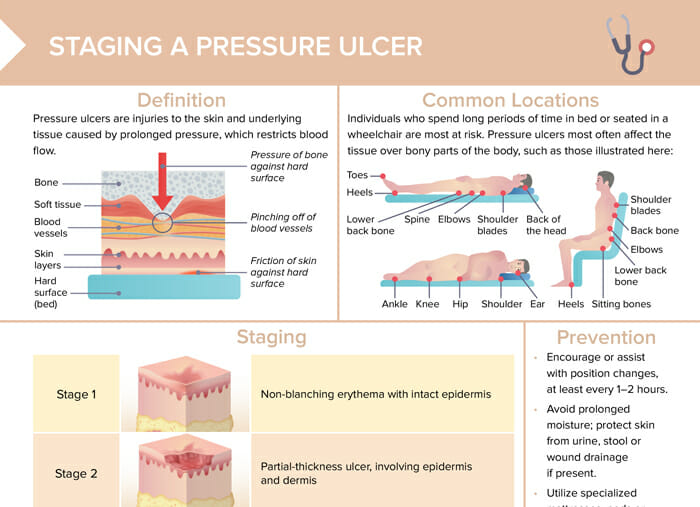
Pressure ulcers are injuries to the skin and underlying tissue caused by prolonged pressure restricting blood flow.
Nursing tip: Always do a full head-to-toe skin assessment upon admission or transfer to your unit, and document appropriately.
Pressure ulcers (older terms: bed sores, decubitus) are usually caused by prolonged pressure on the skin. Other causes include friction, shear, moisture, and contributing factors include poor nutrition, poor blood flow, lack of mobility, old age, or decreased sensation.
Individuals who spend long periods of time in bed or seated in a wheelchair are most at risk.
Pressure ulcers most often affect the tissue over bony parts of the body.
When lying on the back:
When lying on the side:
When sitting:
Table: Stages of pressure ulcers
| Stage 1 | Non-blanching erythema with intact epidermis |
| Stage 2 | Partial-thickness ulcer, involving epidermis and dermis |
| Stage 3 | Full-thickness ulcer extending through dermis into subcutaneous tissue |
| Stage 4 | Deep tissue destruction extending through fascia; may involve muscle, bone, tendon |
| Unstageable | Depth of injury unknown due to presence of necrotic tissue or eschar; surgical debridement required for staging |
Measures that can be taken to help prevent pressure ulcers include:
Treatment depends on the stage and severity. General approaches include:
RELATED TOPIC:
Free Download
Master the topic with a unique study combination of a concise summary paired with video lectures.
Your free account gives you access to:
or