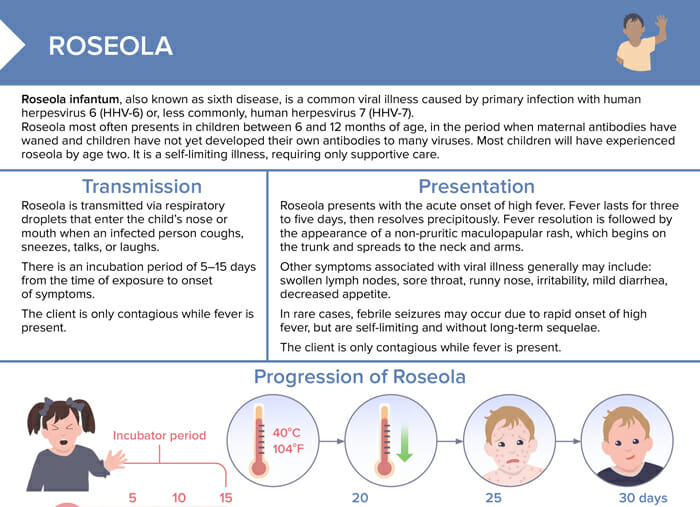


Roseola infantum, also known as sixth disease, is a common viral illness that most often presents in children between 6 and 12 months of age, in the period when maternal antibodies have waned and children have not yet developed their own antibodies to many viruses. Most children will have experienced roseola by age two.
Roseola is caused by primary infection with human herpesvirus 6 (HHV-6) or, less commonly, human herpesvirus 7 (HHV-7).
Roseola is transmitted via respiratory droplets that enter the child’s nose or mouth when an infected person coughs, sneezes, talks, or laughs. There is an incubation period of 5–15 days from the time of exposure to onset of symptoms. The client is only contagious while fever is present.
Yes, roseola is contagious to adults, if they haven’t been exposed to it before. Many adults have immunity from previous exposure during childhood.
Roseola presents with the acute onset of high fever. Fever lasts for three to five days, then resolves precipitously. Fever resolution is followed by the appearance of a non-pruritic maculopapular rash, which begins on the trunk and spreads to the neck and arms. Other symptoms associated with viral illness generally may include:
In rare cases, febrile seizures may occur due to rapid onset of high fever, but are self-limiting and without long-term sequelae. The client is only contagious while fever is present.
Tip: Download the free cheat sheet for a visual representation of the disease progression on a timeline!
Many adults are immune to roseola due to previous exposure in their childhood. If an adult does contract roseola, the symptoms are typically milder than in children.
The roseola rash typically lasts 1 to 2 days; although it can persist for up to a week in some cases.
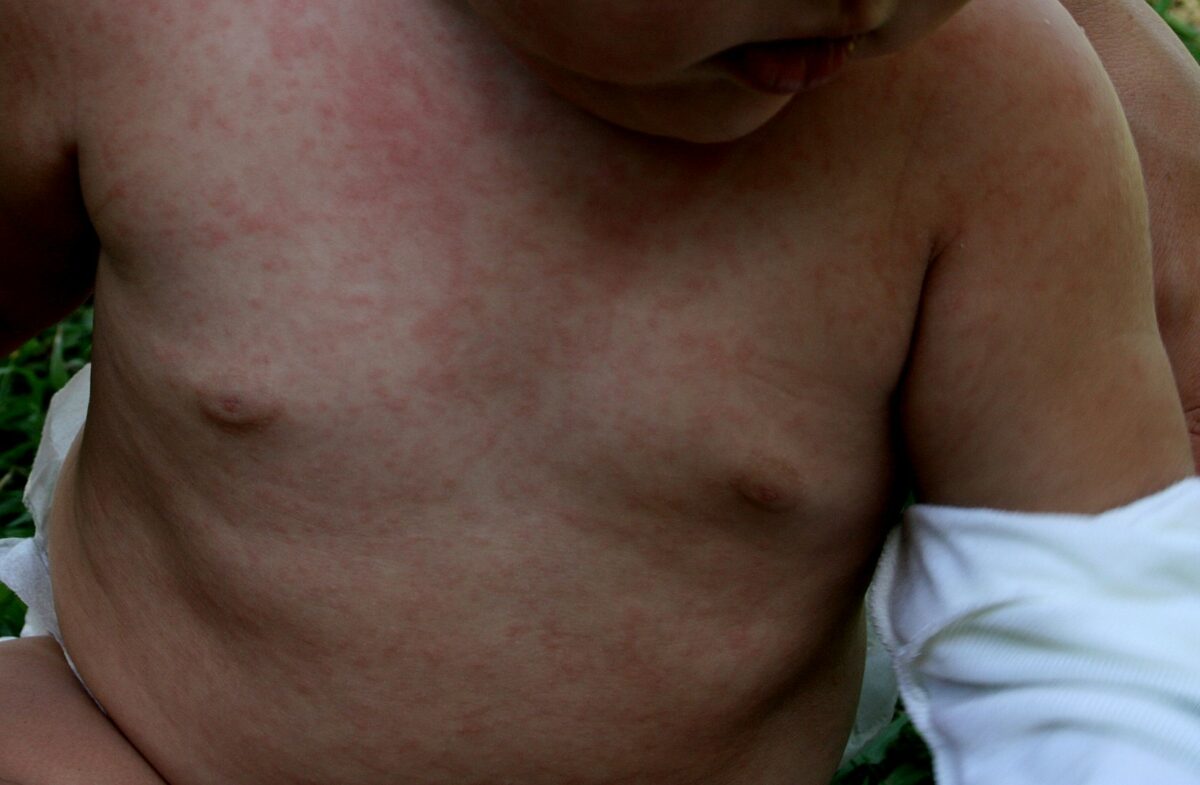
Diffuse maculopapular rash on the chest and abdomen due to roseola infantum
Image: “Sestamalattia” by Emiliano Burzagli. License: Public DomainRoseola is a self-limiting illness, requiring only supportive care.
Nursing tip: When fever caused by roseola is mistakenly treated with antibiotics, subsequent rash may be erroneously interpreted as an allergic reaction. Encourage watchful waiting to avoid antibiotic overuse and erroneous diagnosis of medication allergy.
Roseola can be mistaken for or mixed up with other conditions that cause rashes in children. Clinical presentation, history, and sometimes lab tests help differentiate them.
Amoxicillin rash can be mistaken for roseola due to its appearance. The cause is a reaction to the antibiotic amoxicillin, not a viral infection.
Both fifth and sixth disease cause a rash in children, but fifth disease, or erythema infectiosum, is caused by parvovirus B19 and characterized by a “slapped cheek” rash on the face.
Both conditions present with a rash and fever, but rubella’s rash starts on the face and spreads downward. It’s associated with congenital rubella syndrome if a pregnant woman gets infected.
Both measles and roseola are viral infections that present with fever and rashes, but the measles rash starts at the hairline and moves down. A hallmark sign of measles are Koplik’s spots in the mouth.
While there have been reported cases, it is rare to get roseola twice, as most people develop immunity after first being exposed.
Important points about roseola and pregnancy: