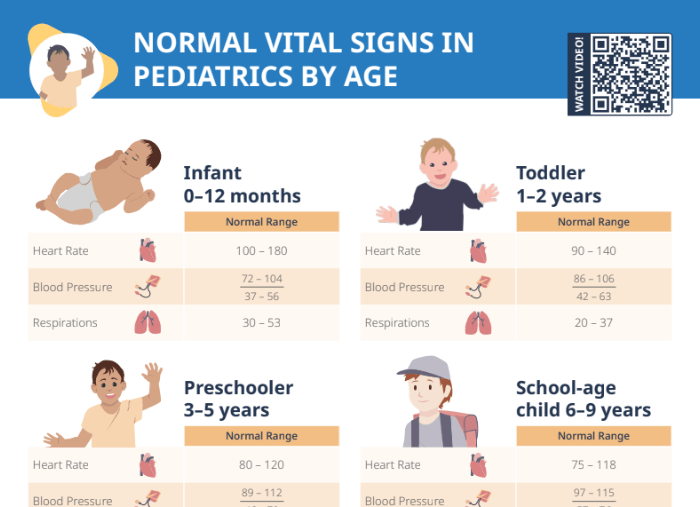
Vital signs are one of the most important tools to assess a patient’s baseline health and to detect changes in their condition. Taking vital signs as well as correctly interpreting them and recognizing warning signs is a fundamental nursing skill. Review the summary below and download the printable vital signs Cheat Sheet!
Vital signs are measurements of the body’s basic functions. Usually, they include:
Heart rate (pulse)
Blood pressure
Respiratory rate
Oxygen saturation
Temperature
What is the purpose of vital signs in nursing?
Monitoring clients’ vital signs is a fundamental part of continuously evaluating their physical health. Changes in vital signs can give information about and indicate various changes in a client’s condition and guide the decisions about nursing interventions.
How to take vital signs
Heart rate: place fingers over pulse point (radial artery), count beats for 30 seconds and double for beats per minute; or apical pulse with the stethoscope for 60 seconds
Blood pressure: measured with blood pressure cuff and stethoscope
Respiratory rate: observe the patient’s chest/breath without their awareness to avoid unnatural rates due to self-awareness
Oxygen saturation: pulse oximeter
Temperature: orally, rectally, axillary, or tympanic /temporal
When to take vital signs
Vital signs are taken frequently in clinical settings, for example:
On admission
In routine checkups
Before and after surgeries, procedures, medications
To monitor critical changes in emergency situations
Based on symptom changes (e.g., patient feeling faint)
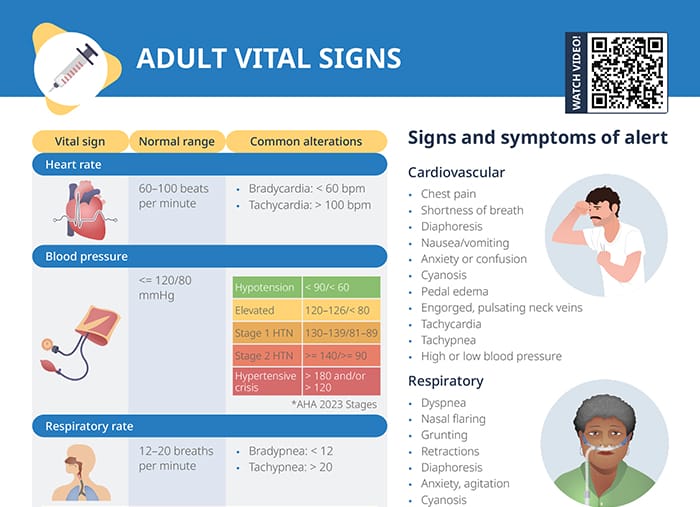
What is a normal heart rate?
The normal range for a resting heart rate is between 60 and 100 beats per minute.
Common alterations include:
Bradycardia, defined as less than 60 beats per minute
Tachycardia, defined as more than 100 beats per minute
What is the normal range for blood pressure?
Ideal blood pressure values are less or equal to 120/80.
Hypotension isnoted withfindings< 90/< 60 . Blood pressure that is too high is classified b the AHA 2023 stages as follows:
120–126/< 80: elevated blood pressure
120–126/82–89: stage 1 hypertension
>= 140/ >= 90: stage 2 hypertension
> 180 and/or > 120: hypertensive crisis
What is a normal respiratory rate?
A healthy adult with a normal respiratory rate will take between 12 and 20 breaths per minute.
Bradypnea, less than 12 breaths per minute
Tachypnea, more than 20 breaths per minute
What is the ideal oxygen saturation?
Oxygen saturation should ideally be 95–100%. Oxygen saturation below 90% means the client is presenting with hypoxemia.
What is a normal temperature for an adult?
The ideal temperature for an adult depends on the mode of measuring:
Oral: 98.6–99.5°F (37–37.5°C)
Temporal: 98.4–99.3°F (36.8–37.4°C)
Axillary: 97.7–99°F (36.5–37.2°C)
Rectal: 97.8–100.4°F (36.6–38°C)
The body becomes hypothermic when the temperature falls below 95°F (35°C).
Fever is defined as follows:
Oral: > 100°F/37.8°C
Temporal/Tympanic: > 100.4°F/37.8°C
Axillary: > 99°F/37.2°C
Rectal: > 100.4°F/38°C
Warning signs and symptoms
When checking vital signs and evaluating a patient, there are signs and symptoms of alert to keep in mind that require further attention and intervention: