
Nursing Knowledge
RELATED STUDY SHEET
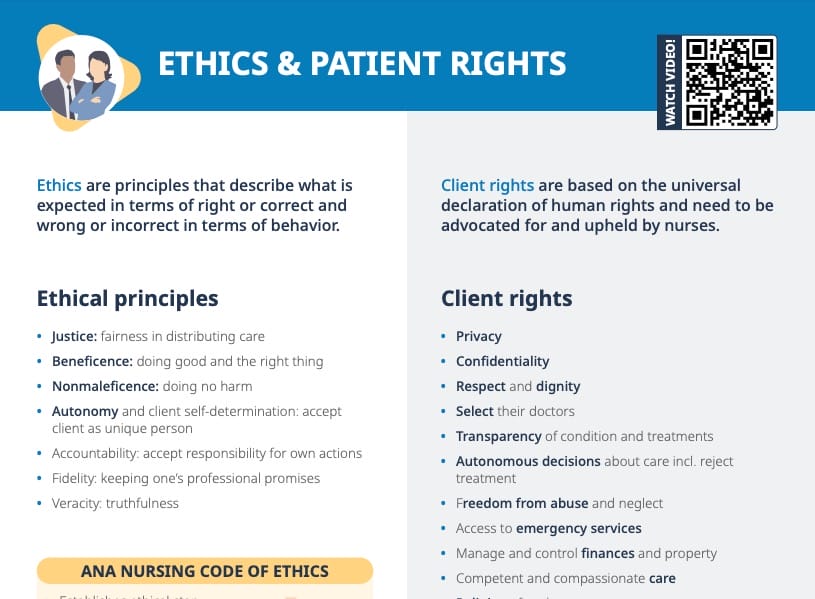
Ethics are principles that describe what is expected in terms of right or wrong in terms of behavior.
Clinical ethics is a subset of ethics that focuses on clinical medicine. It is essential to have an understanding of medical ethics in order to make clinical decisions.
Nurses must act on behalf of patients to promote and protect their rights and best interests, which includes speaking up and acting in favor of patient needs and what is ethically right.
Justice, or fairness, means nurses must be fair when they distribute care among their patients, and their attention and care must be equitably distributed.
Beneficence means doing good and the right thing for the patient.
Nonmaleficence means doing no harm to the patients. This includes intentional as well as unintentional harm.
Accountability is accepting responsibility for one’s own actions. It means to accept the professional and personal consequences of your actions.
Autonomy and patient self-determination mean to accept the patient as a unique person with an innate right to their own opinions and beliefs. Patients must be encouraged to make their own informed decisions without judgment or influence. This includes care aligning with a patient’s cultural beliefs and needs, as well as the patient’s right to refuse treatment.
Fidelity stands for keeping one’s promises. A nurse must remain faithful and true to their professional responsibilities by providing high-quality, safe care.
Veracity means being truthful with patients at all times; including not withholding parts of the truth.
A lot of sources name as the 4 main principles:
The Organ Procurement and Transplantation Network (OPTN) has defined the following major ethical principles to be applied in organ donation:
Casuistry theory is an ethical approach that focuses on case-based reasoning. Instead of applying broad ethical principles universally, casuistry examines individual situations and makes decisions based on the specifics of that case.
In nursing, this could mean evaluating a patient’s situation as a unique case and basing ethical decisions on the individual situation, rather than relying solely on broad ethical guidelines.
Situations that can lead to ethical dilemmas in nursing practice include:
As nurses, it is our obligation to recognize and identify ethical issues that affect staff and patients. Ethical committees within facilities can advise in the resolution of ethical concerns.
An ethics committee is a multidisciplinary group within a healthcare facility that provides guidance on ethical dilemmas and complex patient-care issues. A nurse might consult an ethics committee when faced with a challenging ethical decision where guidance, additional perspectives, or institutional input is needed.
Moral distress occurs when a nurse knows the ethically appropriate action to take but feels constrained or powerless to take that action, often leading to feelings of frustration, guilt, or anguish. It can arise from internal conflicts, organizational constraints, or conflicting duties and responsibilities.
Free Download
Master the topic with a unique study combination of a concise summary paired with video lectures.
Your free account gives you access to:
or