

Nursing Knowledge
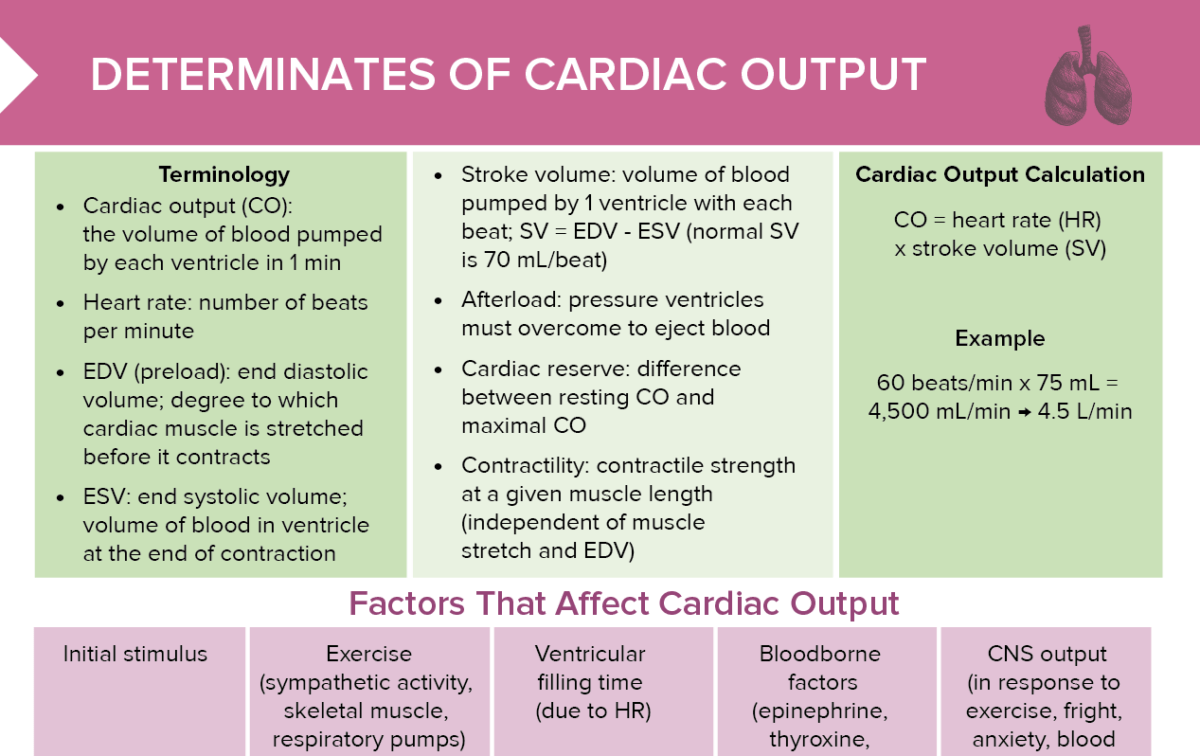
Cardiac output is the volume of blood pumped by each ventricle in one minute. It is calculated by multiplying heart rate by stroke volume.
Cardiac output (CO) = heart rate (HR) x stroke volume (SV)
Cardiac reserve is the difference between resting cardiac output and maximal cardiac output.
Preload (also known as end diastolic volume, EDV) is the degree to which the cardiac muscle is stretched before it contracts.
The end systolic volume (ESV) is the volume of blood in the ventricle at the end of contraction.
Afterload is the pressure ventricles must overcome to eject blood.
Contractility refers to the contractile strength at a given muscle length (independent of muscle stretch and EDV).
Stroke volume is the volume of blood pumped by one ventricle with each beat.
Stroke volume = EDV – ESV
Result: Increased cardiac output (CO = SV x HR). The opposite relationship also occurs, resulting in decreased cardiac output.
Decreased cardiac output occurs when the heart’s function as a pump is compromised.
Potential nursing diagnoses include:
RELATED TOPIC:
Free Download
Master the topic with a unique study combination of a concise summary paired with video lectures.
Your free account gives you access to:
or