What is benign prostatic hypertrophy (BPH)?
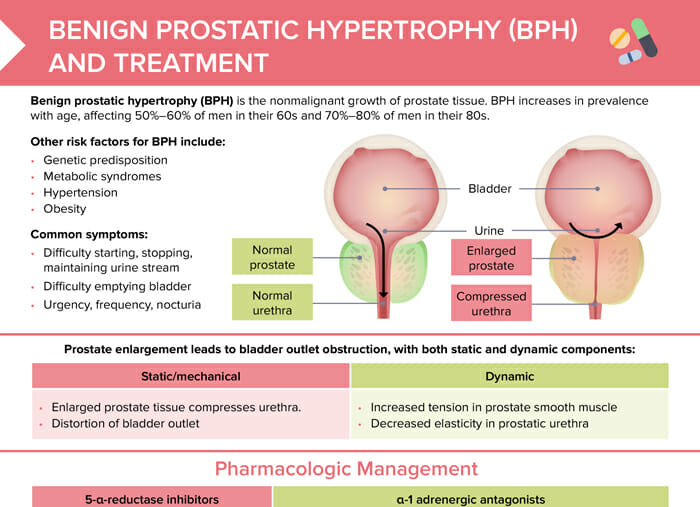
Benign prostatic hypertrophy (BPH) is the nonmalignant growth of prostate tissue. BPH increases in prevalence with age, affecting 50%–60% of men in their 60s and 70%–80% of men in their 80s.
Prostate enlargement leads to bladder outlet obstruction, with both static and dynamic components:
- Static: enlarged prostate compresses urethra; distortion of bladder outlet
- Dynamic: increased tension in prostate smooth muscle; decreased elasticity in prostatic urethra
Risk factors for BPH
The risk of developing BPH increases with:
- Genetic predisposition
- Metabolic syndromes
- Hypertension
- Obesity
Symptoms of BPH
Common symptoms of prostatic hypertrophy include:
- Difficulty starting, stopping, maintaining urine stream
- Difficulty emptying bladder
- Urgency, frequency, nocturia
Nursing diagnosis for BPH
Potential nursing diagnoses for benign prostatic hypertrophy include:
- Impaired urinary elimination
- Acute pain related to bladder distention or catheter placement
- Risk for infection related to urinary retention
Nursing interventions for BPH
Interventions addressing nursing diagnoses
- Impaired urinary elimination: monitor frequency, amount, presence of blood in urine; encourage patient to void at regular intervals and when urge is felt; teach client to avoid fluids before bed and instruct on double-voiding
- Acute pain: prescribed analgesics, monitor for bladder distention and catheter blockage
- Risk for infection: maintain closed urinary drainage system if catheter is present; teach the patient proper perineal hygiene; encourage adequate fluid intake; monitor for signs of infection
Best medication for enlarged prostate
- 5-α-reductase inhibitors (finasteride, dutasteride): shrink prostate epithelial tissue; best for mechanical obstruction
- α-1 adrenergic antagonists (tamsulosin): relaxes smooth muscle in the prostate—prostate capsule, urethra, bladder neck (trigone & sphincter);helps with dynamic obstruction
Treatment is most effective when both classes of medication are used in combination therapy.
Best surgery for enlarged prostate
Surgical treatment options for BPH include:
- Transurethral resection (TURP), most common
- Prostatectomy
- Laser anucleation (HoLEP)
- UroLift®
Choice of surgery depends on the individual and factors like size of the prostate, overall health, and severity of symptoms.