Domina Conceptos Médicos

Estudia para la escuela de medicina y tus examenes con Lecturio.

Paro Cardíaco

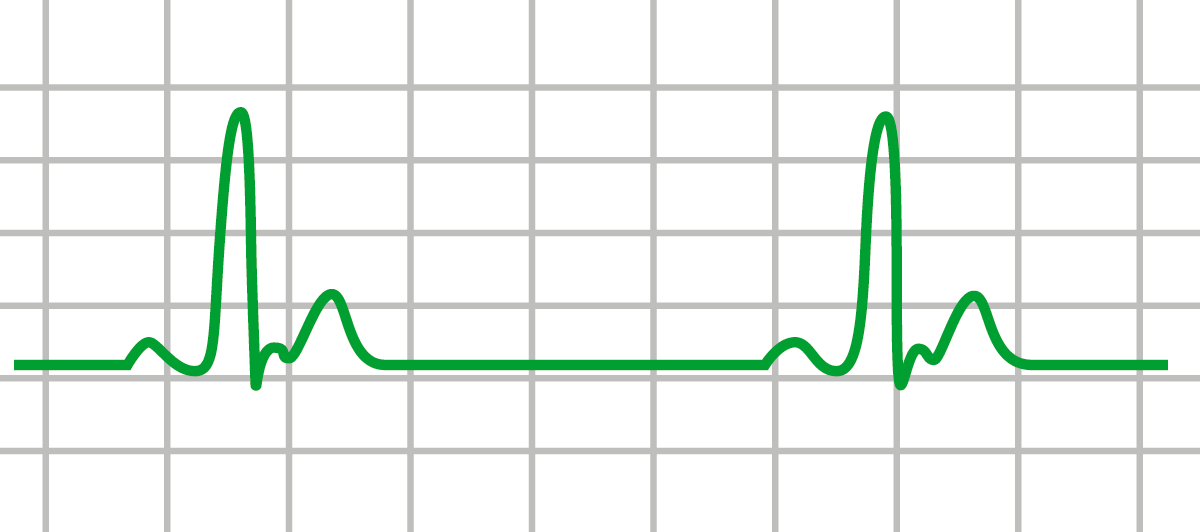
El paro cardíaco es el cese repentino y completo del gasto cardíaco con colapso hemodinámico. Los LOS Neisseria pacientes se presentan sin pulso, sin respuesta y apneicos. Los LOS Neisseria ritmos asociados a la parada cardíaca son la fibrilación/taquicardia ventricular, la asistolia o la actividad eléctrica sin pulso. El tratamiento del paro cardíaco comienza con el soporte vital básico ( BLS BLS Airway Management, por sus siglas en EN Erythema nodosum is an immune-mediated panniculitis (inflammation of the subcutaneous fat) caused by a type IV (delayed-type) hypersensitivity reaction. It commonly manifests in young women as tender, erythematous nodules on the shins. Erythema Nodosum inglés) cuando es extrahospitalario y el soporte vital cardíaco avanzado (ACLS, por sus siglas en EN Erythema nodosum is an immune-mediated panniculitis (inflammation of the subcutaneous fat) caused by a type IV (delayed-type) hypersensitivity reaction. It commonly manifests in young women as tender, erythematous nodules on the shins. Erythema Nodosum inglés) cuando es intrahospitalario. El soporte vital básico comprende la comprobación del estado mental del paciente, la activación del sistema de respuesta a emergencias y la reanimación cardiopulmonar (RCP). Se debe utilizar un desfibrilador externo automático (DEA) cuando esté disponible. La RCP de alta calidad (con desfibrilación temprana en EN Erythema nodosum is an immune-mediated panniculitis (inflammation of the subcutaneous fat) caused by a type IV (delayed-type) hypersensitivity reaction. It commonly manifests in young women as tender, erythematous nodules on the shins. Erythema Nodosum ritmos desfibrilables) es crucial para la supervivencia en EN Erythema nodosum is an immune-mediated panniculitis (inflammation of the subcutaneous fat) caused by a type IV (delayed-type) hypersensitivity reaction. It commonly manifests in young women as tender, erythematous nodules on the shins. Erythema Nodosum caso de paro cardíaco. El soporte vital cardíaco avanzado incluye la RCP, el aseguramiento de las vías aéreas, la administración de medicamentos (como la epinefrina) y la identificación y el tratamiento de la causa del paro. Los LOS Neisseria cuidados posteriores a la parada cardíaca se producen tras el retorno de la circulación espontánea (RCE).

Last updated: Jun 16, 2022

Editorial responsibility: Stanley Oiseth, Lindsay Jones, Evelin Maza

Descripción General

Definición

El paro cardíaco súbito es el cese brusco de la actividad cardíaca.

Epidemiología

  • En EN Erythema nodosum is an immune-mediated panniculitis (inflammation of the subcutaneous fat) caused by a type IV (delayed-type) hypersensitivity reaction. It commonly manifests in young women as tender, erythematous nodules on the shins. Erythema Nodosum los LOS Neisseria Estados Unidos, hay aproximadamente 350 000 casos al AL Amyloidosis año.
    • El 60% ocurre fuera del hospital, con una tasa de supervivencia del 10% (hasta el 30% cuando es presenciado por un espectador).
    • El 40% se produce en EN Erythema nodosum is an immune-mediated panniculitis (inflammation of the subcutaneous fat) caused by a type IV (delayed-type) hypersensitivity reaction. It commonly manifests in young women as tender, erythematous nodules on the shins. Erythema Nodosum el hospital, con una tasa de supervivencia del 20%.
  • La incidencia del paro cardíaco aumenta linealmente con la edad.
  • El 57% de los LOS Neisseria pacientes son hombres.
  • La tasa de supervivencia es del 10% para los LOS Neisseria ritmos no desfibrilables y > 30% para los LOS Neisseria ritmos desfibrilables.

Factores de riesgo

  • Tabaquismo
  • Antecedentes familiares de parada cardiaca súbita (SCA, por sus siglas en EN Erythema nodosum is an immune-mediated panniculitis (inflammation of the subcutaneous fat) caused by a type IV (delayed-type) hypersensitivity reaction. It commonly manifests in young women as tender, erythematous nodules on the shins. Erythema Nodosum inglés)
  • Consumo excesivo de alcohol (6 o más bebidas al AL Amyloidosis día) o beber compulsivamente
  • Ácidos grasos libres elevados (asociados a la muerte súbita cardíaca ( SCD SCD Sickle cell disease (SCD) is a group of genetic disorders in which an abnormal Hb molecule (HbS) transforms RBCs into sickle-shaped cells, resulting in chronic anemia, vasoocclusive episodes, pain, and organ damage. Sickle Cell Disease, por sus siglas en EN Erythema nodosum is an immune-mediated panniculitis (inflammation of the subcutaneous fat) caused by a type IV (delayed-type) hypersensitivity reaction. It commonly manifests in young women as tender, erythematous nodules on the shins. Erythema Nodosum inglés) y a la arritmia ventricular tras un infarto de miocardio)

Etiología y Presentación Clínica

Causas cardíacas del paro cardíaco

  • Enfermedades estructurales del corazón:
    • Enfermedad coronaria: asociada con hasta el 70% de los LOS Neisseria SCA
    • Cardiopatías congénitas
    • Cardiomiopatías
    • Cardiopatías valvulares
    • Miocarditis
    • Disección aórtica
    • Taponamiento pericárdico agudo
  • Sin enfermedad cardíaca estructural:
    • Bloqueo cardíaco completo
    • Síndrome de Brugada
    • Fibrilación ventricular idiopática
    • Síndrome de QT largo
    • Síndrome de preexcitación
    • Muerte súbita familiar
    • Traumatismo de la pared torácica ( commotio cordis Commotio cordis A sudden cardiac arrhythmia (e.g., ventricular fibrillation) caused by a blunt, non-penetrating impact to the precordial region of chest wall. Commotio cordis often results in sudden death without prompt cardiopulmonary defibrillation. Blunt Chest Trauma)

Causas no cardíacas del paro cardíaco

  • Trauma
  • Electrocución
  • Hemorragia excesiva
  • Hipoglicemia
  • Embolia pulmonar
  • Ahogamiento
  • Síndrome de muerte súbita del lactante ( SIDS SIDS Sudden infant death syndrome (SIDS) describes the sudden death of an otherwise healthy infant (< 1 year of age) with no identifiable cause. Sudden infant death syndrome is the leading cause of death in children between 1 and 12 months of age in the United States. Sudden Infant Death Syndrome (SIDS), por sus siglas en EN Erythema nodosum is an immune-mediated panniculitis (inflammation of the subcutaneous fat) caused by a type IV (delayed-type) hypersensitivity reaction. It commonly manifests in young women as tender, erythematous nodules on the shins. Erythema Nodosum inglés)
  • Muerte súbita inexplicada en EN Erythema nodosum is an immune-mediated panniculitis (inflammation of the subcutaneous fat) caused by a type IV (delayed-type) hypersensitivity reaction. It commonly manifests in young women as tender, erythematous nodules on the shins. Erythema Nodosum la epilepsia (SUDEP, por sus siglas en EN Erythema nodosum is an immune-mediated panniculitis (inflammation of the subcutaneous fat) caused by a type IV (delayed-type) hypersensitivity reaction. It commonly manifests in young women as tender, erythematous nodules on the shins. Erythema Nodosum inglés)

Mnemotecnia

Las 5 Hs HS Hypertrophic scars and keloids are raised, red, and rigid (3 rs) scars that develop during cutaneous wound healing and are characterized by a local abnormal proliferation of fibroblasts with over-production of collagen. Over-expression of growth factors and decreased production of molecules that promote matrix breakdown appear to be involved in the etiology. Hypertrophic and Keloid Scars y las 5 Ts de las causas comunes y reversibles de paro cardiaco:

  • 5 Hs:
    1. Hipoxia
    2. Hipovolemia
    3. Hipocalemia o hipercalemia
    4. Hipotermia
    5. Hidrogeniones ( acidosis Acidosis A pathologic condition of acid accumulation or depletion of base in the body. The two main types are respiratory acidosis and metabolic acidosis, due to metabolic acid build up. Respiratory Acidosis)
  • 5 Ts:
    1. Toxinas
    2. Taponamiento
    3. Neumotórax a tensión
    4. Trombosis (infarto de miocardio)
    5. Trombosis (embolia pulmonar)

Presentación clínica

  • El paciente no responde al AL Amyloidosis llamado (pérdida de conciencia)
  • Sin pulso
  • Apneico (puede tener respiraciones agónicas)
  • Algunos tienen síntomas de advertencia
    • Síntomas más comunes:
    • Hasta el 80% de los LOS Neisseria pacientes tienen síntomas 1 hora antes y el 50% tienen síntomas 1 mes antes del SCA.

Ritmos Cardíacos

Hay cuatro ritmos cardíacos principales asociados al AL Amyloidosis SCA. Estos ritmos se dividen en EN Erythema nodosum is an immune-mediated panniculitis (inflammation of the subcutaneous fat) caused by a type IV (delayed-type) hypersensitivity reaction. It commonly manifests in young women as tender, erythematous nodules on the shins. Erythema Nodosum ritmos desfibrilables y no desfibrilables

Ritmos desfibrilables

Los LOS Neisseria ritmos desfibrilables suelen estar causados por una enfermedad cardíaca primaria (más comúnmente isquemia). Menos comúnmente, son causadas por condiciones sistémicas (alteraciones electrolíticas, toxinas, autoinmunidad).

  • Fibrilación ventricular (FV):
    • Actividad eléctrica desorganizada de alta frecuencia en EN Erythema nodosum is an immune-mediated panniculitis (inflammation of the subcutaneous fat) caused by a type IV (delayed-type) hypersensitivity reaction. It commonly manifests in young women as tender, erythematous nodules on the shins. Erythema Nodosum los LOS Neisseria ventrículos
    • No hay contracción mecánica, lo que significa que no hay pulso
  • Taquicardia ventricular (TV) sin pulso:
    • Frecuencia ventricular rápida y regular Regular Insulin con un complejo QRS amplio
    • Más de 100/min en EN Erythema nodosum is an immune-mediated panniculitis (inflammation of the subcutaneous fat) caused by a type IV (delayed-type) hypersensitivity reaction. It commonly manifests in young women as tender, erythematous nodules on the shins. Erythema Nodosum el trazado

Ritmos no desfibrilables

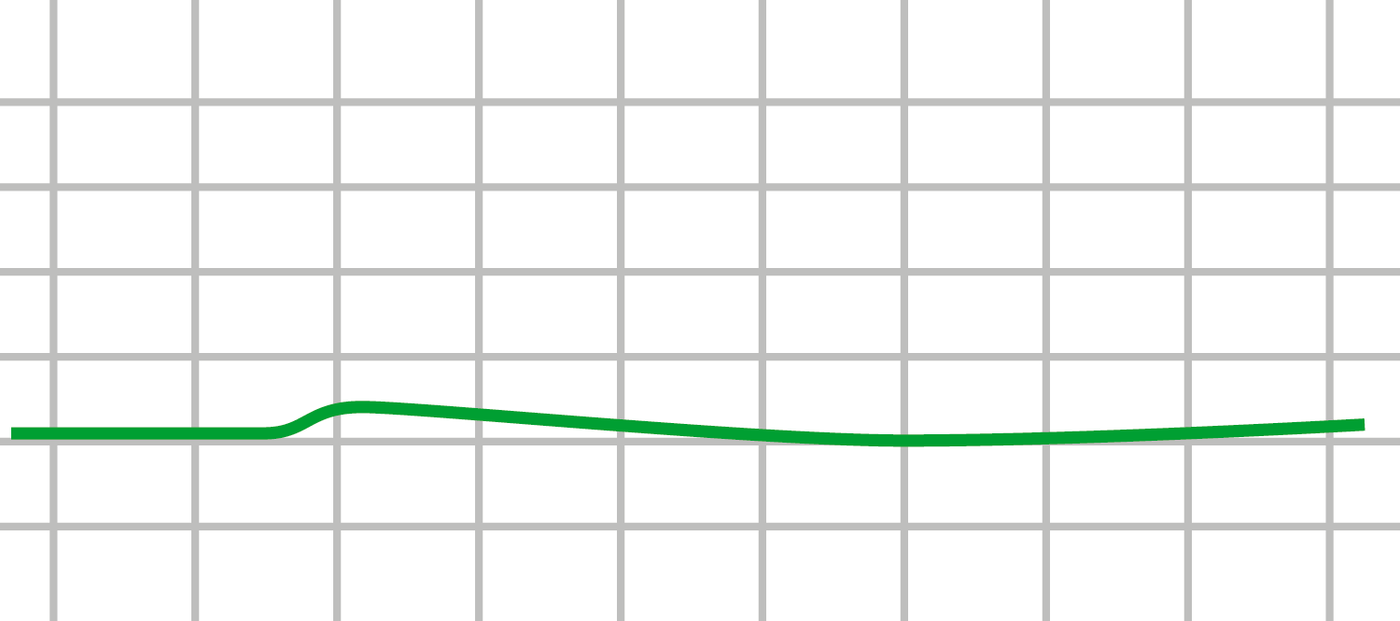
  • Asistolia:
    • No hay actividad eléctrica discernible
    • Línea plana en EN Erythema nodosum is an immune-mediated panniculitis (inflammation of the subcutaneous fat) caused by a type IV (delayed-type) hypersensitivity reaction. It commonly manifests in young women as tender, erythematous nodules on the shins. Erythema Nodosum el electrocardiograma (las ondas P y los LOS Neisseria complejos QRS no están presentes)
  • Actividad eléctrica sin pulso (AEP):
    • El electrocardiograma ( ECG ECG An electrocardiogram (ECG) is a graphic representation of the electrical activity of the heart plotted against time. Adhesive electrodes are affixed to the skin surface allowing measurement of cardiac impulses from many angles. The ECG provides 3-dimensional information about the conduction system of the heart, the myocardium, and other cardiac structures. Electrocardiogram (ECG)) muestra un ritmo cardíaco sin pulso palpable.
    • Puede ser organizado (con complejos ECG ECG An electrocardiogram (ECG) is a graphic representation of the electrical activity of the heart plotted against time. Adhesive electrodes are affixed to the skin surface allowing measurement of cardiac impulses from many angles. The ECG provides 3-dimensional information about the conduction system of the heart, the myocardium, and other cardiac structures. Electrocardiogram (ECG) de apariencia normal) o no organizado (sin complejos discernibles en EN Erythema nodosum is an immune-mediated panniculitis (inflammation of the subcutaneous fat) caused by a type IV (delayed-type) hypersensitivity reaction. It commonly manifests in young women as tender, erythematous nodules on the shins. Erythema Nodosum el ECG ECG An electrocardiogram (ECG) is a graphic representation of the electrical activity of the heart plotted against time. Adhesive electrodes are affixed to the skin surface allowing measurement of cardiac impulses from many angles. The ECG provides 3-dimensional information about the conduction system of the heart, the myocardium, and other cardiac structures. Electrocardiogram (ECG))
    • Por disociación electromecánica, o ausencia de llenado cardíaco (“corazón vacío”)

Tratamiento con Soporte Vital Básico (BLS)

Cadena de supervivencia

  1. Reconocer un paro y confirmar la seguridad de la escena.
    • Intente despertar al AL Amyloidosis paciente con comandos verbales y tacto físico.
    • Observe si hay signos de respiración ( los LOS Neisseria pacientes pueden tener una respiración agónica en EN Erythema nodosum is an immune-mediated panniculitis (inflammation of the subcutaneous fat) caused by a type IV (delayed-type) hypersensitivity reaction. It commonly manifests in young women as tender, erythematous nodules on the shins. Erythema Nodosum el paro cardíaco).
    • Compruebe el pulso del paciente en EN Erythema nodosum is an immune-mediated panniculitis (inflammation of the subcutaneous fat) caused by a type IV (delayed-type) hypersensitivity reaction. It commonly manifests in young women as tender, erythematous nodules on the shins. Erythema Nodosum 10 segundos:
      • Utilize la arteria carótida en EN Erythema nodosum is an immune-mediated panniculitis (inflammation of the subcutaneous fat) caused by a type IV (delayed-type) hypersensitivity reaction. It commonly manifests in young women as tender, erythematous nodules on the shins. Erythema Nodosum adultos.
      • Utilice la arteria braquial o femoral en EN Erythema nodosum is an immune-mediated panniculitis (inflammation of the subcutaneous fat) caused by a type IV (delayed-type) hypersensitivity reaction. It commonly manifests in young women as tender, erythematous nodules on the shins. Erythema Nodosum los LOS Neisseria niños.
  2. Active el sistema de respuesta de emergencia.
    • Pida ayuda/llama a otras personas para que ayuden.
    • Llame al AL Amyloidosis 911, o el número de emergencia del lugar donde se encuentre.
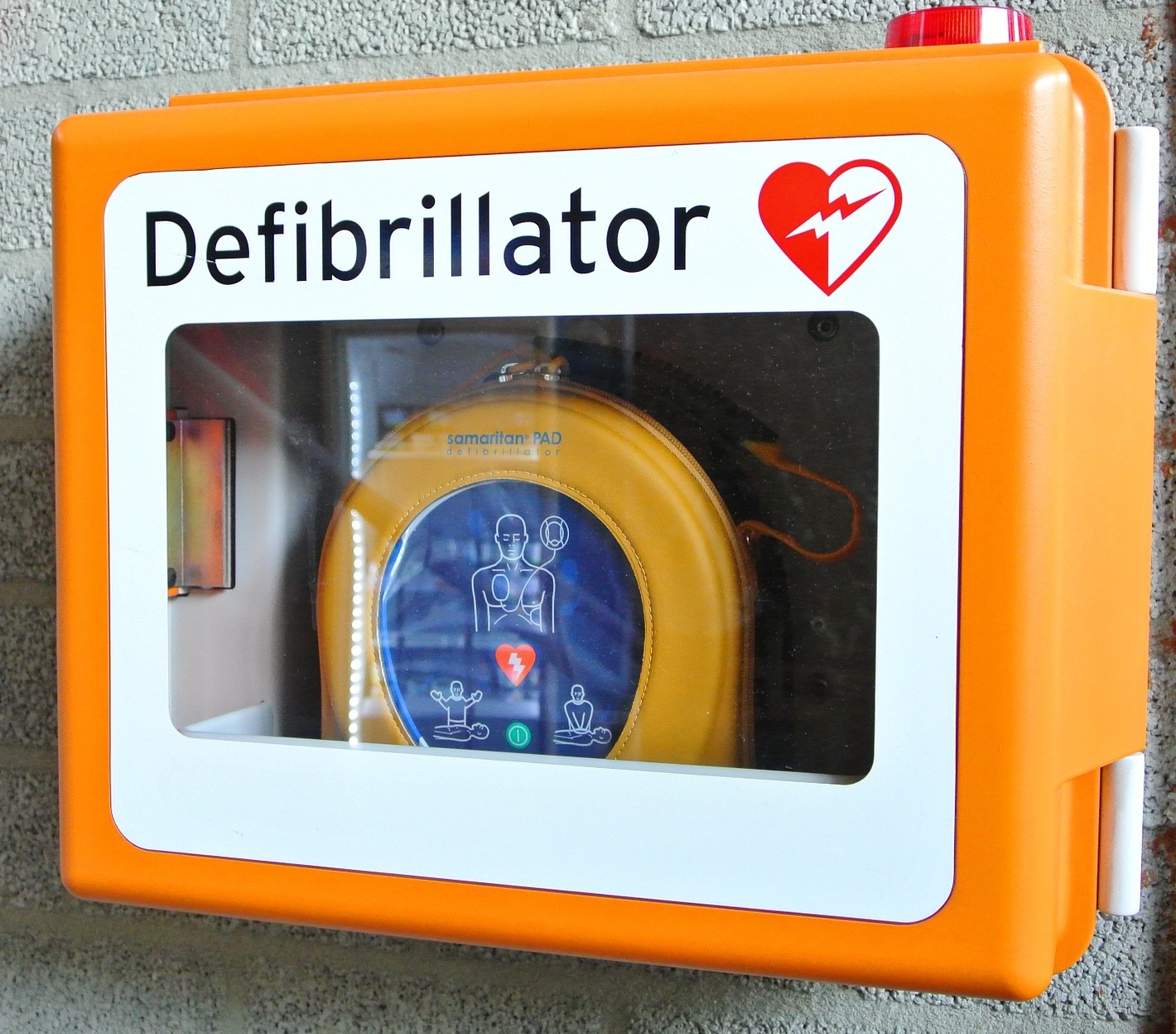
    • Haga que alguien consiga un desfibrilador externo automático (DEA), si está disponible.
  3. Inicie inmediatamente la reanimación cardiopulmonar (RCP).
    • Lo ideal es hacerlo simultáneamente con la petición de ayuda
    • Es importante: Si se sospecha de una sobredosis de opioides, administre naloxona si está disponible.
  4. Compruebe el ritmo cardíaco con el DEA una vez que llegue.
  5. Cuando esté indicada la descarga, continúe con las compresiones torácicas hasta justo antes de que se vaya a administrar la descarga.
  6. Reanude las compresiones torácicas inmediatamente después de administrar la descarga, y continúe hasta que el personal de emergencia llegue.

RCP de alta calidad

  • Es la intervención más importante en EN Erythema nodosum is an immune-mediated panniculitis (inflammation of the subcutaneous fat) caused by a type IV (delayed-type) hypersensitivity reaction. It commonly manifests in young women as tender, erythematous nodules on the shins. Erythema Nodosum caso de paro cardíaco y debe realizarse con prontitud.
  • No se detectan daños graves por la RCP en EN Erythema nodosum is an immune-mediated panniculitis (inflammation of the subcutaneous fat) caused by a type IV (delayed-type) hypersensitivity reaction. It commonly manifests in young women as tender, erythematous nodules on the shins. Erythema Nodosum pacientes que no están en EN Erythema nodosum is an immune-mediated panniculitis (inflammation of the subcutaneous fat) caused by a type IV (delayed-type) hypersensitivity reaction. It commonly manifests in young women as tender, erythematous nodules on the shins. Erythema Nodosum paro cardíaco
  • 30 compresiones torácicas seguidas de 2 ventilaciones (30:2) en EN Erythema nodosum is an immune-mediated panniculitis (inflammation of the subcutaneous fat) caused by a type IV (delayed-type) hypersensitivity reaction. It commonly manifests in young women as tender, erythematous nodules on the shins. Erythema Nodosum adultos
  • 15:2 en EN Erythema nodosum is an immune-mediated panniculitis (inflammation of the subcutaneous fat) caused by a type IV (delayed-type) hypersensitivity reaction. It commonly manifests in young women as tender, erythematous nodules on the shins. Erythema Nodosum víctimas infantiles si se cuenta con 2 reanimadores
  • Componentes principales:
    • Ritmo: 100-120 compresiones/min.
    • Profundidad de compresión: 5-7.6 cm (2-3 pulgadas) (niño: 5 cm (2 pulgadas), bebé: 3.8 cm (1.5 pulgadas))
    • Continuidad: Limitar las pausas durante la RCP.
    • Permita el retroceso completo del pecho.
    • Evite ventilar de forma excesiva (1 respiración cada 5-6 segundos).
  • Acceso a la vía aérea:
    • Inclinación de la cabeza/elevación del mentón para tener acceso a la vía aérea.
    • Para la lesión cervical: empuje de la mandíbula sin extensión de la cabeza
    • Suministrar la respiración boca a boca o mediante ventilación con bolsa-máscara.
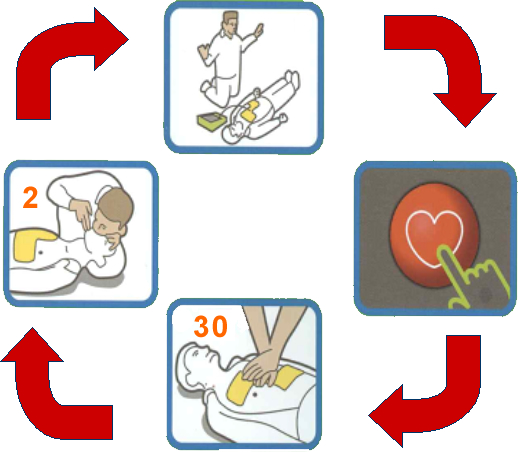
Ciclo general de reanimación cardiopulmonar (RCP)

Ciclo general de RCP: (inicio: imagen inferior)
1. Al reconocer la parada cardíaca, realice 30 compresiones torácicas firmes.
2. Siga las compresiones con 2 respiraciones de rescate.
3. Cuando llegue un DEA, coloque las almohadillas en las zonas adecuadas.
4. Cuando el DEA lo indique, compruebe el ritmo y aplique la descarga cuando se le indique (después de asegurarse de que nadie está en contacto físico con el paciente).
Reanude el ciclo de RCP después de la administración de la descarga.
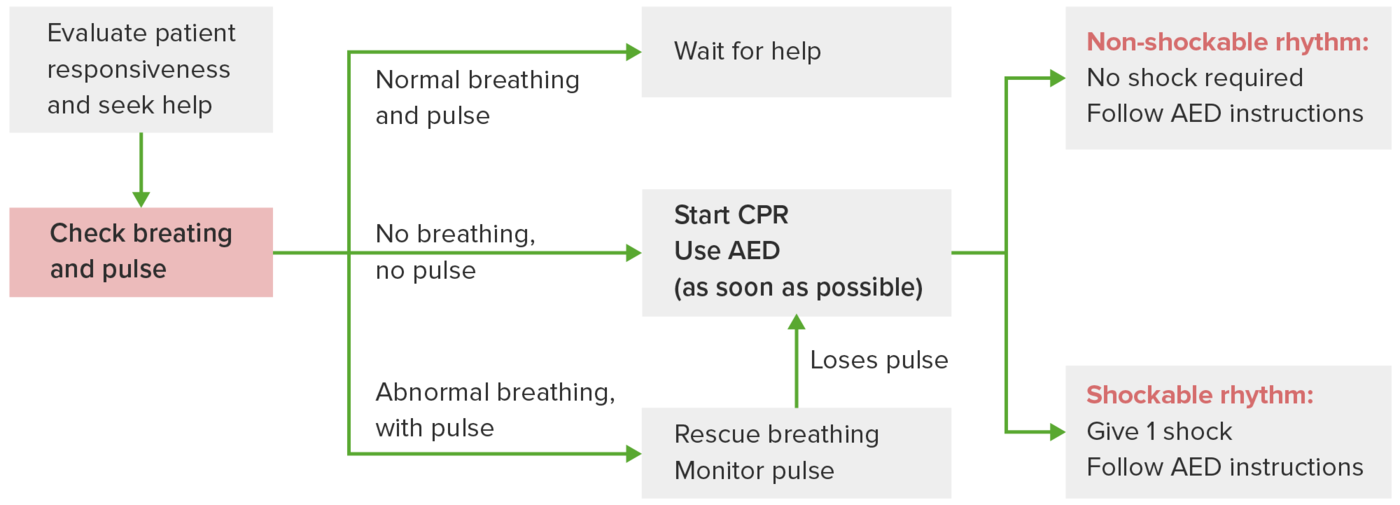
Imagen: “Aed ablauf” por Jörg Rittmeister. Licencia: Dominio Público

Manejo con Soporte Vital Cardíaco Avanzado (ACLS)

Circulación, vías respiratorias, respiración (CAB)

Circulación, vía aérea, respiración es el mantra del soporte vital cardíaco avanzado. Desde 2010, el manejo se ha HA Hemolytic anemia (HA) is the term given to a large group of anemias that are caused by the premature destruction/hemolysis of circulating red blood cells (RBCs). Hemolysis can occur within (intravascular hemolysis) or outside the blood vessels (extravascular hemolysis). Hemolytic Anemia centrado en EN Erythema nodosum is an immune-mediated panniculitis (inflammation of the subcutaneous fat) caused by a type IV (delayed-type) hypersensitivity reaction. It commonly manifests in young women as tender, erythematous nodules on the shins. Erythema Nodosum iniciar primero las compresiones torácicas para tratar la circulación, y después el acceso a la vía aérea y la respiración artificial.
  • C (circulación):
    • RCP de alta calidad
    • Determine el ritmo; en EN Erythema nodosum is an immune-mediated panniculitis (inflammation of the subcutaneous fat) caused by a type IV (delayed-type) hypersensitivity reaction. It commonly manifests in young women as tender, erythematous nodules on the shins. Erythema Nodosum AEP/asistolia, continúe con la RCP.
    • Desfibrila los LOS Neisseria ritmos desfibrilables:
      • Administre una descarga de 120-200 jules con un desfibrilador bifásico (el pico de corriente eléctrica más bajo es eficaz para terminar las taquiarritmias ventriculares).
      • La descarga debe ser de 360 jules en EN Erythema nodosum is an immune-mediated panniculitis (inflammation of the subcutaneous fat) caused by a type IV (delayed-type) hypersensitivity reaction. It commonly manifests in young women as tender, erythematous nodules on the shins. Erythema Nodosum un desfibrilador monofásico.
    • Establecer un acceso intravenoso (IV) o intraóseo (IO).
    • Epinefrina 1 mg IV y repetir cada 3-5 minutos para todos los LOS Neisseria ritmos.
    • Medicamentos para ritmos desfibrilables (taquicardia/fibrilación ventricular):
      • Amiodarona 300 mg IV con dosis repetida de 150 mg IV según se indique
      • Considere administrar lidocaína
      • Para la torsión de puntas: sulfato de magnesio (no es de uso rutinario)
  • A (vía aérea):
    • Dispositivo de bolsa-máscara o “ambú” (si no está intubado)
    • Uso de una vía aérea avanzada (tubo endotraqueal): 10/min
  • B (respiración):
    • Oxigenar al AL Amyloidosis paciente con oxígeno al AL Amyloidosis 100%.
    • Utilice la capnografía de onda cuantitativa (compruebe el nivel de CO₂ al AL Amyloidosis final de la espiración (ETCO2, por sus siglas en EN Erythema nodosum is an immune-mediated panniculitis (inflammation of the subcutaneous fat) caused by a type IV (delayed-type) hypersensitivity reaction. It commonly manifests in young women as tender, erythematous nodules on the shins. Erythema Nodosum inglés), si está bajo o disminuyendo, compruebe la calidad de la RCP.)
  • Diagnóstico diferencial: 5 Hs HS Hypertrophic scars and keloids are raised, red, and rigid (3 rs) scars that develop during cutaneous wound healing and are characterized by a local abnormal proliferation of fibroblasts with over-production of collagen. Over-expression of growth factors and decreased production of molecules that promote matrix breakdown appear to be involved in the etiology. Hypertrophic and Keloid Scars y 5 Ts; tratar como corresponde
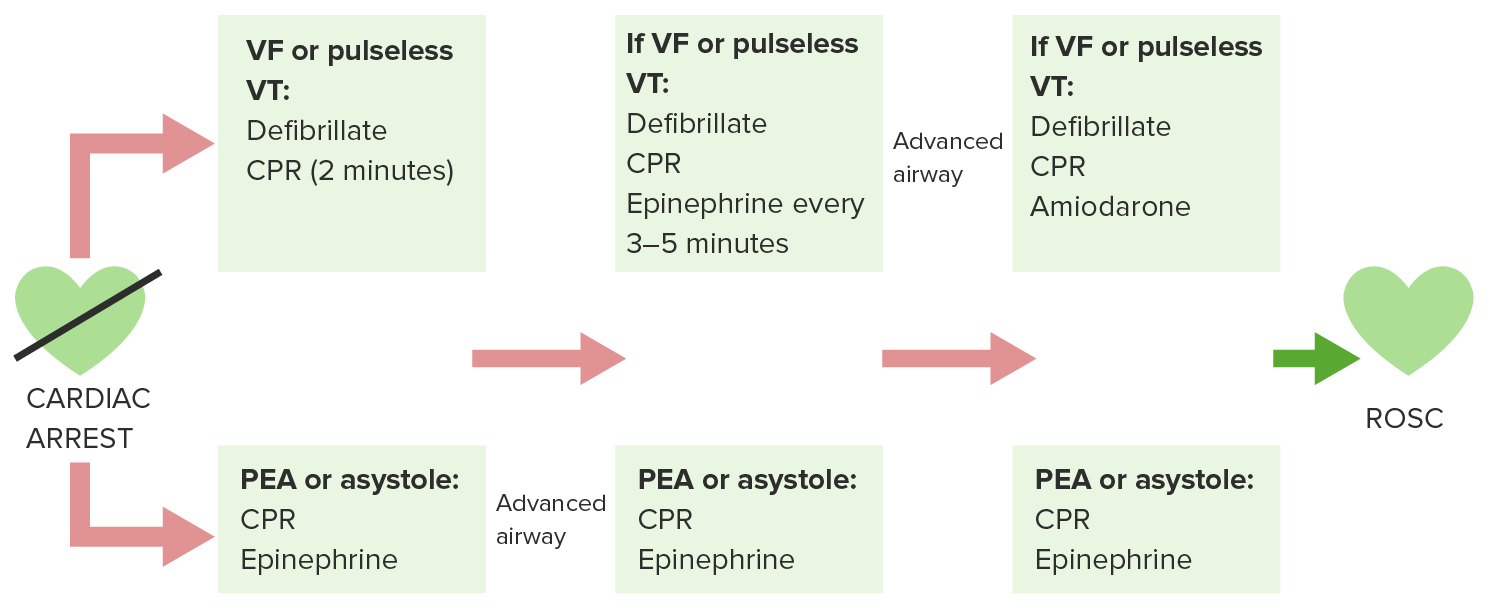
Algoritmo de paro cardíaco en adultos

Diagrama de paro cardíaco en adultos
Al reconocer la parada cardíaca, se realiza una evaluación rápida de la respiración, el pulso y el ritmo (una vez que se dispone de un monitor cardíaco) y se inicia la reanimación cardiopulmonar (RCP). Desfibrilar los ritmos desfibrilables, la fibrilación ventricular (FV) o la taquicardia ventricular (TV) sin pulso. Si hay actividad eléctrica sin pulso/asístole, la RCP continúa. Simultáneamente a través del proceso, se obtiene un acceso intravenoso (o intraóseo) para administrar los medicamentos necesarios. La epinefrina intravenosa se administra cada 3 – 5 minutos.
Se realiza la intubación endotraqueal (vía aérea avanzada). Se monitoriza la capnografía de onda cuantitativa (que muestra el CO₂ exhalado). Si el CO₂ exhalado es bajo, reevalúe la calidad de la RCP.
El ciclo de pasos (desfibrilación y/o reanimación cardiopulmonar con mínima interrupción + soporte de la vía aérea → comprobación del ritmo, el pulso y la presión arterial → administración de medicación intravenosa) continúa hasta el retorno de la circulación espontánea (RCE). También se evalúa la continuación del ciclo si no hay RCE. Los signos de RCE son: pulso y presión arterial presentes, aumento abrupto y sostenido del nivel de CO₂ al final de la espiración (alrededor de ≥ 40 mm Hg) y ondas de presión arterial espontáneas con monitorización intraarterial.

Imagen por Lecturio.

Poblaciones especiales

  • Soporte vital avanzado pediátrico ( PALS PALS Secondary Lymphatic Organs, por sus siglas en EN Erythema nodosum is an immune-mediated panniculitis (inflammation of the subcutaneous fat) caused by a type IV (delayed-type) hypersensitivity reaction. It commonly manifests in young women as tender, erythematous nodules on the shins. Erythema Nodosum inglés):
    • En EN Erythema nodosum is an immune-mediated panniculitis (inflammation of the subcutaneous fat) caused by a type IV (delayed-type) hypersensitivity reaction. It commonly manifests in young women as tender, erythematous nodules on the shins. Erythema Nodosum asistolia/AEP, administrar epinefrina lo antes posible (antes de 5 min).
    • Utilizar un tubo endotraqueal (TET) con manguito para reducir las fugas de aire.
    • La frecuencia respiratoria aumentó a 20-30/min.
    • Los LOS Neisseria medicamentos y la energía de la descarga se administran en EN Erythema nodosum is an immune-mediated panniculitis (inflammation of the subcutaneous fat) caused by a type IV (delayed-type) hypersensitivity reaction. It commonly manifests in young women as tender, erythematous nodules on the shins. Erythema Nodosum función del peso.
  • ACLS para pacientes embarazadas hospitalizadas:
    • Más propensas a la hipoxia: la oxigenación y el manejo de la vía aérea son prioritarios durante la reanimación de una parada cardíaca
    • ACLS en EN Erythema nodosum is an immune-mediated panniculitis (inflammation of the subcutaneous fat) caused by a type IV (delayed-type) hypersensitivity reaction. It commonly manifests in young women as tender, erythematous nodules on the shins. Erythema Nodosum adultos + colocación de la vía por encima del diafragma (garantiza que el útero no obstruya la administración de la vía)
    • Si está recibiendo magnesio intravenoso: Detener y dar cloruro o gluconato de calcio.
    • Proporcionar un desplazamiento uterino lateral para aliviar la compresión aortocava.
    • Atención obstétrica y neonatal:
      • Si no hay RCE en EN Erythema nodosum is an immune-mediated panniculitis (inflammation of the subcutaneous fat) caused by a type IV (delayed-type) hypersensitivity reaction. It commonly manifests in young women as tender, erythematous nodules on the shins. Erythema Nodosum 5 minutos: parto por cesárea perimortem inmediato
      • Equipo de neonatología para recibir al AL Amyloidosis neonato
    • Considerar las etiologías de la parada cardíaca materna (A, B, C, D, E, F, G, H):
      • A – Anesthetic complications (complicaciones anestésicas)
      • B – Bleeding (sangrado)
      • C – Cardiovascular (cardiovasculares)
      • D – Drugs (medicamentos)
      • E – Embolic (embolia)
      • F Fever Fever Fever is defined as a measured body temperature of at least 38°C (100.4°F). Fever is caused by circulating endogenous and/or exogenous pyrogens that increase levels of prostaglandin E2 in the hypothalamus. Fever is commonly associated with chills, rigors, sweating, and flushing of the skin. Fever (fiebre)
      • G – General nonobstetric causes (5 Hs HS Hypertrophic scars and keloids are raised, red, and rigid (3 rs) scars that develop during cutaneous wound healing and are characterized by a local abnormal proliferation of fibroblasts with over-production of collagen. Over-expression of growth factors and decreased production of molecules that promote matrix breakdown appear to be involved in the etiology. Hypertrophic and Keloid Scars and 5 Ts) (causas generales no obstétricas (5 Hs HS Hypertrophic scars and keloids are raised, red, and rigid (3 rs) scars that develop during cutaneous wound healing and are characterized by a local abnormal proliferation of fibroblasts with over-production of collagen. Over-expression of growth factors and decreased production of molecules that promote matrix breakdown appear to be involved in the etiology. Hypertrophic and Keloid Scars y 5 Ts))
      • H Hypertension Hypertension Hypertension, or high blood pressure, is a common disease that manifests as elevated systemic arterial pressures. Hypertension is most often asymptomatic and is found incidentally as part of a routine physical examination or during triage for an unrelated medical encounter. Hypertension (hipertensión)
  • Enfermedad por coronavirus Coronavirus Coronaviruses are a group of related viruses that contain positive-sense, single-stranded RNA. Coronavirus derives its name from “κορώνη korṓnē” in Greek, which translates as “crown,” after the small club-shaped proteins visible as a ring around the viral envelope in electron micrographs. Coronavirus 2019 ( COVID-19 COVID-19 Coronavirus disease 2019 (COVID-19) is an infectious disease caused by the severe acute respiratory syndrome coronavirus 2 (SARS-CoV-2) that mainly affects the respiratory system but can also cause damage to other body systems (cardiovascular, gastrointestinal, renal, and central nervous systems). ):
    • Siempre que sea posible, los LOS Neisseria pacientes son colocados en EN Erythema nodosum is an immune-mediated panniculitis (inflammation of the subcutaneous fat) caused by a type IV (delayed-type) hypersensitivity reaction. It commonly manifests in young women as tender, erythematous nodules on the shins. Erythema Nodosum habitaciones con presión negativa.
    • Póngase el equipo de protección personal (EPP) adecuado antes de entrar.
    • Limitar el personal que realiza la RCP.
    • Oxigenación, preferiblemente con bajo riesgo de aerosolización
    • Ponga en EN Erythema nodosum is an immune-mediated panniculitis (inflammation of the subcutaneous fat) caused by a type IV (delayed-type) hypersensitivity reaction. It commonly manifests in young women as tender, erythematous nodules on the shins. Erythema Nodosum pausa la compresión torácica para la intubación endotraqueal.
    • Cuando sea posible, conecte al AL Amyloidosis paciente a un ventilador con filtro (HEPA, por sus siglas en EN Erythema nodosum is an immune-mediated panniculitis (inflammation of the subcutaneous fat) caused by a type IV (delayed-type) hypersensitivity reaction. It commonly manifests in young women as tender, erythematous nodules on the shins. Erythema Nodosum inglés) (aire de partículas de alta eficiencia) en EN Erythema nodosum is an immune-mediated panniculitis (inflammation of the subcutaneous fat) caused by a type IV (delayed-type) hypersensitivity reaction. It commonly manifests in young women as tender, erythematous nodules on the shins. Erythema Nodosum línea.

Resultados

Signos de retorno de la circulación espontánea

  • Pulso y presión arterial
  • Aumento brusco y sostenido del nivel de CO₂ al AL Amyloidosis final de la espiración (alrededor de ≥ 40 mm Hg)
  • Ondas de presión arterial espontáneas con monitorización intraarterial

Criterios para dar por terminada la reanimación:

  • Hay varios factores que se tienen en EN Erythema nodosum is an immune-mediated panniculitis (inflammation of the subcutaneous fat) caused by a type IV (delayed-type) hypersensitivity reaction. It commonly manifests in young women as tender, erythematous nodules on the shins. Erythema Nodosum cuenta a la hora de tomar la decisión de parar:
    • Duración de la reanimación (> 30 minutos sin ritmo de perfusión)
    • Ritmo inicial: asistolia
    • Ausencia de función del tallo cerebral
    • Intervalo largo entre el paro y el inicio de la reanimación
    • Edad del paciente y comorbilidades
    • Normotermia
  • En EN Erythema nodosum is an immune-mediated panniculitis (inflammation of the subcutaneous fat) caused by a type IV (delayed-type) hypersensitivity reaction. It commonly manifests in young women as tender, erythematous nodules on the shins. Erythema Nodosum la reanimación extrahospitalaria, los LOS Neisseria criterios son:
    • Paro no presenciado por los LOS Neisseria paramédicos
    • Asistolia/AEP (sin descargas)
    • No hay RCE antes de la tercera dosis de epinefrina
  • Nivel de CO₂ al AL Amyloidosis final de la espiración:
    • Indica la producción de CO₂, que aumenta con la perfusión y la circulación pulmonar (↑ en EN Erythema nodosum is an immune-mediated panniculitis (inflammation of the subcutaneous fat) caused by a type IV (delayed-type) hypersensitivity reaction. It commonly manifests in young women as tender, erythematous nodules on the shins. Erythema Nodosum RCE)
    • Cuando esté bajo, confirme primero la colocación del tubo endotraqueal.
    • Un CO₂ exhalado bajo confirmado (<10 mm Hg) en EN Erythema nodosum is an immune-mediated panniculitis (inflammation of the subcutaneous fat) caused by a type IV (delayed-type) hypersensitivity reaction. It commonly manifests in young women as tender, erythematous nodules on the shins. Erythema Nodosum > 20 min de reanimación: ausencia de circulación y es un predictor de mortalidad aguda

Cuidados Posteriores a la Reanimación

Objetivos

  • Mitigación de lesiones cerebrales
  • Manejo de lesiones por isquemia-reperfusión y apoyar los LOS Neisseria sistemas multiorgánicos.
  • Determinar y tratar la causa de paro cardíaco.
  • Implicar a un equipo médico multidisciplinar dada la complejidad de la atención al AL Amyloidosis paciente tras la detención.

Cuidados críticos

  • Soporte hemodinámico:
    • Uso de cristaloides y/o vasopresores o apoyo inotrópico
    • Mantener una presión arterial sistólica > 90 mm Hg o una presión arterial media > 65 mm Hg.
    • Intervención cardíaca urgente en EN Erythema nodosum is an immune-mediated panniculitis (inflammation of the subcutaneous fat) caused by a type IV (delayed-type) hypersensitivity reaction. It commonly manifests in young women as tender, erythematous nodules on the shins. Erythema Nodosum casos de infarto de miocardio con elevación del segmento ST y/o shock Shock Shock is a life-threatening condition associated with impaired circulation that results in tissue hypoxia. The different types of shock are based on the underlying cause: distributive (↑ cardiac output (CO), ↓ systemic vascular resistance (SVR)), cardiogenic (↓ CO, ↑ SVR), hypovolemic (↓ CO, ↑ SVR), obstructive (↓ CO), and mixed. Types of Shock cardiogénico
  • Ventilación mecánica:
    • Valorar la fracción de oxígeno inspirado (FiO2) para la saturación de oxígeno (SPO2) > 94%.
    • Valorar hasta la presión parcial de dióxido de carbono (PaCO2) 35-45 mm Hg.
    • Empieza con 10/min
  • Gestión de la temperatura en EN Erythema nodosum is an immune-mediated panniculitis (inflammation of the subcutaneous fat) caused by a type IV (delayed-type) hypersensitivity reaction. It commonly manifests in young women as tender, erythematous nodules on the shins. Erythema Nodosum el paciente en EN Erythema nodosum is an immune-mediated panniculitis (inflammation of the subcutaneous fat) caused by a type IV (delayed-type) hypersensitivity reaction. It commonly manifests in young women as tender, erythematous nodules on the shins. Erythema Nodosum coma Coma Coma is defined as a deep state of unarousable unresponsiveness, characterized by a score of 3 points on the GCS. A comatose state can be caused by a multitude of conditions, making the precise epidemiology and prognosis of coma difficult to determine. Coma:
    • Mejora los LOS Neisseria desenlaces neurológicos
    • Uso de un dispositivo de refrigeración con bucle de retroalimentación, comenzando a 32-36ºC (89.6-96.8ºF) durante 24 horas
    • ↑ riesgo de muerte por cada aumento de grado por encima de 37ºC (98.6ºF)
  • Otros manejos de los LOS Neisseria cuidados críticos:
    • Control continuo de la temperatura
    • Mantenimiento de niveles adecuados de O2 y CO2
    • Ventilación de protección pulmonar
    • Mantenimiento de la euglucemia (tratamiento con insulina para mantener una glucemia entre 150-180 mg/dL)
    • Monitorización con electroencefalograma ( EEG EEG Seizures)
  • Evaluación y tratamiento de las causas:
    • Obtener una tomografía computarizada (TC) del cerebro
    • Otros estudios de imagen en EN Erythema nodosum is an immune-mediated panniculitis (inflammation of the subcutaneous fat) caused by a type IV (delayed-type) hypersensitivity reaction. It commonly manifests in young women as tender, erythematous nodules on the shins. Erythema Nodosum función del cuadro clínico
    • Pruebas de laboratorio
    • Recuerda las 5 Hs HS Hypertrophic scars and keloids are raised, red, and rigid (3 rs) scars that develop during cutaneous wound healing and are characterized by a local abnormal proliferation of fibroblasts with over-production of collagen. Over-expression of growth factors and decreased production of molecules that promote matrix breakdown appear to be involved in the etiology. Hypertrophic and Keloid Scars y Ts.

Prevención

Prevención primaria

  • Detección de factores de riesgo de cardiopatía isquémica (trastornos lipídicos, hipertensión).
  • Detección de cardiopatías congénitas ( en EN Erythema nodosum is an immune-mediated panniculitis (inflammation of the subcutaneous fat) caused by a type IV (delayed-type) hypersensitivity reaction. It commonly manifests in young women as tender, erythematous nodules on the shins. Erythema Nodosum los LOS Neisseria pacientes en EN Erythema nodosum is an immune-mediated panniculitis (inflammation of the subcutaneous fat) caused by a type IV (delayed-type) hypersensitivity reaction. It commonly manifests in young women as tender, erythematous nodules on the shins. Erythema Nodosum los LOS Neisseria que se sospeche).
  • Reducir los LOS Neisseria factores de riesgo:
    • Controlar la hipertensión
    • Tratar la hipercolesterolemia
    • Tratar la diabetes Diabetes Diabetes mellitus (DM) is a metabolic disease characterized by hyperglycemia and dysfunction of the regulation of glucose metabolism by insulin. Type 1 DM is diagnosed mostly in children and young adults as the result of autoimmune destruction of β cells in the pancreas and the resulting lack of insulin. Type 2 DM has a significant association with obesity and is characterized by insulin resistance. Diabetes Mellitus
    • Dejar de fumar
    • Consumo moderado de alcohol
    • Dieta saludable para el corazón y ejercicio regular Regular Insulin

Prevención secundaria

  • Desfibrilador-cardioversor implantable (DCI):
    • Termina las arritmias ventriculares cuando se repiten
    • Recomendado en EN Erythema nodosum is an immune-mediated panniculitis (inflammation of the subcutaneous fat) caused by a type IV (delayed-type) hypersensitivity reaction. It commonly manifests in young women as tender, erythematous nodules on the shins. Erythema Nodosum lo siguiente:
      • Sobrevivientes de paro cardíaco repentino (por TV/FV) con insuficiencia cardíaca y miocardiopatía
      • Pacientes con cardiopatía estructural (asociada a una TV hemodinámicamente inestable o a una TV sostenida espontánea)
  • Terapia antiarrítmica:

Relevancia Clínica

Los LOS Neisseria siguientes trastornos son causas de paro cardíaco:

  • Taponamiento pericárdico: síndrome clínico causado por la acumulación de líquido en EN Erythema nodosum is an immune-mediated panniculitis (inflammation of the subcutaneous fat) caused by a type IV (delayed-type) hypersensitivity reaction. It commonly manifests in young women as tender, erythematous nodules on the shins. Erythema Nodosum el espacio pericárdico; provoca una reducción del llenado ventricular y el consiguiente compromiso hemodinámico. Los LOS Neisseria pacientes presentan la tríada de Beck (hipotensión, venas yugulares distendidas y sonidos cardíacos distantes). El taponamiento puede causar un paro cardíaco. Se maneja con pericardiocentesis Pericardiocentesis Puncture and aspiration of fluid from the pericardium. Cardiac Surgery.
  • Neumotórax a tensión: acumulación anormal de aire en EN Erythema nodosum is an immune-mediated panniculitis (inflammation of the subcutaneous fat) caused by a type IV (delayed-type) hypersensitivity reaction. It commonly manifests in young women as tender, erythematous nodules on the shins. Erythema Nodosum el espacio pleural debido a una laceración de los LOS Neisseria pulmones. Los LOS Neisseria tipos de neumotórax son el simple (espontáneo) y a tensión. Los LOS Neisseria hallazgos del examen físico incluyen disminución de los LOS Neisseria ruidos respiratorios, hiperresonancia a la percusión y desviación traqueal. El tratamiento incluye la descompresión con agujas y la colocación de un drenaje pleural.
  • Enfermedad coronaria: dolor Dolor Inflammation anginoso agudo por oclusión parcial o total de 1 o más arterias coronarias debido a una enfermedad coronaria avanzada. Pueden identificarse tres entidades clínicas: la angina inestable, el infarto agudo de miocardio (IAM) sin elevación del segmento ST y el IAM con elevación del segmento ST. El diagnóstico se realiza mediante ECG ECG An electrocardiogram (ECG) is a graphic representation of the electrical activity of the heart plotted against time. Adhesive electrodes are affixed to the skin surface allowing measurement of cardiac impulses from many angles. The ECG provides 3-dimensional information about the conduction system of the heart, the myocardium, and other cardiac structures. Electrocardiogram (ECG) y enzimas cardíacas. El tratamiento es con intervención coronaria percutánea y/o tratamiento médico.
  • Miocardiopatías: grupo de enfermedades miocárdicas asociadas a un deterioro de la función sistólica y diastólica. Se clasifican en EN Erythema nodosum is an immune-mediated panniculitis (inflammation of the subcutaneous fat) caused by a type IV (delayed-type) hypersensitivity reaction. It commonly manifests in young women as tender, erythematous nodules on the shins. Erythema Nodosum miocardiopatía dilatada, hipertrófica y restrictiva. Las complicaciones potenciales son la insuficiencia cardíaca, las arritmias y la muerte súbita. El tratamiento varía según el tipo e incluye medicamentos y/o cirugía.

Referencias

  1. Panchal, A. et al. (2020). Part 3: Adult Basic and Advanced Life Support: 2020 American Heart Association Guidelines for Cardiopulmonary Resuscitation and Emergency Cardiovascular Care. Circulation 142 (16): S366–S468. https://www.ahajournals.org/doi/10.1161/CIR.0000000000000916
  2. Podrid, P. J., & Al-Khatib, S. M. (2025). Sudden cardiac arrest in adults: Overview. UpToDate. Retrieved on August 3, 2025, from https://www.uptodate.com/contents/sudden-cardiac-arrest-in-adults-overview
  3. Elmer, J., & Coppler, P. J. (2025). Initial assessment and management of the adult post-cardiac arrest patient. UpToDate. Retrieved on August 3, 2025, from https://www.uptodate.com/contents/initial-assessment-and-management-of-the-adult-post-cardiac-arrest-patient
  4. Zimetbaum, P. J. (2025). Sudden cardiac arrest in adults: Overview. UpToDate. Retrieved on August 3, 2025, from https://www.uptodate.com/contents/sudden-cardiac-arrest-in-adults-overview
  5. Elmer, J., & Coppler, P. J. (2025). Initial assessment and management of the adult post-cardiac arrest patient. UpToDate. Retrieved on August 3, 2025, from https://www.uptodate.com/contents/initial-assessment-and-management-of-the-adult-post-cardiac-arrest-patient
  6. Topjian, A. et al. (2020). Part 4: Pediatric Basic and Advanced Life Support: 2020 American Heart Association Guidelines for Cardiopulmonary Resuscitation and Emergency Cardiovascular Care. Circulation 142(16):S469–S523.

¡Crea tu cuenta gratis o inicia una sesión para seguir leyendo!

Regístrate ahora y obtén acceso gratuito a Lecturio con páginas de concepto, videos médicos y cuestionarios para tu educación médica.

User Reviews

Que tengas una sesión de estudio alegre y navideña 🎁 Ahorra 50% en todos los planes >>

Details