Domina Conceptos Médicos

Estudia para la escuela de medicina y tus examenes con Lecturio.

Miocardiopatía Restrictiva

La miocardiopatía restrictiva (MCR) es una afección bastante infrecuente que se caracteriza por la rigidez progresiva del músculo cardíaco, lo que provoca un deterioro de la relajación y el llenado del corazón durante la diástole, lo que da lugar a una disfunción diastólica y a una eventual insuficiencia cardíaca. La mayoría de las veces se produce de forma secundaria a la cicatrización, el daño y/o la infiltración del músculo cardíaco, siendo la amiloidosis la causa más común. Con poca frecuencia, puede ser idiopática o hereditaria. Los LOS Neisseria signos y síntomas incluyen dificultad para respirar, baja tolerancia al AL Amyloidosis ejercicio, fatiga y edema Edema Edema is a condition in which excess serous fluid accumulates in the body cavity or interstitial space of connective tissues. Edema is a symptom observed in several medical conditions. It can be categorized into 2 types, namely, peripheral (in the extremities) and internal (in an organ or body cavity). Edema periférico. El diagnóstico se realiza a través de la sospecha clínica y se confirma mediante ECG ECG An electrocardiogram (ECG) is a graphic representation of the electrical activity of the heart plotted against time. Adhesive electrodes are affixed to the skin surface allowing measurement of cardiac impulses from many angles. The ECG provides 3-dimensional information about the conduction system of the heart, the myocardium, and other cardiac structures. Electrocardiogram (ECG), radiografía, ecocardiografía y RM cardíaca. El tratamiento incluye medicamentos para la insuficiencia cardíaca, dispositivos implantables como marcapasos  - desfibriladores cardioversores, y trasplante de corazón en EN Erythema nodosum is an immune-mediated panniculitis (inflammation of the subcutaneous fat) caused by a type IV (delayed-type) hypersensitivity reaction. It commonly manifests in young women as tender, erythematous nodules on the shins. Erythema Nodosum casos refractarios.

Last updated: Jan 18, 2026

Editorial responsibility: Stanley Oiseth, Lindsay Jones, Evelin Maza

Descripción General

Definición

La miocardiopatía restrictiva (MCR) es una enfermedad del músculo cardíaco que se caracteriza por una disminución de la distensibilidad de los LOS Neisseria ventrículos, un músculo cardíaco no dilatado y una disfunción diastólica (alteración del llenado de los LOS Neisseria ventrículos).
Epidemiología

  • Miocardiopatía más rara
  • 5% de todos los LOS Neisseria casos
  • La incidencia y la prevalencia dependen de la etiología:
    • Amiloidosis
      • MCR más común en EN Erythema nodosum is an immune-mediated panniculitis (inflammation of the subcutaneous fat) caused by a type IV (delayed-type) hypersensitivity reaction. It commonly manifests in young women as tender, erythematous nodules on the shins. Erythema Nodosum Estados Unidos
      • Hombres = mujeres
      • Común en EN Erythema nodosum is an immune-mediated panniculitis (inflammation of the subcutaneous fat) caused by a type IV (delayed-type) hypersensitivity reaction. It commonly manifests in young women as tender, erythematous nodules on the shins. Erythema Nodosum los LOS Neisseria ancianos
    • Sarcoidosis Sarcoidosis Sarcoidosis is a multisystem inflammatory disease that causes noncaseating granulomas. The exact etiology is unknown. Sarcoidosis usually affects the lungs and thoracic lymph nodes, but it can also affect almost every system in the body, including the skin, heart, and eyes, most commonly. Sarcoidosis
      • Mujeres > hombres
      • Mayor incidencia en EN Erythema nodosum is an immune-mediated panniculitis (inflammation of the subcutaneous fat) caused by a type IV (delayed-type) hypersensitivity reaction. It commonly manifests in young women as tender, erythematous nodules on the shins. Erythema Nodosum Japón
      • Mayor prevalencia entre las mujeres negras
    • Hemocromatosis
      • 1 de cada 200
      • Hombres = mujeres
    • Endocarditis Endocarditis Endocarditis is an inflammatory disease involving the inner lining (endometrium) of the heart, most commonly affecting the cardiac valves. Both infectious and noninfectious etiologies lead to vegetations on the valve leaflets. Patients may present with nonspecific symptoms such as fever and fatigue. Endocarditis de Loeffler
      • Mayor incidencia y causa frecuente de muerte en EN Erythema nodosum is an immune-mediated panniculitis (inflammation of the subcutaneous fat) caused by a type IV (delayed-type) hypersensitivity reaction. It commonly manifests in young women as tender, erythematous nodules on the shins. Erythema Nodosum los LOS Neisseria trópicos de África, Asia ASIA Spinal Cord Injuries y América del Sur y Central
      • Secundario a la alta incidencia de fibrosis Fibrosis Any pathological condition where fibrous connective tissue invades any organ, usually as a consequence of inflammation or other injury. Bronchiolitis Obliterans endomiocárdica en EN Erythema nodosum is an immune-mediated panniculitis (inflammation of the subcutaneous fat) caused by a type IV (delayed-type) hypersensitivity reaction. It commonly manifests in young women as tender, erythematous nodules on the shins. Erythema Nodosum esas ESAs Hematopoietic Growth Factors zonas

Etiología

  • Idiopática
  • Familiar:
    • Diversas mutaciones genéticas conocidas
    • Típicamente asociado a la amiloidosis o considerado parte de la miocardiopatía hipertrófica familiar
  • Enfermedad o afección subyacente que provoca cicatrices o daños en EN Erythema nodosum is an immune-mediated panniculitis (inflammation of the subcutaneous fat) caused by a type IV (delayed-type) hypersensitivity reaction. It commonly manifests in young women as tender, erythematous nodules on the shins. Erythema Nodosum el músculo cardíaco:
    • Amiloidosis (causa más común)
    • Sarcoidosis Sarcoidosis Sarcoidosis is a multisystem inflammatory disease that causes noncaseating granulomas. The exact etiology is unknown. Sarcoidosis usually affects the lungs and thoracic lymph nodes, but it can also affect almost every system in the body, including the skin, heart, and eyes, most commonly. Sarcoidosis
    • Hemocromatosis
    • Fibrosis Fibrosis Any pathological condition where fibrous connective tissue invades any organ, usually as a consequence of inflammation or other injury. Bronchiolitis Obliterans endomiocárdica
    • Endocarditis Endocarditis Endocarditis is an inflammatory disease involving the inner lining (endometrium) of the heart, most commonly affecting the cardiac valves. Both infectious and noninfectious etiologies lead to vegetations on the valve leaflets. Patients may present with nonspecific symptoms such as fever and fatigue. Endocarditis de Loeffler ( endocarditis Endocarditis Endocarditis is an inflammatory disease involving the inner lining (endometrium) of the heart, most commonly affecting the cardiac valves. Both infectious and noninfectious etiologies lead to vegetations on the valve leaflets. Patients may present with nonspecific symptoms such as fever and fatigue. Endocarditis eosinofílica)
    • Fibrosis Fibrosis Any pathological condition where fibrous connective tissue invades any organ, usually as a consequence of inflammation or other injury. Bronchiolitis Obliterans postradiación
    • Esclerodermia
    • Tumores

Fisiopatología

  • El músculo cardíaco se vuelve cada vez más rígido debido a:
    • Infiltración con células/sustancias anormales
    • Depósito excesivo de subproductos metabólicos
    • Lesión fibrosa directa
  • Reducción de la distensibilidad y deterioro de la capacidad de expansión → deterioro de la relajación del corazón (diástole)
  • El músculo cardíaco no puede llenarse correctamente durante la diástole → aumento de las presiones de llenado y disfunción diastólica → las aurículas se dilatan/agrandan secundariamente al AL Amyloidosis aumento de las presiones → congestión pulmonar y sistémica
  • Con los LOS Neisseria aumentos de la frecuencia cardíaca, el corazón es incapaz de ↑ el gasto cardíaco adecuadamente
  • La función sistólica suele ser normal.
  • No hay dilatación o engrosamiento ventricular

Presentación Clínica

La presentación es similar a la observada en EN Erythema nodosum is an immune-mediated panniculitis (inflammation of the subcutaneous fat) caused by a type IV (delayed-type) hypersensitivity reaction. It commonly manifests in young women as tender, erythematous nodules on the shins. Erythema Nodosum la insuficiencia cardíaca derecha.
Síntomas

  • Disnea (dificultad para respirar), especialmente con el esfuerzo
  • Ortopnea (dificultad para respirar al AL Amyloidosis acostarse, como al AL Amyloidosis dormir)
  • Intolerancia al AL Amyloidosis ejercicio
  • Hinchazón en EN Erythema nodosum is an immune-mediated panniculitis (inflammation of the subcutaneous fat) caused by a type IV (delayed-type) hypersensitivity reaction. It commonly manifests in young women as tender, erythematous nodules on the shins. Erythema Nodosum las extremidades inferiores y posiblemente en EN Erythema nodosum is an immune-mediated panniculitis (inflammation of the subcutaneous fat) caused by a type IV (delayed-type) hypersensitivity reaction. It commonly manifests in young women as tender, erythematous nodules on the shins. Erythema Nodosum el abdomen
  • Aumento de peso
  • Mareo
  • Síncopes
  • Dolor Dolor Inflammation torácico
  • Palpitaciones
  • Tos TOS Thoracic outlet syndrome (TOS) is a broad term used for a spectrum of syndromes related to the general region of the thoracic outlet, which involves the compression or irritation of elements of the brachial plexus, subclavian artery, or subclavian vein. Thoracic Outlet Syndrome
  • Fatiga
  • Debilidad

Examen físico

  • Cardíaco:
    • Galope S3 S3 Heart Sounds
    • Soplo cardíaco sistólico (por regurgitación mitral o tricuspídea)
    • Punto de máximo impulso típicamente normal
    • Puede haber distensión venosa yugular, especialmente el signo de Kussmaul (distensión yugular en EN Erythema nodosum is an immune-mediated panniculitis (inflammation of the subcutaneous fat) caused by a type IV (delayed-type) hypersensitivity reaction. It commonly manifests in young women as tender, erythematous nodules on the shins. Erythema Nodosum la inspiración).
  • Pulmonar: crepitantes sobre los LOS Neisseria campos pulmonares (secundario a edema Edema Edema is a condition in which excess serous fluid accumulates in the body cavity or interstitial space of connective tissues. Edema is a symptom observed in several medical conditions. It can be categorized into 2 types, namely, peripheral (in the extremities) and internal (in an organ or body cavity). Edema pulmonar)
  • Abdominal: hepatomegalia
  • Edema Edema Edema is a condition in which excess serous fluid accumulates in the body cavity or interstitial space of connective tissues. Edema is a symptom observed in several medical conditions. It can be categorized into 2 types, namely, peripheral (in the extremities) and internal (in an organ or body cavity). Edema con fóvea en EN Erythema nodosum is an immune-mediated panniculitis (inflammation of the subcutaneous fat) caused by a type IV (delayed-type) hypersensitivity reaction. It commonly manifests in young women as tender, erythematous nodules on the shins. Erythema Nodosum las extremidades inferiores
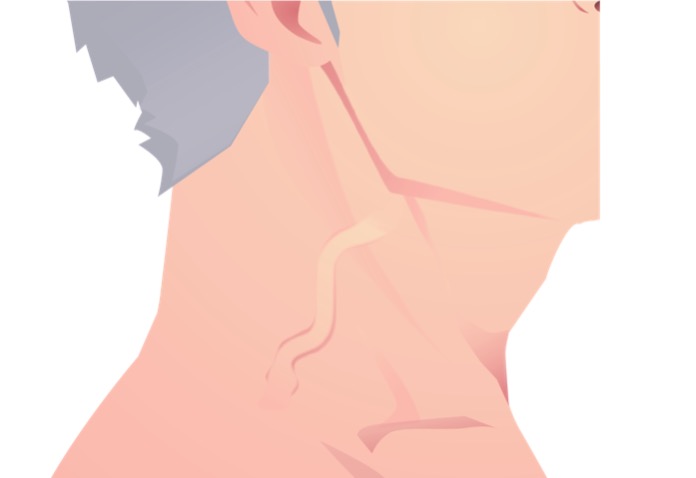
Distensión venosa yugular en falla cardíaca

Distensión venosa yugular:
La distensión de la vena yugular puede ser un hallazgo inespecífico en la insuficiencia cardíaca.
Imagen por Lecturio.

Diagnóstico

Historia clínica y examen físico

  • Signos y síntomas sugestivos de insuficiencia cardíaca:
    • Ascitis
    • Edema Edema Edema is a condition in which excess serous fluid accumulates in the body cavity or interstitial space of connective tissues. Edema is a symptom observed in several medical conditions. It can be categorized into 2 types, namely, peripheral (in the extremities) and internal (in an organ or body cavity). Edema
    • Disminución de la tolerancia al AL Amyloidosis ejercicio
  • Signos de patologías causantes:
    • Hemocromatosis: piel de color bronce
    • Amiloidosis: síndrome del túnel carpiano
    • Sarcoidosis Sarcoidosis Sarcoidosis is a multisystem inflammatory disease that causes noncaseating granulomas. The exact etiology is unknown. Sarcoidosis usually affects the lungs and thoracic lymph nodes, but it can also affect almost every system in the body, including the skin, heart, and eyes, most commonly. Sarcoidosis: síntomas respiratorios

Estudios de laboratorio

  • ↑ Péptido natriurético cerebral ( BNP BNP A peptide that is secreted by the brain and the heart atria, stored mainly in cardiac ventricular myocardium. It can cause natriuresis; diuresis; vasodilation; and inhibits secretion of renin and aldosterone. It improves heart function. It contains 32 amino acids. Renal Sodium and Water Regulation, por sus siglas en EN Erythema nodosum is an immune-mediated panniculitis (inflammation of the subcutaneous fat) caused by a type IV (delayed-type) hypersensitivity reaction. It commonly manifests in young women as tender, erythematous nodules on the shins. Erythema Nodosum inglés):
    • El BNP BNP A peptide that is secreted by the brain and the heart atria, stored mainly in cardiac ventricular myocardium. It can cause natriuresis; diuresis; vasodilation; and inhibits secretion of renin and aldosterone. It improves heart function. It contains 32 amino acids. Renal Sodium and Water Regulation es un marcador de insuficiencia cardíaca.
    • La insuficiencia renal también puede aumentar el BNP BNP A peptide that is secreted by the brain and the heart atria, stored mainly in cardiac ventricular myocardium. It can cause natriuresis; diuresis; vasodilation; and inhibits secretion of renin and aldosterone. It improves heart function. It contains 32 amino acids. Renal Sodium and Water Regulation, por lo que es menos diagnóstico en EN Erythema nodosum is an immune-mediated panniculitis (inflammation of the subcutaneous fat) caused by a type IV (delayed-type) hypersensitivity reaction. It commonly manifests in young women as tender, erythematous nodules on the shins. Erythema Nodosum esos casos.
  • Medir el nitrógeno de urea Urea A compound formed in the liver from ammonia produced by the deamination of amino acids. It is the principal end product of protein catabolism and constitutes about one half of the total urinary solids. Urea Cycle (BUN, por sus siglas en EN Erythema nodosum is an immune-mediated panniculitis (inflammation of the subcutaneous fat) caused by a type IV (delayed-type) hypersensitivity reaction. It commonly manifests in young women as tender, erythematous nodules on the shins. Erythema Nodosum inglés) y la creatinina para controlar la función/perfusión renal.
  • Para investigar la causa subyacente, realizar pruebas adicionales como las pruebas de proteínas en EN Erythema nodosum is an immune-mediated panniculitis (inflammation of the subcutaneous fat) caused by a type IV (delayed-type) hypersensitivity reaction. It commonly manifests in young women as tender, erythematous nodules on the shins. Erythema Nodosum suero y orina (amiloidosis).

Electrocardiografía

  • Típicamente anormal pero inespecífico
  • Puede incluir cambios en EN Erythema nodosum is an immune-mediated panniculitis (inflammation of the subcutaneous fat) caused by a type IV (delayed-type) hypersensitivity reaction. It commonly manifests in young women as tender, erythematous nodules on the shins. Erythema Nodosum el ST, retrasos en EN Erythema nodosum is an immune-mediated panniculitis (inflammation of the subcutaneous fat) caused by a type IV (delayed-type) hypersensitivity reaction. It commonly manifests in young women as tender, erythematous nodules on the shins. Erythema Nodosum la conducción y otras arritmias
  • Se puede observar bajo voltaje en EN Erythema nodosum is an immune-mediated panniculitis (inflammation of the subcutaneous fat) caused by a type IV (delayed-type) hypersensitivity reaction. It commonly manifests in young women as tender, erythematous nodules on the shins. Erythema Nodosum la amiloidosis.
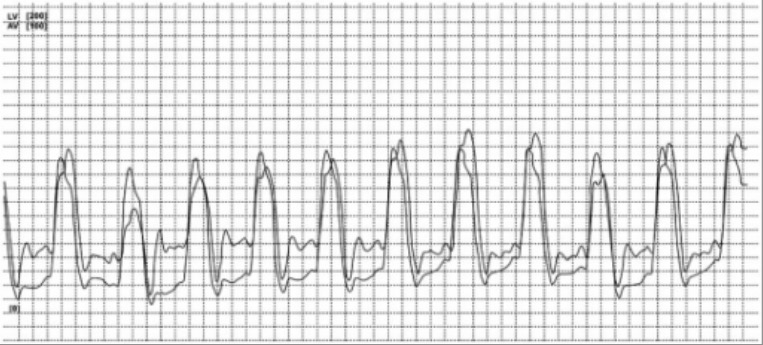
Electrocardiograma que muestra una miocardiopatía restrictiva

Paciente con amiloidosis cardíaca:
Trazado ventricular derecho e izquierdo con cambios concordantes en las presiones durante la espiración y la inspiración que confirman el diagnóstico de miocardiopatía restrictiva

Imagen: “Cardiac amyloidosis” por Division of Cardiology, University of South Alabama, Mobile, Alabama, USA. Licencia: CC BY 2.5

Radiografía de tórax

  • Puede mostrar un corazón normal o agrandado con dilatación biauricular y derrames pleurales
  • La presencia de calcificación pericárdica hace HACE Altitude Sickness sospechar una pericarditis Pericarditis Pericarditis is an inflammation of the pericardium, often with fluid accumulation. It can be caused by infection (often viral), myocardial infarction, drugs, malignancies, metabolic disorders, autoimmune disorders, or trauma. Acute, subacute, and chronic forms exist. Pericarditis constrictiva como diagnóstico alternativo

Ecocardiografía

  • Evaluar el corazón:
    • Tamaño
    • Estructura
    • Función
    • Diferenciar de otras causas.
  • Hallazgos:
    • Aumento de tamaño de las aurículas
    • Función diastólica anormal con un patrón de llenado restrictivo
    • Tamaño ventricular, grosor de la pared y función sistólica del ventrículo izquierdo relativamente conservados
  • Los LOS Neisseria ventrículos pueden tener un aspecto anormal si la causa subyacente son procesos infiltrativos o enfermedades de depósito.

Resonancia magnética cardíaca con realce de gadolinio

La RM cardíaca con realce de gadolinio puede identificar y determinar la extensión de:

  • Daño miocárdico
  • Fibrosis Fibrosis Any pathological condition where fibrous connective tissue invades any organ, usually as a consequence of inflammation or other injury. Bronchiolitis Obliterans
  • Cicatrización
  • Necrosis Necrosis The death of cells in an organ or tissue due to disease, injury or failure of the blood supply. Ischemic Cell Damage
  • Procesos de infiltración

Otras consideraciones y pruebas

  • La biopsia endomiocárdica puede realizarse para confirmar el diagnóstico en EN Erythema nodosum is an immune-mediated panniculitis (inflammation of the subcutaneous fat) caused by a type IV (delayed-type) hypersensitivity reaction. It commonly manifests in young women as tender, erythematous nodules on the shins. Erythema Nodosum los LOS Neisseria casos en EN Erythema nodosum is an immune-mediated panniculitis (inflammation of the subcutaneous fat) caused by a type IV (delayed-type) hypersensitivity reaction. It commonly manifests in young women as tender, erythematous nodules on the shins. Erythema Nodosum los LOS Neisseria que el estudio previo no ha HA Hemolytic anemia (HA) is the term given to a large group of anemias that are caused by the premature destruction/hemolysis of circulating red blood cells (RBCs). Hemolysis can occur within (intravascular hemolysis) or outside the blood vessels (extravascular hemolysis). Hemolytic Anemia sido concluyente.
  • Se requiere una evaluación adicional para determinar la causa subyacente.
  • Si no se identifica una causa secundaria o subyacente, se recomienda una evaluación adicional de los LOS Neisseria antecedentes familiares para detectar una posible miocardiopatía hipertrófica familiar.
  • La MCR idiopática es un diagnóstico de exclusión.

Tratamiento

Tratamiento

El tratamiento está dirigido a controlar la insuficiencia cardíaca y las causas secundarias subyacentes.

Objetivos del tratamiento:

  • ↓ Congestión venosa pulmonar y sistémica
  • ↓ Presión venosa
  • Control de la frecuencia cardíaca ( FC Fc Crystallizable fragments composed of the carboxy-terminal halves of both immunoglobulin heavy chains linked to each other by disulfide bonds. Fc fragments contain the carboxy-terminal parts of the heavy chain constant regions that are responsible for the effector functions of an immunoglobulin (complement fixation, binding to the cell membrane via fc receptors, and placental transport). This fragment can be obtained by digestion of immunoglobulins with the proteolytic enzyme papain. Immunoglobulins: Types and Functions) para ↑ tiempo de llenado (con precaución para evitar la bradicardia)
  • Mantener las contracciones auriculares.
  • Tratar/corregir las alteraciones de la conducción.
  • Controlar/evitar la anemia Anemia Anemia is a condition in which individuals have low Hb levels, which can arise from various causes. Anemia is accompanied by a reduced number of RBCs and may manifest with fatigue, shortness of breath, pallor, and weakness. Subtypes are classified by the size of RBCs, chronicity, and etiology. Anemia: Overview and Types, los LOS Neisseria desequilibrios electrolíticos, las deficiencias nutricionales y la sobrecarga de calcio.

Medicamentos:

  • Diuréticos del asa ASA Anterior Cord Syndrome (i.e., furosemida ( Lasix Lasix A benzoic-sulfonamide-furan. It is a diuretic with fast onset and short duration that is used for edema and chronic renal insufficiency. Loop Diuretics)) para ↓ edema Edema Edema is a condition in which excess serous fluid accumulates in the body cavity or interstitial space of connective tissues. Edema is a symptom observed in several medical conditions. It can be categorized into 2 types, namely, peripheral (in the extremities) and internal (in an organ or body cavity). Edema/sobrecarga de líquidos
  • Bloqueadores de los LOS Neisseria canales de calcio (i.e., verapamilo) para controlar la FC Fc Crystallizable fragments composed of the carboxy-terminal halves of both immunoglobulin heavy chains linked to each other by disulfide bonds. Fc fragments contain the carboxy-terminal parts of the heavy chain constant regions that are responsible for the effector functions of an immunoglobulin (complement fixation, binding to the cell membrane via fc receptors, and placental transport). This fragment can be obtained by digestion of immunoglobulins with the proteolytic enzyme papain. Immunoglobulins: Types and Functions y ↑ el tiempo de llenado (ssar con precaución, especialmente en EN Erythema nodosum is an immune-mediated panniculitis (inflammation of the subcutaneous fat) caused by a type IV (delayed-type) hypersensitivity reaction. It commonly manifests in young women as tender, erythematous nodules on the shins. Erythema Nodosum casos de amiloidosis)
  • Los LOS Neisseria betabloqueadores pueden controlar la FC Fc Crystallizable fragments composed of the carboxy-terminal halves of both immunoglobulin heavy chains linked to each other by disulfide bonds. Fc fragments contain the carboxy-terminal parts of the heavy chain constant regions that are responsible for the effector functions of an immunoglobulin (complement fixation, binding to the cell membrane via fc receptors, and placental transport). This fragment can be obtained by digestion of immunoglobulins with the proteolytic enzyme papain. Immunoglobulins: Types and Functions, ↑ el tiempo de llenado y ↑ la relajación ventricular (usar con precaución, especialmente en EN Erythema nodosum is an immune-mediated panniculitis (inflammation of the subcutaneous fat) caused by a type IV (delayed-type) hypersensitivity reaction. It commonly manifests in young women as tender, erythematous nodules on the shins. Erythema Nodosum casos de amiloidosis)
  • Los LOS Neisseria inhibidores de la enzima convertidora de angiotensina (IECA) o los LOS Neisseria bloqueadores de los LOS Neisseria receptores de la angiotensina II (ARA II) son útiles en EN Erythema nodosum is an immune-mediated panniculitis (inflammation of the subcutaneous fat) caused by a type IV (delayed-type) hypersensitivity reaction. It commonly manifests in young women as tender, erythematous nodules on the shins. Erythema Nodosum determinados casos.
  • La anticoagulación oral, por ejemplo con warfarina, es necesaria si hay fibrilación auricular.

Intervención quirúrgica:

  • Dispositivos (marcapasos o desfibrilador cardioversor implantado) en EN Erythema nodosum is an immune-mediated panniculitis (inflammation of the subcutaneous fat) caused by a type IV (delayed-type) hypersensitivity reaction. It commonly manifests in young women as tender, erythematous nodules on the shins. Erythema Nodosum arritmias significativas o trastornos de la conducción
  • Trasplante cardíaco en EN Erythema nodosum is an immune-mediated panniculitis (inflammation of the subcutaneous fat) caused by a type IV (delayed-type) hypersensitivity reaction. It commonly manifests in young women as tender, erythematous nodules on the shins. Erythema Nodosum pacientes con insuficiencia cardíaca grave refractaria al AL Amyloidosis tratamiento

Complicaciones

  • Arritmias
  • Eventos tromboembólicos (i.e., embolia pulmonar o accidente cerebrovascular)
  • Muerte súbita cardíaca

Pronóstico

  • Pobre con ↓ tasas de supervivencia
  • Los LOS Neisseria que tienen una cardiomiopatía restrictiva debida a la radiación/quimioterapia o a la amiloidosis tienen peor pronóstico.
  • El sexo masculino, la edad > 70 años y una disfunción diastólica más avanzada también se asocian a un mal pronóstico.

Diagnóstico Diferencial

  • Pericarditis Pericarditis Pericarditis is an inflammation of the pericardium, often with fluid accumulation. It can be caused by infection (often viral), myocardial infarction, drugs, malignancies, metabolic disorders, autoimmune disorders, or trauma. Acute, subacute, and chronic forms exist. Pericarditis constrictiva: trastorno en EN Erythema nodosum is an immune-mediated panniculitis (inflammation of the subcutaneous fat) caused by a type IV (delayed-type) hypersensitivity reaction. It commonly manifests in young women as tender, erythematous nodules on the shins. Erythema Nodosum el que el saco pericárdico se engrosa y se vuelve fibrótico, lo que afecta la capacidad del corazón para funcionar correctamente: Los LOS Neisseria signos y síntomas son similares a los LOS Neisseria de la MCR. Todo lo que puede causar una pericarditis Pericarditis Pericarditis is an inflammation of the pericardium, often with fluid accumulation. It can be caused by infection (often viral), myocardial infarction, drugs, malignancies, metabolic disorders, autoimmune disorders, or trauma. Acute, subacute, and chronic forms exist. Pericarditis aguda (inflamación del saco pericárdico) puede causar también una pericarditis Pericarditis Pericarditis is an inflammation of the pericardium, often with fluid accumulation. It can be caused by infection (often viral), myocardial infarction, drugs, malignancies, metabolic disorders, autoimmune disorders, or trauma. Acute, subacute, and chronic forms exist. Pericarditis constrictiva. Puede diferenciarse de la MCR por la presencia de un frote pericárdico observado en EN Erythema nodosum is an immune-mediated panniculitis (inflammation of the subcutaneous fat) caused by a type IV (delayed-type) hypersensitivity reaction. It commonly manifests in young women as tender, erythematous nodules on the shins. Erythema Nodosum la exploración, calcificaciones en EN Erythema nodosum is an immune-mediated panniculitis (inflammation of the subcutaneous fat) caused by a type IV (delayed-type) hypersensitivity reaction. It commonly manifests in young women as tender, erythematous nodules on the shins. Erythema Nodosum el pericardio vistas en EN Erythema nodosum is an immune-mediated panniculitis (inflammation of the subcutaneous fat) caused by a type IV (delayed-type) hypersensitivity reaction. It commonly manifests in young women as tender, erythematous nodules on the shins. Erythema Nodosum una radiografía de tórax y hallazgos diferenciadores en EN Erythema nodosum is an immune-mediated panniculitis (inflammation of the subcutaneous fat) caused by a type IV (delayed-type) hypersensitivity reaction. It commonly manifests in young women as tender, erythematous nodules on the shins. Erythema Nodosum la resonancia magnética cardíaca. El tratamiento consiste en EN Erythema nodosum is an immune-mediated panniculitis (inflammation of the subcutaneous fat) caused by a type IV (delayed-type) hypersensitivity reaction. It commonly manifests in young women as tender, erythematous nodules on the shins. Erythema Nodosum extirpar el pericardio.
  • Miocardiopatía dilatada: tipo más común de miocardiopatía no isquémica: La etiología puede ser idiopática, familiar o secundaria a una variedad de condiciones subyacentes. La miocardiopatía dilatada se caracteriza por el agrandamiento de uno o ambos ventrículos y la reducción de la función sistólica. Los LOS Neisseria pacientes suelen presentar signos y síntomas de insuficiencia cardíaca. Estudios similares a los LOS Neisseria realizados para la MCR ayudan a obtener el diagnóstico. El tratamiento también es similar al AL Amyloidosis de la MCR, incluyendo medicamentos y dispositivos. La miocardiopatía dilatada es el motivo más frecuente de trasplante cardíaco.
  • Miocardiopatía hipertrófica (MCH): es la miocardiopatía hereditaria más frecuente: Las mutaciones genéticas afectan a los LOS Neisseria componentes contráctiles del corazón llamados sarcómeros. El patrón de herencia es autosómico dominante; sin embargo, también se producen mutaciones de novo. La MCH se caracteriza por el engrosamiento asimétrico de la pared del ventrículo izquierdo, la disfunción diastólica y la obstrucción del tracto de salida del ventrículo izquierdo. Los LOS Neisseria pacientes pueden ser asintomáticos o sufrir una muerte súbita cardíaca como primer signo de la enfermedad. Los LOS Neisseria individuos sintomáticos presentan disnea de esfuerzo, dolor Dolor Inflammation torácico, presíncope o síncope. El diagnóstico se hace HACE Altitude Sickness mediante un ECG ECG An electrocardiogram (ECG) is a graphic representation of the electrical activity of the heart plotted against time. Adhesive electrodes are affixed to the skin surface allowing measurement of cardiac impulses from many angles. The ECG provides 3-dimensional information about the conduction system of the heart, the myocardium, and other cardiac structures. Electrocardiogram (ECG), una ecocardiografía, una prueba de esfuerzo y una RM cardíaca. El tratamiento para los LOS Neisseria individuos sintomáticos incluye betabloqueadores como terapia de primera línea, con un manejo adicional dependiendo de la presencia de arritmia y de la obstrucción del tracto de salida del ventrículo izquierdo.

Referencias

  1. Brown KN, Pendela VS, Ahmed I, et al. Restrictive Cardiomyopathy. [Updated 2023 Jul 30]. In: StatPearls [Internet]. Treasure Island (FL): StatPearls Publishing; 2025 Jan-. Available from: https://www.ncbi.nlm.nih.gov/books/NBK537234/
  2. Dilated cardiomyopathy. (2024). Medline Plus. Retrieved January 18, 2026, from https://medlineplus.gov/ency/article/000168.htm
  3. Ammash, N.M. (Jan 10, 2024). Restrictive cardiomyopathies. UpToDate. Retrieved January 18, 2026, from https://www.uptodate.com/contents/restrictive-cardiomyopathies

¡Crea tu cuenta gratis o inicia una sesión para seguir leyendo!

Regístrate ahora y obtén acceso gratuito a Lecturio con páginas de concepto, videos médicos y cuestionarios para tu educación médica.

User Reviews

Details