Domina Conceptos Médicos

Estudia para la escuela de medicina y tus examenes con Lecturio.

Linfoma de Hodgkin

El linfoma de Hodgkin es una neoplasia maligna de los LOS Neisseria linfocitos B que se origina en EN Erythema nodosum is an immune-mediated panniculitis (inflammation of the subcutaneous fat) caused by a type IV (delayed-type) hypersensitivity reaction. It commonly manifests in young women as tender, erythematous nodules on the shins. Erythema Nodosum los LOS Neisseria ganglios linfáticos. Su hallazgo histológico patognomónico es una célula de Hodgkin/Reed-Sternberg (linfocitos B multinucleados gigantes con inclusiones eosinofílicas). La enfermedad se presenta más comúnmente con linfadenopatía (el cuello es el más comúnmente afectado), sudores nocturnos, pérdida de peso, fiebre y, en EN Erythema nodosum is an immune-mediated panniculitis (inflammation of the subcutaneous fat) caused by a type IV (delayed-type) hypersensitivity reaction. It commonly manifests in young women as tender, erythematous nodules on the shins. Erythema Nodosum ocasiones, esplenomegalia y hepatomegalia. Las pruebas de diagnóstico incluyen análisis histológicos de los LOS Neisseria ganglios linfáticos que muestran células de Hodgkin/Reed-Sternberg, análisis de sangre y TC y tomografía por emisión de positrones ( PET PET An imaging technique that combines a positron-emission tomography (PET) scanner and a ct X ray scanner. This establishes a precise anatomic localization in the same session. Nuclear Imaging, por su siglas en EN Erythema nodosum is an immune-mediated panniculitis (inflammation of the subcutaneous fat) caused by a type IV (delayed-type) hypersensitivity reaction. It commonly manifests in young women as tender, erythematous nodules on the shins. Erythema Nodosum inglés). El linfoma de Hodgkin se trata con quimioterapia y radioterapia. El pronóstico ha HA Hemolytic anemia (HA) is the term given to a large group of anemias that are caused by the premature destruction/hemolysis of circulating red blood cells (RBCs). Hemolysis can occur within (intravascular hemolysis) or outside the blood vessels (extravascular hemolysis). Hemolytic Anemia mejorado significativamente con el advenimiento de los LOS Neisseria regímenes quimioterapéuticos.

Last updated: Dec 15, 2025

Editorial responsibility: Stanley Oiseth, Lindsay Jones, Evelin Maza

Descripción General

Definición

El linfoma de Hodgkin es un linfoma monoclonal de linfocitos B (neoplasia) que se origina en EN Erythema nodosum is an immune-mediated panniculitis (inflammation of the subcutaneous fat) caused by a type IV (delayed-type) hypersensitivity reaction. It commonly manifests in young women as tender, erythematous nodules on the shins. Erythema Nodosum los LOS Neisseria ganglios linfáticos en EN Erythema nodosum is an immune-mediated panniculitis (inflammation of the subcutaneous fat) caused by a type IV (delayed-type) hypersensitivity reaction. It commonly manifests in young women as tender, erythematous nodules on the shins. Erythema Nodosum los LOS Neisseria que las células malignas de Hodgkin/Reed-Sternberg se mezclan con una población heterogénea de células inflamatorias no neoplásicas.

Epidemiología

  • Incidencia en EN Erythema nodosum is an immune-mediated panniculitis (inflammation of the subcutaneous fat) caused by a type IV (delayed-type) hypersensitivity reaction. It commonly manifests in young women as tender, erythematous nodules on the shins. Erythema Nodosum Estados Unidos: 2 a 3 casos por 100 000 habitantes
  • Picos de edad bimodal: adultos jóvenes (15–34 años) y > 55 años
  • Se puede ver en EN Erythema nodosum is an immune-mediated panniculitis (inflammation of the subcutaneous fat) caused by a type IV (delayed-type) hypersensitivity reaction. It commonly manifests in young women as tender, erythematous nodules on the shins. Erythema Nodosum niños:
    • Edad pico de incidencia: 12 años
    • Incidencia: 1,1 casos por cada 100 000 niños
    • Casos pediátricos: 85% varones
  • Hombres > mujeres (3:2) en EN Erythema nodosum is an immune-mediated panniculitis (inflammation of the subcutaneous fat) caused by a type IV (delayed-type) hypersensitivity reaction. It commonly manifests in young women as tender, erythematous nodules on the shins. Erythema Nodosum adultos
  • 30% de todos los LOS Neisseria linfomas (el resto son no Hodgkin)
  • Incidencia más baja (Estados Unidos):
    • Indígenas norteamericanos
    • Nativos de Alaska
    • Asiáticos/Isleños del Pacífico

Etiología

  • Etiología exacta desconocida
  • Mayor riesgo con:
    • Virus Virus Viruses are infectious, obligate intracellular parasites composed of a nucleic acid core surrounded by a protein capsid. Viruses can be either naked (non-enveloped) or enveloped. The classification of viruses is complex and based on many factors, including type and structure of the nucleoid and capsid, the presence of an envelope, the replication cycle, and the host range. Virology de Epstein-Barr ( EBV EBV Epstein-barr virus (EBV) is a linear, double-stranded DNA virus belonging to the herpesviridae family. This highly prevalent virus is mostly transmitted through contact with oropharyngeal secretions from an infected individual. The virus can infect epithelial cells and B lymphocytes, where it can undergo lytic replication or latency. Epstein-Barr Virus):
      • Responsable de la mononucleosis Mononucleosis Infectious mononucleosis (IM), also known as “the kissing disease,” is a highly contagious viral infection caused by the Epstein-Barr virus. Its common name is derived from its main method of transmission: the spread of infected saliva via kissing. Clinical manifestations of IM include fever, tonsillar pharyngitis, and lymphadenopathy. Mononucleosis infecciosa
      • Una minoría de los LOS Neisseria pacientes infectados con EBV EBV Epstein-barr virus (EBV) is a linear, double-stranded DNA virus belonging to the herpesviridae family. This highly prevalent virus is mostly transmitted through contact with oropharyngeal secretions from an infected individual. The virus can infect epithelial cells and B lymphocytes, where it can undergo lytic replication or latency. Epstein-Barr Virus desarrollará linfoma de Hodgkin.
      • ADN de EBV EBV Epstein-barr virus (EBV) is a linear, double-stranded DNA virus belonging to the herpesviridae family. This highly prevalent virus is mostly transmitted through contact with oropharyngeal secretions from an infected individual. The virus can infect epithelial cells and B lymphocytes, where it can undergo lytic replication or latency. Epstein-Barr Virus encontrado en EN Erythema nodosum is an immune-mediated panniculitis (inflammation of the subcutaneous fat) caused by a type IV (delayed-type) hypersensitivity reaction. It commonly manifests in young women as tender, erythematous nodules on the shins. Erythema Nodosum células de Hodgkin/Reed-Sternberg en EN Erythema nodosum is an immune-mediated panniculitis (inflammation of the subcutaneous fat) caused by a type IV (delayed-type) hypersensitivity reaction. It commonly manifests in young women as tender, erythematous nodules on the shins. Erythema Nodosum el 50% de los LOS Neisseria pacientes en EN Erythema nodosum is an immune-mediated panniculitis (inflammation of the subcutaneous fat) caused by a type IV (delayed-type) hypersensitivity reaction. It commonly manifests in young women as tender, erythematous nodules on the shins. Erythema Nodosum América del Norte y Europa.
      • ADN de EBV EBV Epstein-barr virus (EBV) is a linear, double-stranded DNA virus belonging to the herpesviridae family. This highly prevalent virus is mostly transmitted through contact with oropharyngeal secretions from an infected individual. The virus can infect epithelial cells and B lymphocytes, where it can undergo lytic replication or latency. Epstein-Barr Virus encontrado en EN Erythema nodosum is an immune-mediated panniculitis (inflammation of the subcutaneous fat) caused by a type IV (delayed-type) hypersensitivity reaction. It commonly manifests in young women as tender, erythematous nodules on the shins. Erythema Nodosum células de Hodgkin/Reed-Sternberg en EN Erythema nodosum is an immune-mediated panniculitis (inflammation of the subcutaneous fat) caused by a type IV (delayed-type) hypersensitivity reaction. It commonly manifests in young women as tender, erythematous nodules on the shins. Erythema Nodosum el 90% de los LOS Neisseria pacientes en EN Erythema nodosum is an immune-mediated panniculitis (inflammation of the subcutaneous fat) caused by a type IV (delayed-type) hypersensitivity reaction. It commonly manifests in young women as tender, erythematous nodules on the shins. Erythema Nodosum países económicamente en EN Erythema nodosum is an immune-mediated panniculitis (inflammation of the subcutaneous fat) caused by a type IV (delayed-type) hypersensitivity reaction. It commonly manifests in young women as tender, erythematous nodules on the shins. Erythema Nodosum desarrollo.
    • Inmunodeficiencia:
      • VIH: riesgo de 5 a 25 veces mayor de desarrollar linfoma de Hodgkin
      • Inmunoterapia
      • Casi todos los LOS Neisseria casos de linfoma de Hodgkin que ocurren en EN Erythema nodosum is an immune-mediated panniculitis (inflammation of the subcutaneous fat) caused by a type IV (delayed-type) hypersensitivity reaction. It commonly manifests in young women as tender, erythematous nodules on the shins. Erythema Nodosum condiciones de inmunodeficiencia son positivos para EBV EBV Epstein-barr virus (EBV) is a linear, double-stranded DNA virus belonging to the herpesviridae family. This highly prevalent virus is mostly transmitted through contact with oropharyngeal secretions from an infected individual. The virus can infect epithelial cells and B lymphocytes, where it can undergo lytic replication or latency. Epstein-Barr Virus.
    • Obesidad
    • Dieta rica en EN Erythema nodosum is an immune-mediated panniculitis (inflammation of the subcutaneous fat) caused by a type IV (delayed-type) hypersensitivity reaction. It commonly manifests in young women as tender, erythematous nodules on the shins. Erythema Nodosum carnes y dulces
    • Inactividad física
    • Alto peso al AL Amyloidosis nacer
    • Tabaquismo
  • La aspirina y la lactancia materna parecen ser protectoras.
  • Predisposición familiar:
    • No está claro si es genética o ambiental
    • Riesgo en EN Erythema nodosum is an immune-mediated panniculitis (inflammation of the subcutaneous fat) caused by a type IV (delayed-type) hypersensitivity reaction. It commonly manifests in young women as tender, erythematous nodules on the shins. Erythema Nodosum parientes cercanos: 3 a 5 veces mayor que la tasa general esperada
    • El riesgo varía según el subtipo.
    • Riesgo más fuerte entre hermanos que en EN Erythema nodosum is an immune-mediated panniculitis (inflammation of the subcutaneous fat) caused by a type IV (delayed-type) hypersensitivity reaction. It commonly manifests in young women as tender, erythematous nodules on the shins. Erythema Nodosum los LOS Neisseria padres.

Clasificación

Según la clasificación de la World Health Organization (WHO), los LOS Neisseria linfomas de Hodgkin tienen los LOS Neisseria siguientes tipos y subtipos según el inmunofenotipo y la morfología.

Linfoma de Hodgkin clásico (95%):

  • Esclerosis nodular:
    • 80% de los LOS Neisseria linfomas de Hodgkin
    • Hombre = mujer
    • Adultos jóvenes
    • Células lacunares
    • Células de Hodgkin/Reed-Sternberg clásicas
    • Fondo de células mixtas
    • Bandas de fibrosis Fibrosis Any pathological condition where fibrous connective tissue invades any organ, usually as a consequence of inflammation or other injury. Bronchiolitis Obliterans
    • Por lo general, estadio I o II (mediastínico)
  • Celularidad mixta:
    • 30% de linfomas de Hodgkin
    • Hombre > mujer
    • Todas las edades
    • Tipo histológico más comúnmente observado en EN Erythema nodosum is an immune-mediated panniculitis (inflammation of the subcutaneous fat) caused by a type IV (delayed-type) hypersensitivity reaction. It commonly manifests in young women as tender, erythematous nodules on the shins. Erythema Nodosum pacientes con VIH
    • Típicamente estadio III o IV
    • Células de Hodgkin/Reed-Sternberg mononucleares y clásicas
    • Fondo de células mixtas
    • Eosinofilia presente
  • Rico en EN Erythema nodosum is an immune-mediated panniculitis (inflammation of the subcutaneous fat) caused by a type IV (delayed-type) hypersensitivity reaction. It commonly manifests in young women as tender, erythematous nodules on the shins. Erythema Nodosum linfocitos:
    • 4% de linfomas de Hodgkin
    • Predominantemente hombres en EN Erythema nodosum is an immune-mediated panniculitis (inflammation of the subcutaneous fat) caused by a type IV (delayed-type) hypersensitivity reaction. It commonly manifests in young women as tender, erythematous nodules on the shins. Erythema Nodosum los LOS Neisseria 30
    • Células de Hodgkin/Reed-Sternberg mononucleares y clásicas
    • Células de fondo: linfocitos T
    • Mejor pronóstico
  • Con depleción linfocítica:
    • 2% de linfomas de Hodgkin
    • Asociado a edad avanzada
    • Células de Hodgkin/Reed-Sternberg clásicas junto con variantes
    • Pocas células de fondo
    • Algo de fibrosis Fibrosis Any pathological condition where fibrous connective tissue invades any organ, usually as a consequence of inflammation or other injury. Bronchiolitis Obliterans difusa
    • Normalmente en EN Erythema nodosum is an immune-mediated panniculitis (inflammation of the subcutaneous fat) caused by a type IV (delayed-type) hypersensitivity reaction. It commonly manifests in young women as tender, erythematous nodules on the shins. Erythema Nodosum hombres mayores
    • Asociación con VIH
    • Linfadenopatía abdominal
    • Peor pronóstico

Linfoma de Hodgkin con predominio de linfocitos nodulares:
  • 5% de linfomas de Hodgkin
  • Entidad clínica distinta y no considerada parte del tipo clásico de linfoma de Hodgkin
  • Hombres > mujeres: 3:1
  • La presentación típica es la linfadenopatía periférica asintomática crónica.
  • Fuerte componente genético
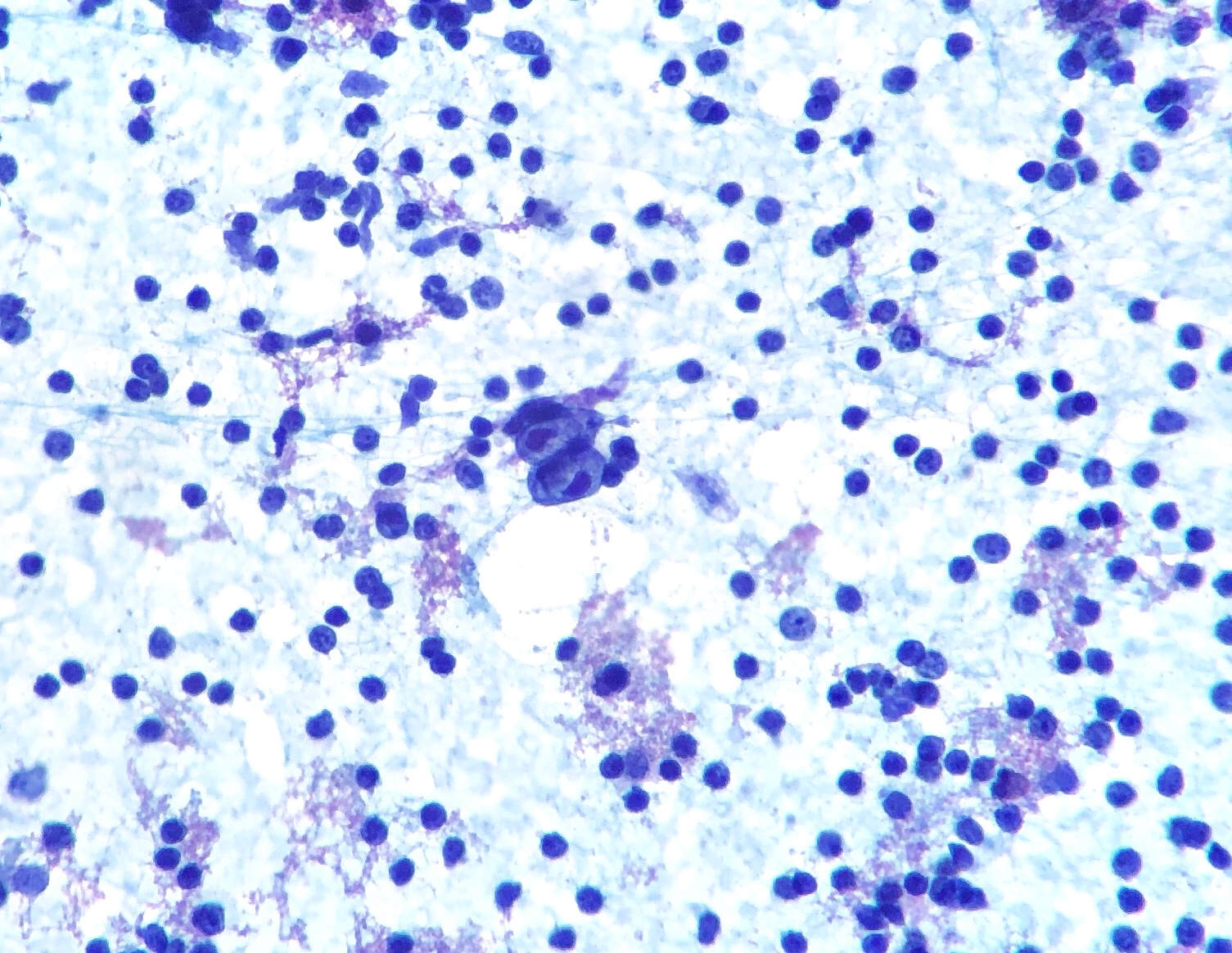
  • Células neoplásicas, linfocíticas e histiocíticas (palomitas de maíz):
    • Expresan antígeno CD20
    • Negativas para CD15 y CD30
  • Las células de Hodgkin/Reed-Sternberg típicas son infrecuentes o están ausentes.
  • Los LOS Neisseria linfocitos B y las células dendríticas son las células de fondo.
  • Más común en EN Erythema nodosum is an immune-mediated panniculitis (inflammation of the subcutaneous fat) caused by a type IV (delayed-type) hypersensitivity reaction. It commonly manifests in young women as tender, erythematous nodules on the shins. Erythema Nodosum pacientes más jóvenes
  • Compromiso cervical y axilar típico

Fisiopatología

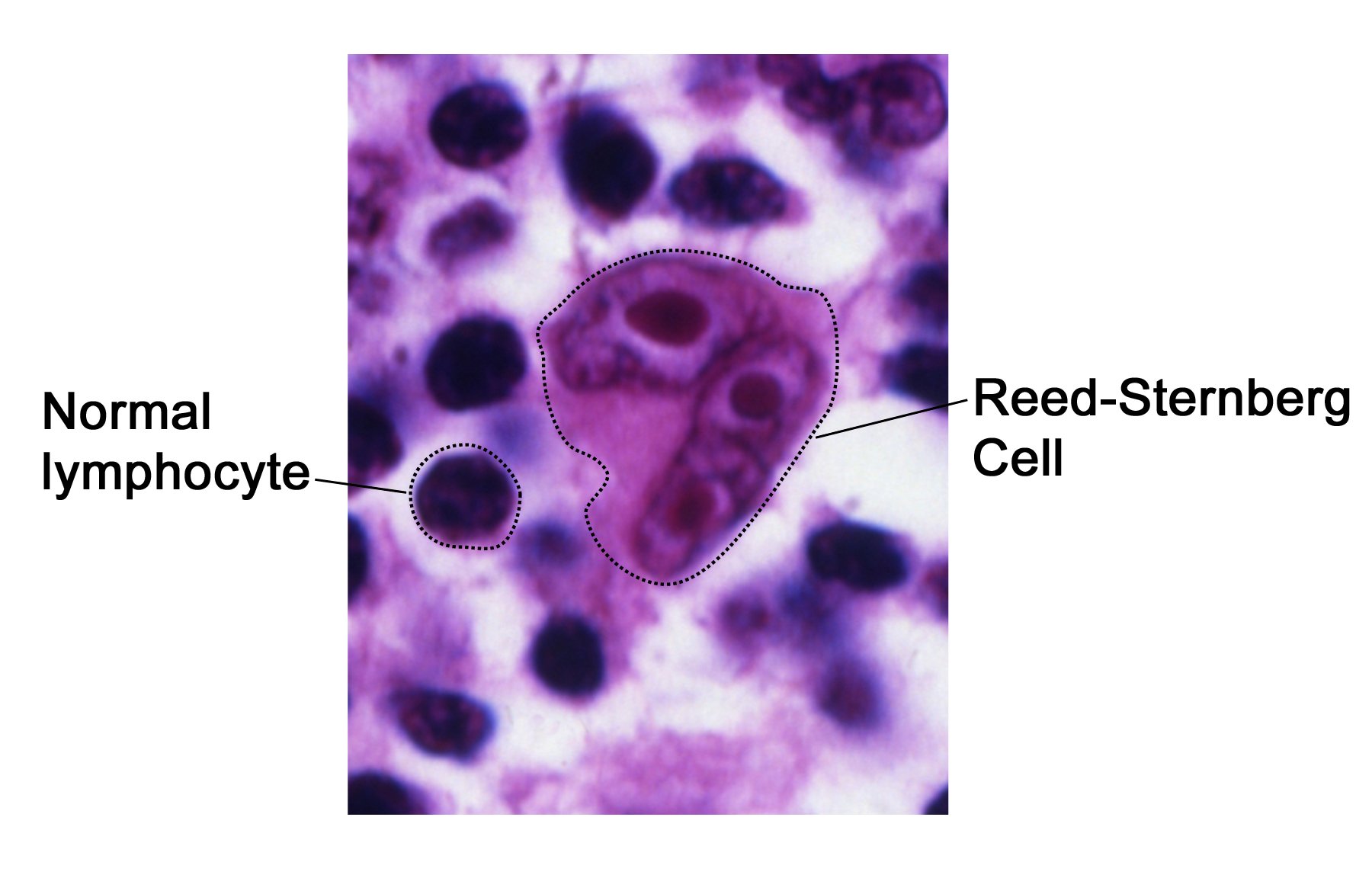
Células de Hodgkin/Reed-Sternberg

  • Células neoplásicas en EN Erythema nodosum is an immune-mediated panniculitis (inflammation of the subcutaneous fat) caused by a type IV (delayed-type) hypersensitivity reaction. It commonly manifests in young women as tender, erythematous nodules on the shins. Erythema Nodosum el linfoma de Hodgkin clásico
  • Núcleos bilobulados con nucleolos prominentes (aspecto de ojo de búho)
  • El linfoma de Hodgkin clásico expresa antígenos CD15 (Leu-M1) y CD30 (Ki-1)
  • Constituyen solo 1%–2% de la masa total de células tumorales
  • Producen citoquinas (e.g., interleucinas y factor de necrosis Necrosis The death of cells in an organ or tissue due to disease, injury or failure of the blood supply. Ischemic Cell Damage tumoral ( TNF TNF Tumor necrosis factor (TNF) is a major cytokine, released primarily by macrophages in response to stimuli. The presence of microbial products and dead cells and injury are among the stimulating factors. This protein belongs to the TNF superfamily, a group of ligands and receptors performing functions in inflammatory response, morphogenesis, and cell proliferation. Tumor Necrosis Factor (TNF), por sus siglas en EN Erythema nodosum is an immune-mediated panniculitis (inflammation of the subcutaneous fat) caused by a type IV (delayed-type) hypersensitivity reaction. It commonly manifests in young women as tender, erythematous nodules on the shins. Erythema Nodosum inglés)), que estimulan la proliferación celular
  • Resultan de la transformación clonal de células de la estirpe de los LOS Neisseria linfocitos B:
    • Derivadas de centros de ganglios linfáticos germinales
    • Las células de origen adquieren múltiples mutaciones
  • Pierden la capacidad de sufrir apoptosis Apoptosis A regulated cell death mechanism characterized by distinctive morphologic changes in the nucleus and cytoplasm, including the endonucleolytic cleavage of genomic DNA, at regularly spaced, internucleosomal sites, I.e., DNA fragmentation. It is genetically-programmed and serves as a balance to mitosis in regulating the size of animal tissues and in mediating pathologic processes associated with tumor growth. Ischemic Cell Damage:
    • La proteína de membrana latente 1, que se expresa en EN Erythema nodosum is an immune-mediated panniculitis (inflammation of the subcutaneous fat) caused by a type IV (delayed-type) hypersensitivity reaction. It commonly manifests in young women as tender, erythematous nodules on the shins. Erythema Nodosum las células infectadas con Epstein-Barr, es responsable de la activación de la vía del factor nuclear kappa-B (NF-kappaB), que es anti-apoptótica.
    • NF-kappaB se transloca al AL Amyloidosis núcleo de las células Reed-Sternberg.
    • NF-kappaB también es responsable de la proliferación de las células de Hodgkin/Reed-Sternberg y la secreción de citoquinas proinflamatorias que son responsables de las características sistémicas del linfoma de Hodgkin clásico.
  • Dejan de ser capaces de producir anticuerpos
  • Algunas células de Hodgkin/Reed-Sternberg muestran evidencia de infección por EBV EBV Epstein-barr virus (EBV) is a linear, double-stranded DNA virus belonging to the herpesviridae family. This highly prevalent virus is mostly transmitted through contact with oropharyngeal secretions from an infected individual. The virus can infect epithelial cells and B lymphocytes, where it can undergo lytic replication or latency. Epstein-Barr Virus y anomalías citogenéticas frecuentes:
    • El EBV EBV Epstein-barr virus (EBV) is a linear, double-stranded DNA virus belonging to the herpesviridae family. This highly prevalent virus is mostly transmitted through contact with oropharyngeal secretions from an infected individual. The virus can infect epithelial cells and B lymphocytes, where it can undergo lytic replication or latency. Epstein-Barr Virus es un virus Virus Viruses are infectious, obligate intracellular parasites composed of a nucleic acid core surrounded by a protein capsid. Viruses can be either naked (non-enveloped) or enveloped. The classification of viruses is complex and based on many factors, including type and structure of the nucleoid and capsid, the presence of an envelope, the replication cycle, and the host range. Virology oncogénico asociado con linfoma de Hodgkin.
    • Se cree que el EBV EBV Epstein-barr virus (EBV) is a linear, double-stranded DNA virus belonging to the herpesviridae family. This highly prevalent virus is mostly transmitted through contact with oropharyngeal secretions from an infected individual. The virus can infect epithelial cells and B lymphocytes, where it can undergo lytic replication or latency. Epstein-Barr Virus es responsable de la producción de señales que hacen que las células sean inmortales (i.e., ya no sufren apoptosis Apoptosis A regulated cell death mechanism characterized by distinctive morphologic changes in the nucleus and cytoplasm, including the endonucleolytic cleavage of genomic DNA, at regularly spaced, internucleosomal sites, I.e., DNA fragmentation. It is genetically-programmed and serves as a balance to mitosis in regulating the size of animal tissues and in mediating pathologic processes associated with tumor growth. Ischemic Cell Damage).
    • La detección del EBV EBV Epstein-barr virus (EBV) is a linear, double-stranded DNA virus belonging to the herpesviridae family. This highly prevalent virus is mostly transmitted through contact with oropharyngeal secretions from an infected individual. The virus can infect epithelial cells and B lymphocytes, where it can undergo lytic replication or latency. Epstein-Barr Virus en EN Erythema nodosum is an immune-mediated panniculitis (inflammation of the subcutaneous fat) caused by a type IV (delayed-type) hypersensitivity reaction. It commonly manifests in young women as tender, erythematous nodules on the shins. Erythema Nodosum células de Hodgkin/Reed-Sternberg varía según el subtipo histológico, la geografía y la inmunocompetencia.

Estroma inflamatorio circundante

  • Células reactivas benignas que son atraídas y proliferan con la expresión de citoquinas por parte de las células de Hodgkin/Reed-Sternberg.
  • Comprende la mayor parte del tumor Tumor Inflammation
  • Mezcla de macrófagos, linfocitos, mastocitos, neutrófilos, eosinófilos y células plasmáticas
  • Las células de Hodgkin/Reed-Sternberg también activan los LOS Neisseria fibroblastos y la deposición de colágeno.

Mutaciones genéticas

  • Afecta la proliferación y supervivencia de las células malignas
  • Mutaciones que producen anomalías en EN Erythema nodosum is an immune-mediated panniculitis (inflammation of the subcutaneous fat) caused by a type IV (delayed-type) hypersensitivity reaction. It commonly manifests in young women as tender, erythematous nodules on the shins. Erythema Nodosum la señalización intracelular:
    • NF-kappaB
    • JAK-STAT
    • NOTCH
  • Mutaciones que producen evasión inmune: genes Genes A category of nucleic acid sequences that function as units of heredity and which code for the basic instructions for the development, reproduction, and maintenance of organisms. DNA Types and Structure relacionados con PD-1 PD-1 An inhibitory t-lymphocyte receptor that has specificity for CD274 antigen and programmed cell death 1 ligand 2 protein. Signaling by the receptor limits T cell proliferation and interferon gamma synthesis. The receptor also may play an essential role in the regulatory pathway that induces peripheral tolerance. T cells: Types and Functions

Diseminación

  • Procede de un solo ganglio linfático a los LOS Neisseria ganglios adyacentes a través de los LOS Neisseria canales linfáticos
  • Propagación distante posteriormente

Presentación Clínica

Evolución:

  • El linfoma de Hodgkin clásico generalmente progresa lentamente.
  • Alguna variabilidad

Presentaciones más comunes:

  • Linfadenopatía asintomática:
    • 66% de los LOS Neisseria casos de linfoma de Hodgkin clásico
    • No dolorosa
    • Firme
    • Consistencia gomosa
    • El cuello es el sitio más común
    • Menos frecuente en EN Erythema nodosum is an immune-mediated panniculitis (inflammation of the subcutaneous fat) caused by a type IV (delayed-type) hypersensitivity reaction. It commonly manifests in young women as tender, erythematous nodules on the shins. Erythema Nodosum ganglios axilares e inguinales
    • Compromiso de los LOS Neisseria ganglios retroperitoneales en EN Erythema nodosum is an immune-mediated panniculitis (inflammation of the subcutaneous fat) caused by a type IV (delayed-type) hypersensitivity reaction. It commonly manifests in young women as tender, erythematous nodules on the shins. Erythema Nodosum el 30% de los LOS Neisseria pacientes
  • Masa torácica en EN Erythema nodosum is an immune-mediated panniculitis (inflammation of the subcutaneous fat) caused by a type IV (delayed-type) hypersensitivity reaction. It commonly manifests in young women as tender, erythematous nodules on the shins. Erythema Nodosum la imagenología:
    • Ganglios mediastínicos comprometidos en EN Erythema nodosum is an immune-mediated panniculitis (inflammation of the subcutaneous fat) caused by a type IV (delayed-type) hypersensitivity reaction. It commonly manifests in young women as tender, erythematous nodules on the shins. Erythema Nodosum más del 50% de los LOS Neisseria pacientes.
    • No detectable en EN Erythema nodosum is an immune-mediated panniculitis (inflammation of the subcutaneous fat) caused by a type IV (delayed-type) hypersensitivity reaction. It commonly manifests in young women as tender, erythematous nodules on the shins. Erythema Nodosum el examen físico
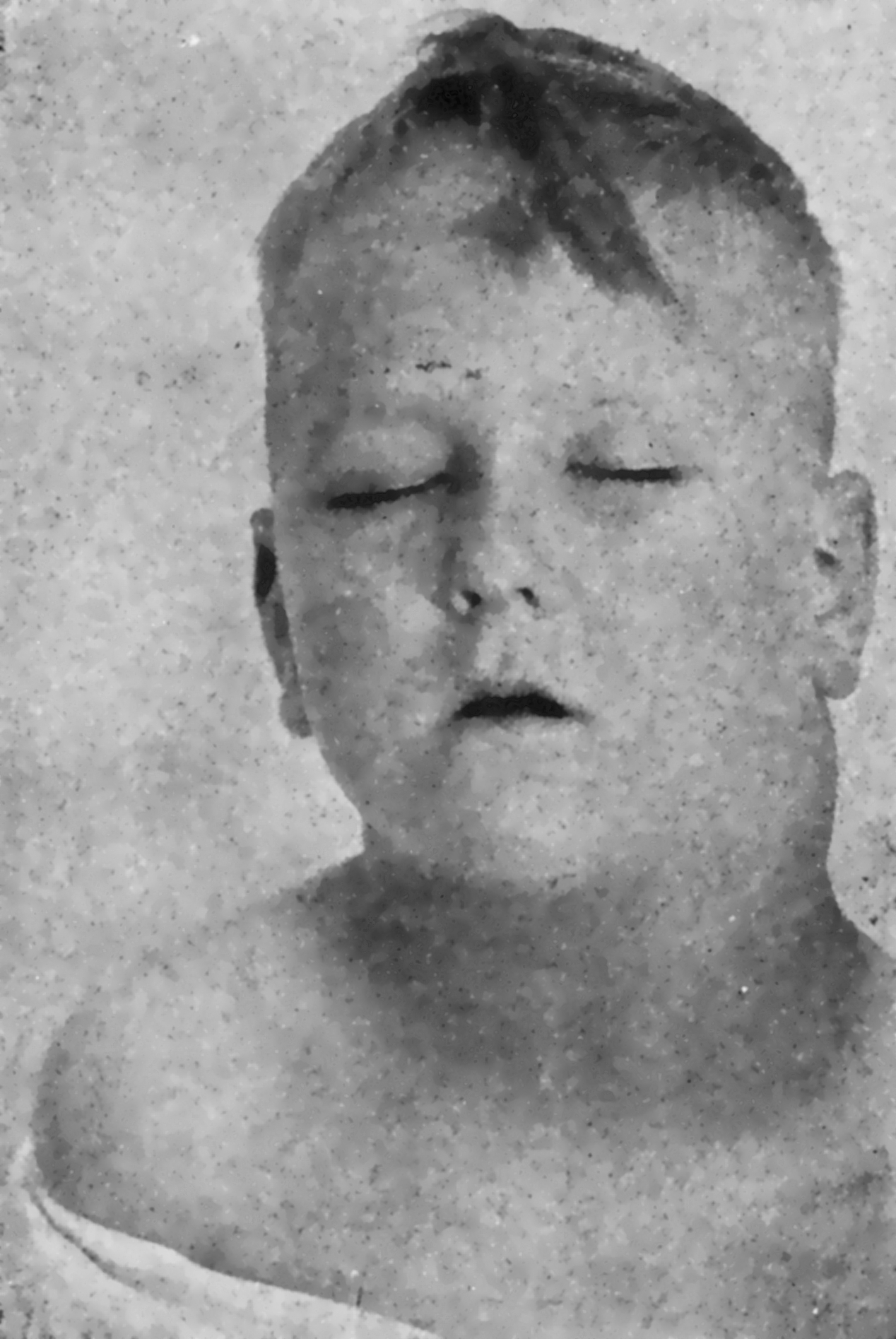
Adenopatías cervicales prominentes

Linfoma de Hodgkin:
Adenopatías cervicales prominentes

Imagen: “Hodgkin’s Disease (Essentials of Medicine)” por Charles Phillips Emerson, Nellie Gates Brown. Licencia: Dominio Público

Síntomas “B” (constitucionales) presentes en EN Erythema nodosum is an immune-mediated panniculitis (inflammation of the subcutaneous fat) caused by a type IV (delayed-type) hypersensitivity reaction. It commonly manifests in young women as tender, erythematous nodules on the shins. Erythema Nodosum el 40% de los LOS Neisseria casos:

  • Fiebre
  • Sudores nocturnos
  • Pérdida de peso involuntaria
  • Fatiga

Otros síntomas:

  • Prurito (10%–15%)
  • Dolor Dolor Inflammation asociado al AL Amyloidosis alcohol (raro): el consumo de alcohol induce dolor Dolor Inflammation en EN Erythema nodosum is an immune-mediated panniculitis (inflammation of the subcutaneous fat) caused by a type IV (delayed-type) hypersensitivity reaction. It commonly manifests in young women as tender, erythematous nodules on the shins. Erythema Nodosum los LOS Neisseria ganglios linfáticos (patognomónico).
  • Lesiones cutáneas (ictiosis, acroqueratosis, eritema nodoso, urticaria Urticaria Urticaria is raised, well-circumscribed areas (wheals) of edema (swelling) and erythema (redness) involving the dermis and epidermis with associated pruritus (itch). Urticaria is not a single disease but rather is a reaction pattern representing cutaneous mast cell degranulation. Urticaria (Hives), eritema multiforme)
  • Dolor Dolor Inflammation óseo (si hay compromiso óseo)
  • Síndromes paraneoplásicos:
    • Neurológico
    • Nefrótico

Diagnóstico y Estadificación

Antecedentes

  • Linfadenopatía:
    • Indolora
    • Síntoma más común
    • Extensión contigua o ganglio único
    • Unilateral
    • Cervical/supraclavicular → axilar → inguinal
    • No sensible, gomosa
  • Síntomas B constitucionales:
    • Fiebre leve
    • Sudores nocturnos
    • Pérdida de peso
  • Prurito
  • Dolor Dolor Inflammation de espalda o de huesos
  • Fiebre de Pel-Ebstein: oleadas de fiebre durante semanas
  • Dolor Dolor Inflammation relacionado al AL Amyloidosis alcohol
  • Antecedentes familiares: particularmente útil en EN Erythema nodosum is an immune-mediated panniculitis (inflammation of the subcutaneous fat) caused by a type IV (delayed-type) hypersensitivity reaction. It commonly manifests in young women as tender, erythematous nodules on the shins. Erythema Nodosum el linfoma de Hodgkin con esclerosis nodular

Examen físico

  • Ganglios linfáticos:
    • Palpables
    • Indoloros
    • Cuello: 60%–80%
    • Axila: 6%–20%
    • Inguinales: 6%–20%
  • Síndrome de la vena cava superior:
    • Si hay suficiente obstrucción de la vena cava superior por infiltración de los LOS Neisseria ganglios mediastínicos
    • Distensión venosa de miembros superiores y cuello
    • Edema Edema Edema is a condition in which excess serous fluid accumulates in the body cavity or interstitial space of connective tissues. Edema is a symptom observed in several medical conditions. It can be categorized into 2 types, namely, peripheral (in the extremities) and internal (in an organ or body cavity). Edema y congestión facial
    • Derrame pleural: dificultad para respirar
    • Tos TOS Thoracic outlet syndrome (TOS) is a broad term used for a spectrum of syndromes related to the general region of the thoracic outlet, which involves the compression or irritation of elements of the brachial plexus, subclavian artery, or subclavian vein. Thoracic Outlet Syndrome
  • Raras manifestaciones extraganglionares:
    • Hepatomegalia
    • Esplenomegalia
    • Disminución de los LOS Neisseria sonidos respiratorios y taquipnea (derrame pleural)
    • Dolor Dolor Inflammation óseo

Pruebas de diagnóstico

Estudios de laboratorio:

  • Hemograma con diferencial:
    • Anemia Anemia Anemia is a condition in which individuals have low Hb levels, which can arise from various causes. Anemia is accompanied by a reduced number of RBCs and may manifest with fatigue, shortness of breath, pallor, and weakness. Subtypes are classified by the size of RBCs, chronicity, and etiology. Anemia: Overview and Types
    • Linfopenia
    • Neutrofilia
    • Eosinofilia
  • Velocidad de eritrosedimentación (VES):
    • Marcador general de inflamación
    • Puede estar elevada
    • Asociada a peor pronóstico
  • Química sérica:
    • Elevación de calcio sérico
    • Elevación de sodio sérico
    • Aumento de la creatinina sérica en EN Erythema nodosum is an immune-mediated panniculitis (inflammation of the subcutaneous fat) caused by a type IV (delayed-type) hypersensitivity reaction. It commonly manifests in young women as tender, erythematous nodules on the shins. Erythema Nodosum síndrome nefrótico
  • Pruebas de función hepática:
    • La fosfatasa alcalina puede aumentar si hay compromiso de:
      • Hígado
      • Hueso
    • Lactato deshidrogenasa aumentada
    • Pueden correlacionarse con la extensión y el volumen de la enfermedad
  • Albúmina
  • Prueba de VIH
  • Pruebas de hepatitis B Hepatitis B Hepatitis B virus (HBV) is a partially double-stranded DNA virus, which belongs to the Orthohepadnavirus genus and the Hepadnaviridae family. Most individuals with acute HBV infection are asymptomatic or have mild, self-limiting symptoms. Chronic infection can be asymptomatic or create hepatic inflammation, leading to liver cirrhosis and hepatocellular carcinoma (HCC). Hepatitis B Virus y C

Imagenología:

  • Radiografía de tórax (masas o ensanchamiento mediastínico)
  • TC para evaluar:
    • Agrandamiento de los LOS Neisseria ganglios linfáticos
    • Hepatomegalia
    • Esplenomegalia
    • Pulmón:
      • Nódulos
      • Derrames
      • Infiltrados
  • PET PET An imaging technique that combines a positron-emission tomography (PET) scanner and a ct X ray scanner. This establishes a precise anatomic localization in the same session. Nuclear Imaging:
    • Se considera esencial para la estadificación inicial de linfoma de Hodgkin:
    • Inyección de fluorodesoxiglucosa, que es un análogo de la glucosa:
      • Ingresa a las células tumorales
      • Emite rayos gamma
      • Los LOS Neisseria rayos gamma son detectados por el escáner.
    • Distingue entre tumor Tumor Inflammation activo y necrótico o fibroso
    • A menudo se realiza junto con una TC
    • Guía la necesidad de tratamiento adicional
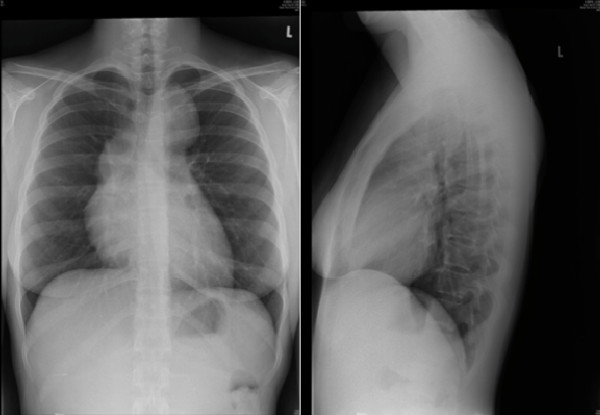
Radiografía de tórax que muestra adenopatías mediastínicas en el linfoma de Hodgin

Radiografía de tórax que muestra adenopatías mediastínicas en el linfoma de Hodgkin

Imagen: “Hodgkin’s lymphoma presenting with markedly elevated IgE: a case report” por Ellis AK, Waserman S. Licencia: CC BY 2.0

Biopsia:

  • Biopsia por escisión de un ganglio linfático periférico (preferida):
    • Prueba obligatoria
    • Microscopía:
      • Células de Hodgkin/Reed-Sternberg
      • Infiltrado de células inflamatorias pleomórficas
      • Fibrosis Fibrosis Any pathological condition where fibrous connective tissue invades any organ, usually as a consequence of inflammation or other injury. Bronchiolitis Obliterans
    • Inmunofenotipo:
      • CD30 (linfoma de Hodgkin clásico)
      • CD15 (linfoma de Hodgkin clásico)
      • CD20 (linfoma de Hodgkin con predominio de linfocitos nodulares)
      • Ausencia de CD45 y CD3 CD3 Complex of at least five membrane-bound polypeptides in mature T-lymphocytes that are non-covalently associated with one another and with the T-cell receptor. The CD3 complex includes the gamma, delta, epsilon, zeta, and eta chains (subunits). When antigen binds to the T-cell receptor, the CD3 complex transduces the activating signals to the cytoplasm of the T-cell. The CD3 gamma and delta chains (subunits) are separate from and not related to the gamma/delta chains of the T-cell receptor. T cells: Types and Functions
  • Biopsia de médula ósea: para determinar la extensión de la enfermedad

Estadificación

La estadificación se basa en EN Erythema nodosum is an immune-mediated panniculitis (inflammation of the subcutaneous fat) caused by a type IV (delayed-type) hypersensitivity reaction. It commonly manifests in young women as tender, erythematous nodules on the shins. Erythema Nodosum la clasificación de Ann Arbor.
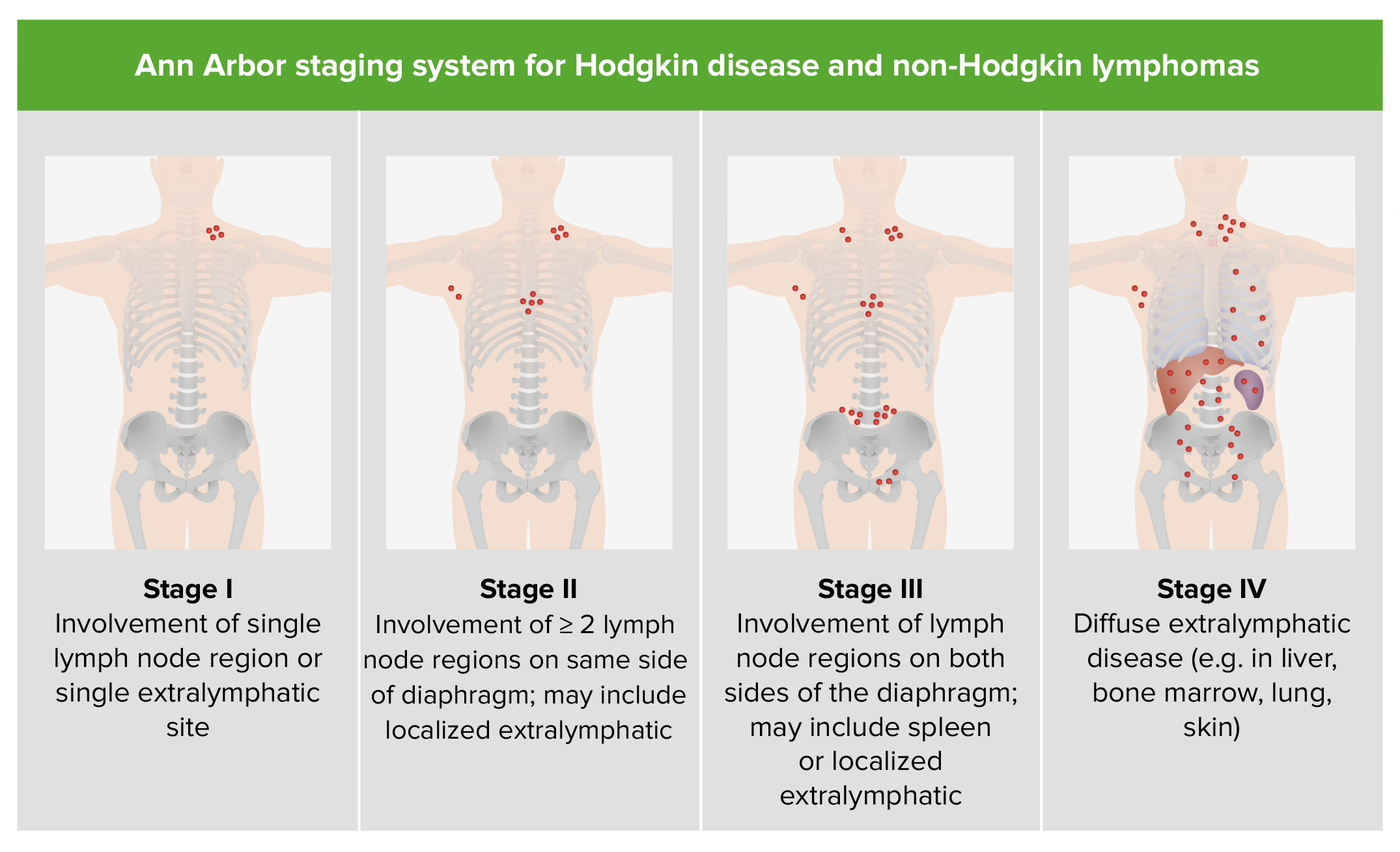
  • Estadio I:
    • 1 grupo de ganglios linfáticos (I): principalmente cervical o
    • Un único sitio extralinfático ( Ie IE Infective endocarditis (IE) is caused by infection or inflammation of the inner lining of the heart (endocardium), most commonly affecting the heart valves. Endocarditis)
  • Estadio II:
    • ≥2 ganglios linfáticos en EN Erythema nodosum is an immune-mediated panniculitis (inflammation of the subcutaneous fat) caused by a type IV (delayed-type) hypersensitivity reaction. It commonly manifests in young women as tender, erythematous nodules on the shins. Erythema Nodosum 1 lado del diafragma (II) o
    • Focos extraganglionares localizados e infestación de ≥ 1 ganglios linfáticos en EN Erythema nodosum is an immune-mediated panniculitis (inflammation of the subcutaneous fat) caused by a type IV (delayed-type) hypersensitivity reaction. It commonly manifests in young women as tender, erythematous nodules on the shins. Erythema Nodosum 1 lado del diafragma (IIe)
  • Estadio III:
    • Compromiso de los LOS Neisseria ganglios linfáticos a ambos lados del diafragma (III), que puede incluir el bazo (IIIs) u
    • Órgano o sitio extralinfático contiguo limitado (IIIe, IIIes)
  • Estadio IV: compromiso diseminado de ≥ 1 órganos extralinfáticos sin afectación de ganglios linfáticos
  • “A” indica la ausencia de síntomas sistémicos.
  • “B” indica la presencia de síntomas sistémicos.
Hodgkin disease staging

Estadificación de la enfermedad de Hodgkin y del linfoma no Hodgkin

Imagen por Lecturio.

Tratamiento y Pronóstico

Tratamiento

  • Objetivos de la terapia:
    • Maximizar la cura en EN Erythema nodosum is an immune-mediated panniculitis (inflammation of the subcutaneous fat) caused by a type IV (delayed-type) hypersensitivity reaction. It commonly manifests in young women as tender, erythematous nodules on the shins. Erythema Nodosum todos los LOS Neisseria estadios.
    • Minimizar las complicaciones a corto y largo plazo.
    • Minimizar los LOS Neisseria riesgos de toxicidad.
    • Eliminar o minimizar la radioterapia consolidada cuando sea posible.
  • Principalmente guiado por el estadio clínico y factores individuales del paciente.
  • Estadio IA:
    • Quimioterapia con ABVD (doxorrubicina (Adriamicina), bleomicina, vinblastina y dacarbazina)
    • Seguida de radioterapia localizada o regional
  • Estadio IB/II:
    • 4–6 cursos de ABVD o brentuximab vedotin-AVD
    • Radioterapia para ganglios voluminosos
  • Estadios III y IV:
    • Regímenes preferidos de la NCCN:
      • 6 ciclos de Nivolumab-AVD (inhibidor del punto de control PD-1 PD-1 An inhibitory t-lymphocyte receptor that has specificity for CD274 antigen and programmed cell death 1 ligand 2 protein. Signaling by the receptor limits T cell proliferation and interferon gamma synthesis. The receptor also may play an essential role in the regulatory pathway that induces peripheral tolerance. T cells: Types and Functions combinado con doxorrubicina, vinblastina y dacarbazina)
      • BrECADD (brentuximab vedotin, etopósido, ciclofosfamida, doxorrubicina, dacarbazina, dexametasona) más G-CSF
    • Regímenes alternativos:
      • 6 ciclos de Brentuximab vedotin-AVD (contraindicado en EN Erythema nodosum is an immune-mediated panniculitis (inflammation of the subcutaneous fat) caused by a type IV (delayed-type) hypersensitivity reaction. It commonly manifests in young women as tender, erythematous nodules on the shins. Erythema Nodosum pacientes con neuropatía)
      • 6 a 8 ciclos de ABVD (puede usarse si nivolumab Nivolumab A genetically engineered, fully humanized immunoglobulin g4 monoclonal antibody that binds to the pd-1 receptor, activating an immune response to tumor cells. It is used as monotherapy or in combination with ipilimumab for the treatment of advanced malignant melanoma. It is also used in the treatment of advanced or recurring non-small cell lung cancer; renal cell carcinoma; and Hodgkin’s lymphoma. Melanoma o brentuximab vedotina no están disponibles o están contraindicados).
    • La radioterapia consolidada para la linfadenopatía residual voluminosa (>1,5 cm) rara vez se necesita con los LOS Neisseria regímenes más recientes.
  • Casos refractarios:
    • Trasplante autólogo de células madre
    • Diferentes quimioterapias
    • Anticuerpos para bloquear PD-L1
    • Anticuerpos contra CD30

Pronóstico

  • International Prognostic Score (IPS): basado en EN Erythema nodosum is an immune-mediated panniculitis (inflammation of the subcutaneous fat) caused by a type IV (delayed-type) hypersensitivity reaction. It commonly manifests in young women as tender, erythematous nodules on the shins. Erythema Nodosum 7 características desfavorables en EN Erythema nodosum is an immune-mediated panniculitis (inflammation of the subcutaneous fat) caused by a type IV (delayed-type) hypersensitivity reaction. It commonly manifests in young women as tender, erythematous nodules on the shins. Erythema Nodosum el momento del diagnóstico:
    • Sexo masculino
    • Edad > 45 años
    • Enfermedad en EN Erythema nodosum is an immune-mediated panniculitis (inflammation of the subcutaneous fat) caused by a type IV (delayed-type) hypersensitivity reaction. It commonly manifests in young women as tender, erythematous nodules on the shins. Erythema Nodosum estadio IV
    • Hipoalbuminemia: albúmina sérica < 4 g/dL
    • Hemoglobina < 10,5 g/dL
    • Recuento de linfocitos < 600/µL y/o < 8% de los LOS Neisseria leucocitos
    • Leucocitos ≥ 15 000/µL
  • Libertad de progresión a los LOS Neisseria 5 años:

Complicaciones

  • Complicaciones de la radioterapia (menos frecuentes con los LOS Neisseria regímenes actuales):
    • Mielodisplasia
    • Leucemia aguda
    • Sarcoma
    • Mayor riesgo de cáncer de pulmón o enfermedad pulmonar fibrótica, particularmente en EN Erythema nodosum is an immune-mediated panniculitis (inflammation of the subcutaneous fat) caused by a type IV (delayed-type) hypersensitivity reaction. It commonly manifests in young women as tender, erythematous nodules on the shins. Erythema Nodosum fumadores
    • Nota: Los LOS Neisseria enfoques de tratamiento modernos reducen significativamente la exposición a la radiación.
  • Complicaciones de la quimioterapia:
    • La adriamicina es cardiotóxica.
    • La bleomicina causa neumonitis.
    • Insuficiencia cardíaca congestiva y mayor riesgo de enfermedad de las arterias coronarias
    • Inmunodeficiencia a largo plazo
    • Neuropatía y atrofia muscular

Diagnóstico Diferencial

  • Procesos reactivos: los LOS Neisseria procesos infecciosos, autoinmunes y otros procesos inflamatorios pueden provocar linfadenopatía, visceromegalia, fiebre y otros síntomas sistémicos. Los LOS Neisseria procesos reactivos tienen un infiltrado polimorfo, pero carecen de células de Reed-Sternberg. El diagnóstico se realiza mediante análisis histológicos, análisis de sangre e imagenología. El tratamiento se adapta a la enfermedad subyacente.
  • Linfoma no Hodgkin: comprende todas las formas de neoplasias malignas de linfocitos que histológicamente no tienen células de Hodgkin/Reed-Sternberg. Los LOS Neisseria signos y síntomas incluyen linfadenopatía y síntomas constitucionales. El diagnóstico se realiza mediante exámenes histológicos del tejido linfoide o de la médula ósea. Se realiza imagenología para ayudar con la estadificación. El tratamiento es con quimioterapia, radioterapia y trasplante de células madre.
  • Linfoma anaplásico de células grandes: neoplasia originada de linfocitos T que produce respuestas inflamatorias y fibrosis Fibrosis Any pathological condition where fibrous connective tissue invades any organ, usually as a consequence of inflammation or other injury. Bronchiolitis Obliterans tisular (un subtipo de linfoma no Hodgkin). Los LOS Neisseria signos y síntomas incluyen linfadenopatía, pero los LOS Neisseria síntomas constitucionales son raros. El linfoma anaplásico de células grandes tiene un curso agresivo. El diagnóstico se realiza mediante una combinación de evaluaciones morfológicas e inmunofenotípicas. El tratamiento es con quimioterapia y trasplante de células madre.
  • Úlcera mucocutánea EBV-positiva: trastorno caracterizado por lesiones ulcerativas circunscritas aisladas que ocurren en EN Erythema nodosum is an immune-mediated panniculitis (inflammation of the subcutaneous fat) caused by a type IV (delayed-type) hypersensitivity reaction. It commonly manifests in young women as tender, erythematous nodules on the shins. Erythema Nodosum pacientes mayores o en EN Erythema nodosum is an immune-mediated panniculitis (inflammation of the subcutaneous fat) caused by a type IV (delayed-type) hypersensitivity reaction. It commonly manifests in young women as tender, erythematous nodules on the shins. Erythema Nodosum el marco de inmunosupresión. Las lesiones suelen estar en EN Erythema nodosum is an immune-mediated panniculitis (inflammation of the subcutaneous fat) caused by a type IV (delayed-type) hypersensitivity reaction. It commonly manifests in young women as tender, erythematous nodules on the shins. Erythema Nodosum la orofaringe, pero pueden verse comprometidos la piel o los LOS Neisseria tejidos gastrointestinales. Las lesiones contienen infiltrados inflamatorios polimorfos con linfocitos B infectados por EBV EBV Epstein-barr virus (EBV) is a linear, double-stranded DNA virus belonging to the herpesviridae family. This highly prevalent virus is mostly transmitted through contact with oropharyngeal secretions from an infected individual. The virus can infect epithelial cells and B lymphocytes, where it can undergo lytic replication or latency. Epstein-Barr Virus dispersos que se asemejan a las células de Hodgkin/Reed-Sternberg. La úlcera mucocutánea positiva para EBV EBV Epstein-barr virus (EBV) is a linear, double-stranded DNA virus belonging to the herpesviridae family. This highly prevalent virus is mostly transmitted through contact with oropharyngeal secretions from an infected individual. The virus can infect epithelial cells and B lymphocytes, where it can undergo lytic replication or latency. Epstein-Barr Virus tiene una presentación extraganglionar, curso benigno y frecuentes regresiones espontáneas, y responde al AL Amyloidosis tratamiento conservador.

Referencias

  1. Ng, A., Aster, J.C., Herrera, A.F. (2025, Feb 18). Classic Hodgkin lymphoma: Presentation, evaluation, and diagnosis in adults. In LaCasce, A.S. (Ed.), UpToDate. Retrieved June 30, 2025, from https://www.uptodate.com/contents/clinical-presentation-and-diagnosis-of-classic-hodgkin-lymphoma-in-adults
  2. Lash, B., Wolfe, Z., Argiris, A. (2025, Jan 7). Hodgkin Lymphoma. In Besa, E.C. (Ed.), Medscape. Retrieved June 30, 2025, from https://reference.medscape.com/article/201886-overview
  3. Engert, A., Plütschow, A., Eich, H.T., et al. (2010). Reduced treatment intensity in patients with early-stage Hodgkin’s lymphoma. N Engl J Med 363:640–652. https://doi.org/10.1056/NEJMoa1000067
  4. Radford, J., Illidge, T., Counsell, N., et al. (2015). Results of a trial of PET-directed therapy for early-stage Hodgkin’s lymphoma. N Engl J Med 372:1598–1607. https://doi.org/10.1056/NEJMoa1408648
  5. Shimabukuro-Vornhagen, A., Haverkamp, H., Engert, A., et al. (2005). Lymphocyte-rich classical Hodgkin’s lymphoma: clinical presentation and treatment outcome in 100 patients treated within German Hodgkin’s Study Group trials. J Clin Oncol 23:5739–5745. https://pubmed.ncbi.nlm.nih.gov/16009944/
  6. Schlammerl K, Kommoss S, Krämer B, Hoopmann M, Bachmann C. Atypical course of a caesarean scar pregnancy. Arch Gynecol Obstet. 2023;307(6):2023-2024. doi:10.1007/s00404-022-06697-9
  7. Ansell SM. Hodgkin lymphoma: 2023 update on diagnosis, risk-stratification, and management. Am J Hematol. 2022;97(11):1478-1488. doi:10.1002/ajh.26717
  8. Ansell SM. Hodgkin lymphoma: 2025 update on diagnosis, risk-stratification, and management. Am J Hematol. 2024;99(12):2367-2378. doi:10.1002/ajh.27470
  9. Cortes J, Rugo HS, Cescon DW, et al. Pembrolizumab plus Chemotherapy in Advanced Triple-Negative Breast Cancer. N Engl J Med. 2022;387(3):217-226. doi:10.1056/NEJMoa2202809
  10. Borchmann P, Ferdinandus J, Schneider G, et al. Assessing the efficacy and tolerability of PET-guided BrECADD versus eBEACOPP in advanced-stage, classical Hodgkin lymphoma (HD21): a randomised, multicentre, parallel, open-label, phase 3 trial [published correction appears in Lancet. 2024 Nov 30;404(10468):2164. doi: 10.1016/S0140-6736(24)02571-6.]. Lancet. 2024;404(10450):341-352. doi:10.1016/S0140-6736(24)01315-1
  11. Arber DA, Orazi A, Hasserjian RP, et al. International Consensus Classification of Myeloid Neoplasms and Acute Leukemias: integrating morphologic, clinical, and genomic data. Blood. 2022;140(11):1200-1228. doi:10.1182/blood.2022015850
  12. Castellino SM, Pei Q, Parsons SK, et al. Brentuximab Vedotin with Chemotherapy in Pediatric High-Risk Hodgkin’s Lymphoma. N Engl J Med. 2022;387(18):1649-1660. doi:10.1056/NEJMoa2206660
  13. Connors JM, Cozen W, Steidl C, et al. Author Correction: Hodgkin lymphoma. Nat Rev Dis Primers. 2021;7(1):79. Published 2021 Oct 20. doi:10.1038/s41572-021-00319-5
  14. Evens AM. Enhancing the treatment landscape: PET-guided BrECADD for advanced-stage, classical Hodgkin lymphoma. Lancet. 2024;404(10450):312-313. doi:10.1016/S0140-6736(24)01404-1
  15. Herrera AF, LeBlanc M, Castellino SM, et al. Nivolumab+AVD in Advanced-Stage Classic Hodgkin’s Lymphoma. N Engl J Med. 2024;391(15):1379-1389. doi:10.1056/NEJMoa2405888
  16. Hoppe RT, Advani RH, Ai WZ, et al. NCCN Guidelines® Insights: Hodgkin Lymphoma, Version 2.2022. J Natl Compr Canc Netw. 2022;20(4):322-334. doi:10.6004/jnccn.2022.0021
  17. Mafra A, Laversanne M, Gospodarowicz M, et al. Global patterns of non-Hodgkin lymphoma in 2020. Int J Cancer. 2022;151(9):1474-1481. doi:10.1002/ijc.34163
  18. National Comprehensive Cancer Network. NCCN Clinical Practice Guidelines in Oncology: Hodgkin Lymphoma. Version 2.2025. https://www.nccn.org/guidelines/guidelines-detail?category=1&id=1439
  19. Rodday AM, Parsons SK, Upshaw JN, et al. The Advanced-Stage Hodgkin Lymphoma International Prognostic Index: Development and Validation of a Clinical Prediction Model From the HoLISTIC Consortium [published correction appears in J Clin Oncol. 2024 Mar 1;42(7):862. doi: 10.1200/JCO.23.02698.]. J Clin Oncol. 2023;41(11):2076-2086. doi:10.1200/JCO.22.02473
  20. Roswarski JL, Longo DL. Hodgkin lymphoma: Focus on evolving treatment paradigms. Best Pract Res Clin Haematol. 2023;36(4):101510. doi:10.1016/j.beha.2023.101510
  21. Siegel RL, Giaquinto AN, Jemal A. Cancer statistics, 2024 [published correction appears in CA Cancer J Clin. 2024 Mar-Apr;74(2):203. doi: 10.3322/caac.21830.]. CA Cancer J Clin. 2024;74(1):12-49. doi:10.3322/caac.21820
  22. Ullah F, Dima D, Omar N, et al. Advances in the treatment of Hodgkin lymphoma: Current and future approaches. Front Oncol. 2023;13:1067289. https://www.frontiersin.org/journals/oncology/articles/10.3389/fonc.2023.1067289/full
  23. Wang X, Zhang H. Hodgkin’s lymphoma: 2023 update on treatment. Cancer Biol Med. 2024;21(4):j.issn.2095-3941. https://pmc.ncbi.nlm.nih.gov/articles/PMC11033717/

¡Crea tu cuenta gratis o inicia una sesión para seguir leyendo!

Regístrate ahora y obtén acceso gratuito a Lecturio con páginas de concepto, videos médicos y cuestionarios para tu educación médica.

User Reviews

Que tengas una sesión de estudio alegre y navideña 🎁 Ahorra 50% en todos los planes >>

Details