Domina Conceptos Médicos

Estudia para la escuela de medicina y tus examenes con Lecturio.

Lesiones Cutáneas Primarias

La identificación y clasificación de las lesiones cutáneas en EN Erythema nodosum is an immune-mediated panniculitis (inflammation of the subcutaneous fat) caused by a type IV (delayed-type) hypersensitivity reaction. It commonly manifests in young women as tender, erythematous nodules on the shins. Erythema Nodosum un paciente son pasos importantes en EN Erythema nodosum is an immune-mediated panniculitis (inflammation of the subcutaneous fat) caused by a type IV (delayed-type) hypersensitivity reaction. It commonly manifests in young women as tender, erythematous nodules on the shins. Erythema Nodosum el diagnóstico de cualquier trastorno de la piel. Las lesiones primarias representan la presentación inicial del proceso de la enfermedad. Las lesiones secundarias se desarrollan a partir de lesiones primarias irritadas o manipuladas y/o progresión de la enfermedad. Junto con la evaluación de los LOS Neisseria antecedentes, se requiere un examen físico completo de la piel, los LOS Neisseria anexos y las membranas mucosas para diferenciar entre las distintas condiciones. Las características clave observadas durante el examen físico incluyen el tipo, la morfología, el tamaño, el color, la forma, la disposición y la distribución de las lesiones que se presentan. A veces, los LOS Neisseria procedimientos diagnósticos pueden ser necesarios.

Last updated: Dec 15, 2025
Editorial responsibility: Stanley Oiseth, Lindsay Jones, Evelin Maza

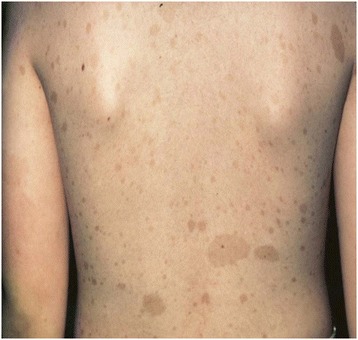
Mácula

  • Una lesión cutánea plana, no palpable, que mide ≤ 1 cm de tamaño
  • Difiere en EN Erythema nodosum is an immune-mediated panniculitis (inflammation of the subcutaneous fat) caused by a type IV (delayed-type) hypersensitivity reaction. It commonly manifests in young women as tender, erythematous nodules on the shins. Erythema Nodosum color de la piel circundante (hipopigmentada/hiperpigmentada o eritematosa)
  • No elevada ni deprimida en EN Erythema nodosum is an immune-mediated panniculitis (inflammation of the subcutaneous fat) caused by a type IV (delayed-type) hypersensitivity reaction. It commonly manifests in young women as tender, erythematous nodules on the shins. Erythema Nodosum comparación con la superficie de la piel
  • Ejemplos:
    • Pecas
    • Lunares
    • Máculas café con leche
    • Máculas en EN Erythema nodosum is an immune-mediated panniculitis (inflammation of the subcutaneous fat) caused by a type IV (delayed-type) hypersensitivity reaction. It commonly manifests in young women as tender, erythematous nodules on the shins. Erythema Nodosum la rubéola
    • Máculas en EN Erythema nodosum is an immune-mediated panniculitis (inflammation of the subcutaneous fat) caused by a type IV (delayed-type) hypersensitivity reaction. It commonly manifests in young women as tender, erythematous nodules on the shins. Erythema Nodosum el sarampión
Máculas hiperpigmentadas café con leche

Máculas café con leche hiperpigmentadas en un paciente con neurofibromatosis tipo 1

Imagen: “Breast Cancer associated with neurofibromatosis type 1: A case series and review of the literature” por Khalil J, Afif M, Elkacemi H, Benoulaid M, Kebdani T, Benjaafar N.  Licencia: CC BY 4.0

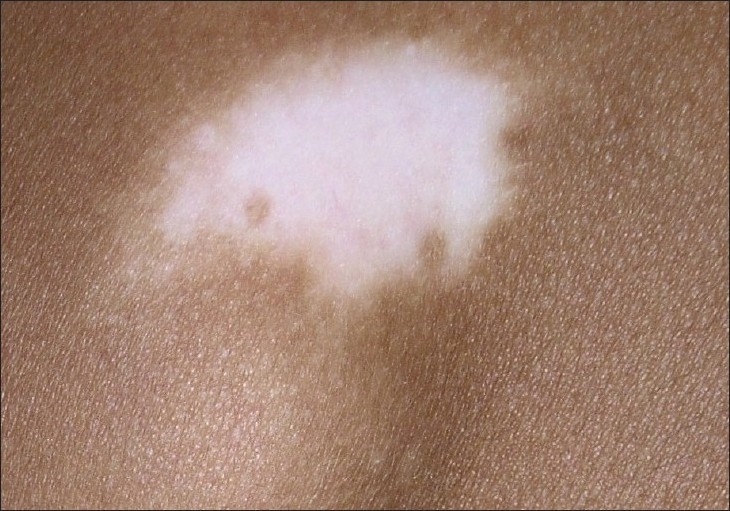
Parche

  • Una lesión cutánea plana que mide > 1 cm de tamaño.
  • Difiere en EN Erythema nodosum is an immune-mediated panniculitis (inflammation of the subcutaneous fat) caused by a type IV (delayed-type) hypersensitivity reaction. It commonly manifests in young women as tender, erythematous nodules on the shins. Erythema Nodosum color de la piel circundante
  • No palpable y más grande que una mácula
  • Los LOS Neisseria ejemplos incluyen vitíligo y melasma Melasma Melasma is a benign skin condition characterized by hyperpigmentation of sun-exposed regions due to excess melanin production and deposition. The condition mainly affects women during their reproductive years, particularly those with darker skin tones. Melasma.

Pápula

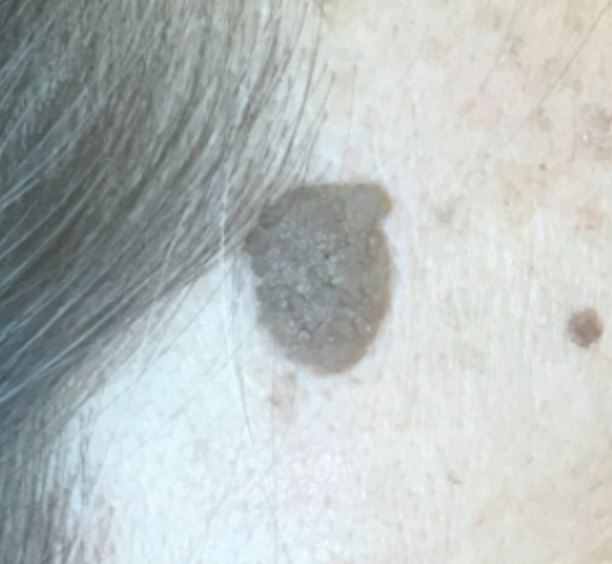
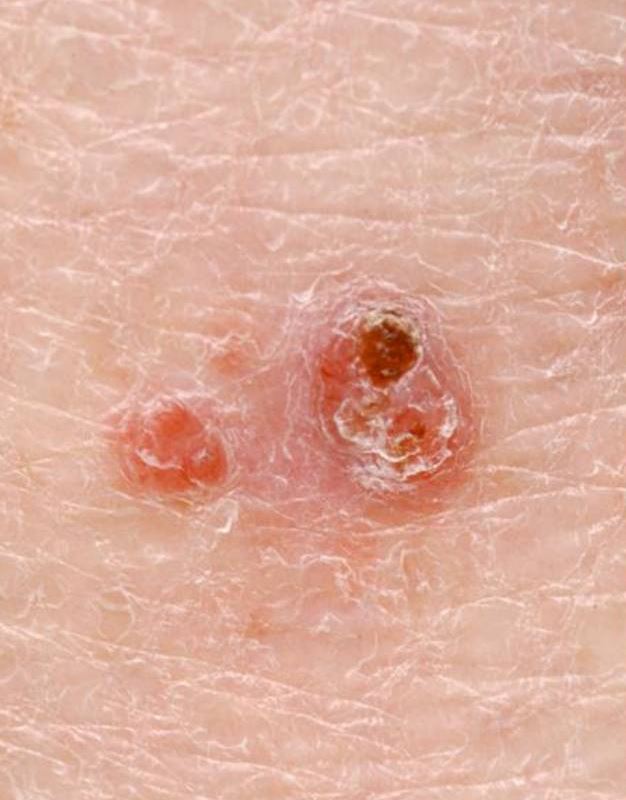
  • Una lesión cutánea elevada y palpable que mide ≤ 1 cm de diámetro
  • El color puede indicar el diagnóstico:
    • Las pápulas marrones o negras son a menudo lesiones melanocíticas.
    • Las pápulas rojas son a menudo lesiones vasculares.
  • Ejemplos:
    • Nevos
    • Verrugas
    • Liquen plano
    • Picaduras de insectos
    • Queratosis seborreicas
    • Molusco contagioso
    • Angiomas
    • Cánceres de piel

Placa

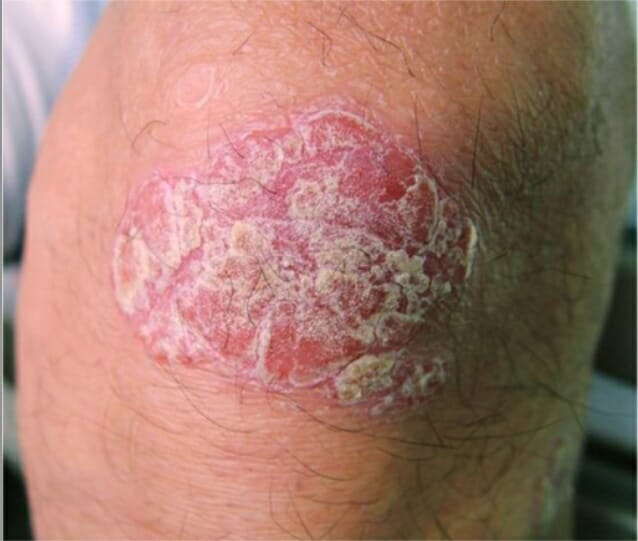
  • Lesión cutánea elevada de > 1 cm de diámetro
  • Por lo general, tiene un cambio superficial palpable a medida que la lesión surge de la epidermis Epidermis The external, nonvascular layer of the skin. It is made up, from within outward, of five layers of epithelium: (1) basal layer (stratum basale epidermidis); (2) spinous layer (stratum spinosum epidermidis); (3) granular layer (stratum granulosum epidermidis); (4) clear layer (stratum lucidum epidermidis); and (5) horny layer (stratum corneum epidermidis). Skin: Structure and Functions
  • Puede tener una apariencia plana o redondeada.
  • Ejemplos:
    • Psoriasis Psoriasis Psoriasis is a common T-cell-mediated inflammatory skin condition. The etiology is unknown, but is thought to be due to genetic inheritance and environmental triggers. There are 4 major subtypes, with the most common form being chronic plaque psoriasis. Psoriasis
    • Granuloma anular
    • Dermatitis Dermatitis Any inflammation of the skin. Atopic Dermatitis (Eczema) seborreica
    • Eccema
Primary lesion on knee

Una lesión psoriásica en la rodilla

Imagen: “Psoriatic lesion on the knee” por Department of Neurology, Wakayama Medical University, Japan. Licencia: CC BY 2.0

Nódulo

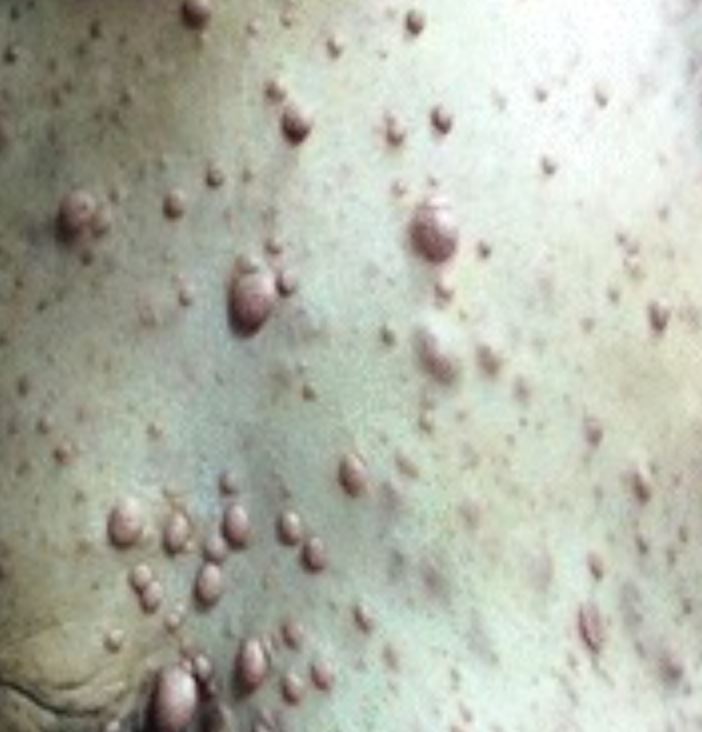
  • Una lesión grande y firme que sobresale de la superficie de la piel circundante y mide de 1–5 cm
  • Por lo general, se extiende a la dermis Dermis A layer of vascularized connective tissue underneath the epidermis. The surface of the dermis contains innervated papillae. Embedded in or beneath the dermis are sweat glands; hair follicles; and sebaceous glands. Skin: Structure and Functions y el tejido subcutáneo
  • La superficie puede ser lisa, queratósica, ulcerada o fúngica.
  • Ejemplos:
    • Neurofibromas
    • Quistes
    • Lipomas
neurofibromas

Neurofibromas

Imagen: “Breast cancer associated with neurofibromatosis type 1: A case series and review of the literature” por Khalil J, Afif M, Elkacemi H, Benoulaid M, Kebdani T, Benjaafar N. Licencia: CC BY 4.0 , recortada por Lecturio.
Vesícula

  • Una pequeña ampolla que contiene líquido (acumulación de líquido en EN Erythema nodosum is an immune-mediated panniculitis (inflammation of the subcutaneous fat) caused by a type IV (delayed-type) hypersensitivity reaction. It commonly manifests in young women as tender, erythematous nodules on the shins. Erythema Nodosum la piel) que mide ≤ 1 cm de diámetro
  • Elevada por encima del plano de la piel circundante
  • El líquido es visible, ya que las lesiones son translúcidas.
  • Observada en EN Erythema nodosum is an immune-mediated panniculitis (inflammation of the subcutaneous fat) caused by a type IV (delayed-type) hypersensitivity reaction. It commonly manifests in young women as tender, erythematous nodules on the shins. Erythema Nodosum:
Vesículas del virus del herpes simple

Vesículas causadas por el virus del herpes simple

Imagen: “Transplant biology at a crossroads” por Sedwick C. . Licencia: CC BY 4.0 , recortada por Lecturio.

Bulla

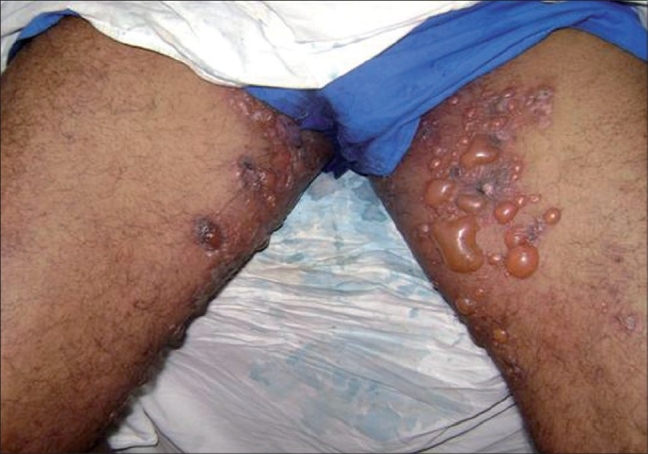
  • Ampolla grande y transparente que contiene líquido y mide > 1 cm de diámetro.
  • Puede ser causada por:
  • Las enfermedades ampollosas autoinmunes clásicas incluyen el pénfigo vulgar y el penfigoide ampolloso.
Hallazgos en penfigoide ampolloso

Hallazgos cutáneos en penfigoide ampolloso:
Múltiples vesículas y ampollas grandes y tensas en la ingle en piel normal a levemente eritematosa

Imagen: “Localized flexural bullous pemphigoid” por Mehta V., Balachandran C. Licencia: CC BY 2.0

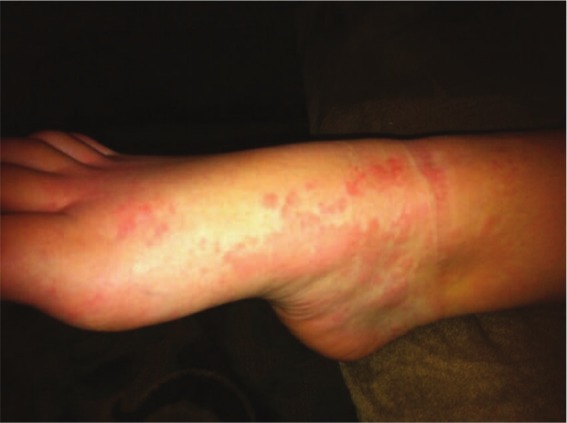
Urticaria (Habón o Ronchas)

  • Lesión bien delimitada y elevada con bordes irregulares:
    • Generalmente eritematosa y puede tener palidez central
    • Formada debido a la extravasación repentina de líquido en EN Erythema nodosum is an immune-mediated panniculitis (inflammation of the subcutaneous fat) caused by a type IV (delayed-type) hypersensitivity reaction. It commonly manifests in young women as tender, erythematous nodules on the shins. Erythema Nodosum la dermis Dermis A layer of vascularized connective tissue underneath the epidermis. The surface of the dermis contains innervated papillae. Embedded in or beneath the dermis are sweat glands; hair follicles; and sebaceous glands. Skin: Structure and Functions
  • Las ronchas son pruriginosas y SIEMPRE desaparecen en EN Erythema nodosum is an immune-mediated panniculitis (inflammation of the subcutaneous fat) caused by a type IV (delayed-type) hypersensitivity reaction. It commonly manifests in young women as tender, erythematous nodules on the shins. Erythema Nodosum 24 horas.
  • Pueden ser causadas por:
    • Hipersensibilidad a medicamentos
    • Picaduras o mordeduras de insectos
    • Condiciones autoinmunes
  • Estímulos físicos (e.g., temperatura, presión, luz solar)
Urticaria

Urticaria

Imagen: “Urticarial Vasculitis in a Teenage Girl” por McGuffin A, Vaughan A, Wolford J. Licencia: CC BY 3.0

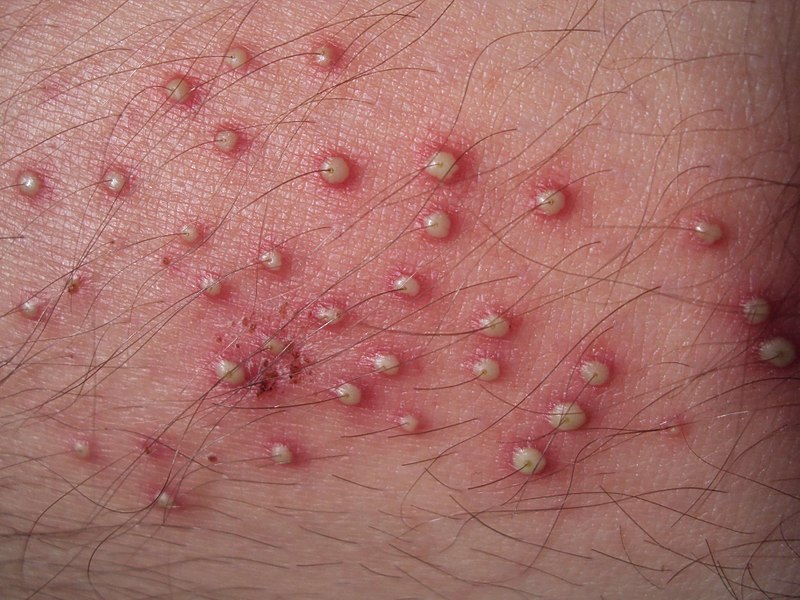
Pústula

  • Una vesícula llena de pus
  • Formada por la acumulación de exudado inflamatorio rico en EN Erythema nodosum is an immune-mediated panniculitis (inflammation of the subcutaneous fat) caused by a type IV (delayed-type) hypersensitivity reaction. It commonly manifests in young women as tender, erythematous nodules on the shins. Erythema Nodosum leucocitos
  • Puede contener bacterias o puede ser estéril
  • Las pústulas son comunes en EN Erythema nodosum is an immune-mediated panniculitis (inflammation of the subcutaneous fat) caused by a type IV (delayed-type) hypersensitivity reaction. It commonly manifests in young women as tender, erythematous nodules on the shins. Erythema Nodosum:
    • Foliculitis
    • Psoriasis Psoriasis Psoriasis is a common T-cell-mediated inflammatory skin condition. The etiology is unknown, but is thought to be due to genetic inheritance and environmental triggers. There are 4 major subtypes, with the most common form being chronic plaque psoriasis. Psoriasis pustulosa
    • Escabiosis
    • Acné
Ejemplo de foliculitis

Foliculitis bacteriana en la parte inferior de la pierna que se presenta como pústulas foliculares

Imagen: “Folliculitis on lower leg” por Da pacem Domine. Licencia: Dominio Público

Telangiectasia

  • También conocidas como “arañas vasculares”
  • Aparecen como líneas rojas finas y brillantes o con un patrón similar a una red
  • Representan una dilatación de los LOS Neisseria capilares que palidecen con la presión.
  • No elevadas y a menudo se encuentran en EN Erythema nodosum is an immune-mediated panniculitis (inflammation of the subcutaneous fat) caused by a type IV (delayed-type) hypersensitivity reaction. It commonly manifests in young women as tender, erythematous nodules on the shins. Erythema Nodosum la cara, el tronco y alrededor del lecho ungueal.
  • Las telangiectasias Telangiectasias Ataxia-telangiectasia ocurren en EN Erythema nodosum is an immune-mediated panniculitis (inflammation of the subcutaneous fat) caused by a type IV (delayed-type) hypersensitivity reaction. It commonly manifests in young women as tender, erythematous nodules on the shins. Erythema Nodosum:
    • Síndrome CREST ( calcinosis Calcinosis Pathologic deposition of calcium salts in tissues. Scleroderma, fenómeno de Raynaud, dismotilidad esofágica, esclerodactilia y telangiectasia Telangiectasia Permanent dilation of preexisting blood vessels creating small focal red lesions, most commonly in the skin or mucous membranes. It is characterized by the prominence of skin blood vessels, such as vascular spiders. Chronic Venous Insufficiency)
    • Dermatomiositis
    • Esclerosis sistémica
    • Ataxia Ataxia Impairment of the ability to perform smoothly coordinated voluntary movements. This condition may affect the limbs, trunk, eyes, pharynx, larynx, and other structures. Ataxia may result from impaired sensory or motor function. Sensory ataxia may result from posterior column injury or peripheral nerve diseases. Motor ataxia may be associated with cerebellar diseases; cerebral cortex diseases; thalamic diseases; basal ganglia diseases; injury to the red nucleus; and other conditions. Ataxia-telangiectasia telangiectasia Telangiectasia Permanent dilation of preexisting blood vessels creating small focal red lesions, most commonly in the skin or mucous membranes. It is characterized by the prominence of skin blood vessels, such as vascular spiders. Chronic Venous Insufficiency
    • Cánceres de piel
Telangiectasias nasales

Telangiectasias nasales:
a: Telangiectasias (flechas)
b: Después del tratamiento con cauterio

Imagen: “Management of Facial Telangiectasias with Hand Cautery” por E Liapakis I, Englander M, Sinani R, I Paschalis E. Licencia: CC BY 3.0

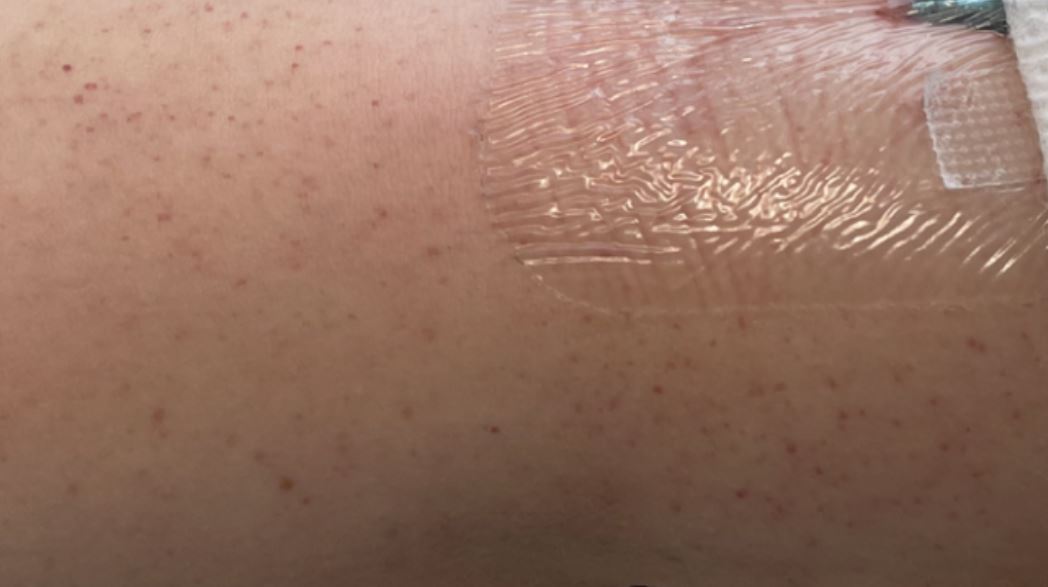
Petequias

  • Focos punteados de hemorragia (que se ven como pequeñas manchas rojas, moradas o marrones) que miden < 3 mm de tamaño
  • Las petequias se ven en EN Erythema nodosum is an immune-mediated panniculitis (inflammation of the subcutaneous fat) caused by a type IV (delayed-type) hypersensitivity reaction. It commonly manifests in young women as tender, erythematous nodules on the shins. Erythema Nodosum el marco de:
    • Trombocitopenia
    • Disfunción plaquetaria
    • Vasculitis Vasculitis Inflammation of any one of the blood vessels, including the arteries; veins; and rest of the vasculature system in the body. Systemic Lupus Erythematosus
    • Infecciones (e.g., meningococemia, fiebre maculosa de las Montañas Rocosas)
Petequias alrededor del sitio intravenoso

Petequias alrededor del sitio intravenoso

Imagen por Jeremy Greer, MD (Lecturio).
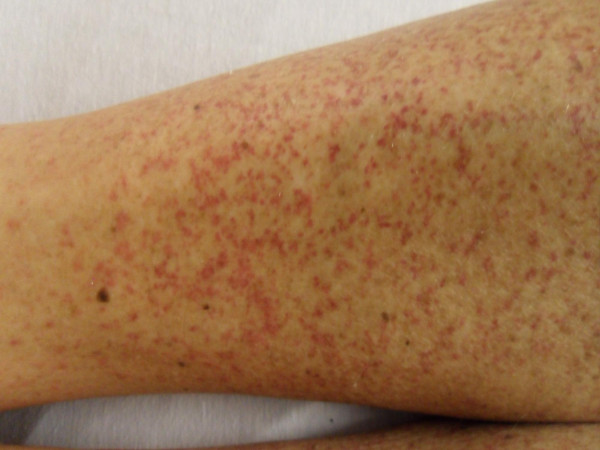
Púrpura

  • Extravasación de eritrocitos de los LOS Neisseria vasos cutáneos en EN Erythema nodosum is an immune-mediated panniculitis (inflammation of the subcutaneous fat) caused by a type IV (delayed-type) hypersensitivity reaction. It commonly manifests in young women as tender, erythematous nodules on the shins. Erythema Nodosum la piel y las membranas mucosas:
    • Usualmente palpable y sin palidez a la diascopia
    • Por lo general, de color rojo, morado o incluso azul
  • La púrpura se observa en EN Erythema nodosum is an immune-mediated panniculitis (inflammation of the subcutaneous fat) caused by a type IV (delayed-type) hypersensitivity reaction. It commonly manifests in young women as tender, erythematous nodules on the shins. Erythema Nodosum vasculitis Vasculitis Inflammation of any one of the blood vessels, including the arteries; veins; and rest of the vasculature system in the body. Systemic Lupus Erythematosus leucocitoclástica (p. ej., vasculitis Vasculitis Inflammation of any one of the blood vessels, including the arteries; veins; and rest of the vasculature system in the body. Systemic Lupus Erythematosus por IgA IgA Represents 15-20% of the human serum immunoglobulins, mostly as the 4-chain polymer in humans or dimer in other mammals. Secretory iga is the main immunoglobulin in secretions. Immunoglobulins: Types and Functions y poliarteritis nodosa).
  • Una gran área de púrpura puede llamarse equimosis.
Petequias o púrpura en el miembro inferior

Petequias/púrpura en el miembro inferior visto en la púrpura de Henoch-Schöenlein

Imagen: “Henoch-Schönlein Purpura in an older man presenting as rectal bleeding and IgA mesangioproliferative glomerulonephritis: A case report” por Cheungpasitporn W, Jirajariyavej T, Howarth CB, Rosen RM. Licencia: CC BY 2.0

Abordaje para el Diagnóstico de las Enfermedades de la Piel

Antecedentes médicos completos

  • Afecciones subyacentes (e.g., trastornos autoinmunes, diabetes Diabetes Diabetes mellitus (DM) is a metabolic disease characterized by hyperglycemia and dysfunction of the regulation of glucose metabolism by insulin. Type 1 DM is diagnosed mostly in children and young adults as the result of autoimmune destruction of β cells in the pancreas and the resulting lack of insulin. Type 2 DM has a significant association with obesity and is characterized by insulin resistance. Diabetes Mellitus)
  • Síntomas acompañantes (e.g., ardor, prurito)
  • Medicamentos
  • Alergias
  • Evolución y duración de las lesiones cutáneas y factores agravantes y atenuantes
  • Antecedentes sociales, sexuales y de viajes

Examen físico

Se debe realizar un examen físico general así como un examen dermatológico dirigido:

  • Piel y sus anexos, así como membranas mucosas
  • Realizado a simple vista y utilizando un dermatoscopio

Características de la piel y afecciones y/o lesiones de la piel comúnmente asociadas a tener en EN Erythema nodosum is an immune-mediated panniculitis (inflammation of the subcutaneous fat) caused by a type IV (delayed-type) hypersensitivity reaction. It commonly manifests in young women as tender, erythematous nodules on the shins. Erythema Nodosum cuenta:
  • Textura:
    • Elevada: pápula, placa, nódulo, quiste, roncha
    • Deprimida: úlcera, atrofia.
    • Plana: mácula, parche
    • Llena de líquido: vesícula, bulla Bulla Blister filled with fluid, > 1 cm diameter Generalized and Localized Rashes, forúnculo, pústula y absceso
  • Morfología:
    • En EN Erythema nodosum is an immune-mediated panniculitis (inflammation of the subcutaneous fat) caused by a type IV (delayed-type) hypersensitivity reaction. It commonly manifests in young women as tender, erythematous nodules on the shins. Erythema Nodosum forma de cúpula: hemangioma Hemangioma A vascular anomaly due to proliferation of blood vessels that forms a tumor-like mass. The common types involve capillaries and veins. It can occur anywhere in the body but is most frequently noticed in the skin and subcutaneous tissue. Imaging of the Liver and Biliary Tract
    • De superficie plana: verruga plana
    • Umbilicada: molusco contagioso
    • Acuminada: condilomas acuminados
    • Verrugosa: verruga vulgar
    • Pedunculada: acrocordones (fibromas blandos)
  • Diámetro: varía dependiendo de la condición
  • Composición: estructuras llenas de líquido, llenas de pus, llenas de sangre o sólidas
  • Bordes: regulares o irregulares, planos o elevados
  • Color: hipopigmentada, hiperpigmentada o eritematosa
  • Disposición: agrupada (herpetiforme)/dispersa
  • Configuración:
    • Anular: tinea corporis Tinea corporis Dermatophytes/Tinea Infections, granuloma anular
    • Redonda/discoide/numular: eccema, lupus discoide
    • Policíclica: urticaria Urticaria Urticaria is raised, well-circumscribed areas (wheals) of edema (swelling) and erythema (redness) involving the dermis and epidermis with associated pruritus (itch). Urticaria is not a single disease but rather is a reaction pattern representing cutaneous mast cell degranulation. Urticaria (Hives)
    • Arqueada: urticaria Urticaria Urticaria is raised, well-circumscribed areas (wheals) of edema (swelling) and erythema (redness) involving the dermis and epidermis with associated pruritus (itch). Urticaria is not a single disease but rather is a reaction pattern representing cutaneous mast cell degranulation. Urticaria (Hives)
    • Lineal: sarna madriguera, liquen nitidus
    • Reticular: livedo reticularis Livedo reticularis A condition characterized by a reticular or fishnet pattern on the skin of lower extremities and other parts of the body. This red and blue pattern is due to deoxygenated blood in unstable dermal blood vessels. The condition is intensified by cold exposure and relieved by rewarming. Chronic Kidney Disease
    • Serpiginosa: larva migrans cutánea
    • Lesiones en EN Erythema nodosum is an immune-mediated panniculitis (inflammation of the subcutaneous fat) caused by a type IV (delayed-type) hypersensitivity reaction. It commonly manifests in young women as tender, erythematous nodules on the shins. Erythema Nodosum diana: eritema multiforme
    • Verticilada: incontinentia pigmenti
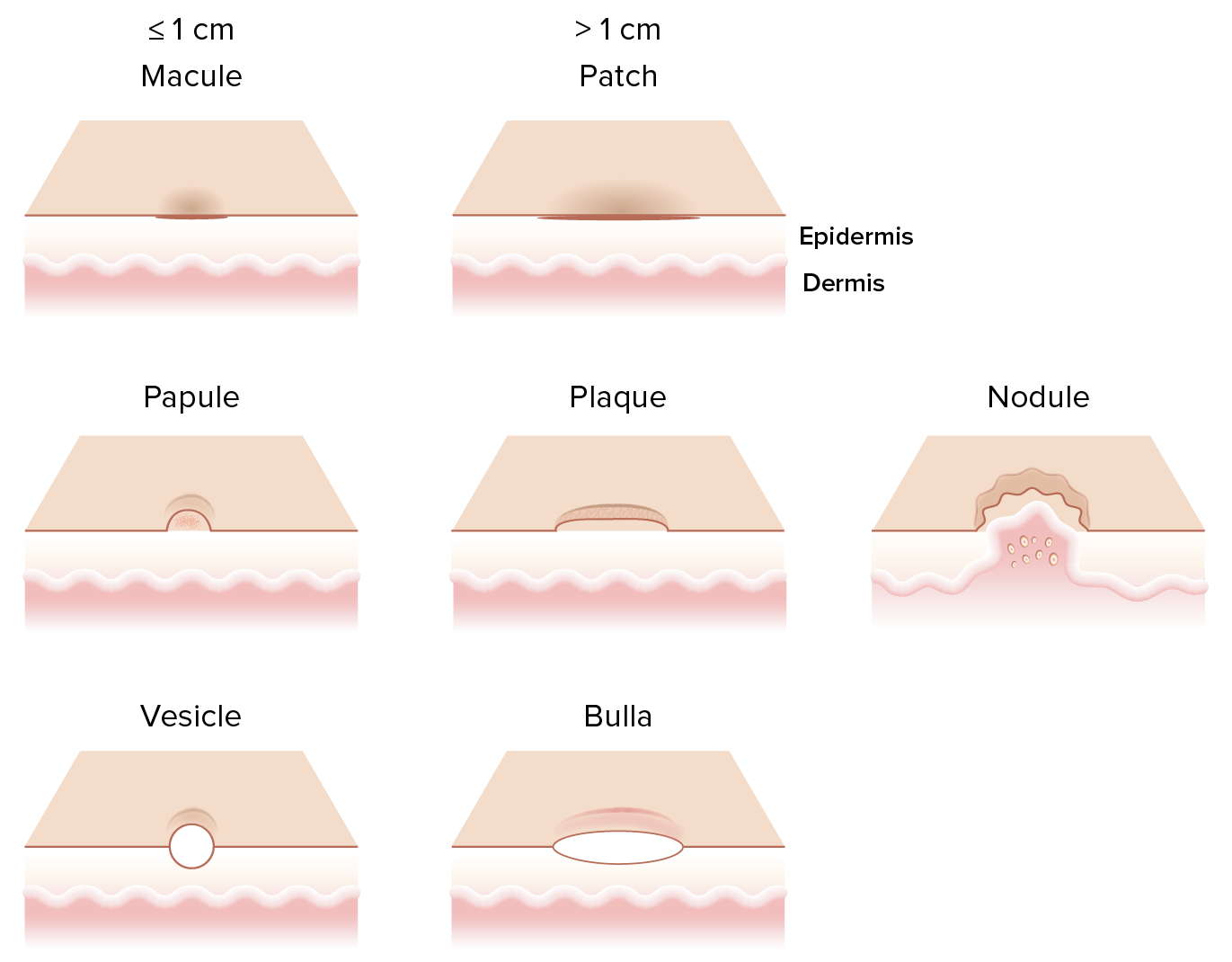
Primary skin lesions

Diferentes lesiones cutáneas primarias:
Una mácula es una lesión cutánea plana y no palpable ≤ 1 cm.
Una pápula es una lesión cutánea elevada y palpable ≤ 1 cm. Un nódulo es una lesión cutánea de 1-5 cm elevada, grande y firme que generalmente se extiende hacia la dermis y el tejido celular subcutáneo Una placa es una lesión cutánea elevada que mide > 1 cm que sufre cambios mientras surge de la epidermis. Una vesícula es una lesión cutánea pequeña de ≤1 cm que contiene líquido mientras que la bulla es una lesión >1 cm con contenido transparente.


Imagen por Lecturio.

Procedimientos diagnósticos

  • Biopsia de piel (lesión extirpada, saucerizada u obtenida por biopsia con sacabocados)
  • Preparación de KOH:
    • Raspado de la lesión y este es colocado en EN Erythema nodosum is an immune-mediated panniculitis (inflammation of the subcutaneous fat) caused by a type IV (delayed-type) hypersensitivity reaction. It commonly manifests in young women as tender, erythematous nodules on the shins. Erythema Nodosum un portaobjetos de vidrio, donde se trata con 1 o 2 gotas de KOH al AL Amyloidosis 10%–20%
    • Si se sospecha de infección micotica
  • Frotis de Tzanck: técnica citológica cuando se observan condiciones vesiculares (infecciones por herpes simple o varicela zóster)
  • Diascopia: para determinar si una lesión palidecerá con la presión, diferenciando una hemorrágica (no palidece) de una lesión llena de líquido
  • Luz de Wood:
    • Utiliza luz ultravioleta de 360 nm para evaluar lesiones
    • Condiciones: eritrasma (color rosa coral), infecciones de heridas por Pseudomonas Pseudomonas Pseudomonas is a non-lactose-fermenting, gram-negative bacillus that produces pyocyanin, which gives it a characteristic blue-green color. Pseudomonas is found ubiquitously in the environment, as well as in moist reservoirs, such as hospital sinks and respiratory equipment. Pseudomonas (azul), vitíligo (blanco)
  • Prueba de parche: se colocan alérgenos en EN Erythema nodosum is an immune-mediated panniculitis (inflammation of the subcutaneous fat) caused by a type IV (delayed-type) hypersensitivity reaction. It commonly manifests in young women as tender, erythematous nodules on the shins. Erythema Nodosum la espalda del paciente bajo apósitos oclusivos y se comprueba si hay reacciones de hipersensibilidad después de 48 horas.

Referencias

  1. Yancey, K.B., Lawley, T.J. (2018). Approach to the patient with a skin disorder. In Jameson, J., et al. (Eds.). Harrison’s Principles of Internal Medicine, 20e. McGraw-Hill.

¡Crea tu cuenta gratis o inicia una sesión para seguir leyendo!

Regístrate ahora y obtén acceso gratuito a Lecturio con páginas de concepto, videos médicos y cuestionarios para tu educación médica.

User Reviews

Que tengas una sesión de estudio alegre y navideña 🎁 Ahorra 50% en todos los planes >>

Details