Domina Conceptos Médicos

Estudia para la escuela de medicina y tus examenes con Lecturio.

Medicamentos Antirreumáticos Modificadores de la Enfermedad

Los LOS Neisseria medicamentos antirreumáticos modificadores de la enfermedad son medicamentos antiinflamatorios que se utilizan para tratar la artritis reumatoide. Los LOS Neisseria medicamentos retrasan, pero no curan, la progresión de la enfermedad. Los LOS Neisseria medicamentos se clasifican como agentes sintéticos o biológicos y cada uno tiene mecanismos de acción y efectos secundarios únicos. Los LOS Neisseria efectos secundarios comunes entre los LOS Neisseria medicamentos antirreumáticos modificadores de la enfermedad incluyen supresión de la medula ósea y hepatotoxicidad. La leflunomida, el metotrexato y los LOS Neisseria inhibidores del factor de necrosis Necrosis The death of cells in an organ or tissue due to disease, injury or failure of the blood supply. Ischemic Cell Damage tumoral ( TNF TNF Tumor necrosis factor (TNF) is a major cytokine, released primarily by macrophages in response to stimuli. The presence of microbial products and dead cells and injury are among the stimulating factors. This protein belongs to the TNF superfamily, a group of ligands and receptors performing functions in inflammatory response, morphogenesis, and cell proliferation. Tumor Necrosis Factor (TNF))-ɑ se deben evitar durante el embarazo debido a su potencial teratogénico. La hidroxicloroquina y la sulfasalazina son seguras para su uso durante el embarazo.

Last updated: Dec 15, 2025

Editorial responsibility: Stanley Oiseth, Lindsay Jones, Evelin Maza

Descripción General de los Medicamentos Antirreumáticos

Definición

Los LOS Neisseria medicamentos antirreumáticos se utilizan para tratar la artritis reumatoide al AL Amyloidosis retrasar la progresión de la enfermedad.

Indicaciones generales

Se administran medicamentos antirreumáticos para:

  • Artritis reumatoide
  • Psoriasis Psoriasis Psoriasis is a common T-cell-mediated inflammatory skin condition. The etiology is unknown, but is thought to be due to genetic inheritance and environmental triggers. There are 4 major subtypes, with the most common form being chronic plaque psoriasis. Psoriasis
  • Artritis psoriásica
  • Lupus eritematoso sistémico y condiciones vasculíticas
  • Artritis idiopática juvenil
  • Colitis Colitis Inflammation of the colon section of the large intestine, usually with symptoms such as diarrhea (often with blood and mucus), abdominal pain, and fever. Pseudomembranous Colitis ulcerosa
  • Enfermedad de Crohn
  • Espondilitis anquilosante

Clasificación

  • Medicamentos sintéticos:
    • Leflunomida
    • Metotrexato
    • Sulfasalazina
    • Hidroxicloroquina
  • Agentes biológicos: inhibidores del factor de necrosis Necrosis The death of cells in an organ or tissue due to disease, injury or failure of the blood supply. Ischemic Cell Damage tumoral ( TNF TNF Tumor necrosis factor (TNF) is a major cytokine, released primarily by macrophages in response to stimuli. The presence of microbial products and dead cells and injury are among the stimulating factors. This protein belongs to the TNF superfamily, a group of ligands and receptors performing functions in inflammatory response, morphogenesis, and cell proliferation. Tumor Necrosis Factor (TNF))-ɑ

Leflunomida

Tabla: Leflunomida
Mecanismo de acción
  • Inhibe la dihidroorotato deshidrogenasa
  • Interrumpe la síntesis de novo de pirimidinas.
  • Inhibe la proliferación de células inmunes
Efectos fisiológicos
  • Efecto antiinflamatorio
  • Efecto antiproliferativo
Metabolismo
  • Conversión hepática en EN Erythema nodosum is an immune-mediated panniculitis (inflammation of the subcutaneous fat) caused by a type IV (delayed-type) hypersensitivity reaction. It commonly manifests in young women as tender, erythematous nodules on the shins. Erythema Nodosum metabolito activo (teriflunomida)
  • Metabolismo posterior en EN Erythema nodosum is an immune-mediated panniculitis (inflammation of the subcutaneous fat) caused by a type IV (delayed-type) hypersensitivity reaction. It commonly manifests in young women as tender, erythematous nodules on the shins. Erythema Nodosum metabolitos inactivos
Eliminación
  • Tiempo de concentración máxima: 6–12 horas
  • Vida media: 18–19 días
Indicaciones específicas
  • Artritis reumatoide
  • Artritis psoriásica
Contraindicaciones específicas
  • Deterioro hepático grave
  • Anafilaxia previa
Complicaciones/efectos secundarios
  • Cefalea
  • Erupción cutánea
  • Diarrea
  • Supresión de medula ósea con pancitopenia
  • Hepatotoxicidad
  • Teratogenicidad
  • Se debe realizar una prueba de embarazo antes de comenzar el tratamiento con leflunomida para descartar un embarazo y se debe aconsejar el uso de métodos anticonceptivos eficaces durante el tratamiento con leflunomida.

Metotrexato

Tabla: Metotrexato
Mecanismo de acción
  • Análogo del folato
  • Inhibe la DHF:
    • ↓ Conversión de DHF en EN Erythema nodosum is an immune-mediated panniculitis (inflammation of the subcutaneous fat) caused by a type IV (delayed-type) hypersensitivity reaction. It commonly manifests in young women as tender, erythematous nodules on the shins. Erythema Nodosum THF
    • ↓ Síntesis de pirimidinas y purinas
    • ↓ Proliferación de células inmunes
Efectos fisiológicos
  • Inmunosupresor
Metabolismo
  • Inicio de acción: 3–6 semanas
  • Tiempo de concentración máxima: 0,75–6 horas
Eliminación
  • Vida media:
    • Niños: 0,75–5,8 horas
    • Adultos: 3–15 horas (la vía intravenosa (IV) tiene una vida media mayor que la oral)
Indicaciones específicas
  • Enfermedades neoplásicas tratadas con metotrexato:
    • Leucemia (e.g., leucemia linfoblástica aguda)
    • Linfoma
    • Sarcoma
    • Coriocarcinoma
  • Enfermedades no neoplásicas tratadas con metotrexato:
    • Artritis reumatoide
    • Aborto médico (junto con misoprostol Misoprostol A synthetic analog of natural prostaglandin e1. It produces a dose-related inhibition of gastric acid and pepsin secretion, and enhances mucosal resistance to injury. It is an effective anti-ulcer agent and also has oxytocic properties. Eicosanoids)
    • Embarazo ectópico
    • Enfermedad inflamatoria intestinal
    • Vasculitis Vasculitis Inflammation of any one of the blood vessels, including the arteries; veins; and rest of the vasculature system in the body. Systemic Lupus Erythematosus
Contraindicaciones específicas
  • Lactancia materna o embarazo
  • Antecedente de anafilaxia
  • Alcoholismo
  • Enfermedad crónica del hígado
  • Inmunodeficiencia
  • Discrasia sanguínea (e.g., anemia Anemia Anemia is a condition in which individuals have low Hb levels, which can arise from various causes. Anemia is accompanied by a reduced number of RBCs and may manifest with fatigue, shortness of breath, pallor, and weakness. Subtypes are classified by the size of RBCs, chronicity, and etiology. Anemia: Overview and Types grave)
Complicaciones/efectos secundarios
  • Supresión de medula ósea con pancitopenia:
    • Reversible con rescate de leucovorina (ácido folínico)
    • Las dosis altas de metotrexato deben seguirse con leucovorina.
  • Hepatotoxicidad
  • Estomatitis
  • Fibrosis Fibrosis Any pathological condition where fibrous connective tissue invades any organ, usually as a consequence of inflammation or other injury. Bronchiolitis Obliterans pulmonar
  • Nefrotoxicidad
  • Teratogenicidad
DHF: dihidrofolato
THF: tetrahidrofolato
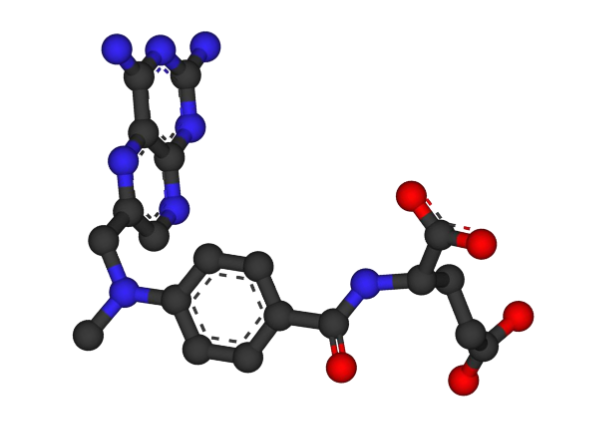
Estructura del metotrexato Fármacos antirreumáticos modificadores de la enfermedad

Estructura del metotrexato: un medicamento que se usa para tratar el cáncer y, como medicamento inmunosupresor, para afecciones como la artritis reumatoide.

Imagen por Lecturio. Licencia: CC BY-NC-SA 4.0

Sulfasalazina

Tabla: Sulfasalazina
Mecanismo de acción
  • Se descompone en EN Erythema nodosum is an immune-mediated panniculitis (inflammation of the subcutaneous fat) caused by a type IV (delayed-type) hypersensitivity reaction. It commonly manifests in young women as tender, erythematous nodules on the shins. Erythema Nodosum sulfapiridina y mesalamina por las bacterias del colon Colon The large intestines constitute the last portion of the digestive system. The large intestine consists of the cecum, appendix, colon (with ascending, transverse, descending, and sigmoid segments), rectum, and anal canal. The primary function of the colon is to remove water and compact the stool prior to expulsion from the body via the rectum and anal canal. Colon, Cecum, and Appendix: Anatomy.
  • El 5-ASA (también llamado mesalamina) inhibe la producción de prostaglandinas inflamatorias
  • Suprime el TNF-ɑ e IL-1
Metabolismo
  • Se convierte en EN Erythema nodosum is an immune-mediated panniculitis (inflammation of the subcutaneous fat) caused by a type IV (delayed-type) hypersensitivity reaction. It commonly manifests in young women as tender, erythematous nodules on the shins. Erythema Nodosum el colon Colon The large intestines constitute the last portion of the digestive system. The large intestine consists of the cecum, appendix, colon (with ascending, transverse, descending, and sigmoid segments), rectum, and anal canal. The primary function of the colon is to remove water and compact the stool prior to expulsion from the body via the rectum and anal canal. Colon, Cecum, and Appendix: Anatomy en EN Erythema nodosum is an immune-mediated panniculitis (inflammation of the subcutaneous fat) caused by a type IV (delayed-type) hypersensitivity reaction. It commonly manifests in young women as tender, erythematous nodules on the shins. Erythema Nodosum sulfapiridina y 5-ASA para su absorción.
Eliminación
  • Vida media promedio de eliminación: 7,5 horas
  • Tiempo promedio de concentración máxima: 6 horas
Indicaciones específicas
  • Artritis reumatoide juvenil
  • Artritis reumatoide
  • Colitis Colitis Inflammation of the colon section of the large intestine, usually with symptoms such as diarrhea (often with blood and mucus), abdominal pain, and fever. Pseudomembranous Colitis ulcerosa
Contraindicaciones específicas
  • Hipersensibilidad conocida
  • Obstrucción
  • Porfiria
Complicaciones/efectos adversos
  • Anafilaxia
  • Hepatotoxicidad
  • Estomatitis
  • Oligospermia reversible
  • Anemia Anemia Anemia is a condition in which individuals have low Hb levels, which can arise from various causes. Anemia is accompanied by a reduced number of RBCs and may manifest with fatigue, shortness of breath, pallor, and weakness. Subtypes are classified by the size of RBCs, chronicity, and etiology. Anemia: Overview and Types hemolítica
5-ASA: ácido 5-aminosalicílico
TNF: factor de necrosis tumoral
IL-1: interleuquina-1

Hidroxicloroquina

Tabla: Hidroxicloroquina
Mecanismo de acción
  • Altera las vacuolas digestivas:
    • Aumenta el pH pH The quantitative measurement of the acidity or basicity of a solution. Acid-Base Balance.
    • Interfiere con la degradación lisosomal de la hemoglobina.
Efectos fisiológicos
  • Suprime el TNF-ɑ e IL-1.
  • Disminuye la inflamación.
Metabolismo La absorción es incompleta.
Eliminación
  • Eliminada por los LOS Neisseria riñones, excretada en EN Erythema nodosum is an immune-mediated panniculitis (inflammation of the subcutaneous fat) caused by a type IV (delayed-type) hypersensitivity reaction. It commonly manifests in young women as tender, erythematous nodules on the shins. Erythema Nodosum la orina.
  • Vida media de eliminación: 40 días
Indicaciones específicas
  • Lupus
  • Malaria Malaria Malaria is an infectious parasitic disease affecting humans and other animals. Most commonly transmitted via the bite of a female Anopheles mosquito infected with microorganisms of the Plasmodium genus. Patients present with fever, chills, myalgia, headache, and diaphoresis. Plasmodium/Malaria
  • Artritis reumatoide
Contraindicaciones específicas Hipersensibilidad conocida
Complicaciones/efectos adversos
  • Retinopatía
  • Prurito en EN Erythema nodosum is an immune-mediated panniculitis (inflammation of the subcutaneous fat) caused by a type IV (delayed-type) hypersensitivity reaction. It commonly manifests in young women as tender, erythematous nodules on the shins. Erythema Nodosum personas de piel oscura
  • Prolongación del intervalo QT con riesgo de torsades de pointes Torsades de pointes A malignant form of polymorphic ventricular tachycardia that is characterized by heart rate between 200 and 250 beats per minute, and QRS complexes with changing amplitude and twisting of the points. The term also describes the syndrome of tachycardia with prolonged ventricular repolarization, long qt intervals exceeding 500 milliseconds or bradycardia. Torsades de pointes may be self-limited or may progress to ventricular fibrillation. Ventricular Tachycardia
TNF: factor de necrosis tumoral
IL-1: interleuquina-1

Inhibidores del TNF-ɑ

Tabla: Inhibidores del TNF-ɑ
Agentes
Mecanismo de acción
  • Desactivan el TNF-ɑ
  • Disminuyen la inflamación.
Indicaciones específicas
  • Artritis reumatoide
  • Enfermedad de Crohn
  • Ciertos cánceres (e.g., infliximab Infliximab A chimeric monoclonal antibody to tnf-alpha that is used in the treatment of rheumatoid arthritis; ankylosing spondylitis; psoriatic arthritis and Crohn’s disease. Disease-Modifying Antirheumatic Drugs (DMARDs) para el cáncer de células renales)
Nota Se debe realizar una prueba cutánea de tuberculina antes de recetar inhibidores del TNF-ɑ.
Complicaciones/efectos adversos
  • Insuficiencia cardíaca
  • Desmielinización
  • Infección
  • Malignidad (linfoma hepatoesplénico de células T)
  • Reactivación de tuberculosis Tuberculosis Tuberculosis (TB) is an infectious disease caused by Mycobacterium tuberculosis complex bacteria. The bacteria usually attack the lungs but can also damage other parts of the body. Approximately 30% of people around the world are infected with this pathogen, with the majority harboring a latent infection. Tuberculosis spreads through the air when a person with active pulmonary infection coughs or sneezes. Tuberculosis
  • Reactivación de infección por HBV HBV Hepatitis B virus (HBV) is a partially double-stranded DNA virus, which belongs to the Orthohepadnavirus genus and the Hepadnaviridae family. Hepatitis B virus is transmitted by exposure to infectious blood or body fluids. Examples of types of exposure include sexual intercourse, IV drug use, and childbirth. Hepatitis B Virus
  • Lupus inducido por medicamentos ( etanercept Etanercept A recombinant version of soluble human tnf receptor fused to an IgG Fc fragment that binds specifically to tumor necrosis factor and inhibits its binding with endogenous tnf receptors. It prevents the inflammatory effect of tnf and is used to treat rheumatoid arthritis; psoriatic arthritis and ankylosing spondylitis. Immunosuppressants)
TNF: factor de necrosis tumoral

Comparación de Medicamentos Antirreumáticos

La siguiente tabla compara y contrasta los LOS Neisseria medicamentos antirreumáticos:

Tabla: Medicamentos antirreumáticos modificadores de la enfermedad
Medicamento Mecanismo de acción Efectos secundarios
Leflunomida
  • Inhibe la dihidroorotato deshidrogenasa.
  • Interrumpe la síntesis de novo de pirimidinas.
  • Supresión de medula ósea con pancitopenia
  • Hepatotoxicidad
  • Teratogenicidad
Metotrexato
  • Análogo del folato
  • Inhibe la dihidrofolato reductasa: disminuye la producción de THF.
  • Interrumpe la síntesis de novo de pirimidinas y purinas.
  • Supresión de medula ósea con pancitopenia
  • Hepatotoxicidad
  • Estomatitis
  • Fibrosis Fibrosis Any pathological condition where fibrous connective tissue invades any organ, usually as a consequence of inflammation or other injury. Bronchiolitis Obliterans pulmonar
  • Nefrotoxicidad
  • Teratogenicidad
Sulfasalazina
  • El 5-ASA (mesalamina) inhibe la producción de prostaglandinas inflamatorias.
  • Suprime el TNF-ɑ e IL-1
  • Alergia a las sulfas
  • Hepatotoxicidad
  • Estomatitis
  • Oligospermia reversible
  • Anemia Anemia Anemia is a condition in which individuals have low Hb levels, which can arise from various causes. Anemia is accompanied by a reduced number of RBCs and may manifest with fatigue, shortness of breath, pallor, and weakness. Subtypes are classified by the size of RBCs, chronicity, and etiology. Anemia: Overview and Types hemolítica
Hidroxicloroquina
  • Suprime el TNF-ɑ e IL-1.
  • Retinopatía
  • Prurito en EN Erythema nodosum is an immune-mediated panniculitis (inflammation of the subcutaneous fat) caused by a type IV (delayed-type) hypersensitivity reaction. It commonly manifests in young women as tender, erythematous nodules on the shins. Erythema Nodosum personas de piel oscura
  • Prolongación del intervalo QT con riesgo de torsades de pointes Torsades de pointes A malignant form of polymorphic ventricular tachycardia that is characterized by heart rate between 200 and 250 beats per minute, and QRS complexes with changing amplitude and twisting of the points. The term also describes the syndrome of tachycardia with prolonged ventricular repolarization, long qt intervals exceeding 500 milliseconds or bradycardia. Torsades de pointes may be self-limited or may progress to ventricular fibrillation. Ventricular Tachycardia
Inhibidores del TNF-ɑ
  • Inactiva el TNF-ɑ
  • Insuficiencia cardíaca
  • Desmielinización
  • Infección
  • Malignidad
  • Reactivación de tuberculosis Tuberculosis Tuberculosis (TB) is an infectious disease caused by Mycobacterium tuberculosis complex bacteria. The bacteria usually attack the lungs but can also damage other parts of the body. Approximately 30% of people around the world are infected with this pathogen, with the majority harboring a latent infection. Tuberculosis spreads through the air when a person with active pulmonary infection coughs or sneezes. Tuberculosis
  • Reactivación de infección por HBV HBV Hepatitis B virus (HBV) is a partially double-stranded DNA virus, which belongs to the Orthohepadnavirus genus and the Hepadnaviridae family. Hepatitis B virus is transmitted by exposure to infectious blood or body fluids. Examples of types of exposure include sexual intercourse, IV drug use, and childbirth. Hepatitis B Virus
  • Lupus inducido por medicamentos ( etanercept Etanercept A recombinant version of soluble human tnf receptor fused to an IgG Fc fragment that binds specifically to tumor necrosis factor and inhibits its binding with endogenous tnf receptors. It prevents the inflammatory effect of tnf and is used to treat rheumatoid arthritis; psoriatic arthritis and ankylosing spondylitis. Immunosuppressants)
TNF: factor de necrosis tumoral
5-ASA: ácido 5-aminosalicílico
IL-1: interleucina-1
HBV: virus de la hepatitis B

Referencias

  1. Lexicomp. Hydroxychloroquine: Drug information. UpToDate. Retrieved May 31, 2021, from https://www.uptodate.com/contents/hydroxychloroquine-drug-information
  2. Kirkham, B. (2020). Tumor necrosis factor-alpha inhibitors: An overview of adverse effects. UpToDate. Retrieved May 31, 2021, from https://www.uptodate.com/contents/tumor-necrosis-factor-alpha-inhibitors-an-overview-of-adverse-effects

¡Crea tu cuenta gratis o inicia una sesión para seguir leyendo!

Regístrate ahora y obtén acceso gratuito a Lecturio con páginas de concepto, videos médicos y cuestionarios para tu educación médica.

User Reviews

Details