Domina Conceptos Médicos

Estudia para la escuela de medicina y tus examenes con Lecturio.

Esplenomegalia

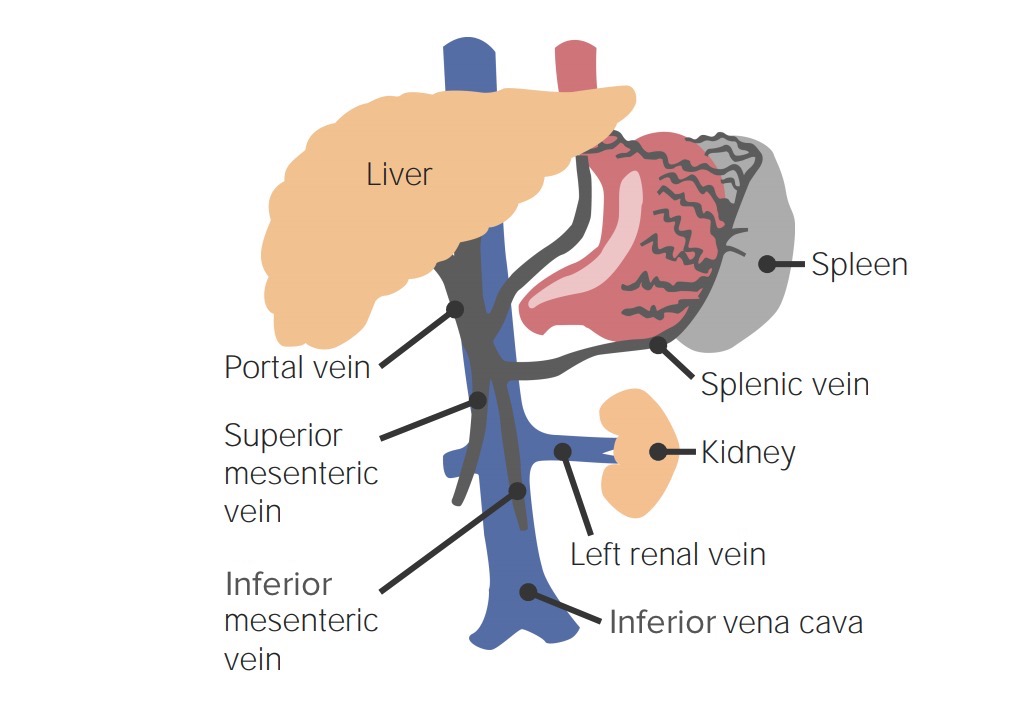
La esplenomegalia es un agrandamiento patológico del bazo atribuible a numerosas causas, como infecciones, hemoglobinopatías, procesos infiltrativos y obstrucción del flujo de salida de la vena porta. Además de los LOS Neisseria riesgos asociados a la patología subyacente, el agrandamiento del bazo expone a los LOS Neisseria individuos afectados a un mayor riesgo de rotura esplénica, una emergencia médica potencialmente mortal que puede provocar un shock Shock Shock is a life-threatening condition associated with impaired circulation that results in tissue hypoxia. The different types of shock are based on the underlying cause: distributive (↑ cardiac output (CO), ↓ systemic vascular resistance (SVR)), cardiogenic (↓ CO, ↑ SVR), hypovolemic (↓ CO, ↑ SVR), obstructive (↓ CO), and mixed. Types of Shock hipovolémico.

Last updated: Dec 15, 2025

Editorial responsibility: Stanley Oiseth, Lindsay Jones, Evelin Maza

Descripción General

El bazo no se considera un órgano vital, ya que el cuerpo puede sobrevivir sin él. Sin embargo, es el órgano linfoide más grande y tiene un papel importante en EN Erythema nodosum is an immune-mediated panniculitis (inflammation of the subcutaneous fat) caused by a type IV (delayed-type) hypersensitivity reaction. It commonly manifests in young women as tender, erythematous nodules on the shins. Erythema Nodosum la inmunidad y la filtración de la sangre.

Definición

Se considera que el bazo está aumentado de tamaño cuando se puede palpar a 2 cm por debajo del reborde costal o cuando las imágenes muestran que su tamaño está por encima de los LOS Neisseria límites superiores de lo normal para la edad.

Fisiología normal

Funciones principales:

  • Filtra la sangre, eliminando las plaquetas y los LOS Neisseria eritrocitos viejos o dañados
  • Actúa como depósito de elementos sanguíneos
  • Filtra y destruye las bacterias encapsuladas que circulan en EN Erythema nodosum is an immune-mediated panniculitis (inflammation of the subcutaneous fat) caused by a type IV (delayed-type) hypersensitivity reaction. It commonly manifests in young women as tender, erythematous nodules on the shins. Erythema Nodosum la sangre
  • Produce linfocitos y sintetiza anticuerpos

La sangre entra en EN Erythema nodosum is an immune-mediated panniculitis (inflammation of the subcutaneous fat) caused by a type IV (delayed-type) hypersensitivity reaction. It commonly manifests in young women as tender, erythematous nodules on the shins. Erythema Nodosum el bazo a través de la arteria esplénica que se ramifica en EN Erythema nodosum is an immune-mediated panniculitis (inflammation of the subcutaneous fat) caused by a type IV (delayed-type) hypersensitivity reaction. It commonly manifests in young women as tender, erythematous nodules on the shins. Erythema Nodosum arteriolas centrales:
  1. Las arteriolas terminan como capilares rodeados de tejido linfático (pulpa blanca).
  2. La pulpa blanca tiene 3 elementos estructurales responsables de la respuesta inmunitaria y de la producción de anticuerpos:
    • Vaina linfocitaria periarteriolar: alberga células T y macrófagos
    • Zona marginal: alberga macrófagos
    • Folículos: albergan células B
  3. La sangre sale de los LOS Neisseria capilares hacia los LOS Neisseria sinusoides y cordones venosos circundantes (pulpa roja).
  4. La pulpa roja es el lugar de almacenamiento de las plaquetas y contiene macrófagos que eliminan los LOS Neisseria eritrocitos dañados o viejos.
  5. Los LOS Neisseria sinusoides drenan en EN Erythema nodosum is an immune-mediated panniculitis (inflammation of the subcutaneous fat) caused by a type IV (delayed-type) hypersensitivity reaction. It commonly manifests in young women as tender, erythematous nodules on the shins. Erythema Nodosum las venas colectoras, que llevan la sangre a la vena esplénica.
  6. La sangre filtrada sale del bazo por la vena esplénica.
  7. La vena esplénica se une a la vena mesentérica superior para formar la vena porta hepática.

Fisiopatología

  • Esplenomegalia: aumento del tamaño del bazo
    • Tres mecanismos generales:
      • Congestión pasiva por compromiso de la vena porta
      • Infiltración
      • Hiperplasia
    • La esplenomegalia puede provocar eventualmente una rotura esplénica.
  • Hiperesplenismo: aumento del funcionamiento del bazo que se produce con o sin agrandamiento del órgano
    • El secuestro de los LOS Neisseria elementos sanguíneos conduce a congestión.
    • La activación del sistema reticuloendotelial provoca trombocitopenia y anemia Anemia Anemia is a condition in which individuals have low Hb levels, which can arise from various causes. Anemia is accompanied by a reduced number of RBCs and may manifest with fatigue, shortness of breath, pallor, and weakness. Subtypes are classified by the size of RBCs, chronicity, and etiology. Anemia: Overview and Types.
    • Mayor riesgo de rotura esplénica
    • Características clínicas:
      • Esplenomegalia
      • Anemia Anemia Anemia is a condition in which individuals have low Hb levels, which can arise from various causes. Anemia is accompanied by a reduced number of RBCs and may manifest with fatigue, shortness of breath, pallor, and weakness. Subtypes are classified by the size of RBCs, chronicity, and etiology. Anemia: Overview and Types
      • Leucopenia
      • Trombocitopenia
      • Pancitopenia
      • Hiperplasia compensatoria de la médula ósea
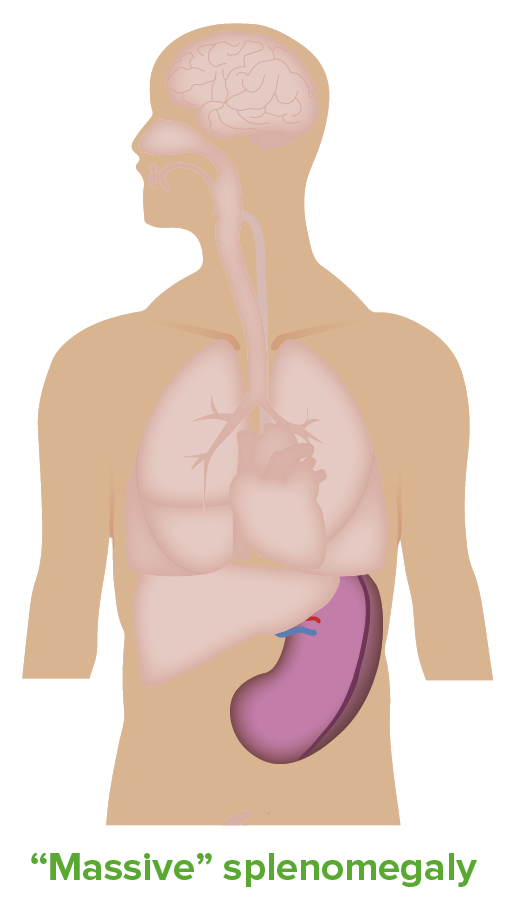
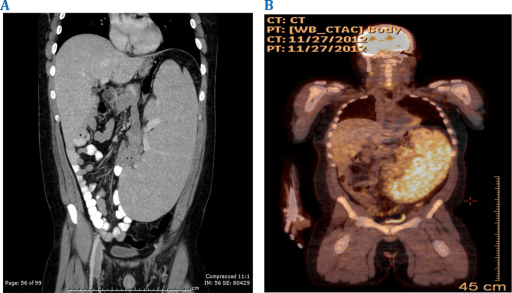
Esplenomegalia masiva

Esplenomegalia:
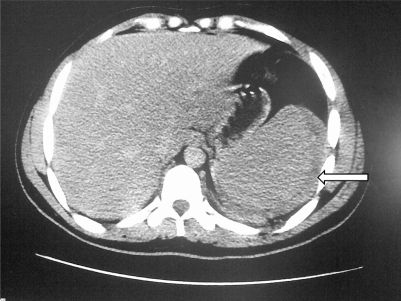
Un bazo agrandado puede identificarse a través de la palpación o puede verse con métodos de imagen avanzados.
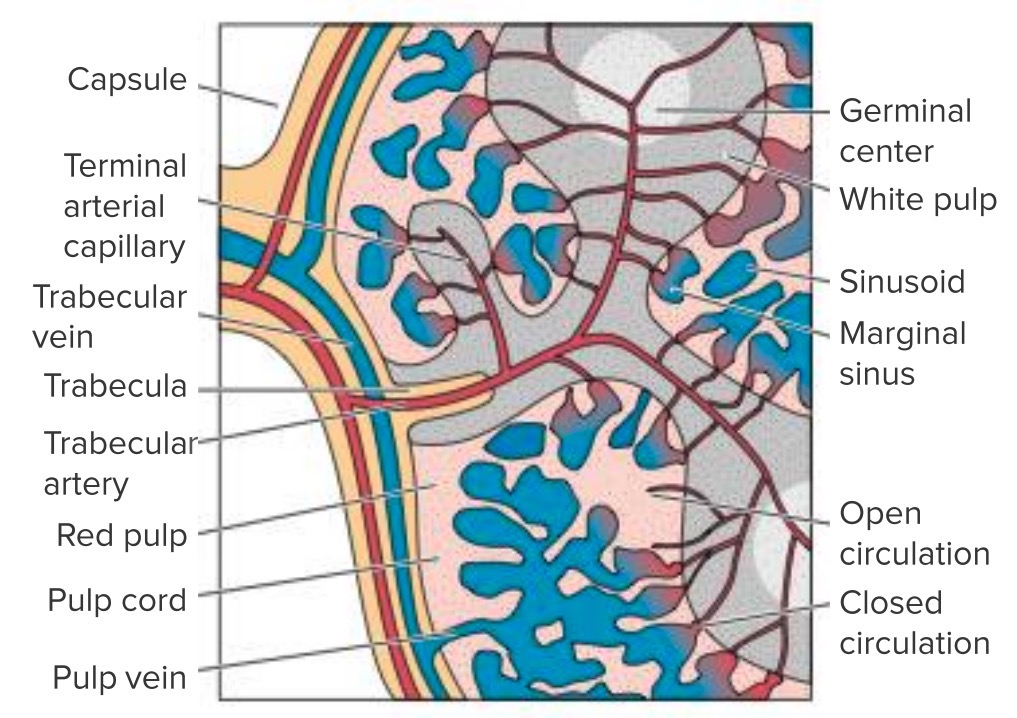
Imagen por Lecturio.

Epidemiología y Etiología

Epidemiología

  • Hasta el 2% de la población estadounidense afectada
  • Ciertas causas subyacentes asociadas a grupos raciales específicos:
    • Enfermedad de células falciformes (afroamericanos)
    • Enfermedades de almacenamiento lisosómico (judíos askenazís)
  • Predisposición geográfica:
    • Zonas con paludismo endémico
    • La esplenomegalia tropical es 2 veces más frecuente en EN Erythema nodosum is an immune-mediated panniculitis (inflammation of the subcutaneous fat) caused by a type IV (delayed-type) hypersensitivity reaction. It commonly manifests in young women as tender, erythematous nodules on the shins. Erythema Nodosum las mujeres
  • Algunas causas son más probables en EN Erythema nodosum is an immune-mediated panniculitis (inflammation of the subcutaneous fat) caused by a type IV (delayed-type) hypersensitivity reaction. It commonly manifests in young women as tender, erythematous nodules on the shins. Erythema Nodosum determinados grupos de edad:
    • Niños: leucemia aguda y enfermedades de almacenamiento
    • Adultos: leucemia crónica

Etiología

  • Hematológicas:
    • Policitemia vera
    • Anemia Anemia Anemia is a condition in which individuals have low Hb levels, which can arise from various causes. Anemia is accompanied by a reduced number of RBCs and may manifest with fatigue, shortness of breath, pallor, and weakness. Subtypes are classified by the size of RBCs, chronicity, and etiology. Anemia: Overview and Types
    • Enfermedad de células falciformes
    • Talasemia
  • Oncológicas:
    • Leucemia:
      • Leucemia Mielocítica Crónica (LMC)
      • Leucemia Linfocítica Crónica (LLC)
    • Linfoma
    • Metástasis
  • Hepáticas:
    • Cirrosis
    • Hipertensión de la vena porta
    • Trombosis de la vena porta o esplénica
    • Insuficiencia cardíaca derecha
  • Enfermedades de almacenamiento:
    • Enfermedad de Gaucher
    • Enfermedad de Niemann-Pick
  • Enfermedades autoinmunes:
    • Sarcoidosis Sarcoidosis Sarcoidosis is a multisystem inflammatory disease that causes noncaseating granulomas. The exact etiology is unknown. Sarcoidosis usually affects the lungs and thoracic lymph nodes, but it can also affect almost every system in the body, including the skin, heart, and eyes, most commonly. Sarcoidosis
    • Lupus eritematoso sistémico (LES)
    • Artritis reumatoide ( AR AR Aortic regurgitation (AR) is a cardiac condition characterized by the backflow of blood from the aorta to the left ventricle during diastole. Aortic regurgitation is associated with an abnormal aortic valve and/or aortic root stemming from multiple causes, commonly rheumatic heart disease as well as congenital and degenerative valvular disorders. Aortic Regurgitation)
  • Infeccioso:
    • Mononucleosis Mononucleosis Infectious mononucleosis (IM), also known as “the kissing disease,” is a highly contagious viral infection caused by the Epstein-Barr virus. Its common name is derived from its main method of transmission: the spread of infected saliva via kissing. Clinical manifestations of IM include fever, tonsillar pharyngitis, and lymphadenopathy. Mononucleosis infecciosa ( EBV EBV Epstein-barr virus (EBV) is a linear, double-stranded DNA virus belonging to the herpesviridae family. This highly prevalent virus is mostly transmitted through contact with oropharyngeal secretions from an infected individual. The virus can infect epithelial cells and B lymphocytes, where it can undergo lytic replication or latency. Epstein-Barr Virus)
    • Malaria Malaria Malaria is an infectious parasitic disease affecting humans and other animals. Most commonly transmitted via the bite of a female Anopheles mosquito infected with microorganisms of the Plasmodium genus. Patients present with fever, chills, myalgia, headache, and diaphoresis. Plasmodium/Malaria
    • Fiebre Tifoidea
    • SIDA
    • Infecciones parasitarias:
      • Leishmaniasis Leishmaniasis Leishmania species are obligate intracellular parasites that are transmitted by an infected sandfly. The mildest form is cutaneous leishmaniasis (CL), characterized by painless skin ulcers. The mucocutaneous type involves more tissue destruction, causing deformities. Visceral leishmaniasis (VL), the most severe form, presents with hepatosplenomegaly, anemia, thrombocytopenia, and fever. Leishmania/Leishmaniasis
      • Esquistosomiasis
    • Septicemia secundaria a bacterias encapsuladas:
      • Streptococcus Streptococcus Streptococcus is one of the two medically important genera of gram-positive cocci, the other being Staphylococcus. Streptococci are identified as different species on blood agar on the basis of their hemolytic pattern and sensitivity to optochin and bacitracin. There are many pathogenic species of streptococci, including S. pyogenes, S. agalactiae, S. pneumoniae, and the viridans streptococci. Streptococcus pneumoniae
      • Neisseria meningitidis Neisseria meningitidis A species of gram-negative, aerobic bacteria. It is a commensal and pathogen only of humans, and can be carried asymptomatically in the nasopharynx. When found in cerebrospinal fluid it is the causative agent of cerebrospinal meningitis. It is also found in venereal discharges and blood. There are at least 13 serogroups based on antigenic differences in the capsular polysaccharides; the ones causing most meningitis infections being a, b, c, y, and w-135. Each serogroup can be further classified by serotype, serosubtype, and immunotype. Neisseria
      • Haemophilus influenzae Haemophilus Influenzae A species of Haemophilus found on the mucous membranes of humans and a variety of animals. The species is further divided into biotypes I through viii. Haemophilus tipo B
  • Genética:
    • Histiocitosis X
    • Amiloidosis (también puede ser adquirida)
  • Estructurales:
    • Quiste(s)
    • Hemangioma Hemangioma A vascular anomaly due to proliferation of blood vessels that forms a tumor-like mass. The common types involve capillaries and veins. It can occur anywhere in the body but is most frequently noticed in the skin and subcutaneous tissue. Imaging of the Liver and Biliary Tract(s)

Related videos

Presentación Clínica

Antecedentes y examen físico

  • Obtenga los LOS Neisseria antecedentes.
  • Examen físico:
    • El paciente debe ser examinado en EN Erythema nodosum is an immune-mediated panniculitis (inflammation of the subcutaneous fat) caused by a type IV (delayed-type) hypersensitivity reaction. It commonly manifests in young women as tender, erythematous nodules on the shins. Erythema Nodosum posición supina.
    • Palpación abdominal:
      • El bazo no debe ser palpable en EN Erythema nodosum is an immune-mediated panniculitis (inflammation of the subcutaneous fat) caused by a type IV (delayed-type) hypersensitivity reaction. It commonly manifests in young women as tender, erythematous nodules on the shins. Erythema Nodosum individuos sanos.
      • Palpación suave por debajo del reborde costal izquierdo
      • Pida al AL Amyloidosis paciente que respire profundamente. Esta maniobra hace HACE Altitude Sickness que el bazo se mueva hacia arriba y hacia abajo, de modo que se lo pueda sentir al AL Amyloidosis presionar por debajo del reborde costal izquierdo.
    • Percusión abdominal: La matidez a la percusión puede revelar la presencia del tejido sólido del bazo.

Sistema de clasificación de Hackett

El grado de esplenomegalia se clasifica de 0 a 5, según el sistema de clasificación de Hackett:

  • Grado 0: bazo normal no palpable
  • Grado 1: bazo palpable solo en EN Erythema nodosum is an immune-mediated panniculitis (inflammation of the subcutaneous fat) caused by a type IV (delayed-type) hypersensitivity reaction. It commonly manifests in young women as tender, erythematous nodules on the shins. Erythema Nodosum inspiración profunda
  • Grado 2: bazo palpable en EN Erythema nodosum is an immune-mediated panniculitis (inflammation of the subcutaneous fat) caused by a type IV (delayed-type) hypersensitivity reaction. It commonly manifests in young women as tender, erythematous nodules on the shins. Erythema Nodosum la línea clavicular media, a mitad de distancia entre el ombligo y el reborde costal
  • Grado 3: El bazo se extiende hasta el ombligo.
  • Grado 4: El bazo sobrepasa el ombligo.
  • Grado 5: El bazo se extiende hacia la sínfisis del pubis.

Causas clasificadas en EN Erythema nodosum is an immune-mediated panniculitis (inflammation of the subcutaneous fat) caused by a type IV (delayed-type) hypersensitivity reaction. It commonly manifests in young women as tender, erythematous nodules on the shins. Erythema Nodosum función del grado de esplenomegalia

El diagnóstico diferencial puede clasificarse en EN Erythema nodosum is an immune-mediated panniculitis (inflammation of the subcutaneous fat) caused by a type IV (delayed-type) hypersensitivity reaction. It commonly manifests in young women as tender, erythematous nodules on the shins. Erythema Nodosum función del grado de esplenomegalia.

Tabla: Causas de esplenomegalia en EN Erythema nodosum is an immune-mediated panniculitis (inflammation of the subcutaneous fat) caused by a type IV (delayed-type) hypersensitivity reaction. It commonly manifests in young women as tender, erythematous nodules on the shins. Erythema Nodosum función del grado de agrandamiento esplénico
Categoría Tamaño del bazo Causas comunes
Masiva > 8 cm por debajo del RCI RCI Quality Measurement and Improvement
  • LMC
  • Policitemia vera
  • Linfoma
  • Mielofibrosis primaria
  • Talasemia
  • Enfermedades de almacenamiento
  • Malaria Malaria Malaria is an infectious parasitic disease affecting humans and other animals. Most commonly transmitted via the bite of a female Anopheles mosquito infected with microorganisms of the Plasmodium genus. Patients present with fever, chills, myalgia, headache, and diaphoresis. Plasmodium/Malaria
  • Infiltración (malignidad)
  • Infección parasitaria
Moderado 5-8 cm por debajo del RCI RCI Quality Measurement and Improvement
  • Insuficiencia cardíaca
  • Cirrosis hepática
  • Hipertensión portal
  • Infección aguda:
    • EBV EBV Epstein-barr virus (EBV) is a linear, double-stranded DNA virus belonging to the herpesviridae family. This highly prevalent virus is mostly transmitted through contact with oropharyngeal secretions from an infected individual. The virus can infect epithelial cells and B lymphocytes, where it can undergo lytic replication or latency. Epstein-Barr Virus
    • Malaria Malaria Malaria is an infectious parasitic disease affecting humans and other animals. Most commonly transmitted via the bite of a female Anopheles mosquito infected with microorganisms of the Plasmodium genus. Patients present with fever, chills, myalgia, headache, and diaphoresis. Plasmodium/Malaria
    • Fiebre Tifoidea
    • Neumococo
    • Meningococo
    • Influenza Influenza Influenza viruses are members of the Orthomyxoviridae family and the causative organisms of influenza, a highly contagious febrile respiratory disease. There are 3 primary influenza viruses (A, B, and C) and various subtypes, which are classified based on their virulent surface antigens, hemagglutinin (HA) and neuraminidase (NA). Influenza typically presents with a fever, myalgia, headache, and symptoms of an upper respiratory infection. Influenza Viruses/Influenza
    • H. influenzae H. influenzae A species of Haemophilus found on the mucous membranes of humans and a variety of animals. The species is further divided into biotypes I through VIII. Haemophilus tipo b
  • Enfermedad de células falciformes
  • LES
  • Tuberculosis Tuberculosis Tuberculosis (TB) is an infectious disease caused by Mycobacterium tuberculosis complex bacteria. The bacteria usually attack the lungs but can also damage other parts of the body. Approximately 30% of people around the world are infected with this pathogen, with the majority harboring a latent infection. Tuberculosis spreads through the air when a person with active pulmonary infection coughs or sneezes. Tuberculosis crónica
Leve <5 cm por debajo del RCI RCI Quality Measurement and Improvement Igual que el moderado
RCI: Reborde costal izquierdo

Diagnóstico

La esplenomegalia es un signo clínico asociado a múltiples causas, más que un diagnóstico. Cuando hay esplenomegalia, los LOS Neisseria pacientes deben ser evaluados adecuadamente para identificar la causa subyacente.
Estudios de laboratorio

  • Hemograma con láminas gruesas y finas de sangre periférica (para malaria Malaria Malaria is an infectious parasitic disease affecting humans and other animals. Most commonly transmitted via the bite of a female Anopheles mosquito infected with microorganisms of the Plasmodium genus. Patients present with fever, chills, myalgia, headache, and diaphoresis. Plasmodium/Malaria)
  • Perfil hepático
  • Serologías para hepatitis viral
  • Tamizaje autoinmune
  • Marcadores inflamatorios
  • Pruebas citogenéticas
  • Cariotipo
  • Biopsia tisular
  • Aspirado de médula ósea

Imagenología

  • Ultrasonido
  • TC
  • RM

Tratamiento

El tratamiento se basa en EN Erythema nodosum is an immune-mediated panniculitis (inflammation of the subcutaneous fat) caused by a type IV (delayed-type) hypersensitivity reaction. It commonly manifests in young women as tender, erythematous nodules on the shins. Erythema Nodosum la causa subyacente y el estado clínico del paciente.

Conservador (tratamiento del trastorno subyacente)

  • Antibióticos (terapéuticos y/o profilácticos)
  • Antimaláricos
  • Quimioterapia
  • Transfusión de sangre o exanguinotransfusión
  • Radioterapia en EN Erythema nodosum is an immune-mediated panniculitis (inflammation of the subcutaneous fat) caused by a type IV (delayed-type) hypersensitivity reaction. It commonly manifests in young women as tender, erythematous nodules on the shins. Erythema Nodosum dosis baja para cuidados paliativos en EN Erythema nodosum is an immune-mediated panniculitis (inflammation of the subcutaneous fat) caused by a type IV (delayed-type) hypersensitivity reaction. It commonly manifests in young women as tender, erythematous nodules on the shins. Erythema Nodosum pacientes con alteraciones hematológicas avanzadas

Esplenectomia

  • Indicado cuando la causa subyacente provoca una esplenomegalia importante
  • Traumatismo y rotura esplénica
  • La vacunación después de la esplenectomía es importante para reducir el riesgo de síndrome de sepsis Sepsis Systemic inflammatory response syndrome with a proven or suspected infectious etiology. When sepsis is associated with organ dysfunction distant from the site of infection, it is called severe sepsis. When sepsis is accompanied by hypotension despite adequate fluid infusion, it is called septic shock. Sepsis and Septic Shock postesplenectomía ( OPSI OPSI Asplenia, por sus siglas en EN Erythema nodosum is an immune-mediated panniculitis (inflammation of the subcutaneous fat) caused by a type IV (delayed-type) hypersensitivity reaction. It commonly manifests in young women as tender, erythematous nodules on the shins. Erythema Nodosum inglés).

Relevancia Clínica

  • Asplenia Asplenia Asplenia is the absence of splenic tissue or function and can stem from several factors ranging from congenital to iatrogenic. There is a distinction between anatomic asplenia, which is due to the surgical removal of the spleen, and functional asplenia, which is due to a condition that leads to splenic atrophy, infarct, congestion, or infiltrative disease. Asplenia: ausencia del bazo. La razón anatómica más común para la asplenia Asplenia Asplenia is the absence of splenic tissue or function and can stem from several factors ranging from congenital to iatrogenic. There is a distinction between anatomic asplenia, which is due to the surgical removal of the spleen, and functional asplenia, which is due to a condition that leads to splenic atrophy, infarct, congestion, or infiltrative disease. Asplenia es la extirpación quirúrgica; solo en EN Erythema nodosum is an immune-mediated panniculitis (inflammation of the subcutaneous fat) caused by a type IV (delayed-type) hypersensitivity reaction. It commonly manifests in young women as tender, erythematous nodules on the shins. Erythema Nodosum raras ocasiones la asplenia Asplenia Asplenia is the absence of splenic tissue or function and can stem from several factors ranging from congenital to iatrogenic. There is a distinction between anatomic asplenia, which is due to the surgical removal of the spleen, and functional asplenia, which is due to a condition that leads to splenic atrophy, infarct, congestion, or infiltrative disease. Asplenia es congénita. Si la asplenia Asplenia Asplenia is the absence of splenic tissue or function and can stem from several factors ranging from congenital to iatrogenic. There is a distinction between anatomic asplenia, which is due to the surgical removal of the spleen, and functional asplenia, which is due to a condition that leads to splenic atrophy, infarct, congestion, or infiltrative disease. Asplenia es congénita, suele estar asociada a una malformación de los LOS Neisseria grandes vasos torácicos. Los LOS Neisseria pacientes asplénicos tienen un alto riesgo de infección por organismos encapsulados y deben ser vacunados contra ellos siempre que sea posible.
  • Mononucleosis: La mononucleosis infecciosa, también conocida como “la enfermedad del beso”, es una enfermedad altamente contagiosa causada por el EBV EBV Epstein-barr virus (EBV) is a linear, double-stranded DNA virus belonging to the herpesviridae family. This highly prevalent virus is mostly transmitted through contact with oropharyngeal secretions from an infected individual. The virus can infect epithelial cells and B lymphocytes, where it can undergo lytic replication or latency. Epstein-Barr Virus. El nombre frecuente de la mononucleosis Mononucleosis Infectious mononucleosis (IM), also known as “the kissing disease,” is a highly contagious viral infection caused by the Epstein-Barr virus. Its common name is derived from its main method of transmission: the spread of infected saliva via kissing. Clinical manifestations of IM include fever, tonsillar pharyngitis, and lymphadenopathy. Mononucleosis proviene de su principal método de transmisión: transferencia de saliva Saliva The clear, viscous fluid secreted by the salivary glands and mucous glands of the mouth. It contains mucins, water, organic salts, and ptyalin. Salivary Glands: Anatomy infectada a través de los LOS Neisseria besos. No hay tratamiento, pero el manejo sintomático suele ser suficiente.
  • Ruptura del bazo: la razón más usual para la ruptura del bazo es un traumatismo abdominal cerrado. Para los LOS Neisseria individuos con esplenomegalia, un traumatismo mínimo es suficiente para provocar una ruptura de la cápsula. Suele ser necesaria una intervención quirúrgica urgente para evitar la pérdida masiva de sangre y el shock Shock Shock is a life-threatening condition associated with impaired circulation that results in tissue hypoxia. The different types of shock are based on the underlying cause: distributive (↑ cardiac output (CO), ↓ systemic vascular resistance (SVR)), cardiogenic (↓ CO, ↑ SVR), hypovolemic (↓ CO, ↑ SVR), obstructive (↓ CO), and mixed. Types of Shock provocado por la rotura esplénica.

Referencias

  1. Chapman, J., Goyal, A., & Azevedo, A. M. (2023). Splenomegaly. In StatPearls [Internet]. U.S. National Library of Medicine. https://www.ncbi.nlm.nih.gov/books/NBK430907/
  2. Aldulaimi, S., & Mendez, A. M. (2021). Splenomegaly: Diagnosis and Management in Adults. American Family Physician, 104(3), 271–276. https://www.aafp.org/pubs/afp/issues/2021/0900/p271.html
  3. Jacob, S. (2008). Chapter 4 – Abdomen. In Human Anatomy (pp. 71–123). Churchill Livingstone. https://doi.org/10.1016/B978-0-443-10373-5.50007-5
  4. Mayo Clinic. (2023). Enlarged spleen (splenomegaly): Diagnosis and treatment. https://www.mayoclinic.org/diseases-conditions/enlarged-spleen/diagnosis-treatment/drc-20354331

¡Crea tu cuenta gratis o inicia una sesión para seguir leyendo!

Regístrate ahora y obtén acceso gratuito a Lecturio con páginas de concepto, videos médicos y cuestionarios para tu educación médica.

User Reviews

Details