
La enfermedad de Whipple es un síndrome de malabsorción infrecuente con manifestaciones sistémicas (neurológicas, cardíacas y musculoesqueléticas) causado por la bacteria Tropheryma whipplei. Los pacientes suelen presentar pérdida de peso, diarrea/esteatorrea y artralgias, así como manifestaciones neurológicas y cardíacas. La enfermedad de Whipple se diagnostica con una biopsia tras la visualización de macrófagos espumosos positivos al ácido periódico de Schiff en EN Erythema nodosum is an immune-mediated panniculitis (inflammation of the subcutaneous fat) caused by a type IV (delayed-type) hypersensitivity reaction. It commonly manifests in young women as tender, erythematous nodules on the shins. Erythema Nodosum los LOS Neisseria tejidos afectados o con PCR PCR Polymerase chain reaction (PCR) is a technique that amplifies DNA fragments exponentially for analysis. The process is highly specific, allowing for the targeting of specific genomic sequences, even with minuscule sample amounts. The PCR cycles multiple times through 3 phases: denaturation of the template DNA, annealing of a specific primer to the individual DNA strands, and synthesis/elongation of new DNA molecules. Polymerase Chain Reaction (PCR) para el ADN bacteriano. Se trata con antibióticos, concretamente ceftriaxona o penicilina G y trimetoprima-sulfametoxazol.
Last updated: Dec 15, 2025
La enfermedad de Whipple es un síndrome de malabsorción con manifestaciones sistémicas que es causado por la infección por Tropheryma Tropheryma A genus of gram-positive bacteria in the family cellulomonadaceae. Whipple’s Disease whipplei.
El agente causante es T. whipplei:
La inmunodeficiencia del huésped ha HA Hemolytic anemia (HA) is the term given to a large group of anemias that are caused by the premature destruction/hemolysis of circulating red blood cells (RBCs). Hemolysis can occur within (intravascular hemolysis) or outside the blood vessels (extravascular hemolysis). Hemolytic Anemia sido implicada en EN Erythema nodosum is an immune-mediated panniculitis (inflammation of the subcutaneous fat) caused by a type IV (delayed-type) hypersensitivity reaction. It commonly manifests in young women as tender, erythematous nodules on the shins. Erythema Nodosum las infecciones sintomáticas.
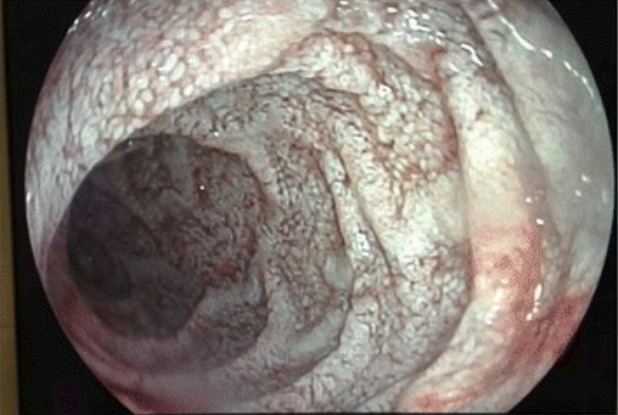
Vista endoscópica de la mucosa yeyunal en la enfermedad de Whipple:
lesiones blancas compatibles con linfangiectasia intestinal difusa
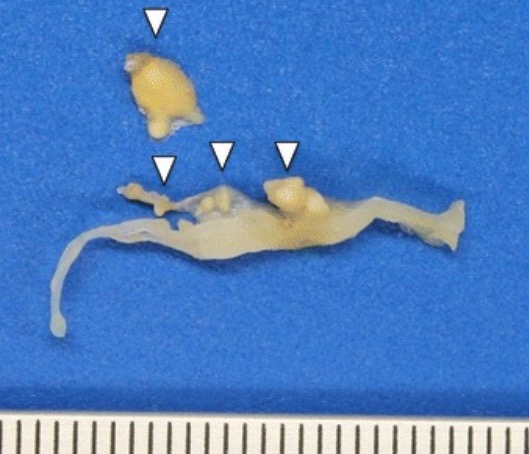
Muestra de válvula mitral infectada por T. whipplei:
sección transversal de la válvula que alberga voluminosas vegetaciones de color amarillo brillante (puntas de flecha), de hasta 6 mm
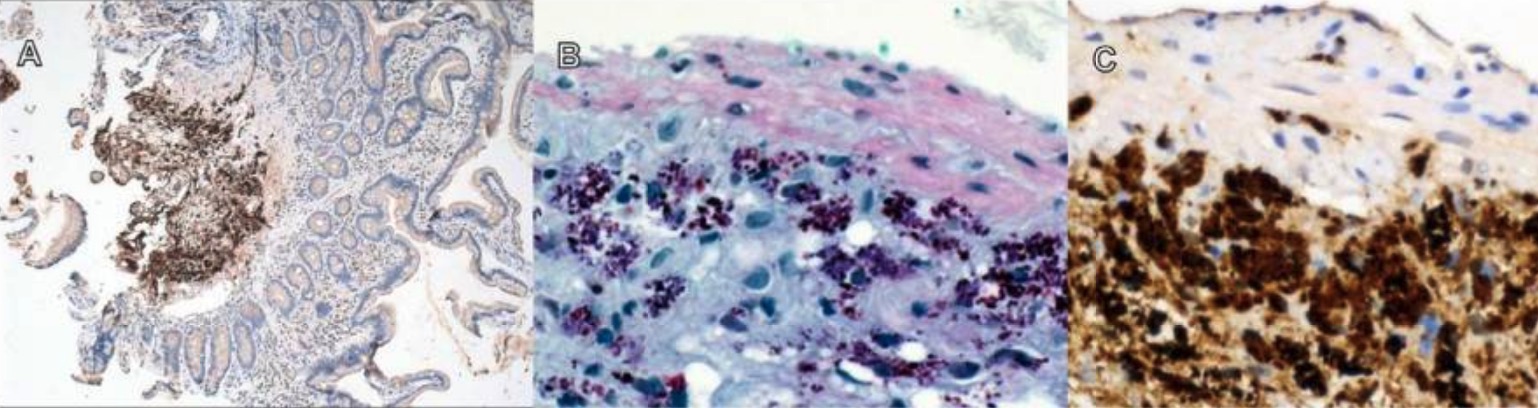
Infección intestinal por T. whipplei:
A: aumento de 40x, inmunotinción de T. whipplei visualizada con hematoxilina
B: aumento de 400x, ácido periódico de Schiff + macrófagos
El pilar del tratamiento son antibióticos: