Domina Conceptos Médicos

Estudia para la escuela de medicina y tus examenes con Lecturio.

Cáncer de Mama

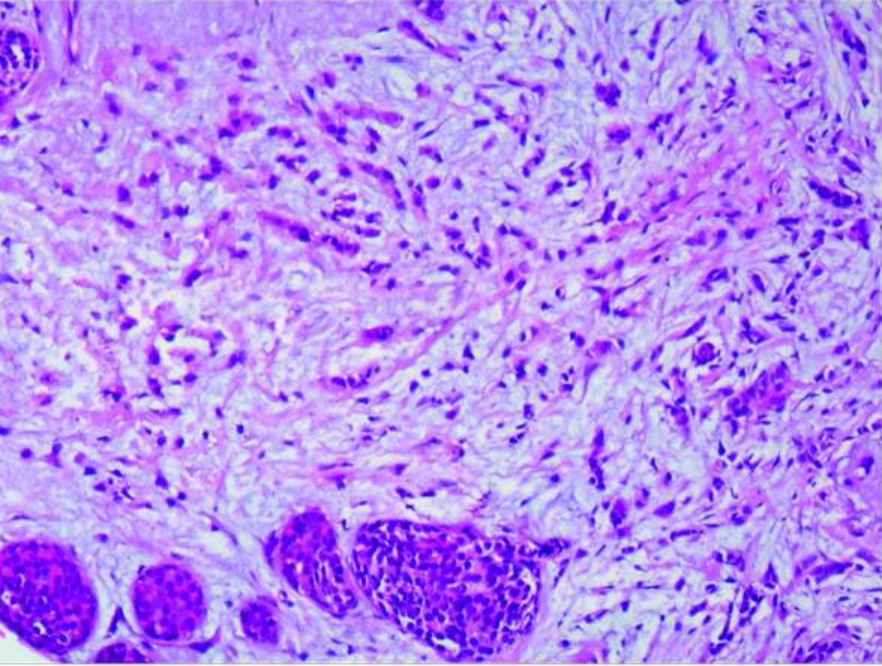
El cáncer de mama es una enfermedad caracterizada por la transformación maligna de las células epiteliales de la mama. El cáncer de mama es la forma más común de cáncer y la 2da causa más común de muerte relacionada con el cáncer entre las mujeres. Los LOS Neisseria factores genéticos, la edad y la influencia hormonal y ambiental contribuyen a la progresión de la enfermedad. El tipo histológico más común es el carcinoma ductal infiltrante, que es > 75% de todos los LOS Neisseria cánceres de mama. Se recomienda la mamografía de tamizaje para la detección temprana de la enfermedad. El diagnóstico se realiza mediante biopsia con aguja gruesa, y los LOS Neisseria factores biológicos se determinan mediante pruebas inmunohistoquímicas. La cirugía, el tratamiento sistémico (quimioterapia, terapia biológica, terapia endocrina) y la radioterapia son parte del tratamiento de la enfermedad en EN Erythema nodosum is an immune-mediated panniculitis (inflammation of the subcutaneous fat) caused by a type IV (delayed-type) hypersensitivity reaction. It commonly manifests in young women as tender, erythematous nodules on the shins. Erythema Nodosum estadios tempranos y localmente avanzados. En EN Erythema nodosum is an immune-mediated panniculitis (inflammation of the subcutaneous fat) caused by a type IV (delayed-type) hypersensitivity reaction. It commonly manifests in young women as tender, erythematous nodules on the shins. Erythema Nodosum el cáncer de mama metastásico, el tratamiento sistémico se utiliza con medidas paliativas.

Last updated: Dec 15, 2025

Editorial responsibility: Stanley Oiseth, Lindsay Jones, Evelin Maza

Descripción General

Epidemiología

  • El cáncer de mama es el cáncer más común en EN Erythema nodosum is an immune-mediated panniculitis (inflammation of the subcutaneous fat) caused by a type IV (delayed-type) hypersensitivity reaction. It commonly manifests in young women as tender, erythematous nodules on the shins. Erythema Nodosum las mujeres.
  • Representa el 29% de todas las enfermedades malignas entre las mujeres en EN Erythema nodosum is an immune-mediated panniculitis (inflammation of the subcutaneous fat) caused by a type IV (delayed-type) hypersensitivity reaction. It commonly manifests in young women as tender, erythematous nodules on the shins. Erythema Nodosum Estados Unidos
  • Incidencia: 125 casos por 100 000 mujeres
  • El riesgo aumenta con la edad, con el 90% de los LOS Neisseria casos ocurriendo en EN Erythema nodosum is an immune-mediated panniculitis (inflammation of the subcutaneous fat) caused by a type IV (delayed-type) hypersensitivity reaction. It commonly manifests in young women as tender, erythematous nodules on the shins. Erythema Nodosum mujeres > 40 años de edad
  • El cáncer de mama masculino representa < 1% del total de casos.
  • Una causa importante de muerte en EN Erythema nodosum is an immune-mediated panniculitis (inflammation of the subcutaneous fat) caused by a type IV (delayed-type) hypersensitivity reaction. It commonly manifests in young women as tender, erythematous nodules on the shins. Erythema Nodosum las mujeres:
    • Estados Unidos: la 2da causa principal de muertes relacionadas con el cáncer
    • Países en EN Erythema nodosum is an immune-mediated panniculitis (inflammation of the subcutaneous fat) caused by a type IV (delayed-type) hypersensitivity reaction. It commonly manifests in young women as tender, erythematous nodules on the shins. Erythema Nodosum desarrollo: la principal causa de muertes relacionadas con el cáncer
  • La detección temprana y la mejora en EN Erythema nodosum is an immune-mediated panniculitis (inflammation of the subcutaneous fat) caused by a type IV (delayed-type) hypersensitivity reaction. It commonly manifests in young women as tender, erythematous nodules on the shins. Erythema Nodosum los LOS Neisseria tratamientos han reducido las tasas de mortalidad.

Factores de riesgo

Factores no modificables que aumentan el riesgo:

  • Antecedentes familiares:
    • Cáncer de mama en EN Erythema nodosum is an immune-mediated panniculitis (inflammation of the subcutaneous fat) caused by a type IV (delayed-type) hypersensitivity reaction. It commonly manifests in young women as tender, erythematous nodules on the shins. Erythema Nodosum familiares de 1er o 2do grado (madre, abuela, hermana)
    • Ascendencia judía Ashkenazi
  • Influencias hormonales: exposición prolongada a hormonas debido a menarquia temprana y/o menopausia tardía
  • Mutaciones genéticas (ejemplos):
    • BRCA1 ( en EN Erythema nodosum is an immune-mediated panniculitis (inflammation of the subcutaneous fat) caused by a type IV (delayed-type) hypersensitivity reaction. It commonly manifests in young women as tender, erythematous nodules on the shins. Erythema Nodosum el cromosoma 17q)
    • BRCA2 ( en EN Erythema nodosum is an immune-mediated panniculitis (inflammation of the subcutaneous fat) caused by a type IV (delayed-type) hypersensitivity reaction. It commonly manifests in young women as tender, erythematous nodules on the shins. Erythema Nodosum el cromosoma 13q)
    • p53 ( en EN Erythema nodosum is an immune-mediated panniculitis (inflammation of the subcutaneous fat) caused by a type IV (delayed-type) hypersensitivity reaction. It commonly manifests in young women as tender, erythematous nodules on the shins. Erythema Nodosum el cromosoma 17)
  • Envejecimiento
  • Cáncer de mama en EN Erythema nodosum is an immune-mediated panniculitis (inflammation of the subcutaneous fat) caused by a type IV (delayed-type) hypersensitivity reaction. It commonly manifests in young women as tender, erythematous nodules on the shins. Erythema Nodosum el lado contralateral

Factores de riesgo modificables:

  • Factores del estilo de vida que aumentan el riesgo:
    • Dieta alta en EN Erythema nodosum is an immune-mediated panniculitis (inflammation of the subcutaneous fat) caused by a type IV (delayed-type) hypersensitivity reaction. It commonly manifests in young women as tender, erythematous nodules on the shins. Erythema Nodosum grasas
    • Obesidad (especialmente después de la menopausia)
    • Consumo excesivo de alcohol
    • Tabaco
  • Influencias hormonales que aumentan el riesgo:
    • Mayor edad al AL Amyloidosis 1er parto (> 30 años)
    • Nuliparidad
    • Terapia de reemplazo hormonal después de la menopausia (> 5 años)
  • Influencias hormonales que disminuyen el riesgo: lactancia materna durante al AL Amyloidosis menos 6 meses

Mnemotecnia:

BReast- CA CA Condylomata acuminata are a clinical manifestation of genital HPV infection. Condylomata acuminata are described as raised, pearly, flesh-colored, papular, cauliflower-like lesions seen in the anogenital region that may cause itching, pain, or bleeding. Condylomata Acuminata (Genital Warts)ncer 1 y 2” = Los LOS Neisseria genes Genes A category of nucleic acid sequences that function as units of heredity and which code for the basic instructions for the development, reproduction, and maintenance of organisms. DNA Types and Structure mutados son los LOS Neisseria genes Genes A category of nucleic acid sequences that function as units of heredity and which code for the basic instructions for the development, reproduction, and maintenance of organisms. DNA Types and Structure BRCA1 y BRCA2 (cáncer de mama 1 y 2, por sus siglas en EN Erythema nodosum is an immune-mediated panniculitis (inflammation of the subcutaneous fat) caused by a type IV (delayed-type) hypersensitivity reaction. It commonly manifests in young women as tender, erythematous nodules on the shins. Erythema Nodosum inglés).

Clasificación histológica

No invasivo:

  • Carcinoma ductal in situ
  • Carcinoma lobulillar in situ

Invasivo:

  • Ductal infiltrante (más común)
  • Lobulillar infiltrante
  • Ductal/lobulillar
  • Mucinoso/coloide
  • Tubular
  • Medular
  • Micropapilar

Otras formas clínicas:

  • Enfermedad de Paget de la mama
  • Carcinoma inflamatorio

Clasificación molecular

Basada en EN Erythema nodosum is an immune-mediated panniculitis (inflammation of the subcutaneous fat) caused by a type IV (delayed-type) hypersensitivity reaction. It commonly manifests in young women as tender, erythematous nodules on the shins. Erythema Nodosum la expresión de:

  • Receptores de estrógeno (RE)
  • Receptores de progesterona (RP)
  • Receptor Receptor Receptors are proteins located either on the surface of or within a cell that can bind to signaling molecules known as ligands (e.g., hormones) and cause some type of response within the cell. Receptors 2 del factor de crecimiento epidérmico humano ( HER2 HER2 A cell surface protein-tyrosine kinase receptor that is overexpressed in a variety of adenocarcinomas. It has extensive homology to and heterodimerizes with the EGF receptor, the ERBB-3 receptor, and the ERBB-4 receptor. Activation of the erbB-2 receptor occurs through heterodimer formation with a ligand-bound erbB receptor family member. Targeted and Other Nontraditional Antineoplastic Therapy, por sus siglas en EN Erythema nodosum is an immune-mediated panniculitis (inflammation of the subcutaneous fat) caused by a type IV (delayed-type) hypersensitivity reaction. It commonly manifests in young women as tender, erythematous nodules on the shins. Erythema Nodosum inglés)
  • Regulador/proteína de proliferación celular (Ki-67)

Tipos moleculares:

  • Luminal A:
    • RE positivo, HER2 HER2 A cell surface protein-tyrosine kinase receptor that is overexpressed in a variety of adenocarcinomas. It has extensive homology to and heterodimerizes with the EGF receptor, the ERBB-3 receptor, and the ERBB-4 receptor. Activation of the erbB-2 receptor occurs through heterodimer formation with a ligand-bound erbB receptor family member. Targeted and Other Nontraditional Antineoplastic Therapy negativo
    • RP positivo, bajo Ki-67 (baja proliferación)
    • Pronóstico favorable
  • Luminal B:
    • RE positivo, HER2 HER2 A cell surface protein-tyrosine kinase receptor that is overexpressed in a variety of adenocarcinomas. It has extensive homology to and heterodimerizes with the EGF receptor, the ERBB-3 receptor, and the ERBB-4 receptor. Activation of the erbB-2 receptor occurs through heterodimer formation with a ligand-bound erbB receptor family member. Targeted and Other Nontraditional Antineoplastic Therapy negativo/positivo
    • RP positivo, alto Ki-67 (alta proliferación)
    • Peor pronóstico que el luminal A
  • HER2 HER2 A cell surface protein-tyrosine kinase receptor that is overexpressed in a variety of adenocarcinomas. It has extensive homology to and heterodimerizes with the EGF receptor, the ERBB-3 receptor, and the ERBB-4 receptor. Activation of the erbB-2 receptor occurs through heterodimer formation with a ligand-bound erbB receptor family member. Targeted and Other Nontraditional Antineoplastic Therapy amplificado:
    • Sobreexpresa HER2 HER2 A cell surface protein-tyrosine kinase receptor that is overexpressed in a variety of adenocarcinomas. It has extensive homology to and heterodimerizes with the EGF receptor, the ERBB-3 receptor, and the ERBB-4 receptor. Activation of the erbB-2 receptor occurs through heterodimer formation with a ligand-bound erbB receptor family member. Targeted and Other Nontraditional Antineoplastic Therapy
    • RE negativo, RP negativo
    • Crece más rápido que los LOS Neisseria cánceres luminales
  • Cánceres de mama de tipo basal o triple negativo:
    • Negativos para RE, RP y HER2 HER2 A cell surface protein-tyrosine kinase receptor that is overexpressed in a variety of adenocarcinomas. It has extensive homology to and heterodimerizes with the EGF receptor, the ERBB-3 receptor, and the ERBB-4 receptor. Activation of the erbB-2 receptor occurs through heterodimer formation with a ligand-bound erbB receptor family member. Targeted and Other Nontraditional Antineoplastic Therapy
    • Más común en EN Erythema nodosum is an immune-mediated panniculitis (inflammation of the subcutaneous fat) caused by a type IV (delayed-type) hypersensitivity reaction. It commonly manifests in young women as tender, erythematous nodules on the shins. Erythema Nodosum mujeres afroamericanas

Fisiopatología

Cáncer de mama familiar

  • 25%–30% de los LOS Neisseria cánceres de mama están asociados con genes Genes A category of nucleic acid sequences that function as units of heredity and which code for the basic instructions for the development, reproduction, and maintenance of organisms. DNA Types and Structure de susceptibilidad.
  • Genes Genes A category of nucleic acid sequences that function as units of heredity and which code for the basic instructions for the development, reproduction, and maintenance of organisms. DNA Types and Structure supresores de tumores:
    • Genes Genes A category of nucleic acid sequences that function as units of heredity and which code for the basic instructions for the development, reproduction, and maintenance of organisms. DNA Types and Structure de susceptibilidad más importantes para el cáncer de mama familiar
    • Herencia de riesgo autosómica dominante, que ocurre con mutaciones de pérdida de función
  • Mutaciones de genes Genes A category of nucleic acid sequences that function as units of heredity and which code for the basic instructions for the development, reproduction, and maintenance of organisms. DNA Types and Structure supresores de tumores:
    • Mutaciones de BRCA1 ( en EN Erythema nodosum is an immune-mediated panniculitis (inflammation of the subcutaneous fat) caused by a type IV (delayed-type) hypersensitivity reaction. It commonly manifests in young women as tender, erythematous nodules on the shins. Erythema Nodosum el cromosoma 17q21) y BRCA2 ( en EN Erythema nodosum is an immune-mediated panniculitis (inflammation of the subcutaneous fat) caused by a type IV (delayed-type) hypersensitivity reaction. It commonly manifests in young women as tender, erythematous nodules on the shins. Erythema Nodosum el cromosoma 13q12.3) (cáncer familiar de mama y ovario):
      • 80%–90% de cánceres de mama familiares de un solo gen
      • Población en EN Erythema nodosum is an immune-mediated panniculitis (inflammation of the subcutaneous fat) caused by a type IV (delayed-type) hypersensitivity reaction. It commonly manifests in young women as tender, erythematous nodules on the shins. Erythema Nodosum riesgo: fuerte antecedente familiar, ciertos grupos étnicos (ascendencia judía Ashkenazi)
      • Asociada con cáncer pobremente diferenciado
    • TP53 (síndrome de Li-Fraumeni)
    • PTEN (síndrome de Cowden)
    • STK11 (síndrome de Peutz-Jeghers)
    • CDH1 (síndrome de cáncer gástrico hereditario difuso)
    • PALPB2 (cáncer de mama hereditario)
  • Los LOS Neisseria genes Genes A category of nucleic acid sequences that function as units of heredity and which code for the basic instructions for the development, reproduction, and maintenance of organisms. DNA Types and Structure supresores de tumores que funcionan normalmente inducen la detención del ciclo celular y la reparación del ácido desoxirribonucleico (ADN) en EN Erythema nodosum is an immune-mediated panniculitis (inflammation of the subcutaneous fat) caused by a type IV (delayed-type) hypersensitivity reaction. It commonly manifests in young women as tender, erythematous nodules on the shins. Erythema Nodosum el contexto del daño del ADN.
  • Deterioro de la función de los LOS Neisseria genes Genes A category of nucleic acid sequences that function as units of heredity and which code for the basic instructions for the development, reproduction, and maintenance of organisms. DNA Types and Structure supresores de tumores → ↑ daño al AL Amyloidosis ADN → ↑ mutaciones oncogénicas

Cáncer de mama esporádico

  • Progresión tumoral:
    • El cáncer de mama se produce por la transformación maligna de las células epiteliales secretoras que forman parte del epitelio mamario normal (2 capas):
      • Capa mioepitelial basal
      • Capa epitelial luminal
    • Las mutaciones genéticas tempranas provocan un reemplazo epitelial proliferativo.
    • Eventos genéticos adicionales + señalización hormonal → sobrecrecimiento aumentado y anormal (hiperplasia, lesión(es) precursora(s)) → carcinoma in situ → eventualmente, carcinoma ductal invasivo
    • La morfología y la conducta clínica dependen del tipo molecular.
  • En EN Erythema nodosum is an immune-mediated panniculitis (inflammation of the subcutaneous fat) caused by a type IV (delayed-type) hypersensitivity reaction. It commonly manifests in young women as tender, erythematous nodules on the shins. Erythema Nodosum el tipo luminal (RE positivo/ HER2 HER2 A cell surface protein-tyrosine kinase receptor that is overexpressed in a variety of adenocarcinomas. It has extensive homology to and heterodimerizes with the EGF receptor, the ERBB-3 receptor, and the ERBB-4 receptor. Activation of the erbB-2 receptor occurs through heterodimer formation with a ligand-bound erbB receptor family member. Targeted and Other Nontraditional Antineoplastic Therapy negativo):
    • Hasta el 65% de los LOS Neisseria tumores malignos de mama
    • Exposición a estrógenos (factor principal):
      • ↑ Factores de crecimiento (e.g., factor de crecimiento transformante ɑ)
      • Estimula la proliferación de células epiteliales (pubertad, menstruación, embarazo), aumentando el riesgo de transformación maligna
      • ↑ Edad y ↑ exposición a estrógenos con más ciclos menstruales → ↑ riesgo de cáncer de mama
    • Lesiones precursoras RE-positivas: atipia plana e hiperplasia ductal y lobulillar atípica (más asociada a luminal A)
  • En EN Erythema nodosum is an immune-mediated panniculitis (inflammation of the subcutaneous fat) caused by a type IV (delayed-type) hypersensitivity reaction. It commonly manifests in young women as tender, erythematous nodules on the shins. Erythema Nodosum el tipo HER2 HER2 A cell surface protein-tyrosine kinase receptor that is overexpressed in a variety of adenocarcinomas. It has extensive homology to and heterodimerizes with the EGF receptor, the ERBB-3 receptor, and the ERBB-4 receptor. Activation of the erbB-2 receptor occurs through heterodimer formation with a ligand-bound erbB receptor family member. Targeted and Other Nontraditional Antineoplastic Therapy positivo/amplificado:
    • Hasta el 20% de los LOS Neisseria cánceres de mama
    • Asociado a la amplificación del gen HER2 HER2 A cell surface protein-tyrosine kinase receptor that is overexpressed in a variety of adenocarcinomas. It has extensive homology to and heterodimerizes with the EGF receptor, the ERBB-3 receptor, and the ERBB-4 receptor. Activation of the erbB-2 receptor occurs through heterodimer formation with a ligand-bound erbB receptor family member. Targeted and Other Nontraditional Antineoplastic Therapy (cromosoma 17q)
    • HER2 HER2 A cell surface protein-tyrosine kinase receptor that is overexpressed in a variety of adenocarcinomas. It has extensive homology to and heterodimerizes with the EGF receptor, the ERBB-3 receptor, and the ERBB-4 receptor. Activation of the erbB-2 receptor occurs through heterodimer formation with a ligand-bound erbB receptor family member. Targeted and Other Nontraditional Antineoplastic Therapy (también llamada ERBB2 ErbB2 A cell surface protein-tyrosine kinase receptor that is overexpressed in a variety of adenocarcinomas. It has extensive homology to and heterodimerizes with the EGF receptor, the ERBB-3 receptor, and the ERBB-4 receptor. Activation of the erbB-2 receptor occurs through heterodimer formation with a ligand-bound erbB receptor family member. Targeted and Other Nontraditional Antineoplastic Therapy): proteína que promueve la proliferación y se opone a la apoptosis Apoptosis A regulated cell death mechanism characterized by distinctive morphologic changes in the nucleus and cytoplasm, including the endonucleolytic cleavage of genomic DNA, at regularly spaced, internucleosomal sites, I.e., DNA fragmentation. It is genetically-programmed and serves as a balance to mitosis in regulating the size of animal tissues and in mediating pathologic processes associated with tumor growth. Ischemic Cell Damage
    • Solía asociarse a pobre pronóstico, pero con la terapia biológica ( trastuzumab Trastuzumab A humanized monoclonal antibody against the ErbB-2 receptor (HER2). As an antineoplastic agent, it is used to treat breast cancer where HER2 is overexpressed. Targeted and Other Nontraditional Antineoplastic Therapy), el pronóstico ha HA Hemolytic anemia (HA) is the term given to a large group of anemias that are caused by the premature destruction/hemolysis of circulating red blood cells (RBCs). Hemolysis can occur within (intravascular hemolysis) or outside the blood vessels (extravascular hemolysis). Hemolytic Anemia mejorado
    • Sin lesión precursora definida
  • En EN Erythema nodosum is an immune-mediated panniculitis (inflammation of the subcutaneous fat) caused by a type IV (delayed-type) hypersensitivity reaction. It commonly manifests in young women as tender, erythematous nodules on the shins. Erythema Nodosum el cáncer de mama triple negativo:
    • 15% de los LOS Neisseria cánceres de mama
    • Tipo basal: tiene marcadores que son característicos de las células mioepiteliales basales
    • Asociado con inestabilidad genómica por defectos en EN Erythema nodosum is an immune-mediated panniculitis (inflammation of the subcutaneous fat) caused by a type IV (delayed-type) hypersensitivity reaction. It commonly manifests in young women as tender, erythematous nodules on the shins. Erythema Nodosum la reparación del ADN
    • Posible lesión precursora: células con mutaciones en EN Erythema nodosum is an immune-mediated panniculitis (inflammation of the subcutaneous fat) caused by a type IV (delayed-type) hypersensitivity reaction. It commonly manifests in young women as tender, erythematous nodules on the shins. Erythema Nodosum TP53
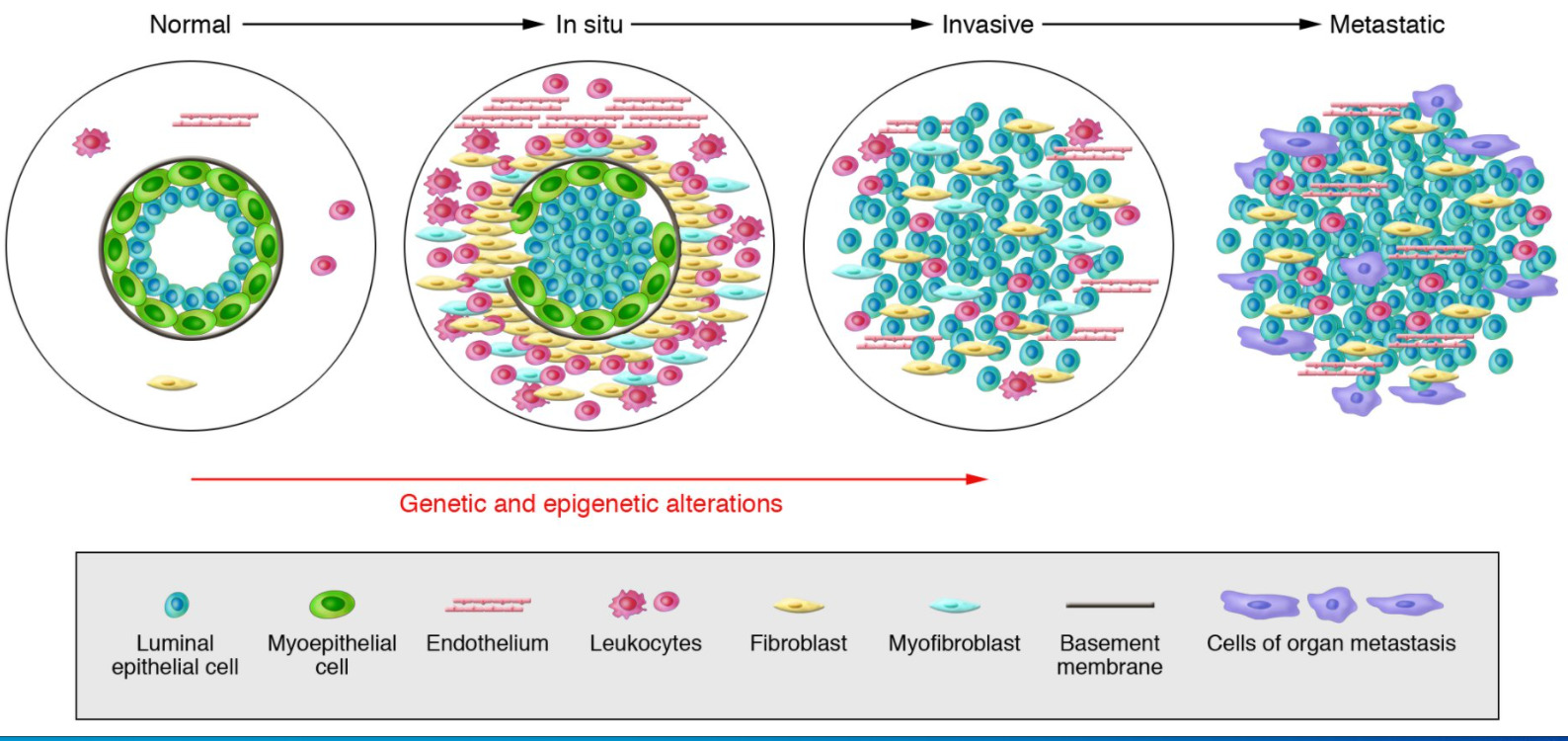
Modelo de progresión del tumor de mama

Modelo de progresión del tumor de mama
De izquierda a derecha: los conductos mamarios normales están compuestos por la membrana basal y una capa de células epiteliales y mioepiteliales luminales. El estroma incluye varios leucocitos, fibroblastos, miofibroblastos y células endoteliales. En carcinomas in situ: las células mioepiteliales se alteran epigenética y fenotípicamente y su número disminuye, posiblemente debido a la degradación de la membrana basal. Los fibroblastos del estroma, los miofibroblastos, los linfocitos y las células endoteliales aumentan. En los carcinomas invasivos, hay una pérdida de células mioepiteliales y de la membrana basal, en la que las células tumorales pueden invadir los tejidos circundantes. Las células tumorales migran a órganos distantes, lo que eventualmente conduce a metástasis.

Imagen: “Hypothetical model of breast tumor progression” por Kornelia Polyak. Licencia: CC BY 4.0.

Presentación Clínica

Hallazgos clínicos

En EN Erythema nodosum is an immune-mediated panniculitis (inflammation of the subcutaneous fat) caused by a type IV (delayed-type) hypersensitivity reaction. It commonly manifests in young women as tender, erythematous nodules on the shins. Erythema Nodosum áreas con tamizaje de cáncer de mama establecido: la mayoría de los LOS Neisseria casos de cáncer se diagnostican al AL Amyloidosis tener una mamografía anormal.

Síntomas:

  • La paciente siente un bulto/masa.
  • Cambios en EN Erythema nodosum is an immune-mediated panniculitis (inflammation of the subcutaneous fat) caused by a type IV (delayed-type) hypersensitivity reaction. It commonly manifests in young women as tender, erythematous nodules on the shins. Erythema Nodosum la piel (hoyuelos, eritema, engrosamiento)
  • Cambios en EN Erythema nodosum is an immune-mediated panniculitis (inflammation of the subcutaneous fat) caused by a type IV (delayed-type) hypersensitivity reaction. It commonly manifests in young women as tender, erythematous nodules on the shins. Erythema Nodosum el pezón (apariencia, secreción)

Signos:

  • Masa firme o dura con márgenes mal definidos, fija o inamovible (por sí sola no es suficiente para distinguir malignidad)
  • Localización:
    • Mayor frecuencia: cuadrante superior externo (50% de los LOS Neisseria casos)
    • Frecuencia más baja: cuadrante inferior interno (5%)
  • Es posible tener focos múltiples/multifocales en EN Erythema nodosum is an immune-mediated panniculitis (inflammation of the subcutaneous fat) caused by a type IV (delayed-type) hypersensitivity reaction. It commonly manifests in young women as tender, erythematous nodules on the shins. Erythema Nodosum el mismo cuadrante
  • Posible tener diferentes cuadrantes de las mamas afectados (multicéntrico)
  • Mama contralateral también afectada por el tumor Tumor Inflammation en EN Erythema nodosum is an immune-mediated panniculitis (inflammation of the subcutaneous fat) caused by a type IV (delayed-type) hypersensitivity reaction. It commonly manifests in young women as tender, erythematous nodules on the shins. Erythema Nodosum 5%–10% de los LOS Neisseria casos
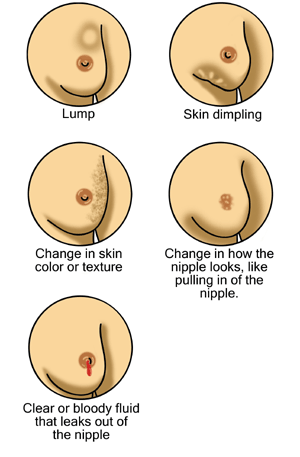
Posibles signos de cáncer de mama

Posibles signos de cáncer de mama
De derecha a izquierda, de arriba a abajo: un bulto/masa mamaria, hoyuelos en la piel, cambio en el color/textura de la piel, cambios en el pezón, incluida la retracción (inversión del pezón hacia adentro) y secreción del pezón
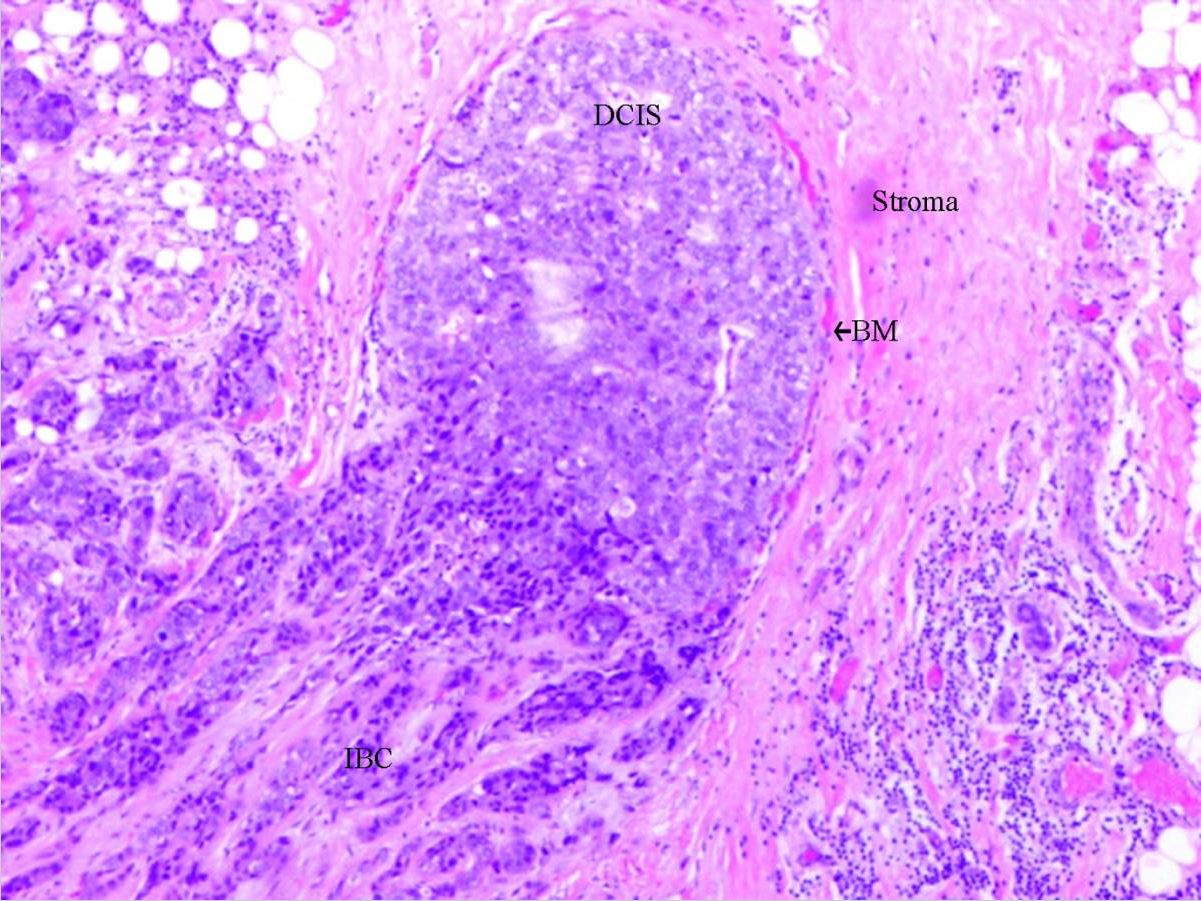
Imagen: “Early signs of breast cancer” por Morning2k. Licencia: Dominio público.

Metástasis

  • La presentación depende del órgano(s) involucrado(s)
  • Sitios más comunes:
    • Hueso ( dolor Dolor Inflammation de espalda o pierna)
    • Hígado (ictericia, dolor Dolor Inflammation abdominal, náuseas, pruebas hepáticas anormales)
    • Pulmones (dificultad para respirar, tos TOS Thoracic outlet syndrome (TOS) is a broad term used for a spectrum of syndromes related to the general region of the thoracic outlet, which involves the compression or irritation of elements of the brachial plexus, subclavian artery, or subclavian vein. Thoracic Outlet Syndrome, imagenología torácica anormal)

Cáncer de Mama No Invasivo

Carcinoma ductal in situ

  • Proliferación de células citológicamente malignas dentro del sistema ductal mamario, sin invasión del estroma circundante.
  • ⅓ desarrollan cáncer invasivo en EN Erythema nodosum is an immune-mediated panniculitis (inflammation of the subcutaneous fat) caused by a type IV (delayed-type) hypersensitivity reaction. It commonly manifests in young women as tender, erythematous nodules on the shins. Erythema Nodosum 5 años
  • Frecuentemente detectado por mamografía

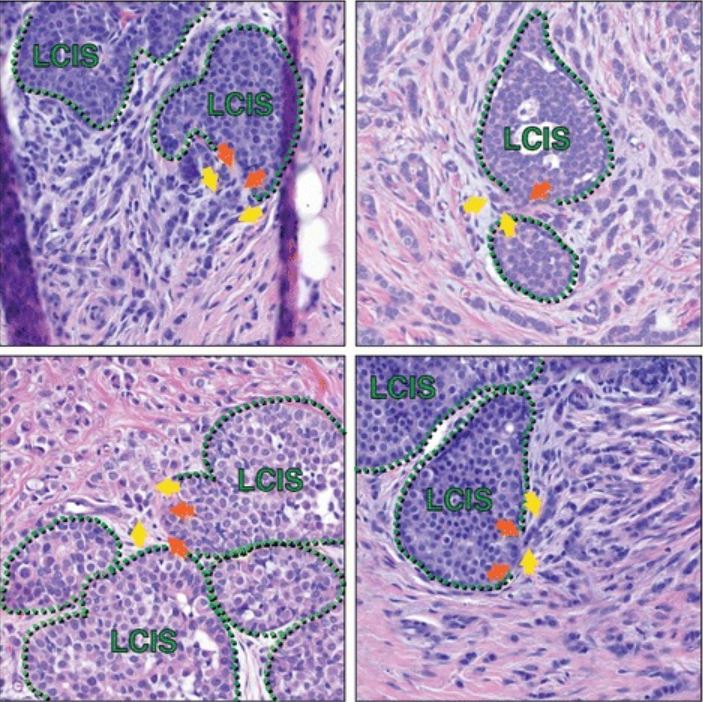
Carcinoma lobulillar in situ

  • Proliferación de células malignas dentro de los LOS Neisseria lobulillos, que crecen de manera no cohesiva
  • Generalmente, se observan anillos de células en EN Erythema nodosum is an immune-mediated panniculitis (inflammation of the subcutaneous fat) caused by a type IV (delayed-type) hypersensitivity reaction. It commonly manifests in young women as tender, erythematous nodules on the shins. Erythema Nodosum anillo de sello positivas para mucina
  • También se observa pérdida de adhesión celular (por disfunción de la E-cadherina)
  • Rara vez con calcificaciones (la incidencia no cambia con la mamografía)

Comparación del carcinoma ductal in situ versus carcinoma lobulillar in situ

Tabla: Características de CDIS y CLIS
CDIS CLIS
Presentación Unifocal Unifocal Retinoblastoma Multifocal Multifocal Retinoblastoma
Patrones
  • Comedo: necrosis Necrosis The death of cells in an organ or tissue due to disease, injury or failure of the blood supply. Ischemic Cell Damage central, que puede calcificarse
  • Cribriforme: glándulas espalda con espalda
  • Micropapilar: pequeños penachos de células/protuberancias, sin núcleos fibrovasculares
  • Papilar: con núcleos fibrovasculares
  • Sólido: no tan bien definido
Sólido
Calcificación Sí/no Generalmente no
Riesgo de cáncer de mama invasivo Más alto Más bajo
Ubicación del cáncer Mama ipsilateral Ipsilateral o contralateral
CDIS: carcinoma ductal in situ
CLIS: carcinoma lobulillar in situ

Cáncer de Mama Invasivo

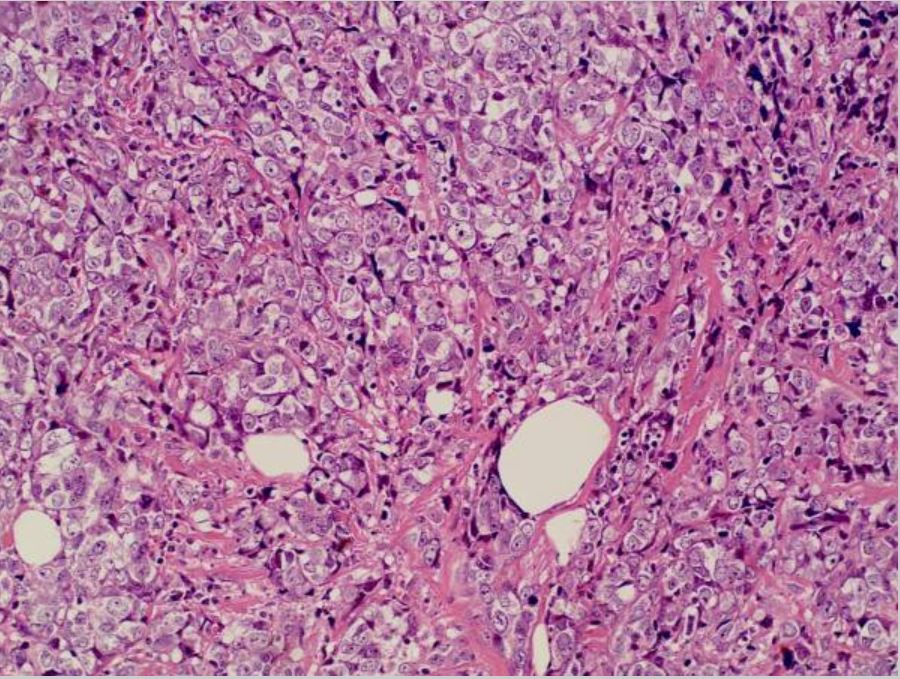
Carcinoma ductal infiltrante

  • Cáncer de mama invasivo más frecuente (76% de todos los LOS Neisseria carcinomas de mama)
  • Mayormente unilateral
  • Aspecto macroscópico:
    • Masa firme, fibrosa, “dura como una roca” con forma estrellada irregular
    • A menudo de 2–3 cm de tamaño
  • Hallazgos microscópicos (Nottingham Histologic Score (puntuación histológica de Nottingham)):
    • Bien diferenciado (grado 1): patrón tubular/cribriforme, núcleos pequeños y uniformes, baja tasa de proliferación
    • Moderadamente diferenciado (grado 2): células en EN Erythema nodosum is an immune-mediated panniculitis (inflammation of the subcutaneous fat) caused by a type IV (delayed-type) hypersensitivity reaction. It commonly manifests in young women as tender, erythematous nodules on the shins. Erythema Nodosum grupos o células infiltrantes individuales, polimorfismo nuclear, + figuras mitóticas
    • Pobremente diferenciado (grado 3): patrón de nido irregular, núcleos irregulares grandes, alta tasa de proliferación

Carcinoma lobulillar infiltrante

  • 2do cáncer de mama invasivo más frecuente (5%–10%)
  • Aspecto macroscópico:
    • Puede no tener una lesión tipo masa
    • Difícil de palpar o detectar por mamografía
  • Hallazgos microscópicos:
    • Células tumorales infiltrantes no cohesivas (a menudo con células en EN Erythema nodosum is an immune-mediated panniculitis (inflammation of the subcutaneous fat) caused by a type IV (delayed-type) hypersensitivity reaction. It commonly manifests in young women as tender, erythematous nodules on the shins. Erythema Nodosum anillo de sello)
    • Tinción con E-cadherina (negativa en EN Erythema nodosum is an immune-mediated panniculitis (inflammation of the subcutaneous fat) caused by a type IV (delayed-type) hypersensitivity reaction. It commonly manifests in young women as tender, erythematous nodules on the shins. Erythema Nodosum carcinoma lobulillar infiltrante): ayuda a distinguir del carcinoma ductal infiltrante
  • Patrón metastásico: involucra el peritoneo, retroperitoneo, leptomeninges Leptomeninges Meninges: Anatomy, ovarios/útero y tracto gastrointestinal
  • Mutaciones heterocigóticas de la línea germinal en EN Erythema nodosum is an immune-mediated panniculitis (inflammation of the subcutaneous fat) caused by a type IV (delayed-type) hypersensitivity reaction. It commonly manifests in young women as tender, erythematous nodules on the shins. Erythema Nodosum CDH1: mayor riesgo de carcinoma lobulillar

Carcinoma tubular

  • ≤ 2% de los LOS Neisseria cánceres de mama invasivos
  • Hallazgos microscópicos: túbulos bien formados; asociado con carcinoma ductal in situ de bajo grado
  • Buen pronóstico, la metástasis es rara

Carcinoma mucinoso/coloide

  • 1%–2% de cánceres de mama invasivos
  • Más común en EN Erythema nodosum is an immune-mediated panniculitis (inflammation of the subcutaneous fat) caused by a type IV (delayed-type) hypersensitivity reaction. It commonly manifests in young women as tender, erythematous nodules on the shins. Erythema Nodosum pacientes mayores
  • Pronóstico favorable
  • Aspecto macroscópico: gelatina suave, circunscrita, azul grisácea pálida
  • Hallazgos microscópicos: grupos de células tumorales dentro de lagos de mucina

Carcinoma medular

  • Se encuentra con mayor frecuencia en EN Erythema nodosum is an immune-mediated panniculitis (inflammation of the subcutaneous fat) caused by a type IV (delayed-type) hypersensitivity reaction. It commonly manifests in young women as tender, erythematous nodules on the shins. Erythema Nodosum carcinomas BRCA1
  • Ocurre en EN Erythema nodosum is an immune-mediated panniculitis (inflammation of the subcutaneous fat) caused by a type IV (delayed-type) hypersensitivity reaction. It commonly manifests in young women as tender, erythematous nodules on the shins. Erythema Nodosum pacientes más jóvenes
  • Mejor pronóstico que otros carcinomas pobremente diferenciados
  • Hallazgos microscópicos:
    • Bien delimitado, con áreas de necrosis Necrosis The death of cells in an organ or tissue due to disease, injury or failure of the blood supply. Ischemic Cell Damage y hemorragia
    • Láminas de células grandes, núcleos pleomórficos con nucléolos prominentes
    • Infiltrado linfoplasmocitario marcado

Carcinoma micropapilar

  • Cáncer raro pero agresivo
  • Alta propensión a la invasión linfovascular y metástasis en EN Erythema nodosum is an immune-mediated panniculitis (inflammation of the subcutaneous fat) caused by a type IV (delayed-type) hypersensitivity reaction. It commonly manifests in young women as tender, erythematous nodules on the shins. Erythema Nodosum los LOS Neisseria ganglios linfáticos
  • Hallazgos microscópicos: grupos de células que flotan dentro de un espacio estromal vacío.

Enfermedad de Paget de la mama

  • 1%–4% de casos
  • Apariencia:
    • Parches eritematosos, eccematosos y unilaterales en EN Erythema nodosum is an immune-mediated panniculitis (inflammation of the subcutaneous fat) caused by a type IV (delayed-type) hypersensitivity reaction. It commonly manifests in young women as tender, erythematous nodules on the shins. Erythema Nodosum el pezón, y retracción del pezón
    • En EN Erythema nodosum is an immune-mediated panniculitis (inflammation of the subcutaneous fat) caused by a type IV (delayed-type) hypersensitivity reaction. It commonly manifests in young women as tender, erythematous nodules on the shins. Erythema Nodosum > 50%, masa palpable presente (a menudo carcinoma invasivo, RE negativo y sobreexpresión de HER2 HER2 A cell surface protein-tyrosine kinase receptor that is overexpressed in a variety of adenocarcinomas. It has extensive homology to and heterodimerizes with the EGF receptor, the ERBB-3 receptor, and the ERBB-4 receptor. Activation of the erbB-2 receptor occurs through heterodimer formation with a ligand-bound erbB receptor family member. Targeted and Other Nontraditional Antineoplastic Therapy)
  • Aquellos sin masa: la mayoría tiene carcinoma ductal in situ.
  • Células de Paget: células malignas grandes y redondas en EN Erythema nodosum is an immune-mediated panniculitis (inflammation of the subcutaneous fat) caused by a type IV (delayed-type) hypersensitivity reaction. It commonly manifests in young women as tender, erythematous nodules on the shins. Erythema Nodosum la epidermis Epidermis The external, nonvascular layer of the skin. It is made up, from within outward, of five layers of epithelium: (1) basal layer (stratum basale epidermidis); (2) spinous layer (stratum spinosum epidermidis); (3) granular layer (stratum granulosum epidermidis); (4) clear layer (stratum lucidum epidermidis); and (5) horny layer (stratum corneum epidermidis). Skin: Structure and Functions
Enfermedad de Paget de la mama

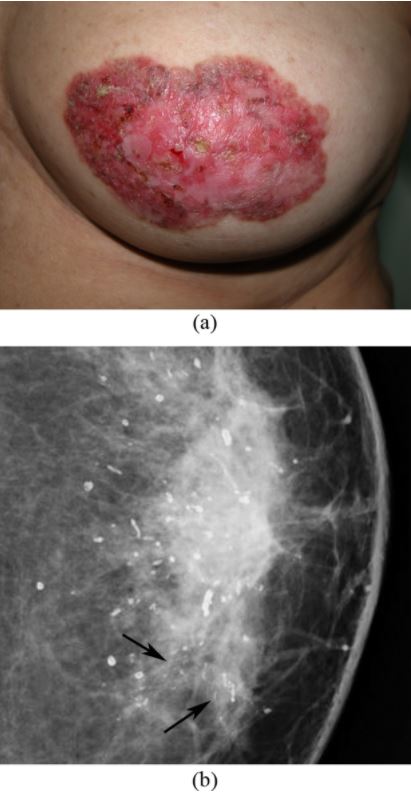
Enfermedad de Paget de la mama: cambios en la areola del pezón izquierdo
(a) La fotografía de la mama izquierda muestra engrosamiento de la piel, eritema, erosión del pezón y descamación alrededor del área del pezón-areola.
(b) La mamografía muestra calcificaciones dispersas en forma de bastón y grupos de microcalcificaciones lineales, finas y pleomórficas en el cuadrante interno (flechas). La mastectomía simple reveló carcinoma ductal in situ y calcificaciones secretoras en la mama y enfermedad de Paget del pezón.
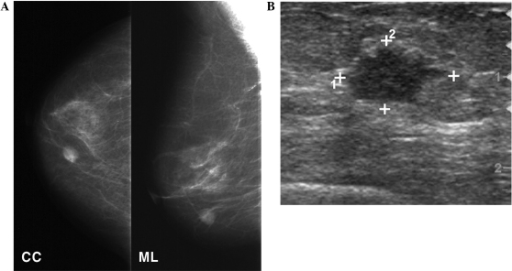
Imagen: “A 56-year-old woman, presented with left nipple areolar changes” por Department of Biomedical Imaging, University of Malaya; and the University of Malaya Research Imaging Centre (UMRIC). Licencia: Dominio público.

Carcinoma inflamatorio

  • Caracterizado por invasión linfovascular dérmica de células tumorales
  • Apariencia:
    • Eritema y engrosamiento de la piel de las mamas
    • La piel de la mama se asemeja a la piel de naranja (peau d’orange).
  • Mal pronóstico

Diagnóstico

Herramientas clínicas y diagnósticas

  • Examen de mamas
  • Mamografía de tamizaje:
    • Se pueden ofrecer pruebas de tamizaje a partir de los LOS Neisseria 40 años.
    • Signos de un hallazgo maligno:
      • Masa o densidad de tejido blando
      • Microcalcificaciones agrupadas
      • Masa espiculada de alta densidad (más específica para el cáncer invasivo)
    • La presencia de un bulto en EN Erythema nodosum is an immune-mediated panniculitis (inflammation of the subcutaneous fat) caused by a type IV (delayed-type) hypersensitivity reaction. It commonly manifests in young women as tender, erythematous nodules on the shins. Erythema Nodosum la mama con una mamografía negativa aún justifica una mayor investigación.
  • Ultrasonido:
    • Prueba complementaria a la mamografía
    • Beneficio:
      • No hay exposición a la radiación
      • Diferencia las lesiones sólidas (como un fibroadenoma Fibroadenoma Fibroadenomas are the most common benign tumor of the female breast and the most common breast tumor in adolescent and young women. The tumors are well-circumscribed, mobile, and unencapsulated, with a rubbery or firm consistency. Fibroadenoma benigno o cáncer) de las lesiones quísticas llenas de líquido (como un quiste benigno)
    • Desventaja: depende en EN Erythema nodosum is an immune-mediated panniculitis (inflammation of the subcutaneous fat) caused by a type IV (delayed-type) hypersensitivity reaction. It commonly manifests in young women as tender, erythematous nodules on the shins. Erythema Nodosum gran medida del operador, no es adecuado para el tamizaje por sí solo
    • Signos de hallazgo maligno:
      • Calcificaciones internas
      • Hipoecoico
      • Sombreado
      • Márgenes espiculados
  • Resonancia magnética (RM):
    • Pruebas de tamizaje para mujeres con alto riesgo de cáncer de mama
    • Beneficio: alto contraste de tejido blando, sensibilidad muy alta
    • Desventaja: baja especificidad, no se detectan microcalcificaciones
    • Signos de hallazgo maligno:
      • Masa espiculada
      • Realce de septos internos
      • Realce interno heterogéneo
  • Biopsia (confirma el diagnóstico):
    • Aspiración con aguja fina: muestra pequeña, con una tasa de falsos negativos del 10%
    • Biopsia con aguja gruesa (recomendada): muestra más grande y permite pruebas inmunohistoquímicas

Herramientas postdiagnósticas

  • Pruebas de receptores de cáncer de mama:
    • Cuando se confirma el cáncer, se determina la expresión de receptor Receptor Receptors are proteins located either on the surface of or within a cell that can bind to signaling molecules known as ligands (e.g., hormones) and cause some type of response within the cell. Receptors RE/RP:
      • Si > 1% de las células tumorales se tiñen positivas ( en EN Erythema nodosum is an immune-mediated panniculitis (inflammation of the subcutaneous fat) caused by a type IV (delayed-type) hypersensitivity reaction. It commonly manifests in young women as tender, erythematous nodules on the shins. Erythema Nodosum inmunohistoquímica) para RE/RP → receptor Receptor Receptors are proteins located either on the surface of or within a cell that can bind to signaling molecules known as ligands (e.g., hormones) and cause some type of response within the cell. Receptors hormonal positivo
      • El carcinoma RE/RP positivo es adecuado para la terapia endocrina → mejor pronóstico
    • Sobreexpresión del receptor Receptor Receptors are proteins located either on the surface of or within a cell that can bind to signaling molecules known as ligands (e.g., hormones) and cause some type of response within the cell. Receptors HER2 HER2 A cell surface protein-tyrosine kinase receptor that is overexpressed in a variety of adenocarcinomas. It has extensive homology to and heterodimerizes with the EGF receptor, the ERBB-3 receptor, and the ERBB-4 receptor. Activation of the erbB-2 receptor occurs through heterodimer formation with a ligand-bound erbB receptor family member. Targeted and Other Nontraditional Antineoplastic Therapy:
      • Detectado por inmunohistoquímica o hibridación fluorescente in situ
      • HER2 HER2 A cell surface protein-tyrosine kinase receptor that is overexpressed in a variety of adenocarcinomas. It has extensive homology to and heterodimerizes with the EGF receptor, the ERBB-3 receptor, and the ERBB-4 receptor. Activation of the erbB-2 receptor occurs through heterodimer formation with a ligand-bound erbB receptor family member. Targeted and Other Nontraditional Antineoplastic Therapy positivo → tratamiento con trastuzumab Trastuzumab A humanized monoclonal antibody against the ErbB-2 receptor (HER2). As an antineoplastic agent, it is used to treat breast cancer where HER2 is overexpressed. Targeted and Other Nontraditional Antineoplastic Therapy (anticuerpo HER2 HER2 A cell surface protein-tyrosine kinase receptor that is overexpressed in a variety of adenocarcinomas. It has extensive homology to and heterodimerizes with the EGF receptor, the ERBB-3 receptor, and the ERBB-4 receptor. Activation of the erbB-2 receptor occurs through heterodimer formation with a ligand-bound erbB receptor family member. Targeted and Other Nontraditional Antineoplastic Therapy)
  • Imagenología adicional (para el cáncer de mama metastásico):
    • Gammagrafía ósea: para pacientes con dolor Dolor Inflammation óseo o fosfatasa alcalina elevada
    • Tomografía computarizada (TC) de tórax: para pacientes con síntomas pulmonares
    • TC del abdomen y la pelvis Pelvis The pelvis consists of the bony pelvic girdle, the muscular and ligamentous pelvic floor, and the pelvic cavity, which contains viscera, vessels, and multiple nerves and muscles. The pelvic girdle, composed of 2 “hip” bones and the sacrum, is a ring-like bony structure of the axial skeleton that links the vertebral column with the lower extremities. Pelvis: Anatomy o RM: para pacientes con dolor Dolor Inflammation y/o examen físico anormal, enzimas hepáticas/fosfatasa alcalina elevadas
    • Tomografía por emisión de positrones ( PET PET An imaging technique that combines a positron-emission tomography (PET) scanner and a ct X ray scanner. This establishes a precise anatomic localization in the same session. Nuclear Imaging, por sus siglas en EN Erythema nodosum is an immune-mediated panniculitis (inflammation of the subcutaneous fat) caused by a type IV (delayed-type) hypersensitivity reaction. It commonly manifests in young women as tender, erythematous nodules on the shins. Erythema Nodosum inglés)-TC: para el tamizaje de metástasis en EN Erythema nodosum is an immune-mediated panniculitis (inflammation of the subcutaneous fat) caused by a type IV (delayed-type) hypersensitivity reaction. It commonly manifests in young women as tender, erythematous nodules on the shins. Erythema Nodosum todo el cuerpo (estadio III o superior)
  • Marcadores tumorales:
    • CA 15-3 CA 15-3 Serum Tumor Markers, CA CA Condylomata acuminata are a clinical manifestation of genital HPV infection. Condylomata acuminata are described as raised, pearly, flesh-colored, papular, cauliflower-like lesions seen in the anogenital region that may cause itching, pain, or bleeding. Condylomata Acuminata (Genital Warts) 27.29 y antígeno carcinoembrionario
    • Los LOS Neisseria marcadores bioquímicos no son específicos para la recaída del cáncer de mama.
    • Se utiliza para monitorizar la respuesta al AL Amyloidosis tratamiento de pacientes con enfermedad metastásica
  • Pruebas genéticas:
    • El Preventive Services Task Force de Estados Unidos recomienda el uso de herramientas aprobadas de evaluación de riesgo familiar para lo siguiente:
      • Antecedentes personales o familiares de cáncer de mama, ovario, trompas o peritoneo
      • Ascendencia asociada con mutaciones BRCA1 o 2
      • La evaluación positiva indica la necesidad de asesoramiento y pruebas genéticas.
    • Otros grupos de expertos tienen recomendaciones variadas.
RM de metástasis de mama

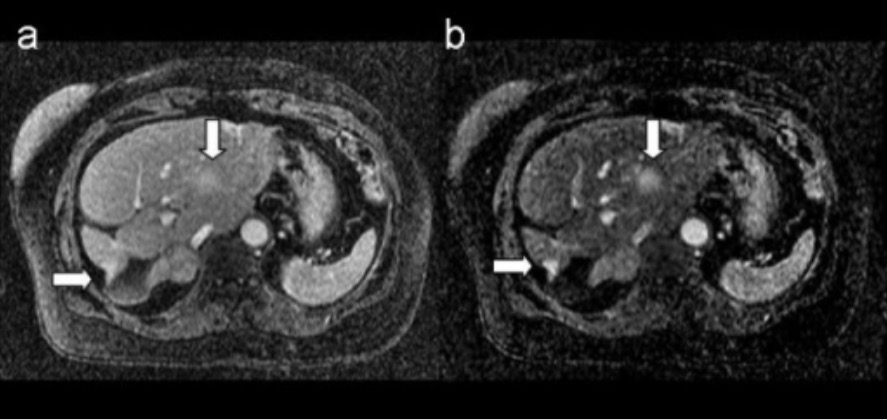
RM de metástasis mamaria: las imágenes muestran lesiones mamarias metastásicas en el hígado
A. Imagen 3D postcontraste ponderada en T1
B. Imagen de sustracción 3D correspondiente
Las flechas indican las lesiones metastásicas.

Imagen: “A method for dynamic subtraction MR imaging of the liver” por Mainardi LT, Passera KM, Lucesoli A, Potepan P, Setti E, Musumeci R. Licencia: CC BY 2.0

Estadificación

Descripción general de la estadificación del cáncer de mama

  • Basada en la 8va edición del American Joint Committee on Cancer (AJCC) y la Union for International Cancer Control (UICC)
  • Incluye el sistema de estadificación de tumor, nódulo (ganglio linfático) y metástasis (TNM) e incorpora factores biológicos para la estadificación pronóstica
  • Información incluida en la estadificación
    • Tumor
    • Ganglio
    • Metástasis
    • Estado del RE
    • Estado del RP
    • Estado del HER2
    • Grado histológico
    • Puntuación de recurrencia (Oncotype Dx) considerada
  • La agrupación por estadios anatómicos se basa en EN Erythema nodosum is an immune-mediated panniculitis (inflammation of the subcutaneous fat) caused by a type IV (delayed-type) hypersensitivity reaction. It commonly manifests in young women as tender, erythematous nodules on the shins. Erythema Nodosum TNM.
  • Agrupación de estadios pronósticos:
    • Se basa en EN Erythema nodosum is an immune-mediated panniculitis (inflammation of the subcutaneous fat) caused by a type IV (delayed-type) hypersensitivity reaction. It commonly manifests in young women as tender, erythematous nodules on the shins. Erythema Nodosum TNM, RE/RP/ HER2 HER2 A cell surface protein-tyrosine kinase receptor that is overexpressed in a variety of adenocarcinomas. It has extensive homology to and heterodimerizes with the EGF receptor, the ERBB-3 receptor, and the ERBB-4 receptor. Activation of the erbB-2 receptor occurs through heterodimer formation with a ligand-bound erbB receptor family member. Targeted and Other Nontraditional Antineoplastic Therapy, grado
    • Sistema de estadificación pronóstica primaria para quienes reciben tratamiento neoadyuvante o para quienes no se someten a cirugía

Estadificación TNM

Tabla: Estadificación tumoral (T)
Estadio tumoral Descripción
Tx El tumor Tumor Inflammation primario no se puede evaluar
T0 Sin evidencia de tumor Tumor Inflammation primario
Tis
  • Tis (CDIS): carcinoma ductal in situ
  • Tis (Paget): enfermedad de Paget del pezón, sin carcinoma invasivo asociado ni CDIS en EN Erythema nodosum is an immune-mediated panniculitis (inflammation of the subcutaneous fat) caused by a type IV (delayed-type) hypersensitivity reaction. It commonly manifests in young women as tender, erythematous nodules on the shins. Erythema Nodosum el parénquima mamario subyacente
T1 Tumor Tumor Inflammation ≤ 20 mm MM Multiple myeloma (MM) is a malignant condition of plasma cells (activated B lymphocytes) primarily seen in the elderly. Monoclonal proliferation of plasma cells results in cytokine-driven osteoclastic activity and excessive secretion of IgG antibodies. Multiple Myeloma en EN Erythema nodosum is an immune-mediated panniculitis (inflammation of the subcutaneous fat) caused by a type IV (delayed-type) hypersensitivity reaction. It commonly manifests in young women as tender, erythematous nodules on the shins. Erythema Nodosum su mayor dimensión
T2 Tumor Tumor Inflammation > 20 mm MM Multiple myeloma (MM) is a malignant condition of plasma cells (activated B lymphocytes) primarily seen in the elderly. Monoclonal proliferation of plasma cells results in cytokine-driven osteoclastic activity and excessive secretion of IgG antibodies. Multiple Myeloma pero ≤ 50 mm MM Multiple myeloma (MM) is a malignant condition of plasma cells (activated B lymphocytes) primarily seen in the elderly. Monoclonal proliferation of plasma cells results in cytokine-driven osteoclastic activity and excessive secretion of IgG antibodies. Multiple Myeloma en EN Erythema nodosum is an immune-mediated panniculitis (inflammation of the subcutaneous fat) caused by a type IV (delayed-type) hypersensitivity reaction. It commonly manifests in young women as tender, erythematous nodules on the shins. Erythema Nodosum su mayor dimensión
T3 T3 A T3 thyroid hormone normally synthesized and secreted by the thyroid gland in much smaller quantities than thyroxine (T4). Most T3 is derived from peripheral monodeiodination of T4 at the 5′ position of the outer ring of the iodothyronine nucleus. The hormone finally delivered and used by the tissues is mainly t3. Thyroid Hormones Tumor Tumor Inflammation de > 50 mm MM Multiple myeloma (MM) is a malignant condition of plasma cells (activated B lymphocytes) primarily seen in the elderly. Monoclonal proliferation of plasma cells results in cytokine-driven osteoclastic activity and excessive secretion of IgG antibodies. Multiple Myeloma en EN Erythema nodosum is an immune-mediated panniculitis (inflammation of the subcutaneous fat) caused by a type IV (delayed-type) hypersensitivity reaction. It commonly manifests in young women as tender, erythematous nodules on the shins. Erythema Nodosum su mayor dimensión
T4 T4 The major hormone derived from the thyroid gland. Thyroxine is synthesized via the iodination of tyrosines (monoiodotyrosine) and the coupling of iodotyrosines (diiodotyrosine) in the thyroglobulin. Thyroxine is released from thyroglobulin by proteolysis and secreted into the blood. Thyroxine is peripherally deiodinated to form triiodothyronine which exerts a broad spectrum of stimulatory effects on cell metabolism. Thyroid Hormones Tumor Tumor Inflammation de cualquier tamaño, con extensión directa a la pared torácica y/o piel (ulceración o nódulos macroscópicos)
CDIS: carcinoma ductal in situ
Nota: el cacinoma lobulillar in situ se considera una entidad benigna; no Tis.
Tabla: Estadificación de los LOS Neisseria ganglios linfáticos regionales (N) (ganglios linfáticos axilares, intramamarios ipsilaterales, mamarios internos y supraclaviculares)
Estadio ganglionar Descripción
cNX Los LOS Neisseria ganglios linfáticos regionales no se pueden evaluar.
cN0 Sin metástasis en EN Erythema nodosum is an immune-mediated panniculitis (inflammation of the subcutaneous fat) caused by a type IV (delayed-type) hypersensitivity reaction. It commonly manifests in young women as tender, erythematous nodules on the shins. Erythema Nodosum ganglios linfáticos regionales
cN1 Metástasis en EN Erythema nodosum is an immune-mediated panniculitis (inflammation of the subcutaneous fat) caused by a type IV (delayed-type) hypersensitivity reaction. It commonly manifests in young women as tender, erythematous nodules on the shins. Erythema Nodosum ganglios linfáticos axilares móviles ipsilaterales de nivel I, II
cN2
  • Ganglios linfáticos axilares ipsilaterales de nivel I, II (fijos o apelmazados)
  • Ganglios mamarios internos ipsilaterales, en EN Erythema nodosum is an immune-mediated panniculitis (inflammation of the subcutaneous fat) caused by a type IV (delayed-type) hypersensitivity reaction. It commonly manifests in young women as tender, erythematous nodules on the shins. Erythema Nodosum ausencia de ganglios linfáticos axilares
cN3
  • Ganglios linfáticos infraclaviculares ipsilaterales (axilares de nivel III) con o sin ganglios linfáticos axilares de nivel I, II
  • Ganglios mamarios internos ipsilaterales con ganglios linfáticos axilares de nivel I, II
  • Ganglios linfáticos supraclaviculares ipsilaterales con/sin ganglios linfáticos axilares o mamarios internos
cN: ganglio clínico (por sus siglas en inglés)
Nota: La diseminación a otros ganglios linfáticos (cervicales o axilares contralaterales) se considera metastásica (M1).
Tabla: Estadificación de metástasis (M)
Metástasis Descripción
M0 Sin evidencia de metástasis a distancia (clínica o radiográfica)
M1 Metástasis detectables
Tabla: Estadio anatómico de la 8va edición de la UICC del AJCC
Estadio Subestadios Tumor Tumor Inflammation Ganglio Metástasis
0 Tis N0 M0
I
  • IA: T1N0M0
  • BI: T0–1, N1M0
T0–T1 N1 M0
II
  • AII: T0–1, N1M0
  • AII: T2N0M0
  • IIB: T2N1M0
  • IIB: T3N0M0
T0– T3 T3 A T3 thyroid hormone normally synthesized and secreted by the thyroid gland in much smaller quantities than thyroxine (T4). Most T3 is derived from peripheral monodeiodination of T4 at the 5′ position of the outer ring of the iodothyronine nucleus. The hormone finally delivered and used by the tissues is mainly t3. Thyroid Hormones N0–N1 M0
III
  • IIIA: T0–2, N2M0
  • IIIA: T3 T3 A T3 thyroid hormone normally synthesized and secreted by the thyroid gland in much smaller quantities than thyroxine (T4). Most T3 is derived from peripheral monodeiodination of T4 at the 5′ position of the outer ring of the iodothyronine nucleus. The hormone finally delivered and used by the tissues is mainly t3. Thyroid Hormones, N1–2, M0
  • IIIB: T4 T4 The major hormone derived from the thyroid gland. Thyroxine is synthesized via the iodination of tyrosines (monoiodotyrosine) and the coupling of iodotyrosines (diiodotyrosine) in the thyroglobulin. Thyroxine is released from thyroglobulin by proteolysis and secreted into the blood. Thyroxine is peripherally deiodinated to form triiodothyronine which exerts a broad spectrum of stimulatory effects on cell metabolism. Thyroid Hormones, N0–2, M0
  • IIIC: cualquier T, N3M0
T0– T3 T3 A T3 thyroid hormone normally synthesized and secreted by the thyroid gland in much smaller quantities than thyroxine (T4). Most T3 is derived from peripheral monodeiodination of T4 at the 5′ position of the outer ring of the iodothyronine nucleus. The hormone finally delivered and used by the tissues is mainly t3. Thyroid Hormones N1–N2 M0
IV Cualquier T Cualquier N M1
AJCC: American Joint Committee on Cancer
UICC: Union for International Cancer Control
T: tumor
N: nódulo (ganglio)
M: metástasis

Categorías

  • Cáncer de mama no metastásico en EN Erythema nodosum is an immune-mediated panniculitis (inflammation of the subcutaneous fat) caused by a type IV (delayed-type) hypersensitivity reaction. It commonly manifests in young women as tender, erythematous nodules on the shins. Erythema Nodosum estadio temprano: estadio I, IIA, un subconjunto del estadio IIB (T2N1)
  • Cáncer de mama no metastásico localmente avanzado: subconjunto de estadio IIB (T3N0), estadio IIIA–IIIC
  • Cáncer de mama metastásico: estadio IV

Tratamiento y Pronóstico

Carcinoma ductal in situ

  • Cirugía: cirugía conservadora de la mama (e.g., tumorectomía) o mastectomía
  • Radioterapia considerada en EN Erythema nodosum is an immune-mediated panniculitis (inflammation of the subcutaneous fat) caused by a type IV (delayed-type) hypersensitivity reaction. It commonly manifests in young women as tender, erythematous nodules on the shins. Erythema Nodosum pacientes con alto riesgo de recurrencia
  • Terapia endocrina para el carcinoma ductal in situ positivo para RE (durante 5 años):
    • Tamoxifeno:
      • Antagonista del RE
      • Opción para todas las mujeres
    • Inhibidores de la aromatasa (e.g., anastrozol):
      • Inactiva la aromatasa, reduciendo la conversión periférica de andrógenos a estrógenos
      • Alternativa para mujeres postmenopáusicas
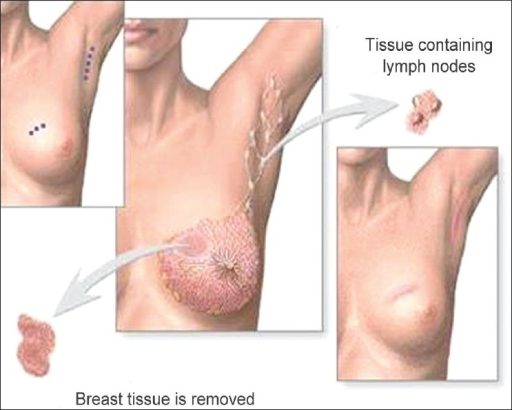
Cirugía conservadora del seno (tumorectomía)

Cirugía conservadora de la mama (tumorectomía): escisión del tumor hasta los márgenes negativos y evaluación de los ganglios linfáticos axilares

Imagen: “Phantom breast syndrome” por Indian Journal of Palliative Care. Licencia: CC BY 2.0.

Cáncer en EN Erythema nodosum is an immune-mediated panniculitis (inflammation of the subcutaneous fat) caused by a type IV (delayed-type) hypersensitivity reaction. It commonly manifests in young women as tender, erythematous nodules on the shins. Erythema Nodosum estadio temprano

  • Cirugía:
    • Cirugía conservadora de la mama o mastectomía
    • Evaluación de ganglios linfáticos axilares realizada con biopsia de ganglio centinela (si es positiva se realiza disección axilar)
  • Radioterapia en EN Erythema nodosum is an immune-mediated panniculitis (inflammation of the subcutaneous fat) caused by a type IV (delayed-type) hypersensitivity reaction. It commonly manifests in young women as tender, erythematous nodules on the shins. Erythema Nodosum la mayoría de los LOS Neisseria casos (si se realiza cirugía conservadora de la mama y para aquellos con riesgo de recurrencia local)
  • Terapia adyuvante o sistémica administrada además de la cirugía:
    • Terapia endocrina:
      • Para pacientes positivas para receptores hormonales (RE/RP)
      • Inhibidores de la aromatasa o tamoxifeno
    • Terapia dirigida a HER2 HER2 A cell surface protein-tyrosine kinase receptor that is overexpressed in a variety of adenocarcinomas. It has extensive homology to and heterodimerizes with the EGF receptor, the ERBB-3 receptor, and the ERBB-4 receptor. Activation of the erbB-2 receptor occurs through heterodimer formation with a ligand-bound erbB receptor family member. Targeted and Other Nontraditional Antineoplastic Therapy:
    • Quimioterapia (doxorrubicina + ciclofosfamida, luego paclitaxel Paclitaxel A cyclodecane isolated from the bark of the pacific yew tree, taxus brevifolia. It stabilizes microtubules in their polymerized form leading to cell death. Microtubule and Topoisomerase Inhibitors):
      • Para cáncer de mama triple negativo (≥ 0,5 cm)
      • Para cánceres HER2 HER2 A cell surface protein-tyrosine kinase receptor that is overexpressed in a variety of adenocarcinomas. It has extensive homology to and heterodimerizes with the EGF receptor, the ERBB-3 receptor, and the ERBB-4 receptor. Activation of the erbB-2 receptor occurs through heterodimer formation with a ligand-bound erbB receptor family member. Targeted and Other Nontraditional Antineoplastic Therapy positivos (> 1 cm)
      • Para cánceres con receptores hormonales positivos (con características de alto riesgo: ≥ 2 cm de tamaño, + ganglios linfáticos, lesiones de alto grado)

Cáncer de mama localmente avanzado

  • Terapia sistémica neoadyuvante:
    • Terapia dirigida a HER2 HER2 A cell surface protein-tyrosine kinase receptor that is overexpressed in a variety of adenocarcinomas. It has extensive homology to and heterodimerizes with the EGF receptor, the ERBB-3 receptor, and the ERBB-4 receptor. Activation of the erbB-2 receptor occurs through heterodimer formation with a ligand-bound erbB receptor family member. Targeted and Other Nontraditional Antineoplastic Therapy + quimioterapia: para cáncer HER2 HER2 A cell surface protein-tyrosine kinase receptor that is overexpressed in a variety of adenocarcinomas. It has extensive homology to and heterodimerizes with the EGF receptor, the ERBB-3 receptor, and the ERBB-4 receptor. Activation of the erbB-2 receptor occurs through heterodimer formation with a ligand-bound erbB receptor family member. Targeted and Other Nontraditional Antineoplastic Therapy positivo
    • Quimioterapia administrada 1ro para el cáncer con receptores hormonales positivos
    • Quimioterapia administrada para el cáncer de mama triple negativo
  • La cirugía (cirugía conservadora de la mama o mastectomía + evaluación de ganglios linfáticos) sigue a la terapia neoadyuvante.
  • Terapia adyuvante:
    • Administrada si no hubo terapia neoadyuvante (principios similares a los LOS Neisseria del cáncer en EN Erythema nodosum is an immune-mediated panniculitis (inflammation of the subcutaneous fat) caused by a type IV (delayed-type) hypersensitivity reaction. It commonly manifests in young women as tender, erythematous nodules on the shins. Erythema Nodosum estadio temprano)
    • Para pacientes que recibieron terapia neoadyuvante:
      • Terapia endocrina o terapia dirigida a HER2 HER2 A cell surface protein-tyrosine kinase receptor that is overexpressed in a variety of adenocarcinomas. It has extensive homology to and heterodimerizes with the EGF receptor, the ERBB-3 receptor, and the ERBB-4 receptor. Activation of the erbB-2 receptor occurs through heterodimer formation with a ligand-bound erbB receptor family member. Targeted and Other Nontraditional Antineoplastic Therapy continuada según lo indicado
      • El uso de quimioterapia está dictado por el estado clínico y las características del tumor Tumor Inflammation.
  • Radioterapia

Cáncer de mama metastásico

  • Terapia sistémica:
    • Inhibidores de la aromatasa con/sin quimioterapia para los LOS Neisseria cánceres positivos para RE
    • Trastuzumab Trastuzumab A humanized monoclonal antibody against the ErbB-2 receptor (HER2). As an antineoplastic agent, it is used to treat breast cancer where HER2 is overexpressed. Targeted and Other Nontraditional Antineoplastic Therapy con quimioterapia para cánceres HER2 HER2 A cell surface protein-tyrosine kinase receptor that is overexpressed in a variety of adenocarcinomas. It has extensive homology to and heterodimerizes with the EGF receptor, the ERBB-3 receptor, and the ERBB-4 receptor. Activation of the erbB-2 receptor occurs through heterodimer formation with a ligand-bound erbB receptor family member. Targeted and Other Nontraditional Antineoplastic Therapy positivos
    • Quimioterapia para los LOS Neisseria cánceres con receptores negativos
    • Inmunoterapia (inhibidores del punto de control inmunitario)
  • Radioterapia para los LOS Neisseria cuidados paliativos

Pronóstico

  • Supervivencia a los LOS Neisseria 10 años:
    • Estadio 0 (carcinoma ductal in situ): 97%
    • Estadio I: 87%
    • Estadio II: 65%
    • Estadio III: 40%
    • Estadio IV: 5%
  • Con metástasis a distancia, no hay cura.

Diagnóstico Diferencial

  • Fibroadenoma Fibroadenoma Fibroadenomas are the most common benign tumor of the female breast and the most common breast tumor in adolescent and young women. The tumors are well-circumscribed, mobile, and unencapsulated, with a rubbery or firm consistency. Fibroadenoma: tumores mamarios benignos que surgen en EN Erythema nodosum is an immune-mediated panniculitis (inflammation of the subcutaneous fat) caused by a type IV (delayed-type) hypersensitivity reaction. It commonly manifests in young women as tender, erythematous nodules on the shins. Erythema Nodosum mujeres jóvenes. El diagnóstico se basa en EN Erythema nodosum is an immune-mediated panniculitis (inflammation of the subcutaneous fat) caused by a type IV (delayed-type) hypersensitivity reaction. It commonly manifests in young women as tender, erythematous nodules on the shins. Erythema Nodosum el hallazgo físico de una masa mamaria móvil y no sensible. Algunos fibroadenomas son asintomáticos, de tamaño pequeño y deben tratarse de forma conservadora. Otros fibroadenomas crecen rápidamente en EN Erythema nodosum is an immune-mediated panniculitis (inflammation of the subcutaneous fat) caused by a type IV (delayed-type) hypersensitivity reaction. It commonly manifests in young women as tender, erythematous nodules on the shins. Erythema Nodosum tamaño, son sintomáticos y deben extirparse quirúrgicamente.
  • Necrosis Necrosis The death of cells in an organ or tissue due to disease, injury or failure of the blood supply. Ischemic Cell Damage grasa de la mama: afección benigna causada por un traumatismo en EN Erythema nodosum is an immune-mediated panniculitis (inflammation of the subcutaneous fat) caused by a type IV (delayed-type) hypersensitivity reaction. It commonly manifests in young women as tender, erythematous nodules on the shins. Erythema Nodosum la mama, que puede pasar desapercibida, dando lugar a necrosis Necrosis The death of cells in an organ or tissue due to disease, injury or failure of the blood supply. Ischemic Cell Damage y calcificación de los LOS Neisseria adipocitos. Las pacientes pueden presentar una masa sólida e indolora con o sin cambios en EN Erythema nodosum is an immune-mediated panniculitis (inflammation of the subcutaneous fat) caused by a type IV (delayed-type) hypersensitivity reaction. It commonly manifests in young women as tender, erythematous nodules on the shins. Erythema Nodosum la piel. La necrosis Necrosis The death of cells in an organ or tissue due to disease, injury or failure of the blood supply. Ischemic Cell Damage grasa de la mama puede simular malignidad y el diagnóstico definitivo se realiza mediante imagenología y biopsia.
  • Mastitis Mastitis Mastitis is inflammation of the breast tissue with or without infection. The most common form of mastitis is associated with lactation in the first few weeks after birth. Non-lactational mastitis includes periductal mastitis and idiopathic granulomatous mastitis (IGM). Mastitis: inflamación del tejido de la glándula mamaria que puede estar asociada a la lactancia o no asociada a la lactancia. La mastitis Mastitis Mastitis is inflammation of the breast tissue with or without infection. The most common form of mastitis is associated with lactation in the first few weeks after birth. Non-lactational mastitis includes periductal mastitis and idiopathic granulomatous mastitis (IGM). Mastitis es más común en EN Erythema nodosum is an immune-mediated panniculitis (inflammation of the subcutaneous fat) caused by a type IV (delayed-type) hypersensitivity reaction. It commonly manifests in young women as tender, erythematous nodules on the shins. Erythema Nodosum mujeres en EN Erythema nodosum is an immune-mediated panniculitis (inflammation of the subcutaneous fat) caused by a type IV (delayed-type) hypersensitivity reaction. It commonly manifests in young women as tender, erythematous nodules on the shins. Erythema Nodosum edad fértil. Las pacientes generalmente presentan fiebre alta, escalofríos, fatiga, malestar general y mialgia. Como parte del tratamiento se administran analgésicos y antibióticos.
  • Absceso mamario: masa mamaria asociada a la mastitis Mastitis Mastitis is inflammation of the breast tissue with or without infection. The most common form of mastitis is associated with lactation in the first few weeks after birth. Non-lactational mastitis includes periductal mastitis and idiopathic granulomatous mastitis (IGM). Mastitis. El absceso mamario se presenta como una masa unilateral y fluctuante, acompañada de fiebre y una mama dolorosa, eritematosa y edematosa. Los LOS Neisseria antecedentes, los LOS Neisseria hallazgos físicos y la aspiración con aguja (que revela contenido purulento) ayudan a diferenciar un absceso mamario. El tratamiento incluye incisión y drenaje, con antibióticos.
  • Papilomas intraductales: crecimientos anormales con una configuración papilar del estroma mamario y el epitelio dentro de un conducto mamario. La característica de presentación más común es la secreción sanguinolenta o serosa del pezón. La biopsia con aguja gruesa confirma el diagnóstico.
  • Quiste mamario simple: masas redondas u ovaladas llenas de líquido de la unidad lobulillar del conducto terminal. Un quiste se siente como una masa palpable que puede causar dolor Dolor Inflammation. El ultrasonido muestra un quiste como una masa anecoica bien delimitada sin componentes sólidos.

Referencias

  1. Bleiweiss, I., Chagpar, A., & Vora, S. (2020). Pathology of breast cancer. UpToDate. Retrieved Jan 15, 2021, from https://www.uptodate.com/contents/pathology-of-breast-cancer
  2. Hao, S., Zhao, YY., Peng, JJ., et al. (2019). Invasive micropapillary carcinoma of the breast had no difference in prognosis compared with invasive ductal carcinoma: a propensity-matched analysis. Sci Rep 9, 286. https://doi.org/10.1038/s41598-018-36362-8
  3. Hayes D.F., & Lippman M.E. (2018). Breast cancer. In Jameson JL, et al. (Ed.), Harrison’s Principles of Internal Medicine, 20th ed. McGraw-Hill.
  4. Lester, S. (2020). The breast. In Kumar, V., Abbas, A. K., Aster, J.C., (Eds.), Robbins & Cotran Pathologic Basis of Disease. (10th ed. pp. 1037–1064).
  5. Moasser M.M., & Ai W.Z. (2019). Neoplasia. In Hammer G.D., & McPhee S.J. (Eds.), Pathophysiology of Disease: An Introduction to Clinical Medicine, 8th ed. McGraw-Hill.
  6. Nascimento, R., & Otoni, K. (2020). Histological and molecular classification of breast cancer: What do we know? Mastology. https://www.mastology.org/wp-content/uploads/2020/09/MAS_2020024_AOP.pdf
  7. Polyak, K. (2007). Breast cancer: Origins and evolution. J Clin Invest. 117(11), 3155–63. https://doi.org/10.1172/JCI33295
  8. Taghian, A., Meravjer, S., Hayes, D., & Vora, S. (2020). Overview of the treatment of newly diagnosed, invasive, non-metastatic breast cancer. UpToDate. Retrieved Jan 16, 2021, from https://www.uptodate.com/contents/overview-of-the-treatment-of-newly-diagnosed-invasive-non-metastatic-breast-cancer

¡Crea tu cuenta gratis o inicia una sesión para seguir leyendo!

Regístrate ahora y obtén acceso gratuito a Lecturio con páginas de concepto, videos médicos y cuestionarios para tu educación médica.

User Reviews

Que tengas una sesión de estudio alegre y navideña 🎁 Ahorra 50% en todos los planes >>

Details