

You’ve probably already seen the HESI or TEAS mentioned in the Admissions requirements lists. Most schools ask you to take at least one of these exams, and they’ll also want to see a minimum passing grade.
But what is the point of these exams? Which one is easiest? Which one is better? Do you only get one chance?
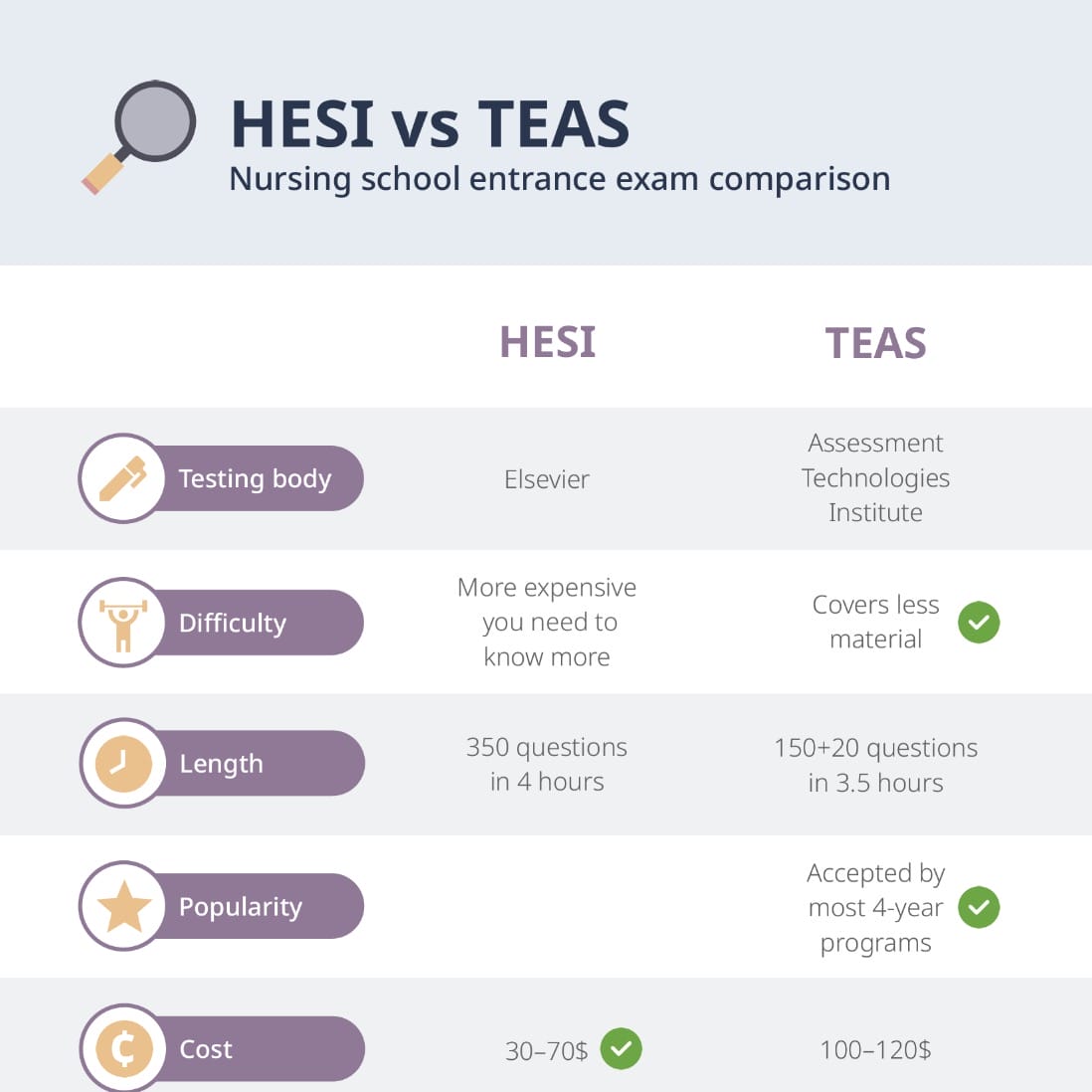
FREE Download: HESI vs TEAS comparison at a glance!
What Is the Point of Nursing School Entrance Exams?
Currently, the United States isn’t just dealing with a nursing shortage – we are also dealing with a nursing instructor shortage. There are only so many lecturers to go around, which limits the number of spots that nursing schools can offer yearly.
As a result, nursing schools now have competitive admission processes. The biggest and best-ranked universities can select the best applicants who are most likely to make it through nursing school, graduate, and pass the NCLEX. In turn, the more students who succeed, the better the school’s passing ratio will be, improving the school’s rankings the following year.
As part of this process, entrance exams fulfill two roles:
- They provide an objective number that will compare your knowledge against all other applicants’
- They serve as proof that you will be able to handle the academic rigor of nursing school
Basics of the HESI Exam
Designed by Elsevier – a well-known name in academic publishing – the Health Education Systems Inc. assessment is a family of tests designed for healthcare students.
There are different HESI versions designed for RN and LPN programs, as well as Advanced Practical Registered Nurses, Paramedicine, and Dentistry. Each version will slightly alter its questions and grading practice to match the course you want. There are even “follow-up” HESI assessments that are meant to be taken at specific points during Nursing school or right before graduation!
When applying for a Bachelor of Science in Nursing, you will most likely be required to take the HESI A2 test. This exam usually has at least seven sections:
- Reading comprehension
- Vocabulary
- Grammar
- Mathematics
- Biology
- Chemistry
- Anatomy and Physiology
Some schools request that candidates take additional sections to determine their learning style and personality profile. These don’t test any extra knowledge, so there won’t be any extra materials to study – but they will cost a bit extra.
Finally, a “critical thinking” section tests your ability to analyze controversial data or make decisions in specific scenarios. This is not something you can study, but you can practice for it!
HESI A2 section selection and timing depend on the school’s configuration. Confirm required sections, testing window, and retake policy with the program. Most questions in the Mathematics, Biology, and Anatomy and Physiology sections will be multiple choice. You will also see some “fill in the blanks” questions for the Vocabulary and Grammar sections.
Either way, expect all sections to be very healthcare-oriented. Even the reading comprehension section will deal with a biology-related topic or will present a hospital case.
After taking the test, you’ll receive a separate score for each section. HESI A2 scores are reported by section, but each program sets the scores and sections it accepts. Use the receiving school’s policy.
About the TEAS Exam
Run by the Assessment Technologies Institute (ATI), the Test of Essential Academic Skills (TEAS) strongly focuses on general academic fitness. This exam includes just four sections:
- Reading comprehension
- Mathematics
- Science
- English and language usage
ATI TEAS Version 7 contains 170 questions and allows 209 minutes. Twenty questions are unscored pretest items.
One crucial quirk about the TEAS is their “equating” grading system. This means that not all questions carry the same weight: instead, each question is internally ranked according to its difficulty, and the points it gives you will be “equated” with its difficulty. The catch? You don’t get to see whether you’re dealing with a tricky or easy question (but you may notice anyway).
You will get your TEAS scores as a composite report, with an overall total grade and sub-scores for each content area. Each program sets its own TEAS policy, including accepted mode, attempts, waiting periods, and minimum scores.
Comparing Both Exams: Which One Is…?
There are probably hours of debate somewhere online comparing the advantages and methodologies of both the HESI and the TEAS. But perhaps you’ll be more interested in a quick rundown of the features that apply to you.
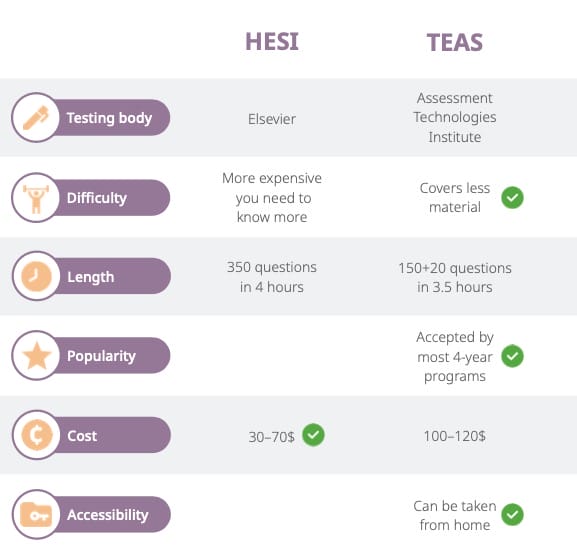
So between the TEAS and the HESI, is there one that is…
Harder?
Depends on what’s hard for you! Is the HESI exam hard? Both are, but the HESI undoubtedly covers a lot more material, so it will require a more organized review schedule. It’s also longer and has more questions, which can be stressful.
At the same time, more questions mean a bit of extra wiggle room when making a few errors. On the TEAS, just one or two questions can cost you a lot of points, especially if it’s one of the “harder” questions, which are worth more.
Cheaper?
TEAS at ATI and TEAS at PSI exams are $120. Institution and testing-center prices can vary with added fees.
HESI A2 pricing depends on the school’s sections and testing arrangement. Use the program’s registration total rather than a national range.
Longer?
Definitely the HESI. It takes four hours instead of three and a half, and the syllabus is longer, so you’ll need to start studying sooner.
More popular?
I couldn’t find any exact figures showing how many nursing schools request one exam over the other – in fact, some of them will take either. I can tell you that, as an overall trend, the HESI seems to be more popular among accelerated BSN or “bridge” programs (which allow a Licensed Practical Nurse to become a Registered Nurse).
With its stronger focus on general knowledge and academic aptitude, the TEAS is usually accepted by traditional four-year programs. But check with your school first!
More accessible?
Technically, the TEAS offers more accessible options, as ATI allows you to take a “proctored” exam from home. You’ll need to read the system requirements carefully before opting for this option, though: in addition to stable connectivity, you’ll need a webcam, a microphone, and to check which other software you have running in the background.
Take the Course: Nursing School Survival Guide RN
Nurse Liz has been there herself. Learn from her experience as she shares all her inside tips and tricks for every stop of nursing school.
How to Study for Your Nursing School Entrance Exam
Ultimately, the choice between the TEAS and the HESI will not be up to you – your school will decide. But as competition is fierce these days, there’s a good chance that you’ll be applying to several nursing schools at once. So how should you prepare?
1. Target the HESI
If there’s any chance you’ll have to take the HESI, are not sure which one you’ll be asked for, or will apply to several schools, then plan to study for the HESI. Why? Because it covers many more topics, so it will take you longer to go through everything. Meanwhile, all the topics in the TEAS should be included in the HESI syllabus.
2. Start with a simulation
It’s hard to focus your efforts without knowing your weak spots. So before you start filling in your calendar with vague “study sessions,” take a practice test online. This will show you which area is your weakest and help you identify which types of questions to expect (and which ones are most troublesome).
3. Follow a program
These exams require some guidance, whether it’s an online course, a question bank, or an exam-specific study book. Ideally, you should start preparing at least six weeks before your actual exam.
If possible, take a second simulation exam mid-way through your study period and compare your results with your first try. Make sure you schedule extra time for your weakest area, do a few practice questions daily, and include a “final review” of each topic in the final week before your exam.
4. Aim for the highest possible score
A “minimum passing grade” is not a guarantee of admission! So even if you feel confident or did very well on a practice exam, you should still study and try to get the best possible score for your test.
Standardized exams are intimidating but can help create a winning nursing school application. This is not the end of the road! Nursing school admission usually requires an essay, recommendation letters, and an interview. Stay tuned to learn how to show your best self at each stage.
Frequently Asked Questions (FAQs)
1. What’s the difference between the HESI and TEAS nursing entrance exams?
The HESI A2, published by Elsevier, is healthcare-focused and typically covers seven sections — reading comprehension, vocabulary, grammar, math, biology, chemistry, and anatomy & physiology. The TEAS, administered by ATI, tests general academic skills across four sections: reading, math, science, and English/language usage. Most nursing schools require one or the other, and a few will accept either.
2. Which exam is harder, the HESI or the TEAS?
It depends on your strengths. The HESI covers far more material and takes longer, requiring a more organized study schedule, but its higher question count gives you more room to miss a few without major damage. The TEAS uses an “equating” system where harder questions are worth more points, so a single missed question — especially a high-difficulty one — can cost you more.
3. How much do the HESI and TEAS exams cost?
The TEAS costs $120 at ATI or PSI testing centers, though institution and testing-center fees can add to that. HESI A2 pricing varies by school depending on which sections are required and how the test is administered, so it’s best to check the exact total with your program’s registration process.
4. Which exam takes longer to complete?
The HESI is the longer exam, running about four hours compared to the TEAS’s three and a half. The TEAS (Version 7) consists of 170 questions, including 20 unscored pretest items, over 209 minutes. The HESI’s longer syllabus also means it generally requires more advance study time.
5. How should I study if I’m not sure which exam I’ll need to take?
Since the HESI’s syllabus covers most of the topics found on the TEAS, it’s the safer one to prepare for if you’re uncertain or applying to multiple schools. A good strategy: take a practice exam first to spot weak areas, follow a structured study program starting at least six weeks out, take a second practice test midway through, and aim for the highest score possible rather than just the minimum passing grade.