


Vírus Coxsackie

O vírus Coxsackie é um membro de uma família de vírus chamada Picornaviridae Picornaviridae A family of small RNA viruses comprising some important pathogens of humans and animals. Transmission usually occurs mechanically. There are nine genera: aphthovirus; cardiovirus; enterovirus; erbovirus; hepatovirus; kobuvirus; parechovirus; rhinovirus; and teschovirus. Coxsackievirus e do género Enterovirus Enterovirus A genus of the family picornaviridae whose members preferentially inhabit the intestinal tract of a variety of hosts. The genus contains many species. Newly described members of human enteroviruses are assigned continuous numbers with the species designated 'human enterovirus'. Coxsackievirus. Os vírus Coxsackie são vírus de RNA RNA A polynucleotide consisting essentially of chains with a repeating backbone of phosphate and ribose units to which nitrogenous bases are attached. RNA is unique among biological macromolecules in that it can encode genetic information, serve as an abundant structural component of cells, and also possesses catalytic activity. RNA Types and Structure de sentido positivo, de cadeia simples, e são divididos em vírus coxsackie do grupo A e B. Ambos os grupos de vírus causam infeções respiratórias superiores, rash Rash Rocky Mountain Spotted Fever cutâneos, meningite asséptica ou encefalite. Os vírus do grupo A causam herpangina Herpangina Acute types of coxsackievirus infections or echovirus infections that usually affect children during the summer and are characterized by vesiculoulcerative lesions on the mucous membranes of the throat; dysphagia; vomiting, and fever. Coxsackievirus; doença mão-pé-boca; e conjuntivite hemorrágica aguda. Os vírus do grupo B causam miopericardite, pleurodinia epidémica e doença neonatal sistémica. Os diagnósticos são geralmente feitos clinicamente. Podem ser realizadas cultura viral e PCR PCR Polymerase chain reaction (PCR) is a technique that amplifies DNA fragments exponentially for analysis. The process is highly specific, allowing for the targeting of specific genomic sequences, even with minuscule sample amounts. The PCR cycles multiple times through 3 phases: denaturation of the template DNA, annealing of a specific primer to the individual DNA strands, and synthesis/elongation of new DNA molecules. Polymerase Chain Reaction (PCR) para confirmação, se o diagnóstico for incerto. As infeções por vírus Coxsackie são autolimitadas e o tratamento é de suporte.

Last updated: Dec 15, 2025
Editorial responsibility: Stanley Oiseth, Lindsay Jones, Evelin Maza

Classificação

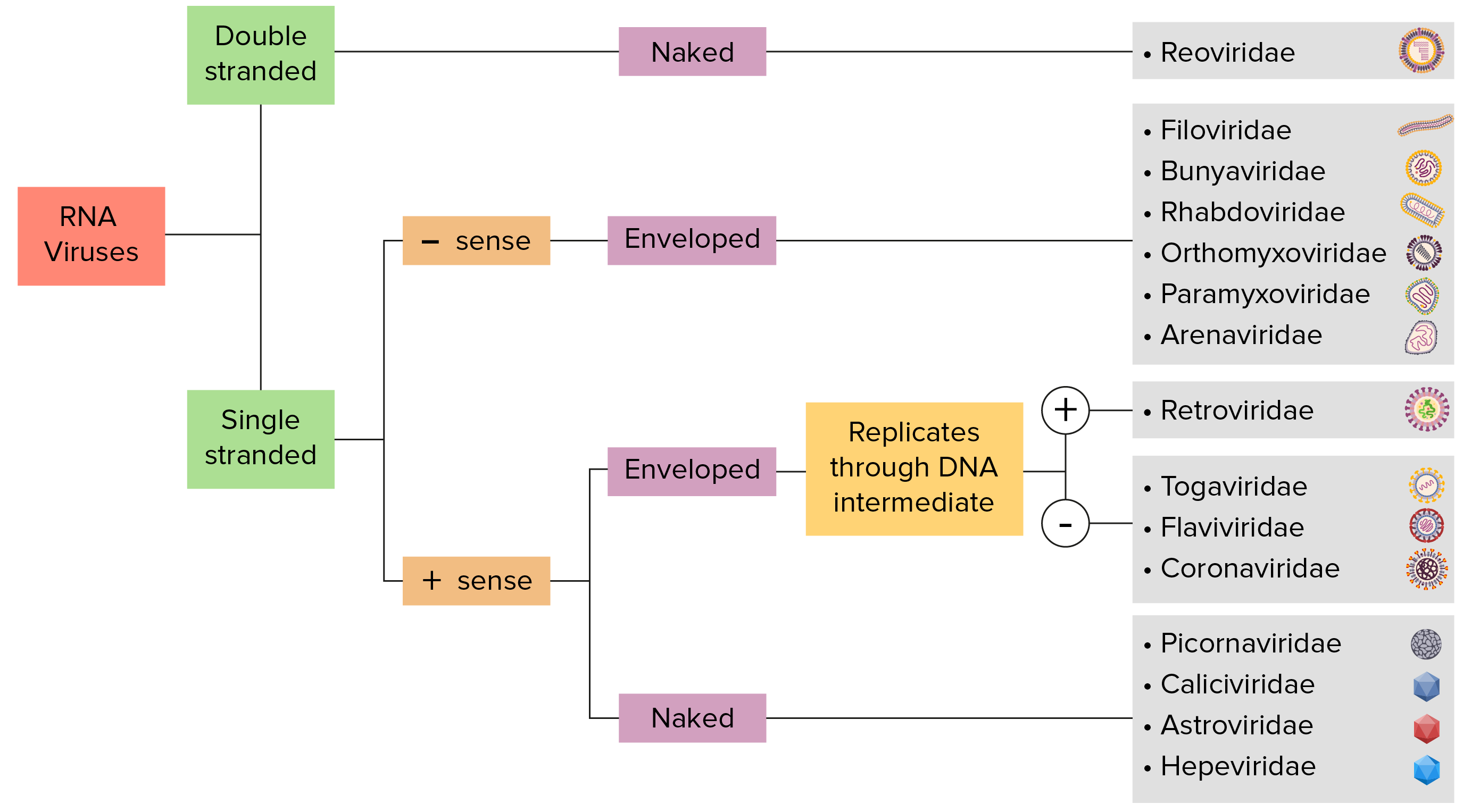
Classificação do fluxograma de vírus de RNA

Identificação do vírus RNA:
Os vírus podem ser classificados de várias maneiras. A maioria dos vírus, no entanto, terá um genoma formado por DNA ou RNA. Os vírus de genoma de RNA podem ser ainda caracterizados por um RNA de cadeia simples ou dupla. Os vírus “envelopados” são cobertos por uma fina camada de membrana celular (geralmente retirada da célula hospedeira). Se a camada estiver ausente, os vírus são chamados de vírus “nus”. Os vírus com genomas de cadeia simples são vírus de “sentido positivo” se o genoma for usado diretamente como RNA mensageiro (mRNA), que é traduzido em proteínas. Os vírus de “sentido negativo” usam a RNA polimerase dependente de RNA, uma enzima viral, para transcrever o seu genoma em RNA mensageiro.
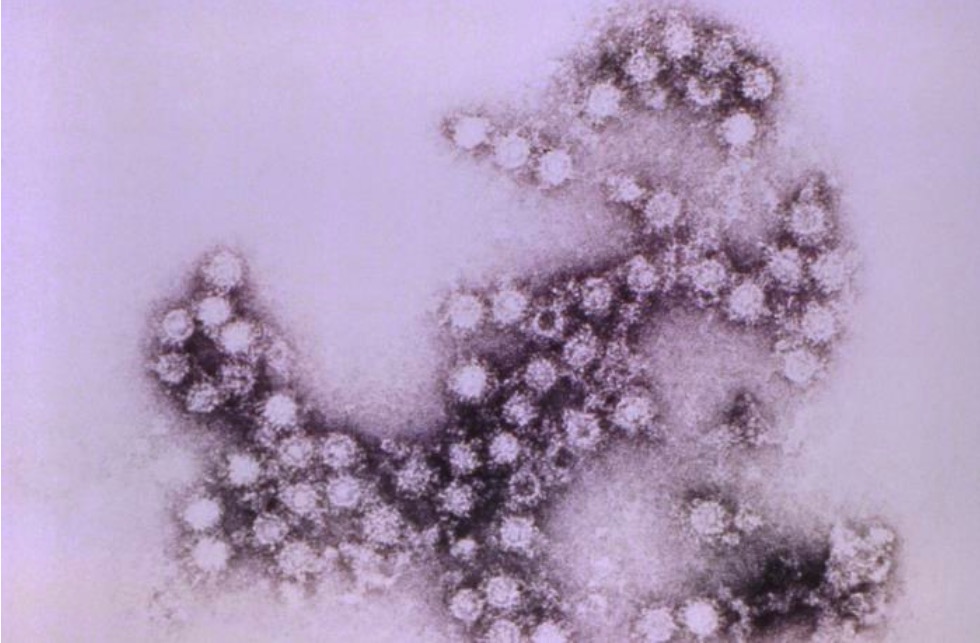
Imagem por Lecturio. Licença: CC BY-NC-SA 4.0

Características Gerais e Epidemiologia

Características gerais do vírus Coxsackie

  • Família: Picornaviridae Picornaviridae A family of small RNA viruses comprising some important pathogens of humans and animals. Transmission usually occurs mechanically. There are nine genera: aphthovirus; cardiovirus; enterovirus; erbovirus; hepatovirus; kobuvirus; parechovirus; rhinovirus; and teschovirus. Coxsackievirus
  • Género: Enterovírus
  • Vírus RNA RNA A polynucleotide consisting essentially of chains with a repeating backbone of phosphate and ribose units to which nitrogenous bases are attached. RNA is unique among biological macromolecules in that it can encode genetic information, serve as an abundant structural component of cells, and also possesses catalytic activity. RNA Types and Structure:
    • Linear
    • Cadeia simples
    • Sentido positivo
    • Funciona como mRNA mRNA RNA sequences that serve as templates for protein synthesis. Bacterial mRNAs are generally primary transcripts in that they do not require post-transcriptional processing. Eukaryotic mRNA is synthesized in the nucleus and must be exported to the cytoplasm for translation. Most eukaryotic mRNAs have a sequence of polyadenylic acid at the 3′ end, referred to as the poly(a) tail. The function of this tail is not known for certain, but it may play a role in the export of mature mRNA from the nucleus as well as in helping stabilize some mRNA molecules by retarding their degradation in the cytoplasm. RNA Types and Structure
  • Diâmetro: aproximadamente 30 nm
  • Simetria icosaédrica
  • Sem envelope Envelope Bilayer lipid membrane acquired by viral particles during viral morphogenesis. Although the lipids of the viral envelope are host derived, various virus-encoded integral membrane proteins, i.e. Viral envelope proteins are incorporated there. Virology lipídico
  • Vírus estáveis em ácido
Vírus Coxsackie B4

Imagem de microscopia eletrónica de transmissão (TEM, pela sigla em inglês) que representa vários virions redondos do vírus Coxsackie B4

Imagem: “5630” por CDC. Licença: Public Domain

Espécies clinicamente relevantes

Vírus Coxsackie do grupo A (23 sorotipos):

  • Herpangina Herpangina Acute types of coxsackievirus infections or echovirus infections that usually affect children during the summer and are characterized by vesiculoulcerative lesions on the mucous membranes of the throat; dysphagia; vomiting, and fever. Coxsackievirus
  • Doença mão-pé-boca (HFMD, pela sigla em inglês): o mais MAIS Androgen Insensitivity Syndrome frequentemente implicado é o Coxsackievirus Coxsackievirus Coxsackievirus is a member of a family of viruses called Picornaviridae and the genus Enterovirus. Coxsackieviruses are single-stranded, positive-sense RNA viruses, and are divided into coxsackie group A and B viruses. Both groups of viruses cause upper respiratory infections, rashes, aseptic meningitis, or encephalitis. Coxsackievirus A16 (bem como o Enterovirus Enterovirus A genus of the family picornaviridae whose members preferentially inhabit the intestinal tract of a variety of hosts. The genus contains many species. Newly described members of human enteroviruses are assigned continuous numbers with the species designated ‘human enterovirus’. Coxsackievirus A71)
  • Conjuntivite hemorrágica aguda

Vírus Coxsackie do grupo B (6 sorotipos):

  • Miopericardite
  • Pleurodinia
  • Hepatite
  • Doença neonatal

Ambos os grupos podem causar:

  • Infeção do trato respiratório superior
  • Meningite asséptica
  • Encefalite
  • Exantemas

Epidemiologia

Patogénese

Reservatório

Os humanos são o único reservatório.

Transmissão

  • Via fecal-oral
  • Aerossóis respiratórios

Fisiopatologia

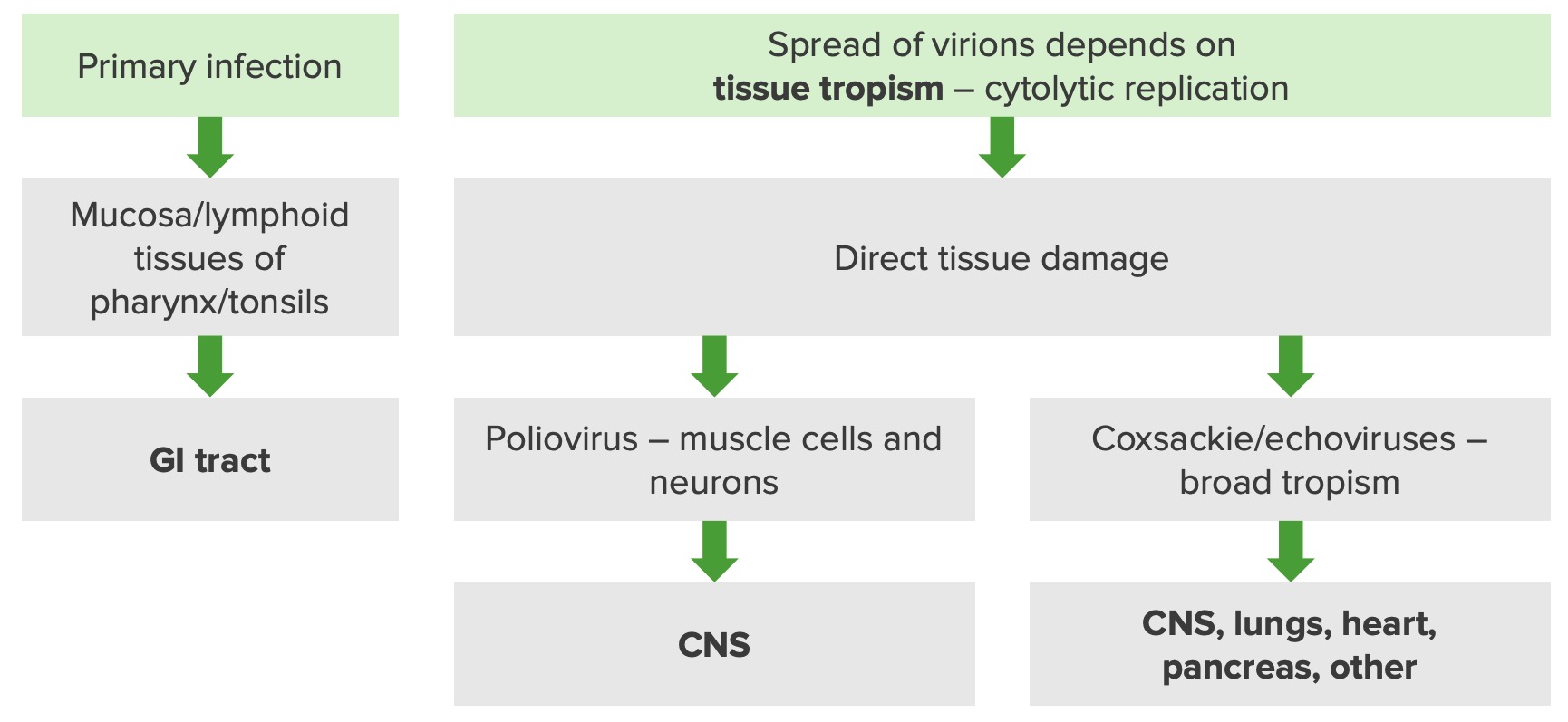
  • Entrada do vírus via oral → replicação no tecido linfático submucoso da faringe e intestino
  • Disseminação para gânglios linfáticos regionais → replicação
  • Viremia Viremia The presence of viruses in the blood. Erythema Infectiosum assintomática → sistema e órgãos reticuloendoteliais:
    • SNC
    • Pulmões e pleura Pleura The pleura is a serous membrane that lines the walls of the thoracic cavity and the surface of the lungs. This structure of mesodermal origin covers both lungs, the mediastinum, the thoracic surface of the diaphragm, and the inner part of the thoracic cage. The pleura is divided into a visceral pleura and parietal pleura. Pleura: Anatomy
    • Coração
    • Pâncreas
    • Fígado
    • Pele e membranas mucosas
  • Replicação nestes locais → morte celular e inflamação → manifestações clínicas
Patogênese dos enterovírus

Patogénese dos enterovírus:
Os vírus Coxsackie inicialmente entram e infetam os tecidos linfoides. A viremia ocorre, permitindo a disseminação para outros locais, como sistema nervoso central, pulmões, coração e pele.

Imagem por Lecturio. Licença: CC BY-NC-SA 4.0

Apresentação Clínica

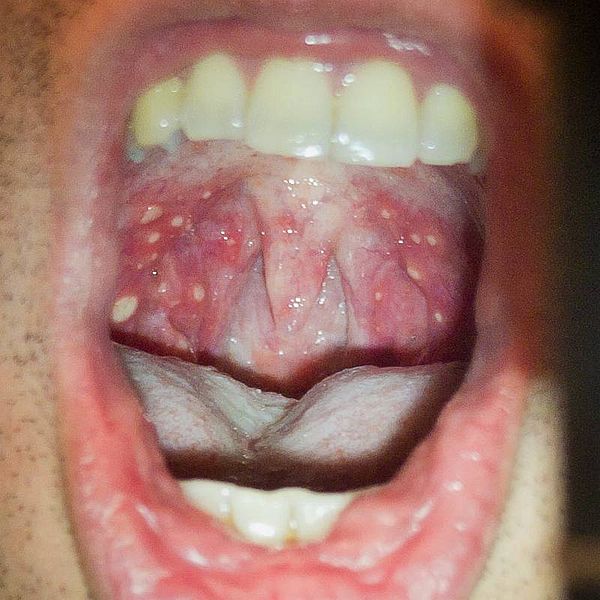
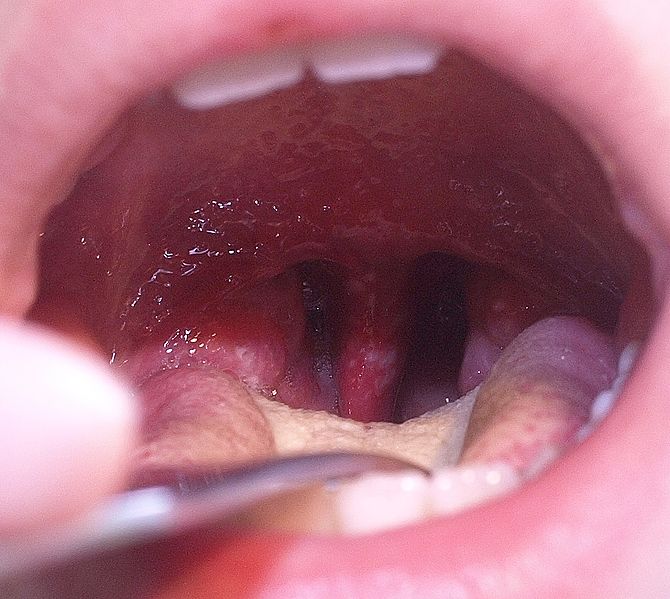
Herpangina Herpangina Acute types of coxsackievirus infections or echovirus infections that usually affect children during the summer and are characterized by vesiculoulcerative lesions on the mucous membranes of the throat; dysphagia; vomiting, and fever. Coxsackievirus

Os vírus Coxsackie do grupo A são a principal causa desta doença autolimitada.

Sintomas:

  • Febre
  • Faringite
  • Disfagia
  • Cefaleia
  • Odinofagia

Achados do exame objetivo:

  • Lesões vesiculares com eritema circundante de:
    • Amígdalas
    • Palato mole Mole Nevi (singular nevus), also known as “moles,” are benign neoplasms of the skin. Nevus is a non-specific medical term because it encompasses both congenital and acquired lesions, hyper- and hypopigmented lesions, and raised or flat lesions. Nevus/Nevi
    • Úvula
    • Língua
  • As lesões evoluem para úlceras superficiais antes da cicatrização.

Doença mão-pé-boca

A doença da mão-pé-boca é uma doença leve e autolimitada, causada pelo vírus Coxsackie do grupo A.

Sintomas:

  • Febre
  • Dor na boca
  • Faringite
  • Anorexia Anorexia The lack or loss of appetite accompanied by an aversion to food and the inability to eat. It is the defining characteristic of the disorder anorexia nervosa. Anorexia Nervosa
  • Mal-estar

Achados do exame objetivo:

  • Enantema oral:
    • Máculas inicialmente eritematosas
    • Progride para vesículas com eritema circundante
    • Eventual rutura → úlceras superficiais com base cinza-amarelada
    • Mais MAIS Androgen Insensitivity Syndrome frequentemente envolvem a língua e a mucosa bucal
  • Exantema:
    • Aparência pode ser:
      • Macular
      • papular
      • Vesicular
    • Não doloroso ou pruriginoso
    • Localizações:
      • Mãos (palmas)
      • Pés (solas dos pés)
      • Nádegas
      • Pernas
      • Braços
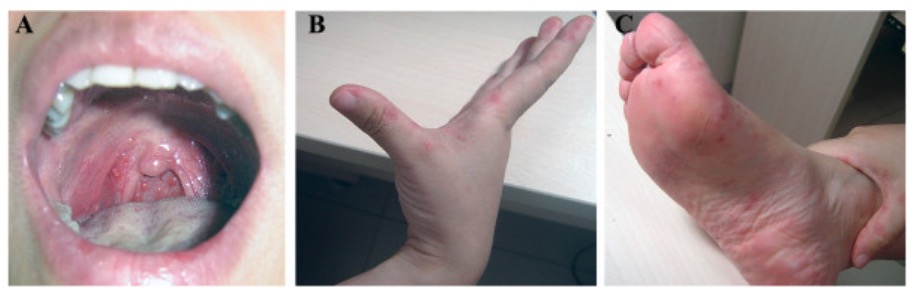
Apresentação da doença mão-pé-boca

Doente adulto com doença mão-pé-boca:
A: Enantema oral
B e C: Exantema nas mãos e pés

Imagem: “A typical adult HFMD patient” por Department of Infectious Diseases, Centre for Gastroenterology and Hepatology, The First Affiliated Hospital of Jiaxing College, 1882 Central-South Road, Jiaxing 314001, Zhejiang Province, People’s Republic of China. Licença: CC BY 4.0

Outras manifestações

Tabela: Apresentações adicionais de infeções por vírus Coxsackie
Condição Grupo Coxsackie Sinais e sintomas
Conjuntivite hemorrágica aguda A
  • Edema Edema Edema is a condition in which excess serous fluid accumulates in the body cavity or interstitial space of connective tissues. Edema is a symptom observed in several medical conditions. It can be categorized into 2 types, namely, peripheral (in the extremities) and internal (in an organ or body cavity). Edema da pálpebra
  • Dor
  • Fotofobia
  • Hemorragia subconjuntival
Pleurodinia epidémica (doença de Bornholm) B
  • Dor torácica súbita, aguda e paroxística
  • Desconforto da musculatura do tronco
  • Febre
  • Cefaleia
  • Fadiga
Miocardite B
  • Sintomas semelhantes à gripe
  • Dispneia
  • Dor torácica
  • Fadiga
Doença neonatal B
  • Febre
  • Letargia
  • Dificuldade respiratória
  • Encefalite
  • Hepatite
  • Miocardite (insuficiência cardíaca)
Exantema A e B
Meningite asséptica A e B
Encefalite A e B
  • Letargia
  • Alterações de personalidade
  • Parésia
  • Convulsões
  • Coma Coma Coma is defined as a deep state of unarousable unresponsiveness, characterized by a score of 3 points on the GCS. A comatose state can be caused by a multitude of conditions, making the precise epidemiology and prognosis of coma difficult to determine. Coma
Sintomas semelhantes à gripe A e B
  • Febre
  • Mal-estar
  • Tosse
  • Cefaleia
  • Faringite
  • Congestão nasal

Diagnóstico e Tratamento

Diagnóstico

O diagnóstico é geralmente feito clinicamente. O seguinte pode ser realizado se o diagnóstico for incerto ou no caso de doença grave:

  • Cultura viral
  • PCR PCR Polymerase chain reaction (PCR) is a technique that amplifies DNA fragments exponentially for analysis. The process is highly specific, allowing for the targeting of specific genomic sequences, even with minuscule sample amounts. The PCR cycles multiple times through 3 phases: denaturation of the template DNA, annealing of a specific primer to the individual DNA strands, and synthesis/elongation of new DNA molecules. Polymerase Chain Reaction (PCR)
  • A serologia tem valor limitado.

Tratamento

A maioria das infeções por vírus Coxsackie é autolimitada e o tratamento é maioritariamente de suporte.

Prevenção

  • Minimizar o contacto com indivíduos infetados.
  • Lavagem das mãos

Comparação de Enterovírus

A tabela a seguir resume as características e doenças associadas a diferentes enterovírus:

Tabela: Comparação de enterovírus
Vírus Vírus Coxsackie Poliovírus Echovírus
Características
  • Vírus RNA RNA A polynucleotide consisting essentially of chains with a repeating backbone of phosphate and ribose units to which nitrogenous bases are attached. RNA is unique among biological macromolecules in that it can encode genetic information, serve as an abundant structural component of cells, and also possesses catalytic activity. RNA Types and Structure cadeia simples
  • Icosaédrico
  • Sem envelope Envelope Bilayer lipid membrane acquired by viral particles during viral morphogenesis. Although the lipids of the viral envelope are host derived, various virus-encoded integral membrane proteins, i.e. Viral envelope proteins are incorporated there. Virology
  • Aproximadamente 30nm
  • Vírus RNA RNA A polynucleotide consisting essentially of chains with a repeating backbone of phosphate and ribose units to which nitrogenous bases are attached. RNA is unique among biological macromolecules in that it can encode genetic information, serve as an abundant structural component of cells, and also possesses catalytic activity. RNA Types and Structure cadeia simples
  • Icosaédrico
  • Sem envelope Envelope Bilayer lipid membrane acquired by viral particles during viral morphogenesis. Although the lipids of the viral envelope are host derived, various virus-encoded integral membrane proteins, i.e. Viral envelope proteins are incorporated there. Virology
  • 25-30 nm
  • Vírus RNA RNA A polynucleotide consisting essentially of chains with a repeating backbone of phosphate and ribose units to which nitrogenous bases are attached. RNA is unique among biological macromolecules in that it can encode genetic information, serve as an abundant structural component of cells, and also possesses catalytic activity. RNA Types and Structure cadeia simples
  • Icosaédrico
  • Sem envelope Envelope Bilayer lipid membrane acquired by viral particles during viral morphogenesis. Although the lipids of the viral envelope are host derived, various virus-encoded integral membrane proteins, i.e. Viral envelope proteins are incorporated there. Virology
  • 20-30nm
Transmissão
  • Via fecal-oral
  • Aerossóis respiratórios
  • Via fecal-oral
  • Aerossóis respiratórios
  • Via fecal-oral
  • Aerossóis respiratórios
Clínico
  • URI
  • Herpangina Herpangina Acute types of coxsackievirus infections or echovirus infections that usually affect children during the summer and are characterized by vesiculoulcerative lesions on the mucous membranes of the throat; dysphagia; vomiting, and fever. Coxsackievirus
  • HFMD
  • Meningite asséptica
  • Miopericardite
  • Pleurodinia epidémica
  • Infeção neonatal
  • Doença semelhante à gripe
  • Meningite asséptica
  • Paralisia flácida assimétrica
  • Envolvimento bulbar
  • URI
  • Exantema
  • Meningite asséptica
  • Encefalite
  • Miopericardite
  • Infeção neonatal
Diagnóstico
  • Clínico
  • PCR PCR Polymerase chain reaction (PCR) is a technique that amplifies DNA fragments exponentially for analysis. The process is highly specific, allowing for the targeting of specific genomic sequences, even with minuscule sample amounts. The PCR cycles multiple times through 3 phases: denaturation of the template DNA, annealing of a specific primer to the individual DNA strands, and synthesis/elongation of new DNA molecules. Polymerase Chain Reaction (PCR)
  • Cultura viral
  • Clínico
  • PCR PCR Polymerase chain reaction (PCR) is a technique that amplifies DNA fragments exponentially for analysis. The process is highly specific, allowing for the targeting of specific genomic sequences, even with minuscule sample amounts. The PCR cycles multiple times through 3 phases: denaturation of the template DNA, annealing of a specific primer to the individual DNA strands, and synthesis/elongation of new DNA molecules. Polymerase Chain Reaction (PCR)
  • Serologia
  • Cultura viral
  • Clínico
  • PCR PCR Polymerase chain reaction (PCR) is a technique that amplifies DNA fragments exponentially for analysis. The process is highly specific, allowing for the targeting of specific genomic sequences, even with minuscule sample amounts. The PCR cycles multiple times through 3 phases: denaturation of the template DNA, annealing of a specific primer to the individual DNA strands, and synthesis/elongation of new DNA molecules. Polymerase Chain Reaction (PCR)
  • Cultura viral
Tratamento Suporte Suporte Suporte
Prevenção Lavagem das mãos Vacinação Lavagem das mãos
HFMD: doença mão-pé-boca
URI: infeção do trato respiratório superior

Diagnóstico Diferencial

  • Infeção por vírus sincicial respiratório: infeção do trato respiratório inferior causada por um vírus RNA RNA A polynucleotide consisting essentially of chains with a repeating backbone of phosphate and ribose units to which nitrogenous bases are attached. RNA is unique among biological macromolecules in that it can encode genetic information, serve as an abundant structural component of cells, and also possesses catalytic activity. RNA Types and Structure de cadeia simples, com envelope Envelope Bilayer lipid membrane acquired by viral particles during viral morphogenesis. Although the lipids of the viral envelope are host derived, various virus-encoded integral membrane proteins, i.e. Viral envelope proteins are incorporated there. Virology. A infeção pelo vírus sincicial respiratório apresenta-se com febre, tosse, sibilos, taquipneia e crepitações. O diagnóstico é clínico. O tratamento é de suporte.
  • Infeção por rinovírus: infeção causada por um vírus de RNA RNA A polynucleotide consisting essentially of chains with a repeating backbone of phosphate and ribose units to which nitrogenous bases are attached. RNA is unique among biological macromolecules in that it can encode genetic information, serve as an abundant structural component of cells, and also possesses catalytic activity. RNA Types and Structure de sentido positivo, lábil em ácido, da família  Picornaviridae Picornaviridae A family of small RNA viruses comprising some important pathogens of humans and animals. Transmission usually occurs mechanically. There are nine genera: aphthovirus; cardiovirus; enterovirus; erbovirus; hepatovirus; kobuvirus; parechovirus; rhinovirus; and teschovirus. Coxsackievirus. Como os rinovírus são inativados pelo ácido gástrico, só podem afetar a mucosa nasal e a conjuntiva, causando edema Edema Edema is a condition in which excess serous fluid accumulates in the body cavity or interstitial space of connective tissues. Edema is a symptom observed in several medical conditions. It can be categorized into 2 types, namely, peripheral (in the extremities) and internal (in an organ or body cavity). Edema dos tecidos subepiteliais. Uma infeção por rinovírus apresenta-se como uma “constipação comum” com sintomas leves do trato respiratório superior. O diagnóstico é clínico, e a doença é tipicamente minor e autolimitada. O tratamento é de suporte.
  • Mononucleose infecciosa: doença causada pelo EBV EBV Epstein-barr virus (EBV) is a linear, double-stranded DNA virus belonging to the herpesviridae family. This highly prevalent virus is mostly transmitted through contact with oropharyngeal secretions from an infected individual. The virus can infect epithelial cells and B lymphocytes, where it can undergo lytic replication or latency. Epstein-Barr Virus que se caracteriza por febre, fadiga, linfadenopatia e faringite. As complicações podem incluir neuropatia periférica, meningite viral, síndrome de Guillain-Barré e miocardite. O diagnóstico é baseado em características clínicas e testes Testes Gonadal Hormones, como o teste de anticorpo heterófilo positivo ou serologia. O tratamento é de suporte.
  • Meningite bacteriana: infeção aguda das meninges Meninges The brain and the spinal cord are enveloped by 3 overlapping layers of connective tissue called the meninges. The layers are, from the most external layer to the most internal layer, the dura mater, arachnoid mater, and pia mater. Between these layers are 3 potential spaces called the epidural, subdural, and subarachnoid spaces. Meninges: Anatomy. Os doentes apresentam cefaleia, febre, rigidez de nuca e rápida deterioração clínica. A punção lombar é realizada para fazer o diagnóstico. Ao contrário dos achados na meningite asséptica, os estudos do LCR mostram líquido turvo, baixos níveis de glicose e contagem elevada de leucócitos com predominância de neutrófilos. A coloração de Gram e a cultura são usadas para determinar as bactérias causadoras. O tratamento inclui antibióticos e corticoides.
  • Infeção por adenovírus: vírus de DNA DNA A deoxyribonucleotide polymer that is the primary genetic material of all cells. Eukaryotic and prokaryotic organisms normally contain DNA in a double-stranded state, yet several important biological processes transiently involve single-stranded regions. DNA, which consists of a polysugar-phosphate backbone possessing projections of purines (adenine and guanine) and pyrimidines (thymine and cytosine), forms a double helix that is held together by hydrogen bonds between these purines and pyrimidines (adenine to thymine and guanine to cytosine). DNA Types and Structure de cadeia dupla, sem envelope Envelope Bilayer lipid membrane acquired by viral particles during viral morphogenesis. Although the lipids of the viral envelope are host derived, various virus-encoded integral membrane proteins, i.e. Viral envelope proteins are incorporated there. Virology, que normalmente causa infeções respiratórias leves; conjuntivite, pneumonia Pneumonia Pneumonia or pulmonary inflammation is an acute or chronic inflammation of lung tissue. Causes include infection with bacteria, viruses, or fungi. In more rare cases, pneumonia can also be caused through toxic triggers through inhalation of toxic substances, immunological processes, or in the course of radiotherapy. Pneumonia atípica, gastroenterite, meningoencefalite e miocardite também podem ocorrer. O diagnóstico é tipicamente clínico, mas pode ser realizado um teste de PCR PCR Polymerase chain reaction (PCR) is a technique that amplifies DNA fragments exponentially for analysis. The process is highly specific, allowing for the targeting of specific genomic sequences, even with minuscule sample amounts. The PCR cycles multiple times through 3 phases: denaturation of the template DNA, annealing of a specific primer to the individual DNA strands, and synthesis/elongation of new DNA molecules. Polymerase Chain Reaction (PCR) para confirmar o diagnóstico de doença grave. O tratamento é de suporte.
  • Infeção pelo vírus do Nilo Ocidental: infeção por um flavivírus. A maioria dos doentes está assintomática ou apresenta cefaleia, mialgias e artralgias, vómitos, diarreia ou rash Rash Rocky Mountain Spotted Fever cutâneo. Uma pequena proporção de doentes desenvolve encefalite, meningite ou paralisia flácida. O diagnóstico pode ser feito por serologia, PCR PCR Polymerase chain reaction (PCR) is a technique that amplifies DNA fragments exponentially for analysis. The process is highly specific, allowing for the targeting of specific genomic sequences, even with minuscule sample amounts. The PCR cycles multiple times through 3 phases: denaturation of the template DNA, annealing of a specific primer to the individual DNA strands, and synthesis/elongation of new DNA molecules. Polymerase Chain Reaction (PCR) e culturas virais, que podem diferenciar infeção pelo vírus do Nilo Ocidental de uma infeção por echovírus. O tratamento é de suporte.
  • Doença de Lyme: infeção transmitida por carraças, causada pela espiroqueta gram-negativa,  Borrelia burgdorferi Borrelia burgdorferi A specific species of bacteria, part of the borrelia burgdorferi group, whose common name is lyme disease spirochete. Borrelia. A apresentação da doença de Lyme pode variar dependendo do estadio da doença e pode incluir o rash Rash Rocky Mountain Spotted Fever cutâneo característico do eritema migratório (não presente em infeção por echovírus). Também são comuns manifestações neurológicas, cardíacas, oculares e articulares em estadios mais MAIS Androgen Insensitivity Syndrome avançados. O diagnóstico da doença de Lyme baseia-se em achados clínicos e exposição à carraça, apoiado por testes Testes Gonadal Hormones serológicos. O tratamento é com antibioterapia.
  • Erliquiose e anaplasmose: infeções transmitidas por carraças, causadas por  Ehrlichia chaffeensis Ehrlichia chaffeensis A species of gram-negative bacteria that is the causative agent of human ehrlichiosis. This organism was first discovered at fort chaffee, arkansas, when blood samples from suspected human ehrlichiosis patients were studied. Ehrlichiosis and Anaplasmosis e  Anaplasma phagocytophilum Anaplasma phagocytophilum A species of gram-negative bacteria in the genus anaplasma, family anaplasmataceae, formerly called ehrlichia phagocytophila or ehrlichia equi. This organism is tick-borne (ixodes) and causes disease in horses and sheep. In humans, it causes human granulocytic ehrlichiosis. Ehrlichiosis and Anaplasmosis , respetivamente. Os sintomas de erliquiose e anaplasmose incluem febre, cefaleia e mal-estar. Coagulação intravascular disseminada, falência multiorgânica e coma Coma Coma is defined as a deep state of unarousable unresponsiveness, characterized by a score of 3 points on the GCS. A comatose state can be caused by a multitude of conditions, making the precise epidemiology and prognosis of coma difficult to determine. Coma também podem ocorrer com doença grave. O diagnóstico é feito por PCR PCR Polymerase chain reaction (PCR) is a technique that amplifies DNA fragments exponentially for analysis. The process is highly specific, allowing for the targeting of specific genomic sequences, even with minuscule sample amounts. The PCR cycles multiple times through 3 phases: denaturation of the template DNA, annealing of a specific primer to the individual DNA strands, and synthesis/elongation of new DNA molecules. Polymerase Chain Reaction (PCR). O tratamento de ambas as doenças é com doxiciclina.

Referências

  1. Woodland, D.L. (2019). Hand, foot, and mouth disease. Viral Immunol. 32(4):159. https://www.ncbi.nlm.nih.gov/pubmed/31038400
  2. Zhu, L., Yin, H., Sun, H., Qian, T., Zhu, J., Qi, G., Wang, Y., Qi, B. (2019). The clinical value of aquaporin-4 in children with hand, foot, and mouth disease and the effect of magnesium sulfate on its expression: A prospective randomized clinical trial. Eur J Clin Microbiol Infect Dis. 38(7):1343–1349. https://www.ncbi.nlm.nih.gov/pubmed/31028503
  3. Wu, C.Y., Lin, F.L. (2019). Hand-foot-and-mouth-disease-induced Koebner phenomenon in psoriasis. J Dtsch Dermatol Ges. 17(5):549–551. https://www.ncbi.nlm.nih.gov/pubmed/30994243
  4. Muzumdar, S., Rothe, M.J., Grant-Kels, J.M. (2019). The rash with maculopapules and fever in children. Clin Dermatol. Mar-Apr 37(2):119–128. https://www.ncbi.nlm.nih.gov/pubmed/30981292
  5. Muehlenbachs, A., Bhatnagar, J., Zaki, S.R. (2015). Tissue tropism, pathology and pathogenesis of enterovirus infection. J Pathol. 11. http://reference.medscape.com/medline/abstract/25211036
  6. Romero, J.R. (2025). Hand, foot, and mouth disease and herpangina. In Torchia, M.M. (Ed.), UpToDate. Retrieved September 30, 2025, from https://www.uptodate.com/contents/hand-foot-and-mouth-disease-and-herpangina
  7. Modlin, J.F. (2025). Enterovirus and parechovirus infections: Clinical features, laboratory diagnosis, treatment, and prevention. In Bloom, A. (Ed.), UpToDate. Retrieved September 30, 2025, from https://www.uptodate.com/contents/enterovirus-and-parechovirus-infections-clinical-features-laboratory-diagnosis-treatment-and-prevention
  8.  Tesini, B.L. (2024). Overview of enterovirus infections. [online] MSD Manual Professional Version. Retrieved September 30, 2025, from https://www.msdmanuals.com/professional/infectious-diseases/enteroviruses/overview-of-enterovirus-infections
  9. Tesinin, B.L. (2024). Epidemic pleurodynia. [online] MSD Manual Professional Version. Retrieved September 30, 2025, from https://www.msdmanuals.com/professional/infectious-diseases/enteroviruses/epidemic-pleurodynia
  10. Muller, M.L. (2022). Coxsackieviruses. In Bronze, M.S. (Ed.), Medscape. Retrieved September 30, 2025, from https://emedicine.medscape.com/article/215241-overview
  11. Guerra, A.M., Orille, E., Waseem, M. (2023). Hand foot and mouth disease. [online] StatPearls. Retrieved September 30, 2025, from https://www.ncbi.nlm.nih.gov/books/NBK431082/
  12. Tariq, N., Kyriakopoulos, C. (2023). Group B coxsackie virus. [online] StatPearls. Retrieved September 30, 2025, from https://www.ncbi.nlm.nih.gov/books/NBK560783/
  13. Zell, R., Delwart, E., Gorbalenya, A. E., Hovi, T., King, A. M. Q., Knowles, N. J., Lindberg, A. M., Pallansch, M. A., Palmenberg, A. C., Reuter, G., Simmonds, P., Skern, T., Stanway, G., Yamashita, T., & ICTV Report Consortium. (2017). ICTV virus taxonomy profile: Picornaviridae: Enterovirus. International Committee on Taxonomy of Viruses. Retrieved September 30, 2025, from https://ictv.global/report/chapter/picornaviridae/picornaviridae/enterovirus

Crie sua conta gratuita ou faça login para continuar lendo!

Cadastre-se agora e tenha acesso grátis ao Lecturio, com páginas de conceitos, vídeos de medicina e questões para sua educação médica.

Aprende mais com a Lecturio:

Multiple devices displaying human anatomy and health education content.

Complementa o teu estudo da faculdade com o companheiro de estudo tudo-em-um da Lecturio, através de métodos de ensino baseados em evidência.

Estuda onde quiseres

Two iPhones display medical education apps, one showing anatomy, the other Bookmatcher.

A Lecturio Medical complementa o teu estudo através de métodos de ensino baseados em evidência, vídeos de palestras, perguntas e muito mais – tudo combinado num só lugar e fácil de usar.

User Reviews

Double Flash Sale! ⚡ Save 30% on all Plans and Accredited Courses!

¡Flash Sale Doble! ⚡ Ahorra 30% en todos planes y cursos acreditados!

Details