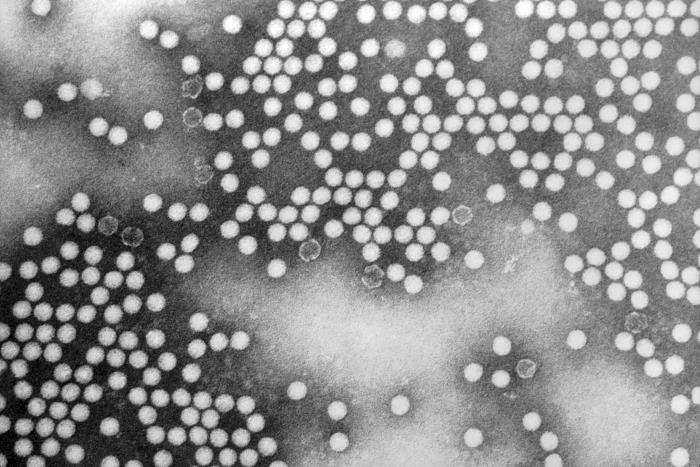



Poliovírus/Poliomielite

A poliomielite é uma doença infecciosa causada pelo poliovírus. Este vírus é um membro da família Picornaviridae Picornaviridae A family of small RNA viruses comprising some important pathogens of humans and animals. Transmission usually occurs mechanically. There are nine genera: aphthovirus; cardiovirus; enterovirus; erbovirus; hepatovirus; kobuvirus; parechovirus; rhinovirus; and teschovirus. Coxsackievirus. É um pequeno vírus de RNA RNA A polynucleotide consisting essentially of chains with a repeating backbone of phosphate and ribose units to which nitrogenous bases are attached. RNA is unique among biological macromolecules in that it can encode genetic information, serve as an abundant structural component of cells, and also possesses catalytic activity. RNA Types and Structure de cadeia simples, de sentido positivo, sem envelope Envelope Bilayer lipid membrane acquired by viral particles during viral morphogenesis. Although the lipids of the viral envelope are host derived, various virus-encoded integral membrane proteins, i.e. Viral envelope proteins are incorporated there. Virology lipídico. A transmissão ocorre por via fecal-oral e, ocasionalmente, por aerossóis respiratórios. A maioria dos doentes está assintomática ou terá uma apresentação leve e abortiva com sintomas semelhantes aos da gripe. Aqueles que desenvolvem poliomielite não paralítica irão desenvolver sinais e sintomas de meningite asséptica. Uma proporção muito pequena de doentes irá progredir para poliomielite paralítica, com progressão neurológica (incluindo paralisia flácida assimétrica). O diagnóstico é determinado pela apresentação clínica e pode ser apoiado por cultura viral, PCR PCR Polymerase chain reaction (PCR) is a technique that amplifies DNA fragments exponentially for analysis. The process is highly specific, allowing for the targeting of specific genomic sequences, even with minuscule sample amounts. The PCR cycles multiple times through 3 phases: denaturation of the template DNA, annealing of a specific primer to the individual DNA strands, and synthesis/elongation of new DNA molecules. Polymerase Chain Reaction (PCR) e serologia. Os antivirais atuais são ineficazes e o tratamento é de suporte. Existem 2 vacinas disponíveis, que quase já erradicaram esta doença em todo o mundo.

Last updated: Dec 15, 2025
Editorial responsibility: Stanley Oiseth, Lindsay Jones, Evelin Maza

Classificação

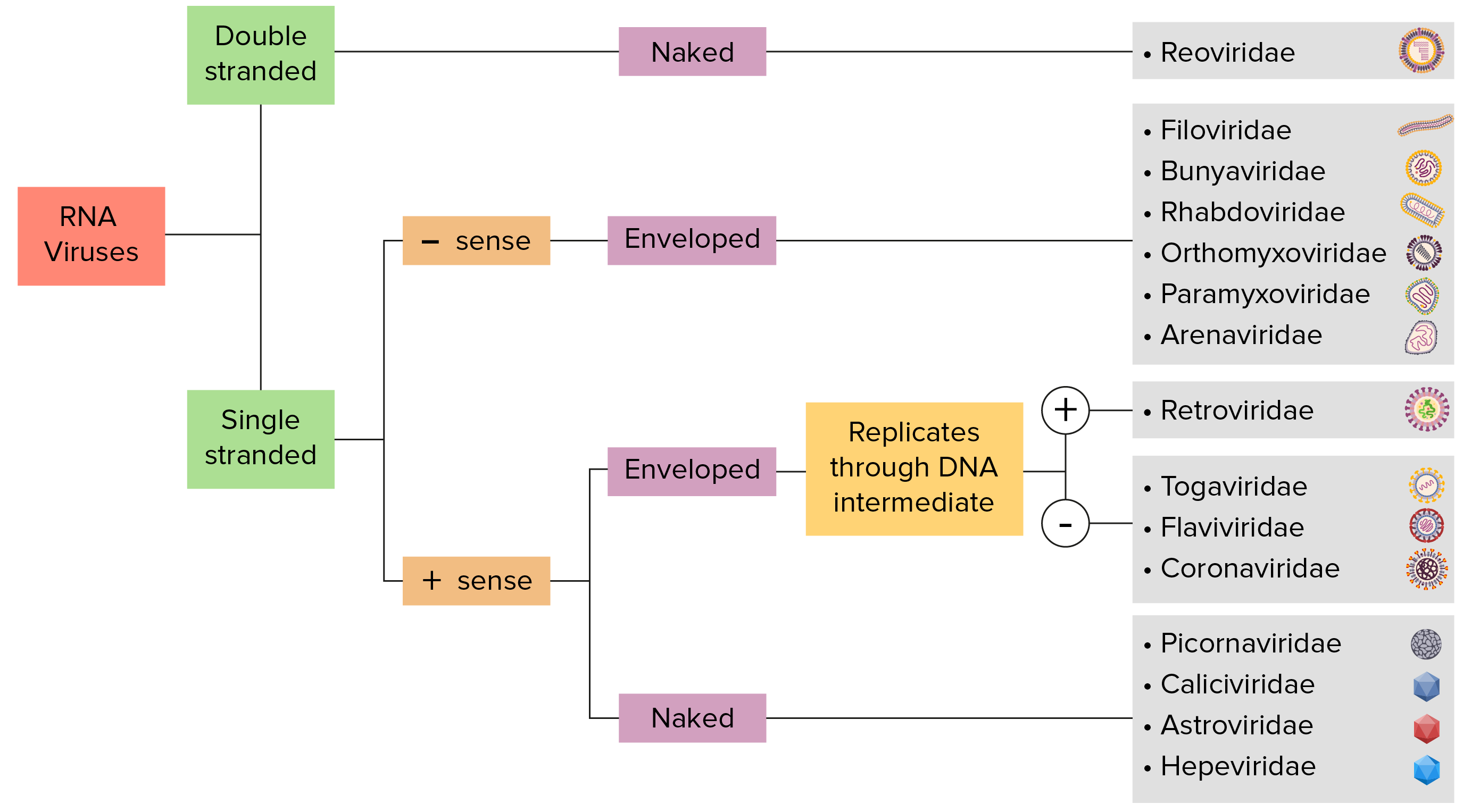
Classificação do fluxograma de vírus de RNA

Identificação do vírus RNA:
Os vírus podem ser classificados de várias maneiras. A maioria dos vírus, no entanto, terá um genoma formado por DNA ou RNA. Os vírus de genoma de RNA podem ser ainda caracterizados por um RNA de cadeia simples ou dupla. Os vírus “envelopados” são cobertos por uma fina camada de membrana celular (geralmente retirada da célula hospedeira). Se a camada estiver ausente, os vírus são chamados de vírus “nus”. Os vírus com genomas de cadeia simples são vírus de “sentido positivo” se o genoma for usado diretamente como RNA mensageiro (mRNA), que é traduzido em proteínas. Os vírus de “sentido negativo” usam a RNA polimerase dependente de RNA, uma enzima viral, para transcrever o seu genoma em RNA mensageiro.
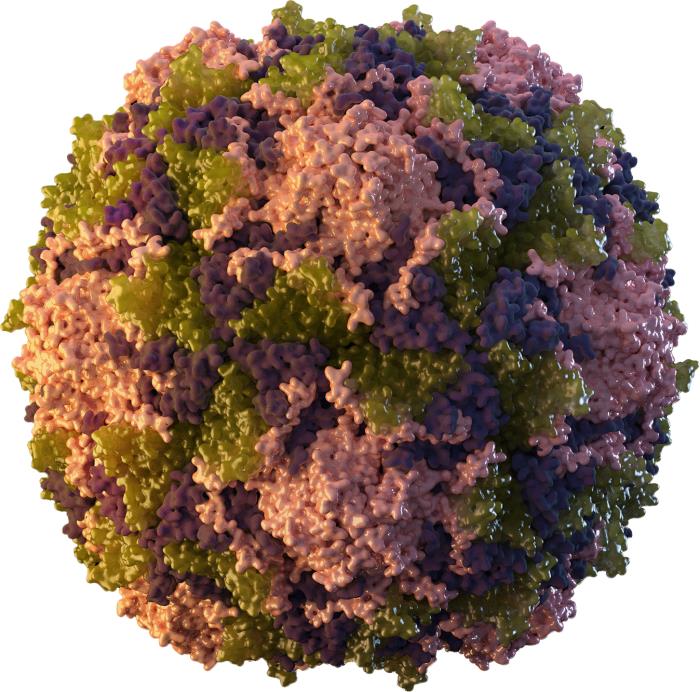
Imagem por Lecturio. Licença: CC BY-NC-SA 4.0

Características Gerais e Epidemiologia

Características gerais do poliovírus

  • Família: Picornaviridae Picornaviridae A family of small RNA viruses comprising some important pathogens of humans and animals. Transmission usually occurs mechanically. There are nine genera: aphthovirus; cardiovirus; enterovirus; erbovirus; hepatovirus; kobuvirus; parechovirus; rhinovirus; and teschovirus. Coxsackievirus
  • Género: Enterovírus
  • Classificado como uma estirpe de Enterovirus C Enterovirus C A species of enterovirus infecting humans and containing 11 serotypes, all coxsackieviruses. Poliovirus/Poliomyelitis
  • Vírus RNA RNA A polynucleotide consisting essentially of chains with a repeating backbone of phosphate and ribose units to which nitrogenous bases are attached. RNA is unique among biological macromolecules in that it can encode genetic information, serve as an abundant structural component of cells, and also possesses catalytic activity. RNA Types and Structure:
    • Linear
    • Cadeia simples
    • Sentido positivo
    • Funciona como mRNA mRNA RNA sequences that serve as templates for protein synthesis. Bacterial mRNAs are generally primary transcripts in that they do not require post-transcriptional processing. Eukaryotic mRNA is synthesized in the nucleus and must be exported to the cytoplasm for translation. Most eukaryotic mRNAs have a sequence of polyadenylic acid at the 3′ end, referred to as the poly(a) tail. The function of this tail is not known for certain, but it may play a role in the export of mature mRNA from the nucleus as well as in helping stabilize some mRNA molecules by retarding their degradation in the cytoplasm. RNA Types and Structure
  • Diâmetro: 25-30 nm
  • Simetria icosaédrica
  • Sem envelope Envelope Bilayer lipid membrane acquired by viral particles during viral morphogenesis. Although the lipids of the viral envelope are host derived, various virus-encoded integral membrane proteins, i.e. Viral envelope proteins are incorporated there. Virology lipídico
  • Ácido-estável

Espécies clinicamente relevantes

A poliomielite é causada por 3 serotipos de poliovírus:

Epidemiologia

  • O poliovírus foi erradicado na maioria dos países devido aos extensos esforços de vacinação.
  • 150 casos foram notificados em 2019.
  • Países endémicos incluem:
    • Paquistão
    • Afeganistão

Related videos

Patogénese

Reservatório

Os humanos são o único reservatório conhecido.

Transmissão

Este vírus altamente contagioso é transmitido através de:
  • Via fecal-oral
  • Aerossóis respiratórios

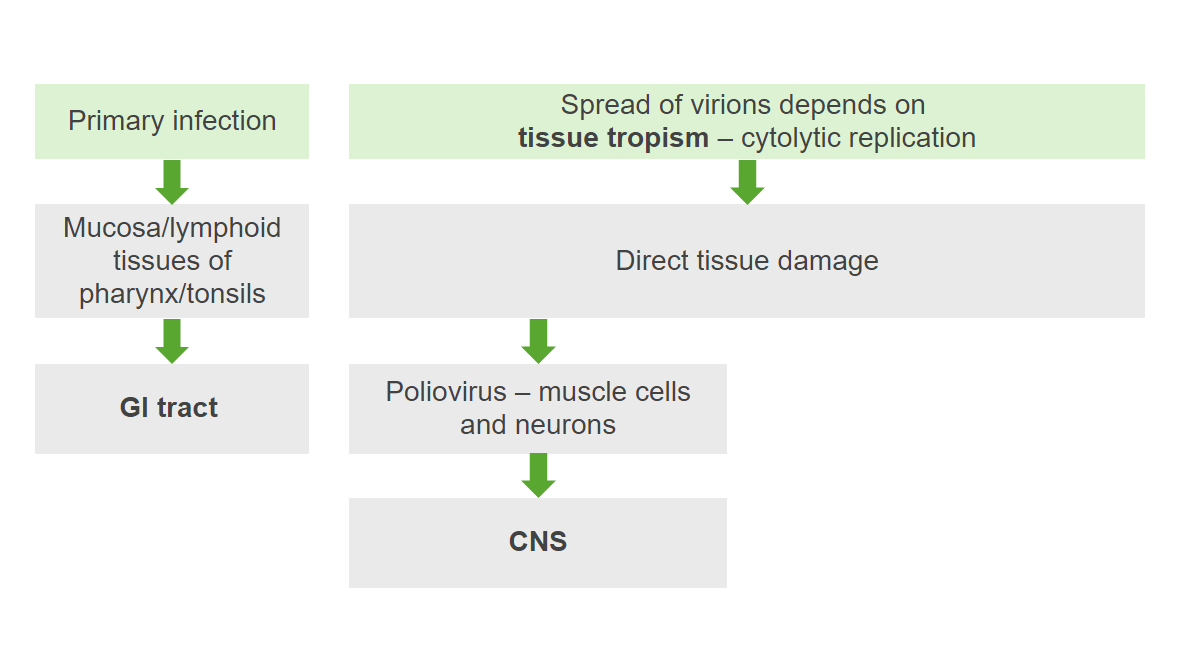
Fisiopatologia

  • Entrada do vírus via oral → replicação nos tecidos orofaríngeo e linfático GI
  • Viremia Viremia The presence of viruses in the blood. Erythema Infectiosum assintomática → sistema reticuloendotelial
  • Se a infeção não for contida → ocorre viremia Viremia The presence of viruses in the blood. Erythema Infectiosum secundária → sintomas virais
  • O vírus entra no SNC (processo pouco claro)
  • A replicação viral ocorre em neurónios da coluna (particularmente no corno anterior) e tronco cerebral → dano e necrose → sinais e sintomas neurológicos
patogênese do poliovírus

Patogénese do poliovírus:
O vírus inicialmente entra e infeta os tecidos linfoides. Ocorre viremia, permitindo a eventual disseminação para o sistema nervoso. A replicação resulta em dano tecidual e sintomas.

Imagem por Lecturio. Licença: CC BY-NC-SA 4.0

Apresentação Clínica e Diagnóstico

Poliomielite abortiva

A maioria dos doentes infetados são assintomática ou desenvolve uma doença leve semelhante à gripe:

  • Febre
  • Mal-estar
  • Cefaleia
  • Faringite
  • Náuseas e vómitos

Poliomielite não paralítica

Aproximadamente 4% dos indivíduos infetados irão desenvolver poliomielite não paralítica. A apresentação será com meningite asséptica após um pródromo semelhante ao da poliomielite abortiva.

  • Febre
  • Cefaleia
  • Rigidez da nuca

Poliomielite paralítica

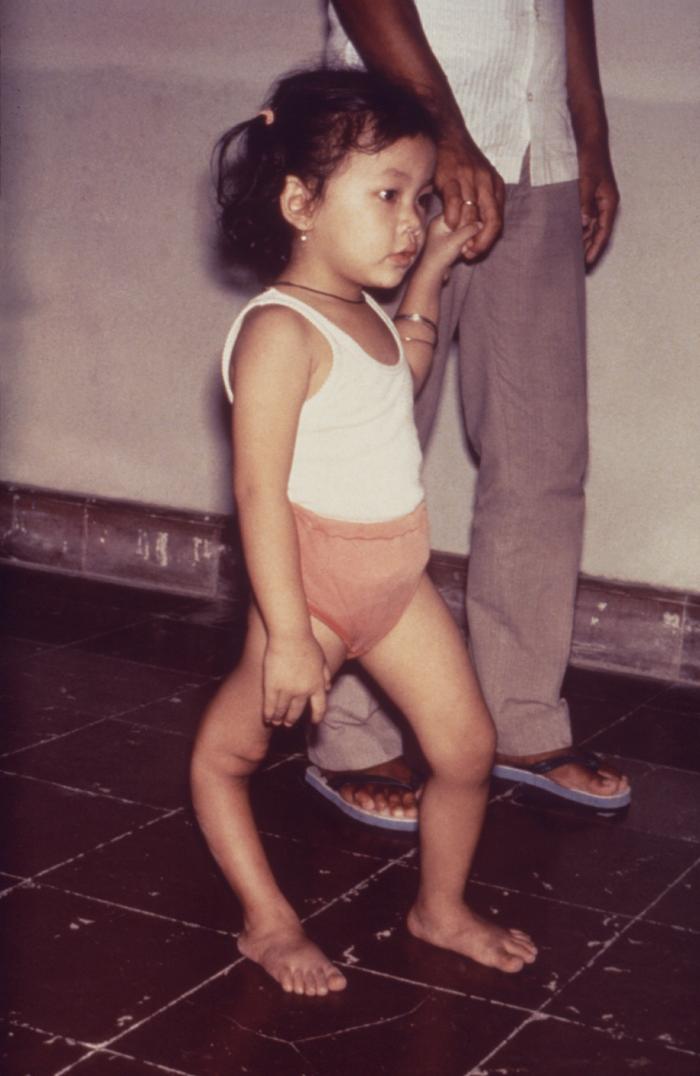
Uma minoria de doentes com poliomielite não paralítica irá progredir para a forma paralítica da doença, caracterizada por:
  • Espasmos musculares
  • Mialgias
  • Fraqueza muscular profunda e assimétrica:
  • Reflexos diminuídos ou ausentes
  • Exame sensitivo normal
  • Retenção urinária
  • Envolvimento bulbar:
    • Disfagia
    • Disfonia
    • Dificuldade em lidar com secreções
    • Compromisso respiratório
    • Disfunção autonómica
infecção por poliovírus paralítico

Jovem com deformidade da extremidade inferior direita como consequência de paralisia por infeção por poliovírus paralítica

Imagem: “Paralytic poliovirus infection” por CDC. Licença: Public Domain

Síndrome pós-poliomielite

A síndrome pós-poliomielite manifesta-se como agravamento dos sintomas em sobreviventes da poliomielite. Pode ocorrer décadas após a infeção inicial.

  • Fadiga
  • Fraqueza progressiva e atrofia dos músculos afetados
  • Fasciculações
  • Dor
  • Síndrome das Pernas Inquietas
  • Insuficiência respiratória

Diagnóstico

O diagnóstico é baseado na apresentação clínica e apoiado pela avaliação diagnóstica.

Punção lombar:

  • Frequentemente realizada no contexto de meningite asséptica
  • Achados:
    • Pleocitose moderada
    • ↑ Proteína
    • Glicose normal

Testes Testes Gonadal Hormones específicos:

  • Cultura viral
    • Isolamento do vírus nas fezes: gold standard
    • Também pode ser feito com esfregaço ou secreções orofaríngeos
  • PCR PCR Polymerase chain reaction (PCR) is a technique that amplifies DNA fragments exponentially for analysis. The process is highly specific, allowing for the targeting of specific genomic sequences, even with minuscule sample amounts. The PCR cycles multiple times through 3 phases: denaturation of the template DNA, annealing of a specific primer to the individual DNA strands, and synthesis/elongation of new DNA molecules. Polymerase Chain Reaction (PCR)
  • Serologia

Tratamento e Prevenção

Tratamento

Não existe terapia antiviral Antiviral Antivirals for Hepatitis B eficaz para a poliomielite. O tratamento é de suporte.

  • Vigilância hemodinâmica apertada para doentes com envolvimento bulbar
  • Ventilação mecânica para insuficiência respiratória ou proteção da via aérea
  • Analgésicos para dor
  • Talas para evitar deformidades

Prognóstico

Doentes com poliomielite não paralítica apresentam recuperação completa. Para aqueles com poliomielite paralítica:

  • 2 em cada 3 doentes não recuperam a força total.
  • 30%–40% desenvolvem síndrome pós-poliomielite.
  • Mortalidade:
    • 4%–6%
    • 10%–20% em adultos ou doença bulbar

Prevenção

Existem 2 vacinas utilizadas:

  • Salk Salk A suspension of formalin-inactivated poliovirus grown in monkey kidney cell tissue culture and used to prevent poliomyelitis. Poliovirus/Poliomyelitis (vacina de poliovírus inativado):
    • Dado por via parenteral
    • Forma apenas anticorpos IgG IgG The major immunoglobulin isotype class in normal human serum. There are several isotype subclasses of igg, for example, igg1, igg2a, and igg2b. Hypersensitivity Pneumonitis, não IgA IgA Represents 15-20% of the human serum immunoglobulins, mostly as the 4-chain polymer in humans or dimer in other mammals. Secretory iga is the main immunoglobulin in secretions. Immunoglobulins: Types and Functions
  • Sabin Sabin A live vaccine containing attenuated poliovirus, types I, II, and III, grown in monkey kidney cell tissue culture, used for routine immunization of children against polio. This vaccine induces long-lasting intestinal and humoral immunity. Killed vaccine induces only humoral immunity. Oral poliovirus vaccine should not be administered to immunocompromised individuals or their household contacts. Poliovirus/Poliomyelitis (vacina oral contra poliovírus):
    • Vírus vivo atenuado
    • Cria IgG IgG The major immunoglobulin isotype class in normal human serum. There are several isotype subclasses of igg, for example, igg1, igg2a, and igg2b. Hypersensitivity Pneumonitis e IgA IgA Represents 15-20% of the human serum immunoglobulins, mostly as the 4-chain polymer in humans or dimer in other mammals. Secretory iga is the main immunoglobulin in secretions. Immunoglobulins: Types and Functions
    • Não usado nos Estados Unidos
    • Os doentes eliminam o vírus → podem sofrer mutações e circular
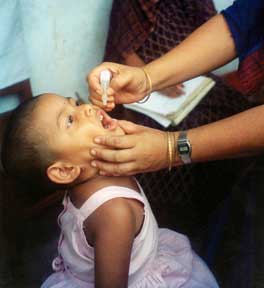
Vacina Poliodrops Poliovírus

Jovem a receber a vacina oral contra o poliovírus

Imagem: “A child receiving an oral polio vaccine” por USAID. Licença: Public Domain

Comparação de Enterovírus

Tabela: Comparação de enterovírus
Vírus Coxsackievírus Poliovírus Ecovírus
Características
  • Vírus RNA RNA A polynucleotide consisting essentially of chains with a repeating backbone of phosphate and ribose units to which nitrogenous bases are attached. RNA is unique among biological macromolecules in that it can encode genetic information, serve as an abundant structural component of cells, and also possesses catalytic activity. RNA Types and Structure cadeia simples
  • Icosaédrico
  • Sem envelope Envelope Bilayer lipid membrane acquired by viral particles during viral morphogenesis. Although the lipids of the viral envelope are host derived, various virus-encoded integral membrane proteins, i.e. Viral envelope proteins are incorporated there. Virology
  • Aproximadamente 30nm
  • Vírus RNA RNA A polynucleotide consisting essentially of chains with a repeating backbone of phosphate and ribose units to which nitrogenous bases are attached. RNA is unique among biological macromolecules in that it can encode genetic information, serve as an abundant structural component of cells, and also possesses catalytic activity. RNA Types and Structure cadeia simples
  • Icosaédrico
  • Sem envelope Envelope Bilayer lipid membrane acquired by viral particles during viral morphogenesis. Although the lipids of the viral envelope are host derived, various virus-encoded integral membrane proteins, i.e. Viral envelope proteins are incorporated there. Virology
  • 25-30 nm
  • Vírus RNA RNA A polynucleotide consisting essentially of chains with a repeating backbone of phosphate and ribose units to which nitrogenous bases are attached. RNA is unique among biological macromolecules in that it can encode genetic information, serve as an abundant structural component of cells, and also possesses catalytic activity. RNA Types and Structure cadeia simples
  • Icosaédrico
  • Sem envelope Envelope Bilayer lipid membrane acquired by viral particles during viral morphogenesis. Although the lipids of the viral envelope are host derived, various virus-encoded integral membrane proteins, i.e. Viral envelope proteins are incorporated there. Virology
  • 20-30nm
Transmissão
  • Via fecal-oral
  • Aerossóis respiratórios
  • Via fecal-oral
  • Aerossóis respiratórios
  • Via fecal-oral
  • Aerossóis respiratórios
Clínico
  • URI
  • Herpangina Herpangina Acute types of coxsackievirus infections or echovirus infections that usually affect children during the summer and are characterized by vesiculoulcerative lesions on the mucous membranes of the throat; dysphagia; vomiting, and fever. Coxsackievirus
  • HFMD
  • Meningite asséptica
  • Miopericardite
  • Pleurodinia epidémica
  • Infeção neonatal
  • Doença semelhante à gripe
  • Meningite asséptica
  • Paralisia flácida assimétrica
  • Envolvimento bulbar
  • URI
  • Exantema
  • Meningite asséptica
  • Encefalite
  • Miopericardite
  • Infeção neonatal
Diagnóstico
  • Clínico
  • PCR PCR Polymerase chain reaction (PCR) is a technique that amplifies DNA fragments exponentially for analysis. The process is highly specific, allowing for the targeting of specific genomic sequences, even with minuscule sample amounts. The PCR cycles multiple times through 3 phases: denaturation of the template DNA, annealing of a specific primer to the individual DNA strands, and synthesis/elongation of new DNA molecules. Polymerase Chain Reaction (PCR)
  • Cultura viral
  • Clínico
  • PCR PCR Polymerase chain reaction (PCR) is a technique that amplifies DNA fragments exponentially for analysis. The process is highly specific, allowing for the targeting of specific genomic sequences, even with minuscule sample amounts. The PCR cycles multiple times through 3 phases: denaturation of the template DNA, annealing of a specific primer to the individual DNA strands, and synthesis/elongation of new DNA molecules. Polymerase Chain Reaction (PCR)
  • Serologia
  • Cultura viral
  • Clínico
  • PCR PCR Polymerase chain reaction (PCR) is a technique that amplifies DNA fragments exponentially for analysis. The process is highly specific, allowing for the targeting of specific genomic sequences, even with minuscule sample amounts. The PCR cycles multiple times through 3 phases: denaturation of the template DNA, annealing of a specific primer to the individual DNA strands, and synthesis/elongation of new DNA molecules. Polymerase Chain Reaction (PCR)
  • Cultura viral
Tratamento Suporte Suporte Suporte
Prevenção Lavagem das mãos Vacinação Lavagem das mãos
HFMD: doença mão-pé-boca
URI: infeção do trato respiratório superior

Diagnóstico Diferencial

  • Síndrome de Guillain-Barré ( GBS GBS An acute inflammatory autoimmune neuritis caused by t cell- mediated cellular immune response directed towards peripheral myelin. Demyelination occurs in peripheral nerves and nerve roots. The process is often preceded by a viral or bacterial infection, surgery, immunization, lymphoma, or exposure to toxins. Common clinical manifestations include progressive weakness, loss of sensation, and loss of deep tendon reflexes. Weakness of respiratory muscles and autonomic dysfunction may occur. Polyneuropathy, pela sigla em inglês): neuropatia inflamatória adquirida aguda, rapidamente progressiva, que pode ser desencadeada por agentes patológicos infecciosos. Ao contrário da poliomielite, a fraqueza muscular progressiva na GBS GBS An acute inflammatory autoimmune neuritis caused by t cell- mediated cellular immune response directed towards peripheral myelin. Demyelination occurs in peripheral nerves and nerve roots. The process is often preceded by a viral or bacterial infection, surgery, immunization, lymphoma, or exposure to toxins. Common clinical manifestations include progressive weakness, loss of sensation, and loss of deep tendon reflexes. Weakness of respiratory muscles and autonomic dysfunction may occur. Polyneuropathy é simétrica, há perda sensitiva e a febre é rara. O diagnóstico é clínico. A punção lombar mostra uma contagem de leucócitos normal e proteínas elevadas (dissociação albuminocitogénica). O tratamento requer terapia de suporte intensiva, imunoglobulina IV e plasmaferese.
  • Infeção pelo vírus do Nilo Ocidental: infeção por um flavivírus. A maioria dos doentes com vírus do Nilo Ocidental está assintomática ou apresentar cefaleia, mialgias e artralgias, vómitos, diarreia ou rash Rash Rocky Mountain Spotted Fever cutâneo. Uma pequena proporção desenvolve encefalite, meningite ou paralisia flácida. O diagnóstico pode ser feito com serologia, PCR PCR Polymerase chain reaction (PCR) is a technique that amplifies DNA fragments exponentially for analysis. The process is highly specific, allowing for the targeting of specific genomic sequences, even with minuscule sample amounts. The PCR cycles multiple times through 3 phases: denaturation of the template DNA, annealing of a specific primer to the individual DNA strands, and synthesis/elongation of new DNA molecules. Polymerase Chain Reaction (PCR) e culturas virais. Tal TAL Renal Sodium and Water Regulation diferenciará o vírus do Nilo Ocidental da poliomielite. O tratamento é de suporte.
  • Porfiria aguda intermitente: doença autossómica dominante, rara, que resulta no défice de hidroximetilbilano sintase. Este défice leva à acumulação de precursores do grupo heme. Os doentes podem apresentar dor abdominal, sintomas psiquiátricos e neuropatias periféricas que podem mimetizar o GBS GBS An acute inflammatory autoimmune neuritis caused by t cell- mediated cellular immune response directed towards peripheral myelin. Demyelination occurs in peripheral nerves and nerve roots. The process is often preceded by a viral or bacterial infection, surgery, immunization, lymphoma, or exposure to toxins. Common clinical manifestations include progressive weakness, loss of sensation, and loss of deep tendon reflexes. Weakness of respiratory muscles and autonomic dysfunction may occur. Polyneuropathy. Pode ocorrer progressão para tetraplegia e insuficiência respiratória. O diagnóstico é baseado nos níveis elevados de precursores da porfirina na urina. O tratamento inclui heme IV, dextrose Dextrose Intravenous Fluids e prevenção de desencadeantes.
  • Distrofia muscular: grupo de distúrbios musculares não inflamatórios causados por uma mutação no gene Gene A category of nucleic acid sequences that function as units of heredity and which code for the basic instructions for the development, reproduction, and maintenance of organisms. Basic Terms of Genetics DMD DMD Duchenne muscular dystrophy (DMD) is an X-linked recessive genetic disorder that is caused by a mutation in the dmd gene. The mutation leads to the production of abnormal dystrophin, resulting in muscle-fiber destruction and replacement with fatty or fibrous tissue. Duchenne Muscular Dystrophy. Esta mutação leva à destruição da fibra muscular e à substituição por tecido gordo ou fibroso. Os doentes apresentam fraqueza muscular proximal progressiva, que leva à eventual perda da deambulação, além de contraturas, escoliose, cardiomiopatia e insuficiência respiratória. Ao contrário da poliomielite, pode ser observada uma elevação acentuada da CK. O teste genético confirma o diagnóstico. O tratamento é de suporte.
  • Esclerose múltipla ( MS MS Multiple sclerosis (MS) is a chronic inflammatory autoimmune disease that leads to demyelination of the nerves in the CNS. Young women are more predominantly affected by this most common demyelinating condition. Multiple Sclerosis, pela sigla em inglês): doença inflamatória crónica autoimune que leva à desmielinização do SNC. A apresentação clínica da MS MS Multiple sclerosis (MS) is a chronic inflammatory autoimmune disease that leads to demyelination of the nerves in the CNS. Young women are more predominantly affected by this most common demyelinating condition. Multiple Sclerosis varia dependendo do local das lesões, mas pode incluir sintomas neurológicos que afetam a visão, funções motoras, sensitiva e função autonómica. O diagnóstico é feito com ressonância magnética do cérebro e da coluna vertebral, bem como exame do LCR. O tratamento envolve corticoides para exacerbações agudas e agentes modificadores da doença para retardar a progressão da doença.

Referências

  1. Simionescu, L., Modlin, J.F. (2025). Poliomyelitis and post-polio syndrome. In Goddeau, R. P., Jr. (Ed.), UpToDate. Retrieved October 16, 2025, from https://www.uptodate.com/contents/poliomyelitis-and-post-polio-syndrome
  2. Modlin, J. F. (2024). Poliovirus vaccination. In Baron, E. L. (Ed.), UpToDate. Retrieved October 16, 2025, from https://www.uptodate.com/contents/poliovirus-vaccination
  3. Wolbert, J. G., Higginbotham, K. (2024). Poliomyelitis. StatPearls. Retrieved October 16, 2025, from https://www.ncbi.nlm.nih.gov/books/NBK558944/
  4. Tesinin, B. L. (2024). Poliomyelitis. MSD Manual Professional Version. Retrieved October 16, 2025, from https://www.msdmanuals.com/professional/infectious-diseases/enteroviruses/poliomyelitis
  5. Ranade, A. S., Belthur, M. V. (2023). Poliomyelitis. In Thomson, J. D. (Ed.), Medscape. Retrieved October 16, 2025, from https://emedicine.medscape.com/article/1259213-overview
  6. Aylward, R. B. (2006). Eradicating polio: today’s challenges and tomorrow’s legacy. Annals of Tropical Medicine and Parasitology 100:401–413. 

Crie sua conta gratuita ou faça login para continuar lendo!

Cadastre-se agora e tenha acesso grátis ao Lecturio, com páginas de conceitos, vídeos de medicina e questões para sua educação médica.

Aprende mais com a Lecturio:

Multiple devices displaying human anatomy and health education content.

Complementa o teu estudo da faculdade com o companheiro de estudo tudo-em-um da Lecturio, através de métodos de ensino baseados em evidência.

Estuda onde quiseres

Two iPhones display medical education apps, one showing anatomy, the other Bookmatcher.

A Lecturio Medical complementa o teu estudo através de métodos de ensino baseados em evidência, vídeos de palestras, perguntas e muito mais – tudo combinado num só lugar e fácil de usar.

User Reviews

Have a holly, jolly study session 🎁 Save 50% on all plans now >>

Que tengas una sesión de estudio alegre y navideña 🎁 Ahorra 50% en todos los planes >>

Details