Venipuncture is a common medical procedure used to obtain blood samples for laboratory testing, transfusions, and other medical procedures. It involves puncturing a vein with a needle and collecting blood in a tube or syringe. This guide provides a comprehensive overview of the venipuncture procedure, including pre- and post-procedure considerations, the correct order of draw for blood collection tubes, and nursing considerations.
Venipuncture is a medical procedure used to obtain blood samples for diagnostic testing. It involves puncturing a vein with a needle and collecting blood in a tube or syringe.
What are common venipuncture sites?
Common venipuncture sites include the median cubital vein, the cephalic vein, and the basilic vein.
Which vein is the first choice for venipuncture?
The median cubital vein in the antecubital fossa is often the first choice for venipuncture. It’s usually easy to locate and tends to be less painful for the client.
Venipuncture sites to avoid
If possible, the following sites should be avoided with venipuncture:
Any areas near infections or rashes
Scars, hematomas, lesions
Avoid using an arm on the side of a mastectomy, dialysis fistula or an arm that has an IV line or blood pressure cuff on
Sites above an IV line
Venipuncture angle
For venipuncture, the needle should typically be inserted at an angle of 30 degrees to the skin’s surface. The exact angle may vary depending on the vein’s depth and the client’s specific anatomy. A shallower angle is often used for veins that are close to the surface.
What supplies do you need for venipuncture?
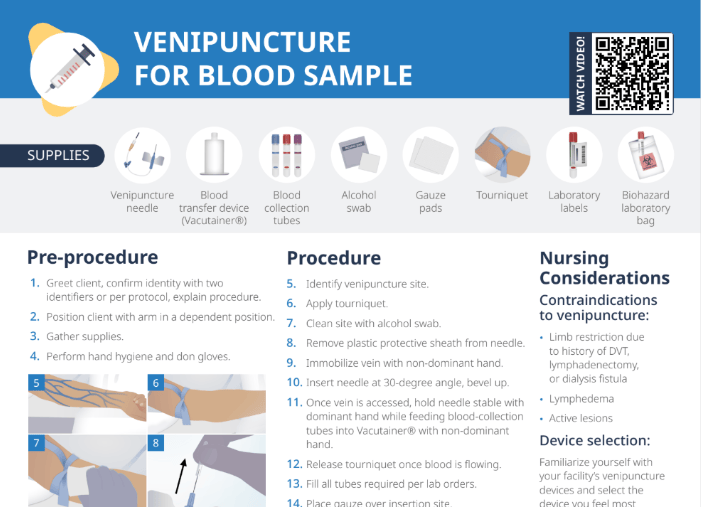
Venipuncture needle
Blood transfer device (Vacutainer®)
Blood collection tubes
Alcohol swab
Gauze pads
Tourniquet
Laboratory labels
Biohazard laboratory bag
Nursing considerations before venipuncture
Familiarize yourself with your facility’s venipuncture devices and select the device you feel most capable using.
If using a butterfly needle, a waste container should be used to remove air from tubing before collecting ordered samples.
The most common needle used is 21-gauge.
Determine if the client has a fear of needles and help with relaxation.
Greet client, confirm identity with two identifiers or per protocol, explain procedure.
Position client with arm in a dependent position.
Gather supplies.
Perform hand hygiene and don gloves.
Procedure
Identify venipuncture site.
Apply tourniquet.
Clean site with alcohol swab.
Remove plastic protective sheath from needle.
Immobilize vein with non-dominant hand.
Insert needle at 30-degree angle, bevel up.
Once vein is accessed, hold needle stable with dominant hand while feeding blood-collection tubes into Vacutainer® with non-dominant hand.
Release tourniquet once blood is flowing.
Fill all tubes required per lab orders.
Place gauze over insertion site.
Withdraw needle, activate safety device and deposit in sharps container.
Apply pressure to venipuncture site until bleeding stops.
Post-procedure
Invert tubes several times to mix blood samples with tube additives.
Label each tube at client’s bedside.
Place tubes in biohazard bag.
Send samples to lab.
What is the correct order of draw for venipuncture?
Blood samples must be drawn in the correct order to avoid cross-contamination by additives found in other collection tubes.
The correct order of draw for blood collection tubes is:
Sterile
Light blue
Red
Serum separator tube
Plasma separator tube
Green
Lavender
Gray
You can remember the order with this mnemonic:
Stop: Sterile
Light: Light blue
Red: Red
Stay: Sterile separator tube
Put: Plasma separator tube
Green: Green
Light: Lavender
Go: Gray
When should venipuncture be avoided?
Contraindications to venipuncture include limb restriction due to history of DVT, lymphadenectomy, or dialysis fistula, lymphedema, and active lesions.