

Nursing Knowledge
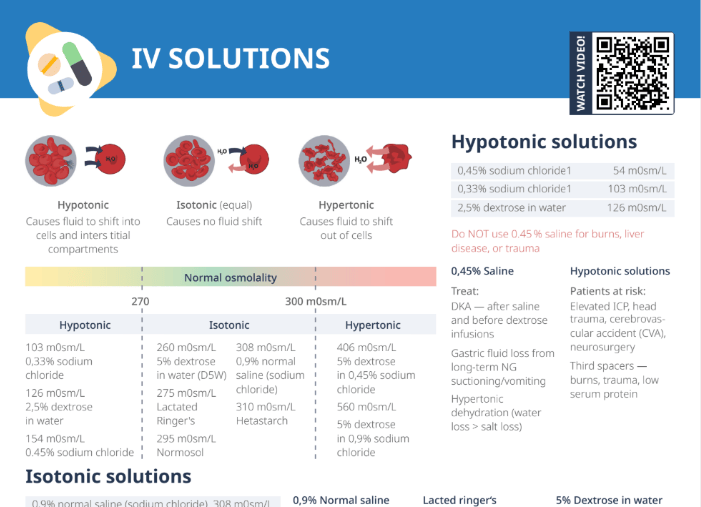
Intravenous (IV) solutions can be broadly categorized into three types based on their osmolality: isotonic, hypotonic, and hypertonic.
The choice of which IV fluid to use depends on the client’s condition, lab values, fluid and electrolyte balance, and acid-base balance. For example, normal saline may be used in a client with hypovolemia, whereas a hypotonic solution might be appropriate for a client with hypernatremia. A hypertonic solution could be used for a client with cerebral edema.
Osmolality is a measure of the concentration of solutes in a solution. It’s expressed in osmoles per kilogram of solvent (Osm/kg). In clinical settings, osmolality is commonly used to evaluate the body’s water balance and electrolyte homeostasis.
Isotonic solutions have the same osmolality as blood plasma and do not cause any fluid shift. They are used to replace fluids and electrolytes, maintain hydration, and treat hypovolemia.
Examples of isotonic solutions:
| 0.9% normal saline (sodium chloride) | 308 m0sm/L |
| Lactated Ringer solution | 275 m0sm/L |
| 5% dextrose in water (D5W) | 260 m0sm/L |
| Hetastarch | 310 m0sm/L |
| Normosol | 295 m0sm/L |
Hypotonic solutions have a lower osmolality than blood plasma and cause fluid to shift into cells and interstitial compartments. They are used to treat cellular dehydration, reduce edema, and dilute extracellular fluid.
Examples of hypotonic solutions:
| 0.45% sodium chloride | 154 m0sm/L |
| 0.33% sodium chloride | 103 m0sm/L |
| 2.5% dextrose in water | 126 m0sm/L |
Hypertonic solutions have a higher osmolality than blood plasma and cause fluid to shift out of cells. They are used to treat hyponatremia, cerebral edema, stabilize blood pressure, regulate urine output, and minimize the effects of a drastic decrease in serum osmolality.
Examples of hypertonic solutions:
| (D5 ½ NS) 5% dextrose in 0.45% sodium chloride | 406 m0sm/L |
| (D5 NS) 5% dextrose in 0.9% sodium chloride | 560 m0sm/L |
Hypertonic solutions can cause fluid overload, electrolyte imbalances, hyperglycemia, and phlebitis. They should be used with caution in clients with heart failure, renal impairment, or dehydration.
Balanced solutions, like lactated Ringer solution or Plasma-Lyte, closely resemble the composition of plasma and help maintain acid-base balance and electrolyte levels. They are often used when large volumes of fluid are needed, as they can reduce the risk of causing electrolyte imbalances or acidosis compared to saline.
No, not all medications are compatible with all IV solutions. Always check medication compatibility with the chosen IV fluid before administration.
RELATED TOPIC:
Free Download
Master the topic with a unique study combination of a concise summary paired with video lectures.
Your free account gives you access to:
or