Childbirth is a complex physiological process that involves 4 stages of labor. This guide provides a comprehensive overview of the different stages of labor and how their beginnings and ends are defined, as well as an explanation of the cardinal mechanisms involved in childbirth.
Labor is the coordinated sequence of involuntary uterine contractions, initiated by biochemical signals, that leads to progressive effacement and dilation of the cervix and voluntary muscular efforts leading to expulsion of the products of conception (fetus, placenta, and membranes).
What are the stages of labor?
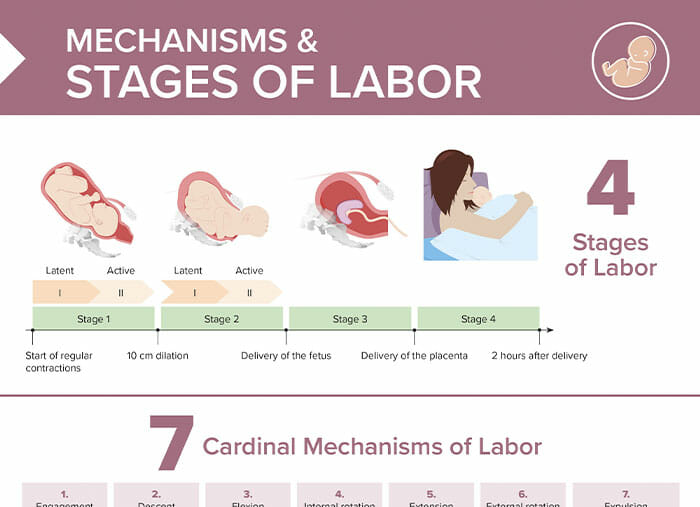
It is common to view the labor and delivery process as taking place in 4 stages. The correct sequence of labor and delivery stages is:
Stage 1
This stage begins with the onset of regular contractions. By the end of stage one, the cervix is fully dilated (10 centimeters).
Early phase (latent): Contractions start, cervix begins to dilate (usually to about 3 cm). Contractions may be mild and 20 to 30 minutes apart at first, gradually becoming more frequent.
Active phase: Cervix dilates from about 3 cm to 7 cm. Contractions are more regular (every 3–5 minutes, 45–60 seconds).
Transition phase: Cervix dilates from 7 cm to 10 cm. Contractions are usually very strong (every 2–3 minutes, lasting about a minute).
Stage 2 (“pushing” stage)
This stage begins once the cervix is fully dilated and ends with the delivery of the baby.
Stage 3
This stage starts after the baby is born. Delivery of the placenta marks the end of the third stage. The duration of this stage typically ranges from five to 30 minutes.
Stage 4 (postpartum stage)
The fourth stage of labor is the recovery period immediately after delivery (monitoring for complications).
The cardinal mechanisms of labor (or “movements of labor”) are a series of movements that occur during childbirth to help facilitate delivery of the baby through the birth canal.
Engagement: The baby’s head enters the pelvic inlet.
Descent: The baby’s head descends further into the pelvic cavity. This occurs throughout labor, aided by uterine contractions, amniotic fluid pressure, and maternal pushing.
Flexion: As the baby’s head descends and encounters resistance from the pelvic bones and soft tissues, it naturally tucks its chin toward its chest, presenting the smallest head diameter to the birth canal.
Internal rotation: The baby’s head rotates about 90 degrees to align with the long axis of the body as it moves down the pelvis, typically from an orientation where the baby is facing sideways to facing the mother’s back.
Extension: As the baby’s head passes under the pubic bone, it extends backwards, with the chin leaving the chest, so that the head can fully emerge.
External rotation: After the head is delivered, it rotates again so that the baby’s face is turned towards one of the mother’s inner thighs, allowing the shoulders to align with the pelvic outlet.
Expulsion: Following delivery of the head and shoulders, the rest of the baby’s body is delivered relatively easily and quickly.
What do labor and delivery nurses do?
Here are some primary responsibilities of L&D nurses:
Assessing and monitoring clients’ vital signs during labor
Monitoring labor progress
Pain management
Emotional support and education, during delivery as well as postpartum (initial care, breastfeeding, recovery)
Assisting with procedures during labor (e.g. episiotomy)
Recognize and manage emergency situations
Potential complications in childbirth
Complications that the healthcare team need to be on the lookout for during childbirth: