

NCLEX QUESTION TYPE TUTORIAL
The nurse is caring for an adolescent with a possible diagnosis of a cervical spinal cord injury following a sports injury. Which action by the unlicensed assistive personnel (UAP) is contraindicated?
A teenager has been in a sports accident and potentially may have a spinal cord injury. Two other people are in the scenario: the nurse and a UAP. Nurses supervise and can delegate tasks to UAPs, so they must know and monitor what UAPs are doing and are able to judge which of their actions are safe. The task here is to determine which of the four actions by the UAP is the most unsafe or wrong for the client (outside of an UAP’s scope of care; may put the patient in danger).
Spinal cord injuries involve damage to the neural tissue within the spinal canal and can result in disruption of motor, sensory, or autonomic functions. Spinal cord injuries can be complete or incomplete and their effects can be temporary or permanent.
The most important immediate measures when a client is suspected of having a spinal cord injury include:
All tasks that UAPs (i.e., nursing assistants) perform are done under a licensed nurse’s supervision. Typical tasks of unlicensed assistive personnel include:
All tasks that require clinical judgment are outside of a UAP’s scope of practice.
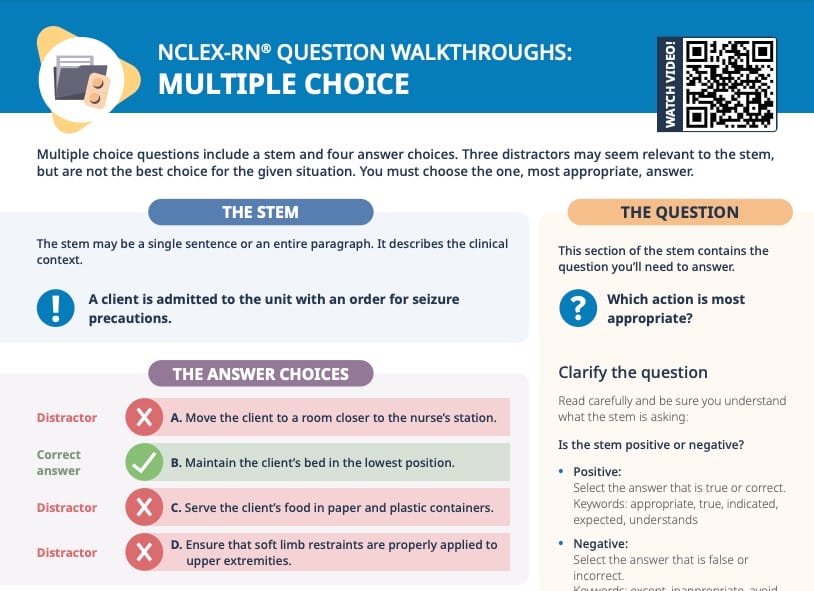
We are dealing with a single-choice question here. The safest way to arrive at a correct answer for these is to use a 2-step process, starting with eliminating distractors.
Go through all 4 answer choices while taking notes on your scratch paper about your reasoning for each of them. In your first pass, don’t try to choose the correct answer yet: Only eliminate the answers you are sure are false, and “keep” the rest for now to look at in more detail later.
Tip: In this stage, make sure to not get confused about if the question is asked positively or negatively. In this question, you are asked to pick which action is contraindicated and should not be done by the UAP. So, you’re eliminating the answers that would be okay to do, and choosing an action that is incorrect to do as your correct answer.
Keeping the head in a neutral position is a good measure for spinal cord injuries to avoid further injury. There are no clear objections to the UAP taking care that the head stays in a neutral position, so this answer choice can be eliminated. This is not contraindicated and is within a UAP’s scope of care.
Removing the protective gear is not appropriate when there is a suspicion for spinal cord injury. Doing this is contraindicated even for nurses, not just UAPs. So, we definitely should not eliminate this answer choice. For both C and D, it may be possible to think of ways how doing this could move the patient too much and potentially cause harm, so let’s compare those 3 answer choices in more detail in the next step.
For C and D again, try to think about if this action would potentially harm the patient: It is surely possible to make up scenarios for both of them how cutting up clothing or dealing with a blood pressure cuff could harm a patient. But when you look at the hard facts of what the answers actually say, none of these is nearly as risky as answer choice B (removing the protective gear). Answer B is the one involving the most movement and risk for the patient that should remain immobilized. Removing protective gear at this time is clearly contraindicated, and answer B is the correct answer.
The nurse in this scenario would make sure an assessment is done and work with the physician/nurse practitioner to make sure any kind of movement is safe for the client. Before this has happened and clear instructions have been given, the UAP should absolutely not remove any protective gear. At this stage, nobody should be doing that, so it would not be appropriate for the UAP to be the first to do it.
Make sure to think about what you can take from this example question that you can apply to other questions:
Free Download
Benefit from a unique study combination of a concise summary paired with video lectures.
Your free account gives you access to:
or