

Nursing Knowledge
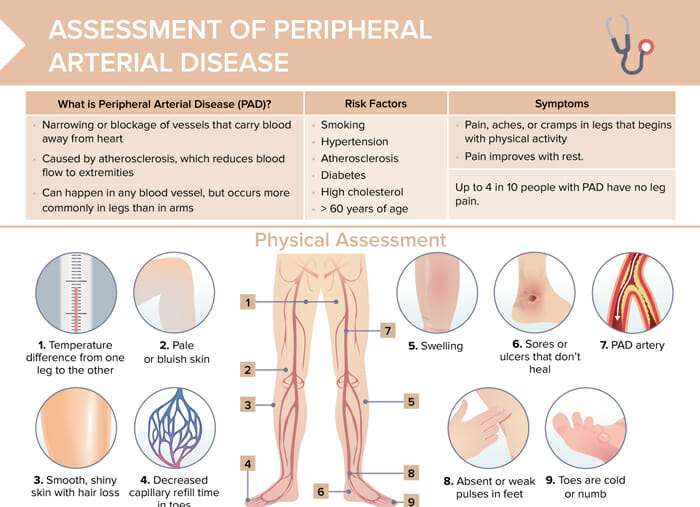
Peripheral artery disease (PAD) is a narrowing or blockage of vessels that carry blood away from the heart. It is caused by atherosclerosis, which reduces blood flow from the extremities. PAD can happen in any blood vessel, but occurs more commonly in the legs than in the arms.
Factors indicating a need for screening are risk factors that include: age over 65 or age over 50 with a history of diabetes or smoking; symptoms of leg pain; healing issues; absent pulses. Screening is typically done with the ankle-brachial index test.
The ankle-brachial index (ABI) test can be used to diagnose PAD.
The test compares blood pressure between the upper and lower extremities.
Highest systolic ankle pressure/highest brachial systolic pressure = ABI.
Classification of PAD according to ABI
| > 1.4 | Vessel hardening |
| 1.0–1.4 | Normal |
| 0.9–1.0 | Acceptable |
| 0.8–0.9 | Mild arterial disease |
| 0.5–0.8 | Moderate arterial disease |
| < 0.5 | Severe arterial disease |
Additional possible testing:
Peripheral artery disease is treated through a multi-faceted approach:
Each modality aims to improve blood flow, alleviate symptoms, and prevent disease progression.
While individual comfort varies widely, elevating the legs is discouraged, as this position can decrease arterial blood flow to the legs, exacerbating symptoms.
Peripheral venous disease (PVD), often just called venous disease, refers to conditions that affect the veins of the peripheral system, typically in the legs. Unlike PAD which involves narrowed or blocked arteries, PVD is characterized by issues with veins, especially the valves inside them.
The most common form of PVD is chronic venous insufficiency (CVI). In CVI, the vein valves that prevent blood from flowing backward become damaged or weak, leading to blood pooling in the legs.
Diagnosis of PVD includes combining clinical factors with tests:
Effective management of PVD often requires compression therapy (often first-line treatment), medications (diuretics, anticoagulants), lifestyle modifications (exercise, leg elevation), and, in some cases, surgical interventions (vein stripping, laser surgery).
The most significant peripheral artery disease symptom is pain, aches, or cramps that begin with physical activity. The pain improves with rest. It is to note that up to 4 in 10 people with PAD have no leg pain. Other specific symptoms of PAD include
In peripheral venous disease, affected clients also suffer from leg pain, but this is not usually relieved by rest. The leg pain is persistent and characterized by “heaviness.” Swelling in legs and ankles is exacerbated by prolonged standing. Strong, palpable pulses are present, but may be hard to find due to edema. Further symptoms of PVD:
Patient education and administering prescribed medications are important nursing interventions for both conditions.
RELATED TOPIC:
FREE CHEAT SHEET
Free Download
Master the topic with a unique study combination of a concise summary paired with video lectures.
Your free account gives you access to:
or