Postpartum Nursing: Normal Changes & Nursing Diagnosis
Nursing Knowledge
Postpartum Nursing: Normal Changes & Nursing Diagnosis
Postpartum changes refer to the physical and psychological changes that occur in a woman’s body after childbirth. These changes can have a significant impact on the health and well-being of both the mother and the newborn. As such, it is important for nurses and other healthcare professionals to have a thorough understanding of these changes in order to provide appropriate care and support to postpartum women.
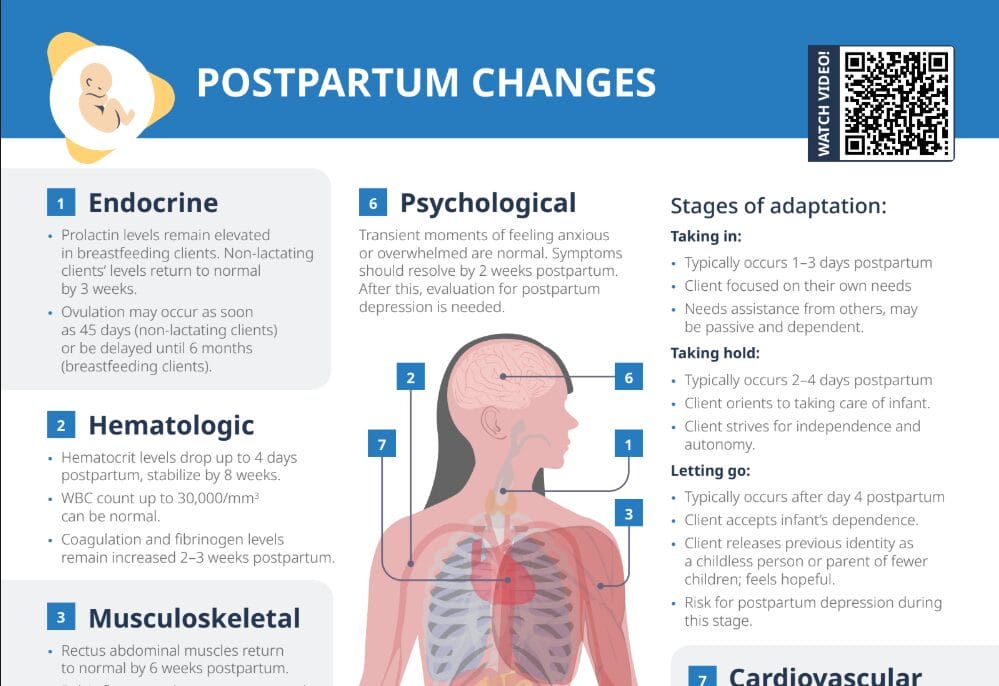
Prolactin levels remain elevated in breastfeeding clients. Non-lactating clients’ levels return to normal by 3 weeks.
Ovulation may occur as soon as 45 days (non-lactating clients) or be delayed until 6 months (breastfeeding clients).
Hematologic postpartum changes
Hematocrit levels drop up to 4 days postpartum, stabilizes by 8 weeks.
WBC count up to 30,000/mm3 can be normal.
Coagulation and fibrinogen levels remain increased 2–3 weeks postpartum.
Musculoskeletal postpartum changes
Rectus abdominal muscles return to normal by 6 weeks postpartum.
Pelvic floor muscle returns to normal by 6 weeks postpartum.
Gastrointestinal postpartum changes
Increased appetite after delivery
Bowel movement may be delayed 2–3 days.
Breastfeeding clients need an additional 300–500 calories per day to support lactation.
Reproductive postpartum changes
Breasts: colostrum present first 3 days, then changes to mature milk stimulated by breastfeeding
Non-breastfeeding clients should avoid any breast stimulation. Milk production may take several days, up to several weeks, to stop.
While breast engorgement can be normal postpartum, signs of mastitis require further evaluation and treatment.
Uterus involutes 1 cm/day (non-palpable by 2 weeks postpartum).
Cramping may be stronger in multiparous and breastfeeding clients.
Cervix: os appears slit-like instead of circular, returns to 1 cm dilation by 1 week postpartum.
Lochia is normal discharge that contains blood, mucus, and uterine tissue and may last up to 6 weeks postpartum.
Lochia rubra: bright red, days 1–3
Lochia serosa: pink, days 4–10
Lochia alba: white/yellow, days 11–6 weeks
Psychological postpartum changes
Transient moments of feeling anxious or overwhelmed are normal. Symptoms should resolve by 2 weeks postpartum. After this, evaluation for postpartum depression is needed.
Stages of adaptation:
Taking in:
Typically occurs 1–3 days postpartum
Client focused on their own needs
Needs assistance from others, may be passive and dependent
Taking hold:
Typically occurs 2–4 days postpartum
Client orients to taking care of infant
Client strives for independence and autonomy
Letting go:
Typically occurs after day 4 postpartum
Client accepts infant’s dependence
Client releases previous identity as a childless person or parent of fewer children; feels hopeful
Risk for postpartum depression during this stage
Cardiovascular postpartum changes
Plasma volume decreases by 1,000 mL.
Bradycardia down to 40 bpm may be noted postpartum.
Renal postpartum changes
Diuresis occurs after first 12 hours postpartum, up to 3,000 mL/day.
Dilated ureters and renal pelvis returns to normal by 6–8 weeks postpartum.
Postpartum nursing diagnosis
Potential postpartum nursing diagnoses include:
Acute pain related to perineal trauma, episiotomy, C-section, post-birth contractions
Fatigue related to childbirth, body changes and new responsibilities
Impaired urinary elimination related to trauma/swelling or anesthesia effects
Risk for constipation related to hormonal changes, fear of pain with defecation, medications or anesthesia effects