

The nurse cares for a 58-year-old male who was brought into the emergency department (ED) by his son.
| Vital signs | Results |
| Temperature | 98.6 °F (37.0 °C) |
| Heart rate | 120 beats/min |
| Respiratory rate | 24 breaths/min |
| Blood pressure | 155/98 mm Hg |
| Pulse oximeter reading | 89% on room air |
Start with reading through the scenario and the initial tabs of information provided. Translate them into your own words and judge if the findings are normal or not, identifying the abnormal/unstable clues.
Tip: Client statements are always important!
Tip: The NCLEX allows clicking through the tabs at any time, but we recommend going through them once, but slowly and methodically. You can always check back later, but rushing can scatter your thoughts.
This is the initial task displayed on the right side of the screen. You will be solving this using the initial information you got which is described above.
Select the 4 findings that require immediate follow-up.
Tip: Note the number: they’re asking for exactly 4, not a “select all that apply.”
This is a prioritization question and reworded could be: Which 4 things out of this list need to be handled first?
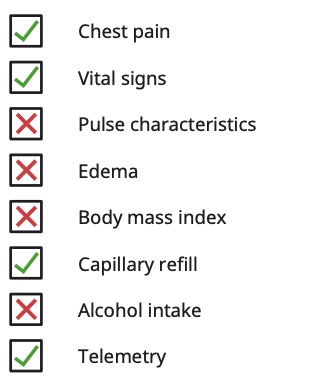
Tip: For some students, it is safer to arrive at an answer on scratch paper rather than clicking a lot to check and uncheck boxes. Writing on paper may help you trust your reasoning more. Try it out and settle on your strategy!
After you submit an answer to the first question, the right-hand side of the screen will change to the next one. The tabs on the left side have changed, so the initial information is still being used.
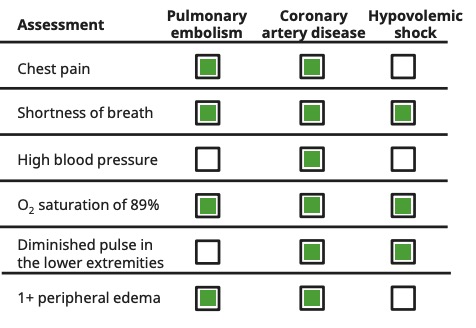
Based on the client’s assessment, which additional information is helpful to interpret the client’s risk for potential issues?
| Assessment | Pulmonary embolism | Coronary artery disease | Hypovolemic shock |
| Chest pain | ☐ | ☐ | ☐ |
| Shortness of breath | ☐ | ☐ | ☐ |
| High blood pressure | ☐ | ☐ | ☐ |
| O2 saturation 89% | ☐ | ☐ | ☐ |
| Diminished pulse in lower extremities | ☐ | ☐ | ☐ |
| 1+ peripheral edema | ☐ | ☐ | ☐ |
Tip: Before you get to checking boxes, recap the pathophysiologies of all 3 conditions in your head and summarize their symptoms (maybe even shortly write them down).
Tip: In a table like this, you could go diagnosis by diagnosis, or go through the symptoms across all columns. We recommend you do it both ways as a double-check to be confident in your answers!
The third question has a fill-in-the-blanks statement with dropdowns giving you the options to choose from.
The client is at the highest risk for developing _______________ as evidenced by ____________ and _____________.
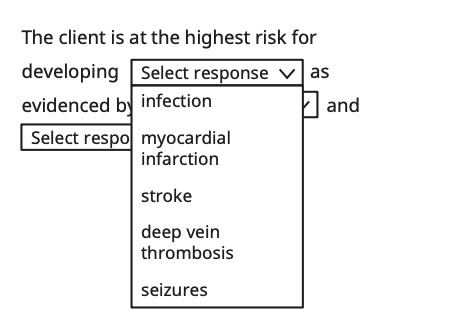
A lot of signs point to the client being at risk for myocardial infarction over the other options: chest pain, shortness of breath, irregular heartbeat, severe pain, hypertension. With no or insufficient signs of infection (normal temperature), stroke (no confusion or numbness), DVT (does have edema but no leg pain or reddened skin), or seizures, myocardial infarction is the correct answer here.
Solution:
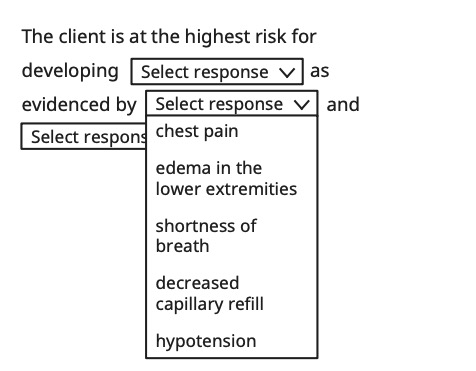
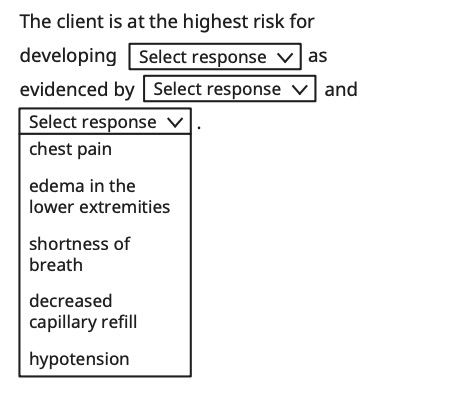
The second and third slots ask for the reasoning for the condition you chose as the one the client is most likely experiencing. Both dropdowns have the same options, so it comes down to choosing 2 out of 5.
Chest pain is a classic symptom of myocardial infarction, so definitely a correct choice.
For the others:
So, the best answers for myocardial infarction would be chest pain and shortness of breath.
Tip: Note how the second and third slot depend on your answer in the first one. Always keep an overview of the statement in its entirety while going through the dropdowns to not miss connections between the options.
Tip: Review the statement as a whole after picking all your answer choices to make sure it really makes sense.
New info appears on the left side: The nurse reviews the medical records and plans care for the client. The tabs, however, stay the same.
For each potential nursing intervention, click to specify whether the intervention is indicated or contraindicated for the care of the client.
| Potential interventions | Indicated | Contraindicated |
| Place the client in a supine position. | ☐ | ☐ |
| Obtain an electrocardiogram. | ☐ | ☐ |
| Provide supplemental O2. | ☐ | ☐ |
| Administer nitrates. | ☐ | ☐ |
| Instruct to increase fluid intake. | ☐ | ☐ |
Tip: For each intervention, there are only 2 options here: to do or not to do it. So, there is no prioritization to think about, it is “simply” yes or no. It works the same as a select-all-that-apply question would.
The scenario text changes to:
The nurse reviews the orders from the health care provider.
Additional tab appears:
Laboratory tests ordered
Click to highlight the 4 orders that the nurse needs to perform immediately.
Again, you need to choose 4 out of the full list that have the highest priority. All of these will be done, the question only asks which ones to do first. Including the new information provided (the laboratory tests that were done), there are 2 that are more specific: CKMB test for heart damage and the cardiac troponin STAT.
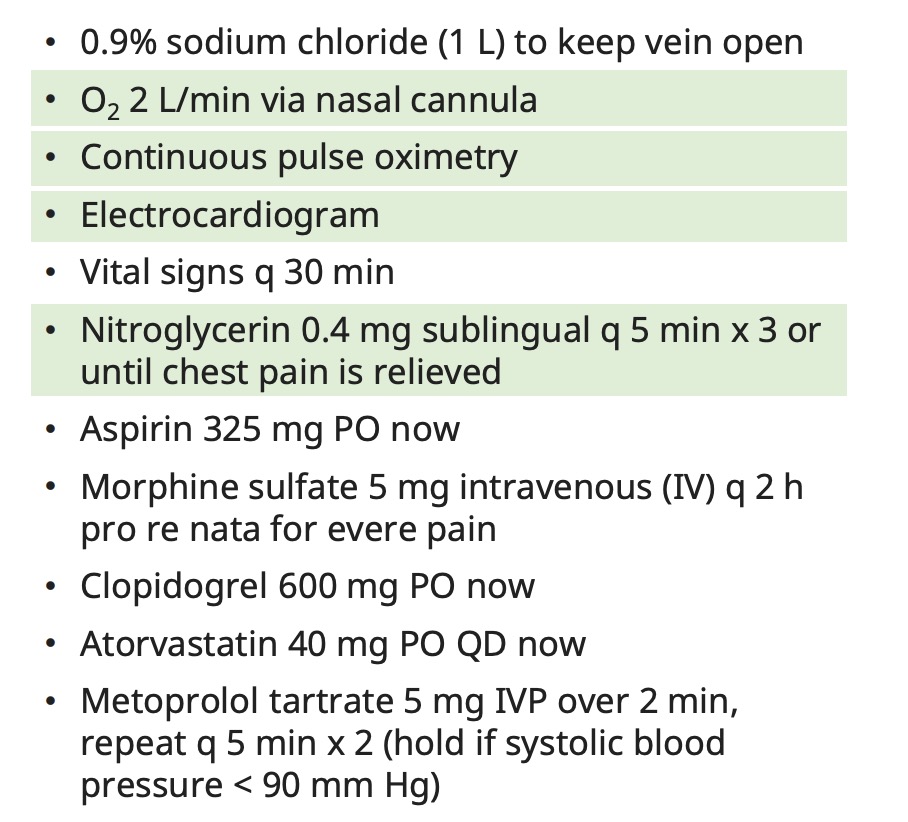
For the sixth and last question, you get new information. The scenario text stays at “The nurse reviews the orders from the health care provider.”
But, you get 3 new tabs with information, labeled with time stamps:
1318
Orders received. O2 applied at 2 L by nasal cannula, IV access obtained to the left metacarpal vein. IV fluids started. No signs of IV-related complications. The client was placed in the high Fowler’s position and administered nitroglycerin 0.4 mg sublingual x 1 for pain of 6/10, aspirin 325 mg PO, clopidogrel 600 mg PO, and metoprolol tartrate 5 mg IVP for blood pressure of 156/90 mm Hg. The client states upper chest pain has decreased to 4/10 after nitroglycerin. Blood pressure is reassessed and has decreased to 148/86 mm Hg.
1325
Electrocardiography shows ST elevation, which alerts the providers that there is a total blockage of the involved coronary artery and that the heart muscle is currently “dying”. Blood is drawn for labs. Pain in the upper chest is rated as 4/10.
1340
The client is awake, oriented x 3 (person, place, and time), and sitting up in bed. He appears comfortable and his breathing is unlabored and not diaphoretic. The client states, “I feel a little better.” The client rates the intermittent pain in his upper chest as a 4 (on a 1–10 scale) and states, “it is much less than it was.” His skin is pink, dry, and warm to the touch. The capillary refill is 3 sec. The client can now speak complete sentences without shortness of breath. Absence of adventitious sounds in lungs bilaterally. The vital signs are as follows: temperature: 97.52 °F (36.4 °C); heart rate: 88/min; respiratory rate: 18/min, blood pressure: 129/95 mm Hg; pulse oximetry reading: 90% on 2 L/min O2 via nasal cannula.
The question on the right side shows:
The nurse has performed the interventions as ordered by the physician. Which assessment data shows improvement in the client’s symptoms? Select all that apply.
Tip: Remember, don’t second guess your previous answer. All interventions would have been done anyway. Look at this question with fresh eyes.
So, what changed about the client’s status?
Tip: Note the question asks for symptoms that have improved. This does not mean the values necessarily need to be in normal range – it just means they need to reflect a significant improvement!