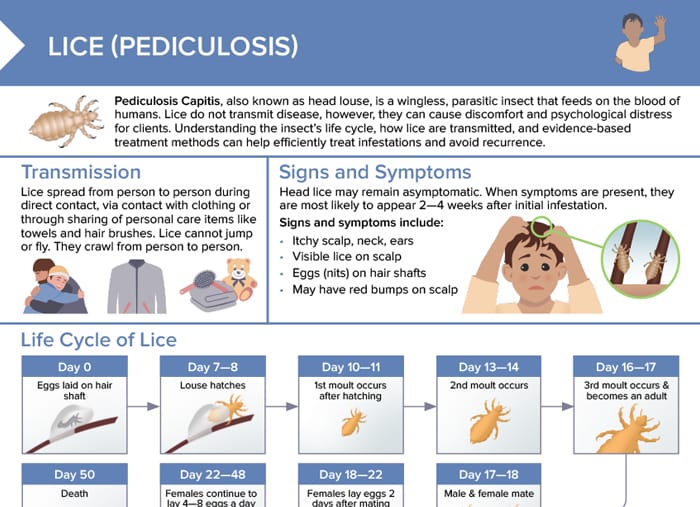


Pediculosis capitis is the biological name of the head louse, a wingless, parasitic insect that feeds on the blood of humans.
Lice do not transmit disease, however, they can cause discomfort and psychological distress for clients. Understanding the insect’s life cycle, how lice are transmitted, and evidence-based treatment methods can help efficiently treat infestations and avoid recurrence.
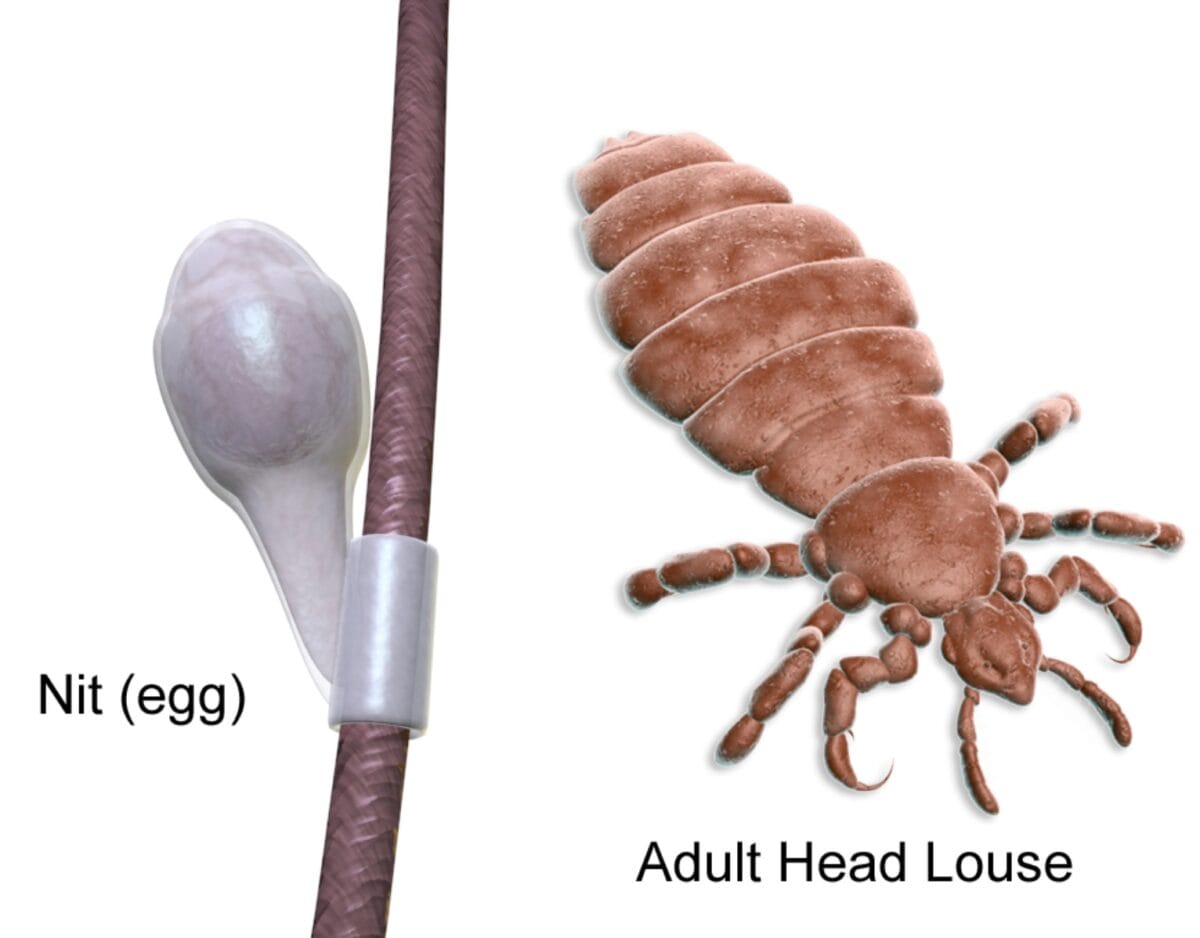
Illustration of an adult head louse and a louse egg (nit)
Image: “Head louse” by BruceBlaus. License: CC BY-SA 4.0Head lice may remain asymptomatic. When symptoms are present, they are most likely to appear 2–4 weeks after initial infestation:
Both a head lice infestation and dandruff can cause itching, even though the itching caused by dandruff is usually much milder. You can differentiate dandruff and lice by looking at the specific appearance: dandruff is flakey and typically white or yellowish. It is dry and falls off the hair easily. Lice eggs are oval, yellowish-white, and stick to the hair. Adult lice are brown and about the size of a sesame seed.
While dandruff can appear anywhere on the scalp, lice prefer warmer areas, so nits are more commonly found close to the scalp behind the ears and near the neckline.
Using a fine-toothed comb on wet hair can help in physical detection; nits will stick to the shaft, while dandruff will wash off. A magnifying glass can help ensure a correct diagnosis.
Lice spreads from person to person during direct contact, via contact with clothing or through sharing of personal care items (towels and hair brushes/combs). Lice cannot jump or fly. They crawl from person to person.
Treatment often involves a combination of pharmacologic and mechanical removal methods.
A wide variety of over-the-counter products kill lice by causing respiratory paralysis. These products do not affect nits and should be repeated in 7–10 days to kill newly hatched lice.
Lice can be removed by shaving the hair off or using a nit comb to thoroughly remove the lice and nits.
It’s best not to recommend using salt to treat head lice.
There’s no scientific evidence supporting its effectiveness, and it could cause skin irritation. Instead, focus on advising proven methods: using a specialized nit comb for mechanical removal and, if necessary, medically approved pediculicides.
The persistent itching that comes with a head lice infestation can lead to complications that become more likely if the infestation persists over a longer time period:
Tip: Evaluate and treat all affected family members at the same time.
Teach clients how to eliminate lice from the household environment: