
Nursing Knowledge
The primary ovarian hormones are estrogen, progesterone, and small amounts of testosterone.
These hormones are essential for fertility, menstrual cycles, and overall reproductive health.
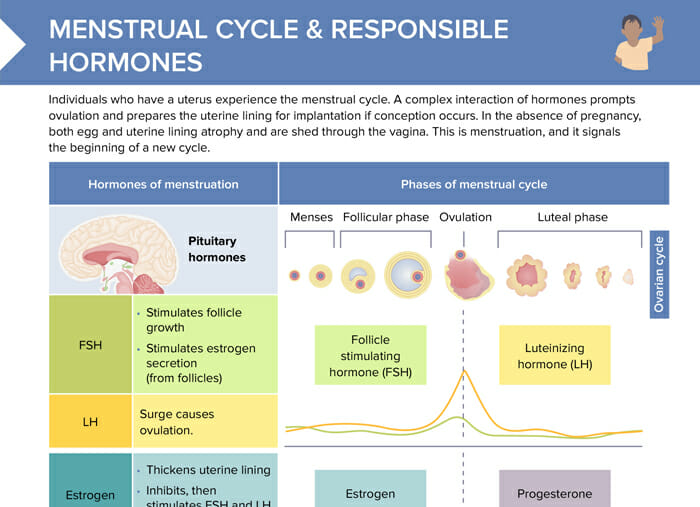
The menstrual cycle describes the repeating sequence of events preparing the female reproductive system for a potential birth each month. A complex interaction of hormones prompts ovulation and prepares the uterine lining for implantation if conception occurs. In the absence of pregnancy, both egg and uterine lining atrophy and are shed through the vagina. This is menstruation, and it signals the beginning of a new cycle.
The length of the menstrual cycle can vary between individuals and over time, but typically ranges from 21 to 35 days for adults, with an average of 28 days.
The phases can roughly be placed in the following time frames:
The pituitary gland releases a number of different hormones, including the following ones that are involved in regulating the menstrual cycle:
The pituitary hormone FSH stimulates follicle growth and estrogen secretion (from follicles).
For women of reproductive age, FSH levels generally range from 4.7 to 21.5 mIU/mL. Lower levels are usually better for fertility. Elevated FSH levels, especially if they are higher than 10 mIU/mL on Day 3 of the menstrual cycle, may indicate reduced ovarian reserve and could be a concern for fertility. However, FSH levels are just one aspect of fertility evaluation; other tests and factors are typically considered.
LH is secreted by the pituitary gland. A surge of luteinizing hormone causes ovulation.
Estrogen, one of the ovarian hormones, thickens the uterine lining and inhibits, then stimulates FSH and LH to trigger ovulation.
The ovarian hormone progesterone thickens the uterine lining and inhibits FSH and LH.
Estrogen and progesterone are low in this phase. Uterine lining is shed, causing menstruation.
FSH stimulates follicle growth; rising estrogen thickens the uterine lining.
A surge in LH triggers ovulation.
LH stimulates the empty follicle to become the corpus luteum, which secretes progesterone, which in turn prepares the uterine lining for a potential pregnancy. If pregnancy doesn’t occur, estrogen and progesterone drop, leading back to the menstrual phase.
The endometrial cycle occurs concurrently with the menstrual cycle and has three main phases:
Low levels of estrogen and progesterone lead to the shedding of the uterine lining.
Estrogen, rising due to follicular development, stimulates the endometrium to thicken and prepare for possible implantation of a fertilized egg.
Progesterone, produced by the corpus luteum, further prepares the endometrium by making it more glandular and vascular to support a potential pregnancy.
Free Download
Master the topic with a unique study combination of a concise summary paired with video lectures.
Your free account gives you access to:
or