

Nursing Knowledge
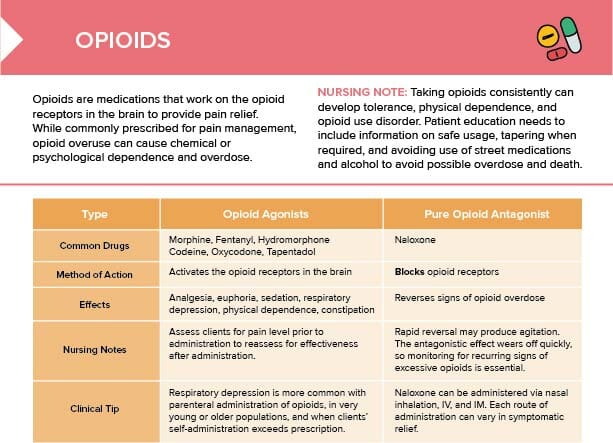
Opioids are medications that work on the opioid receptors in the brain to provide pain relief. The term includes prescription drugs for pain relief and anesthesia as well as illegal drugs not used medically, like heroin.
Opioids are prescribed for pain relief in cases of moderate to severe pain that may not respond well to other pain medications.
Due to the euphoric effects, opioids are frequently misused. The potential for physical dependence has led to significant public health issues in North America and other parts of the world, namely an ongoing epidemic of addiction, known as the “opioid crisis.”
Opioids bind to the opioid receptors in the brain (spinal cord and digestive tract as well), decreasing the amount of pain signals that the body sends to the brain and therefore reducing the perception of pain.
Opioid antagonists block the opioid receptors.
Nursing note: Assess clients for pain level prior to administration to reassess for effectiveness after administration.
The length of time an opioid can be detected in the body can vary greatly depending upon the type of opioid, method of use, and other factors. Generally, opioids can be detected in urine for 1–4 days after use. Certain opioids, such as methadone, can be detected for up to a week. Hair tests can potentially detect opioid use for up to 90 days or more.
The terms “opioids” and “opiates” are often used interchangeably, but they do technically refer to different substances:
Effects of opioids:
Classic triad of signs of opioid overdose:
Treat with an opioid antagonist. Naloxone can be administered via nasal inhalation, IV, and IM. Each route of administration can vary in symptomatic relief.
Respiratory depression is more common with parenteral administration of opioids in very young or older populations and when clients’ self-administration exceeds prescription. To prevent respiratory depression, naloxone can be administered via nasal inhalation, IV, and IM. Rapid reversal may produce agitation. The antagonistic effect wears off quickly, so monitoring for recurring signs of excessive opioids is essential.
Key reasons why opioids can be addictive:
Symptoms of opioid withdrawal include:
Opioids can be divided into categories according to their origin:
RELATED TOPIC:
Free Download
Master the topic with a unique study combination of a concise summary paired with video lectures.
Your free account gives you access to:
or