
Nursing Knowledge
RELATED STUDY SHEET
A nursing diagnosis is a clinical judgment and a statement about a patient’s response to actual or potential health conditions or needs. It serves as the basis for selecting nursing interventions and making appropriate clinical decisions.
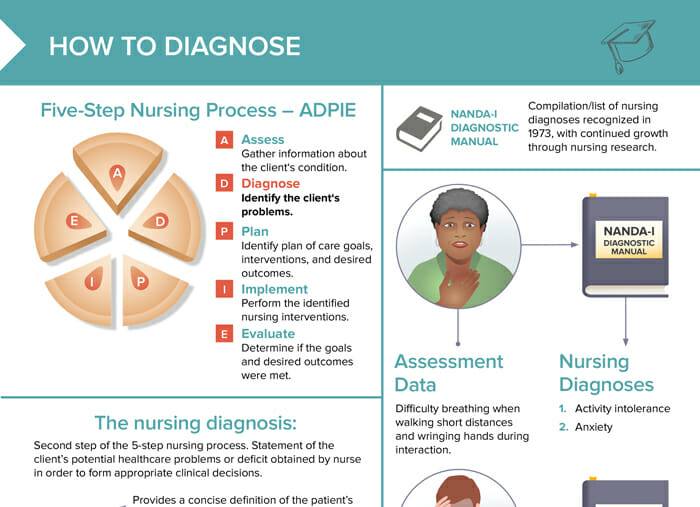
Making nursing diagnoses is the second step of the 5-step nursing process (ADPIE):
In this step, the nurse actually identifies their client’s problems and names them according to nursing diagnoses.
Medical diagnoses are made by physicians and identify a specific disease that a patient has.
Nursing diagnoses, on the other hand, focus on the patient’s response to that disease or condition, guiding individualized care plans. Nursing diagnoses are standardized and often use frameworks like NANDA-I (North American Nursing Diagnosis Association International) for consistent terminology and categorization.
The goals of making nursing diagnoses are:
How to make nursing diagnoses:
The NANDA-I (North American Nursing Diagnosis Association International) diagnostic manual is a compilation/list of nursing diagnoses originally recognized in 1973, with continued growth through nursing research.
Assessment data: Client has difficulty breathing when walking short distances and is wringing their hands during interaction.
Nursing diagnosis:
Assessment data: Client has alteration in fluid volume due to dehydration, anemia, neurological impairment, and impaired memory related to dehydration.
Nursing diagnosis:
Fitting official NANDA nursing diagnoses for this assessment include Fluid volume deficit and impaired memory.
A child with allergic rhinitis will experience increased mucus production, nasal congestion, and postnasal drip. These symptoms can lead to the child having difficulty maintaining a clear airway, which is correctly diagnosed with the nursing diagnosis of ineffective airway clearance.
A child with rheumatic fever likely will experience joint pain and inflammation. Relevant nursing diagnoses would include acute pain related to inflammation and swelling, plus potentially impaired mobility and others.
The condition most likely to have a nursing diagnosis of fluid volume deficit is dehydration. Other conditions that may warrant this diagnosis include severe burns, hemorrhage, or conditions that cause polyuria like uncontrolled diabetes.
A nursing diagnosis of “a cough” would be incorrect because a cough is a symptom, not a nursing diagnosis.
Potential correct nursing diagnoses in a client suffering from a cough could be ineffective airway clearance, impaired gas exchange, or others depending on the assessment.
Free Download
Master the topic with a unique study combination of a concise summary paired with video lectures.
Your free account gives you access to:
or