
Nursing Knowledge
RELATED STUDY SHEET
Charting in nursing is the systematic documentation of a client’s medical history, care provided, observations, interventions, responses, and any other important information around their care. It forms an integral part of the medical record.
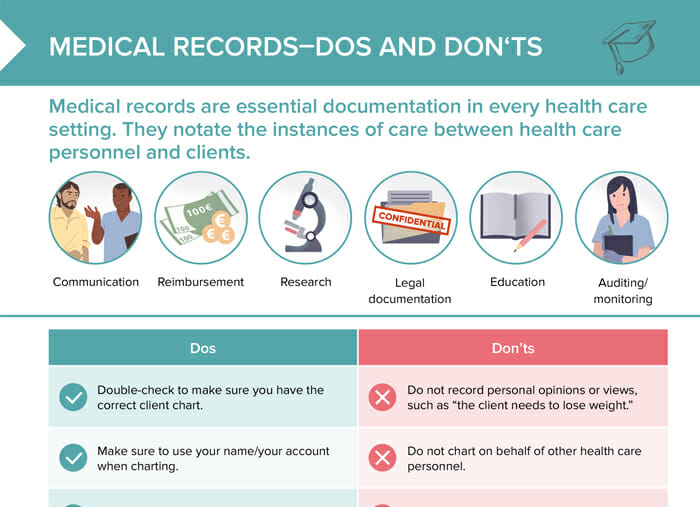
Medical records, often referred to as health records or medical charts, are systematic documentation of a client’s medical history and care over time.
Many medical records have transitioned from paper-based systems to Electronic Health Records (EHRs), which offer greater accessibility, interoperability, and efficiency.
How medical records are set up varies between facilities. This is an example of what the content outline of a medical record could look like:
Table: Example of a medical record template
| Client data | Name, age, gender, address, contacts |
| Responsible primary care provider | Contact information |
| Insurance information | Provider and policy |
| Known allergies | Medications, food, environmental |
| Medication plan | With dosage, frequency and indication |
| Medical/surgical and family history | Include relation and dates of diagnosis |
| Social history | Smoking, alcohol, other drugs, occupation and relationships |
| Visit documentation | Date, reason, findings, treatment |
| Lab and imaging results |
The duration for which medical records need to be saved depends on local regulations, client age, type of record, and other factors. In general, adult medical records in the United States need to be retained for at least 6–10 years after the last interaction with the client. For minors, records need to be kept until the client reaches the age of majority plus the required retention time frame for adults.
Nursing charting systems are methods that nurses can apply to make their client care documentation more structured and consistent. Examples are:
An example of focus charting:
Focus: shortness of breath
Date:
Time:
Data: Client reports difficulty in breathing since morning. Oxygen saturation measured at 88% on room air.
Action: Positioned clients in a high Fowler’s. Administered 2L oxygen through a nasal cannula and provided a nebulizer treatment.
Response: After intervention, the client’s breathing became less labored to respirations at 18/min, with oxygen saturation increasing to 94%. Client verbalized relief, stating, “I can breathe easier now.”
Free Download
Master the topic with a unique study combination of a concise summary paired with video lectures.
Your free account gives you access to:
or