
Nursing Knowledge
RELATED STUDY SHEET
Definition: Leadership in nursing encompasses the skills, behaviors, and abilities that enable nurses to inspire and influence others, guide teams toward achieving common goals, make informed decisions, and advocate for both patients and colleagues.
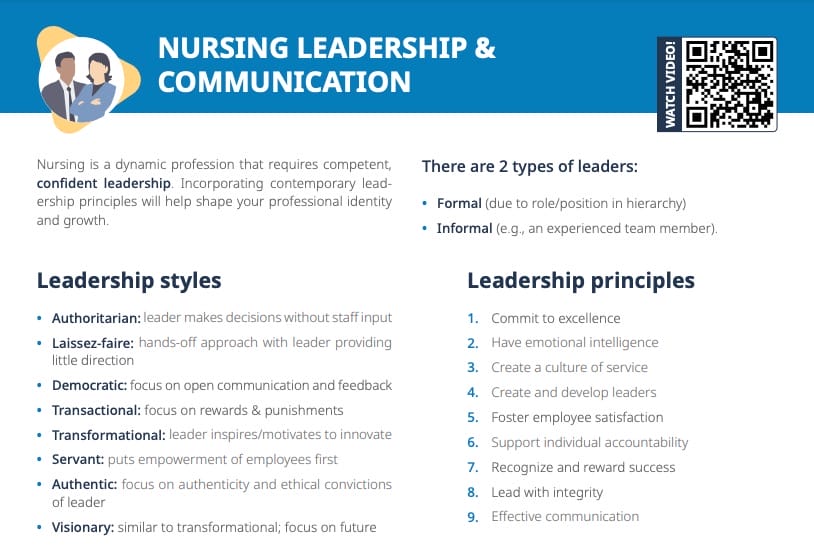
There can be two types of leaders:
Effective leadership and management in nursing are critical because they directly affect the quality of patient care, nurse job satisfaction, team collaboration, and the overall functioning of healthcare institutions. Effective nursing leaders can drive positive change, promote innovation, and ensure that the highest standards of care are consistently met.
Various types of leadership have been emerging in nursing, catering to the diverse contexts and challenges faced in healthcare environments. These styles reflect different approaches to decision-making, team interaction, and problem-solving, each having its own strengths and limitations. Depending on the situation, team dynamics, and individual personalities, one style might be more effective than another.
They can be categorized into the three types known as the classic leadership styles authoritarian/autocratic, laissez-faire, and democratic, and a collection of more contemporary styles (transactional, transformational, servant, authentic, visionary).
In an autocratic or authoritarian leadership style, the leader makes decisions without considering any input from staff. Negative reinforcement and punishment are often needed to enforce the rules which can be detrimental to a productive work environment, but in certain emergency situations where quick decisions are vital, this style can have benefits.
Laissez-faire leadership means that the leader does not provide much, or any, direction and supervision. It is a very hands-off approach where decisions are not really made, changes rarely occur, and quality improvement is typically reactive.
In democratic leadership, the leader encourages open communication and staff participation. Focus is put on individual responsibility, accountability, and feedback.
In transactional leadership, the main dynamic is giving rewards or punishments to the employees respective of their performance.
Transformational leadership in nursing is based on the encouragement of the employees to give their best through the focus on a common mission and vision.
A leader using servant leadership style has the main goal of serving the team and helping them develop and perform as highly as possible. A servant leader shares the power and puts the team’s needs first.
Authentic leadership describes a leadership style that is based on the authenticity of the leader. The leader acts according to their own ethical convictions and nature.
Visionary leadership in nursing is very similar to the transformational leadership style, with an increased emphasis on the future. The goals for the upcoming years are kept in mind and used as a guideline for leadership decisions.
Regardless of the specific leadership strategies applied, there are a set of leadership principles in nursing to follow that will ensure effective leadership.
One of the most important leadership skills in nursing is effective communication.
Communication in nursing is the exchange of information, feelings, and meanings between nurses and clients or other team members. It can be verbal (oral including tone) or nonverbal (facial expressions and body language).
Other important skills for leaders include:
Nursing tip:
5 signs of emotional intelligence you need to lead effectively:
As an example, imagine a nurse manager for the OR of a local hospital who has designed a process for self-scheduling of the staff and who generally allows staff members to resolve their own conflicts. When new nurses ask her questions, she provides them with the hospital’s policy and procedure manuals. Which type of classic leadership style is this manager demonstrating?
Answer: This is an example of laissez-faire leadership.
Examples of typical leadership roles in nursing include:
Remember that formal leadership roles are not the only positions in which leadership skills can be applied. Informal leadership, if working well with the formal leadership, can be a valuable addition to the collaborative work in the healthcare team.
Interview questions screening candidates for leadership positions in nursing will aim to evaluate the applicant’s ability to lead effectively. A lot of them will probably test the leadership skills listed above.
This question would be asked to assess a candidate’s conflict resolution skills, interpersonal communication, and leadership style.
An example of an answer could be:
“Certainly. In my previous role as a nurse manager, two of my team members had a disagreement over patient care responsibilities. I addressed the issue by organizing a meeting with both individuals. I listened actively to each of their perspectives, ensuring they felt heard. I then guided them towards identifying the root cause of the misunderstanding and facilitated a discussion on how to prevent such issues in the future. By the end of the conversation, they had reached a mutual understanding and collaborated effectively moving forward.”
This would be asked to gauge the candidate’s decision-making abilities, time management, and trust in their team during times of high pressure.
An example of an answer could be:
“In high-stress situations, it’s vital to remain calm and organized. I start by quickly assessing the situation and identifying the most urgent tasks. Using my knowledge of my team’s strengths and capabilities, I delegate responsibilities accordingly. It’s essential to trust the expertise of the team. I also ensure open communication lines, so if any issues arise or priorities shift, we can adjust swiftly. Afterward, I find it beneficial to debrief with the team, discussing what went well and areas for improvement.”
Free Download
Master the topic with a unique study combination of a concise summary paired with video lectures.
Your free account gives you access to:
or