

Nursing Knowledge
Infertility is defined as pregnancy not being achieved after 12 months of unprotected sex. In couples over 35, infertility treatments may be initiated after 6 months.
Infertility statistics by the WHO suggest that roughly 1 in 6 people worldwide experience infertility, specifying the lifetime prevalence at 17.8% in high-income countries and 16.5% in low- and middle-income countries.
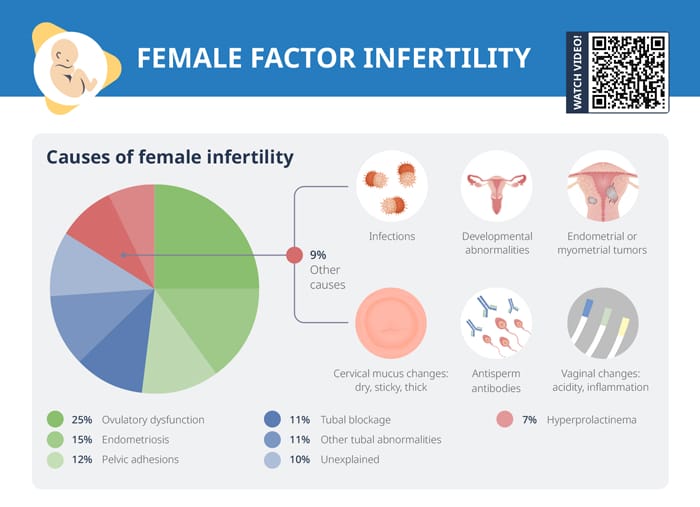
In heterosexual couples, infertility may be due to female and/or male factors, or idiopathic.
Endometriosis is a condition where tissue similar to the lining inside the uterus (endometrium) grows outside the uterus. This can cause infertility through:
Fertility treatment is always a complex process involving physical, psychological, emotional, and spiritual dimensions. It requires a thoughtful, interdisciplinary team approach.
Fertility treatments may be sought by couples unable to conceive after 6–12 months depending on the age, same-sex and gender diverse couples, as well as unpartnered individuals who desire pregnancy.
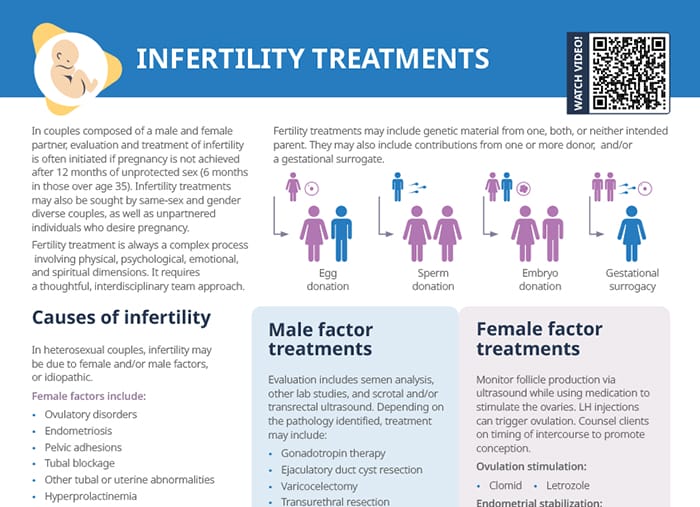
Fertility treatments may include genetic material from one, both, or neither intended parent. They may also include contributions from one or more donors, and/or a gestational surrogate via:
Evaluation includes semen analysis, other lab studies, and scrotal and/or transrectal ultrasound. Depending on the pathology identified, treatment may include:
Monitor follicle production via ultrasound while using medication to stimulate the ovaries. LH injections can trigger ovulation. Counsel clients on timing of intercourse to promote conception.
Assisted reproductive technologies may be used when male and female factor treatments are not successful, or when these treatments are not an option given client characteristics (e.g., in same sex couples).
Options include:
Most forms of birth control, including oral contraceptives, IUDs, and implants, temporarily prevent pregnancy while in use, but normal fertility typically returns soon after stopping their use. Some clients may experience a brief delay in the return of regular menstrual cycles after discontinuing hormonal birth control, but this delay is usually temporary and does not result in long-term infertility.
Tests for males aim to check for if enough healthy sperm is produced, tests for females evaluate if healthy eggs are released by the ovaries.
Tests for males:
Tests for females:
RELATED TOPIC:
Free Download
Master the topic with a unique study combination of a concise summary paired with video lectures.
Your free account gives you access to:
or