

Nursing Knowledge
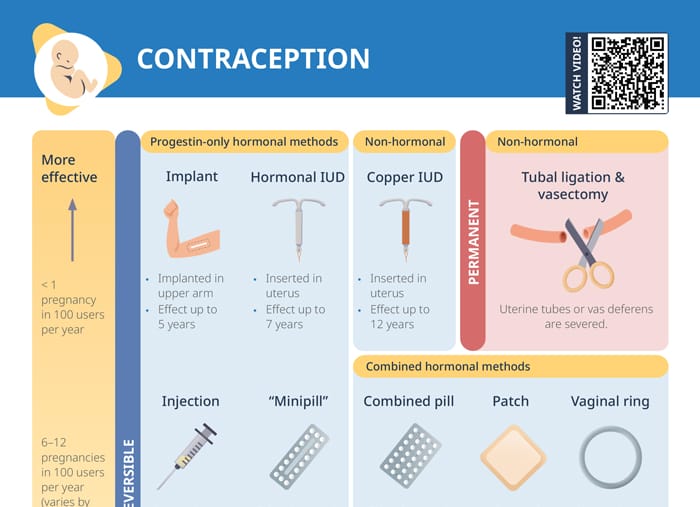
Methods of contraception can be roughly categorized as hormonal, barrier methods, intrauterine devices, sterilization, natural methods, and emergency contraception. Each method varies in effectiveness, usage, and suitability for different individuals.
They could also be categorized into irreversible methods (tubal ligation/vasectomy) and reversible methods (all other methods).
Hormonal methods of contraception can be divided into progestin-only methods and combined hormonal methods. Progestin-only contraceptives only contain progestin (the synthetic form of progesterone), while combined contraceptives contain both estrogen and progestin, providing generally more regulation of menstrual cycles and potentially more effective, but problematic for people who cannot take estrogen.
The birth control pill is a medication taken orally to prevent pregnancy. It usually contains synthetic hormones (either a combination of estrogen and progestin or progestin alone for mini-pills) and works by inhibiting ovulation, thickening cervical mucus, and altering the uterine lining to prevent fertilization and implantation.
14% of women aged 15–49 in the United States are currently using the birth control pill. (Data from 2023).
Drospirenone and ethinyl estradiol (yaz) is a combined hormonal contraceptive pill containing drospirenone and ethinyl estradiol.
Drospirenone (slynd) is a progestin-only pill. Unlike traditional progestin-only pills, it has a 24-hour window for taking late pills.
Norgestimate and ethinyl estradiol (sprintec) is a combined oral contraceptive.
Ethinylestradiol/Levonorgestrel (vienva) is another combined oral contraceptive.
Ethinylestradiol/norethisterone acetate (junel) is a combined hormonal pill.
Norgestimate and ethinyl estradiol (mili) is a composition of this low-dose combined oral contraceptive pill.
A contraceptive implant is a small rod inserted into the skin of the upper arm. Over the several years of its use, it continuously releases progestin into the body, preventing ovulation.
Birth control patches are worn on the skin like band aids and continuously release estrogen and progestin into the bloodstream. They are changed weekly.
Injections of progestin are another way of hormonal birth control that, other than the pill, does not have to be taken care of by the client themselves daily. Shots are typically given every three months.
Outside of tubal ligation/vasectomy and copper IUDs, barrier methods are a popular way of nonhormonal contraception. They include condoms, diaphragms, and cervical caps. Sometimes used in combination with a spermicide, they physically block sperm from entering the uterus.
Condoms are the only contraceptive method that additionally offers protection against STDs.
For fertility awareness methods to be effective for contraception, training, ongoing monitoring, and abstinence or the use of a barrier method during fertile periods is necessary. Generally, this should be only recommended to clients who don’t need a big focus on the effectiveness or fail-safety of their method of contraception.
In terms of pregnancies occurring in spite of the use of contraception, the most effective methods of contraception with less than one pregnancy in 100 users per year include:
Closely following with 6–12 pregnancies in 100 users per year are:
The least effective with over 18 pregnancies in 100 users per year are:
RELATED TOPIC:
Free Download
Master the topic with a unique study combination of a concise summary paired with video lectures.
Your free account gives you access to:
or