Foley catheters (also known as indwelling urinary catheters) are a common medical device used to drain urine from the bladder. They are often used in clinical nursing practice to manage urinary retention or incontinence, and can be inserted into the bladder through the urethra or a surgical opening. In this guide, you will learn about the different types of catheters available, how to properly insert and care for them, and potential complications that may arise.
What are the different types of indwelling urinary catheters?
Indwelling urinary (Foley) catheters: inserted into the bladder through the urethra, small, inflated balloon to keep in place (urine drains into bag)
Intermittent catheters: used short-term to empty bladder (for medical procedures or when urinary retention)
Suprapubic catheters: inserted through a small hole in the abdomen into the bladder (often used when the urethra is blocked or damaged, or long-term)
Condom catheters: used for men who suffer from incontinence, condom-like sheath with tube
What supplies are needed for Foley catheter insertion?
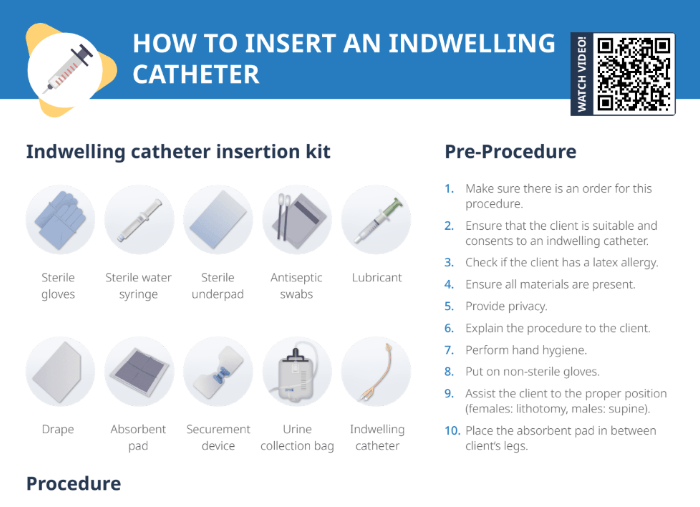
Indwelling catheter insertion kit:
Sterile gloves
Sterile water syringe
Sterile underpad
Antiseptic swabs
Lubricant
Drape
Absorbent pad
Securement device
Urine collection bag
Indwelling catheter
Steps for preparing for an indwelling urinary catheter insertion
Ensure procedure is ordered
Ensure client is suitable and consents
Check client for latex allergy
Ensure you have all needed supplies
Provide privacy and explain procedure to client
Perform hand hygiene and put on non-sterile (clean) gloves
Assist client to proper position (lithotomy/supine)
Place absorbent pad between client’s legs
How to insert a Foley catheter (step-by-step)
Open the catheter kit maintaining sterility.
Place the sterile underpad underneath the client.
Place the sterile drape over the perineal area.
Remove unsterile gloves and put on sterile gloves.
Remove the antiseptic swabs from their packaging.
Attach the sterile water syringe to the balloon inflation
port.
Open the lubricant packet and squeeze lube onto the packing tray.
Remove the catheter cover.
With the sterile dominant hand, dip the catheter tip into the lubricant.
Using the nondominant hand, separate the labia minora or hold the penis at a 60–90-degree angle and retract the foreskin (if applicable).
With the dominant hand, use the antiseptic swabs to clean the labia (left side, right side, center). Use a new swab for each swipe.
For the penis, use an antiseptic swab to clean the glans in a circular motion from the inside outward. Use a new swab for each swipe, for a total of three times.
With the dominant hand, slowly insert the catheter into the urethra. Instruct the client to breathe normally and that some pressure is expected. Do not force a catheter if resistance is felt.
Continue to hold the labia apart or hold the penis in place as the dominant hand advances the catheter inward. Slowly advance until urine is seen in the catheter tubing.
Engage the sterile water syringe to inflate the balloon.
Release your non-dominant hand and adjust the catheter as needed.
Secure the catheter to the client’s thigh using the securement device.
Secure the urine collection bag lower than the client’s position.