

Nursing Knowledge
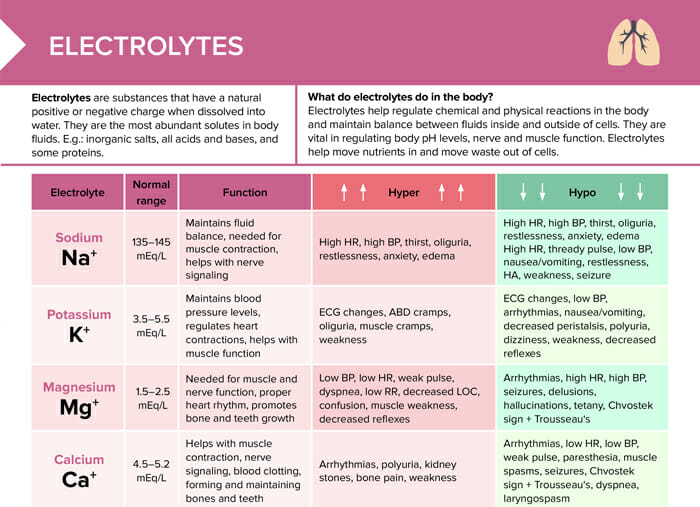
Electrolytes are substances that have a natural positive or negative charge when dissolved into water. They are the most abundant solutes in body fluids. Examples are inorganic salts, all acids and bases, and some proteins.
Electrolytes help regulate chemical and physical reactions in the body, maintain balance between fluids inside and outside of cells, regulate body pH levels, and aid in nerve and muscle function.
Table: Electrolytes and their functions
| Electrolyte | Functions |
| Sodium | Fluid balance, muscle contraction, nerve signaling |
| Potassium | Blood pressure levels, heart contractions, muscle function |
| Magnesium | Muscle/nerve function, heart rhythm, bone/teeth growth |
| Calcium | Muscle contraction, nerve signaling, blood clotting, bones/teeth |
| Chloride | Fluid balance, proper blood pH, stomach acid production |
| Phosphate | Teeth/bones, nerve/muscle function |
| Bicarbonate | Maintains acid-base balance |
The most common electrolytes found in the body include sodium, potassium, magnesium, calcium, chloride, phosphate, and bicarbonate.
The normal range for each of these electrolytes is as follows:
Symptoms of an electrolyte imbalance can vary depending on which electrolyte is affected but may include high or low heart rate or blood pressure, thirst, restlessness, anxiety, edema, nausea/vomiting, headache, weakness or seizures.
Table: Symptoms of electrolyte imbalances
| Electrolyte | Symptoms of “too much” (hyper) | Symptoms of “not enough” (hypo) |
| Sodium | High HR, high BP, thirst, oliguria, restlessness, anxiety, edema | High HR, thready pulse, low BP, nausea/vomiting, restlessness, HA, weakness, seizure |
| Potassium | ECG changes, ABD cramps, oliguria, muscle cramps, weakness | ECG changes, low BP,Arrhythmias, nausea/vomiting, decreased peristalsis, polyuria, dizziness, weakness, decreased reflexes |
| Magnesium | Low BP, low HR, weak pulse, dyspnea, low RR, decreased LOC, confusion, muscle weakness, decreased reflexes | Arrhythmias, high HR, high BP, seizures, delusions, hallucinations, tetany, Chvostek sign + Trousseau’s sign |
| Calcium | Arrhythmias, polyuria, kidney stones, bone pain, weakness | Arrhythmias, low HR, low BP, weak pulse, paresthesia, musclespasms, seizures, Chvosteksign + Trousseau’s sign, dyspnea, laryngospasm |
| Chloride | Irregular HR, high BP, fluidretention, excessive thirst,confusion, personality changes, seizures, fatigue, muscle weakness, spasms, numbness or tingling | Irregular HR, low BP, fluid loss, diarrhea or vomiting,weakness, fatigue, confusion, muscle cramps, difficulty breathing |
| Phosphate | Arrhythmias, muscle spasms, numbness and tingling around mouth or extremities, seizures, bone and joint pain, itchy skin, rash | Confusion, muscle weakness, fatigue, bone and muscle pain, seizures, numbness, confusion, irritability |
| Bicarbonate | Confusion, hand tremor,light-headedness, muscle twitching, nausea/vomiting, numbness or tingling in face or extremities, tetany | High HR, confusion, dizziness, fatigue, loss of appetite, vomiting HA, rapid breathing or long deep breaths, weakness |
Certain medical conditions such as kidney disease or diabetes can affect electrolyte levels in the body by causing imbalances due to changes in fluid balance or hormone levels. Certain medications such as diuretics can also cause imbalances by increasing excretion of certain electrolytes like potassium or magnesium from the body.
Depending on the specific electrolytes that are imbalanced, the healthcare provider may order oral or IV supplements. For instance, potassium chloride can be given for hypokalemia, while sodium bicarbonate can be administered for cases of severe metabolic acidosis. Always follow the physician’s orders, and be aware of potential side effects.
Other measures for electrolyte imbalances involve rehydrating the client, identifying and addressing underlying causes of imbalances, monitoring and reevaluating electrolyte levels and educating the client on how dietary habits influence the electrolyte balance.
Electrolyte imbalances can be caused by a variety of factors. Here are some of the most common ones:
Chvostek’s sign and Trousseau’s sign are clinical indicators of hypocalcemia, a deficiency of calcium in the body. Chvostek’s sign is a twitching of the facial muscles. Trousseau’s sign presents as muscle spasms in the hand (characteristic hand posture) that can be induced by inflating a blood pressure cuff on the upper arm to above systolic blood pressure for 2 to 3 minutes. Both are caused by a hyperexcitability of the nerves due to low blood calcium levels.
RELATED TOPIC:
Free Download
Master the topic with a unique study combination of a concise summary paired with video lectures.
Your free account gives you access to:
or