

Nursing Knowledge
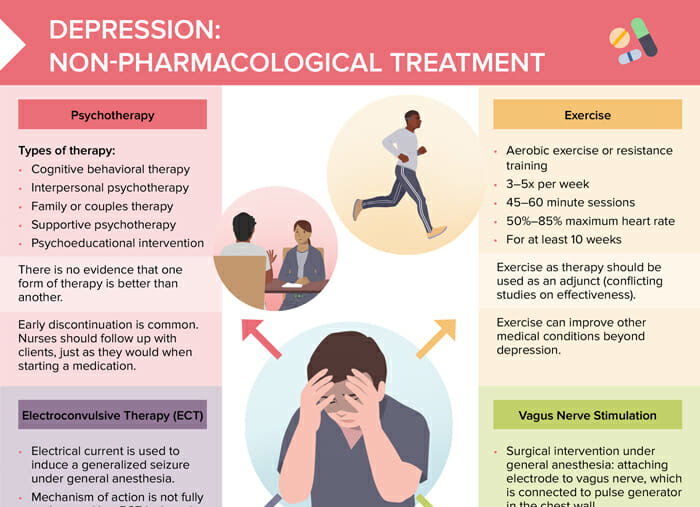
Aside from antidepressant medications, the following treatment measures are used for treating major depressive disorder:
In combination with pharmacological treatment, therapy is the first-line treatment for depression. It comes in many different forms that can be chosen according to the individual needs of a patient:
There is no evidence that one form of therapy is better than another. All forms help treat depression by equipping the patient with better coping skills, identifying negative thought patterns, and offering strategies to manage symptoms. This can lead to better mood regulation, improved relationships, and a higher quality of life.
Nursing note: Early discontinuation is common. Follow up with clients, just as you would when starting a medication.
The time it takes for therapy to work for depression can vary widely from person to person. Some may start to feel better within a few sessions, while others may need several months to notice significant improvement. Factors like the severity of the depression, the specific type of therapy, and how often therapy sessions occur can all influence the timeline. Generally, a commitment of at least 6 to 12 sessions is often recommended to assess its effectiveness.
While exercise can help alleviate the symptoms of depression, it should only be used as an adjunct to other therapy measures. There are conflicting studies on its effectiveness.
As a recommendation, aerobic exercise or resistance training can be done 3–5x per week in 45–60 minute sessions, at 50%–80% maximum heart rate, for at least ten weeks.
Note: Exercise can improve other medical conditions beyond depression.
In ECT, electrical current is used to induce a generalized seizure under general anesthesia. ECT is considered safe and effective for treatment-resistant depression, but remains stigmatized due to perceptions of the procedure.
The mechanism of action is not fully understood. It is thought that ECT helps with depression by releasing neurotransmitters and changing brain connectivity.
ECT typically requires multiple treatments to be effective. On average, 6–12 sessions are needed.
Continuation or maintenance ECT may be required. Generally, ECT is more effective when combined with pharmacotherapy.
The decision to stop ECT is highly individualized and made by the psychiatrist in collaboration with the treated patient. Factors may include: significant improvement in depressive or psychotic symptoms, stabilization of mood, or the occurrence of intolerable side effects.
Vagus nerve stimulation is a surgical intervention under general anesthesia: An electrode is attached to the vagus nerve, which is connected to a pulse generator in the chest wall. Intermittent stimulation is produced by a hand-held transmitter.
Vagus nerve stimulation can be considered for treatment-resistant depression when at least 4 medications have failed.
Note: Serious adverse events can occur and evidence is still emerging as to the effectiveness of this treatment.
The mechanism of action of vagus nerve stimulation in the treatment of depression is not understood.
Depression is classified as treatment-resistant if the affected client does not respond adequately to standard treatments like medication and psychotherapy. Typically, a patient is considered to have treatment-resistant depression after failing to respond to at least two different antidepressant medications given at adequate doses for an adequate duration.
RELATED TOPIC:
Free Download
Master the topic with a unique study combination of a concise summary paired with video lectures.
Your free account gives you access to:
or