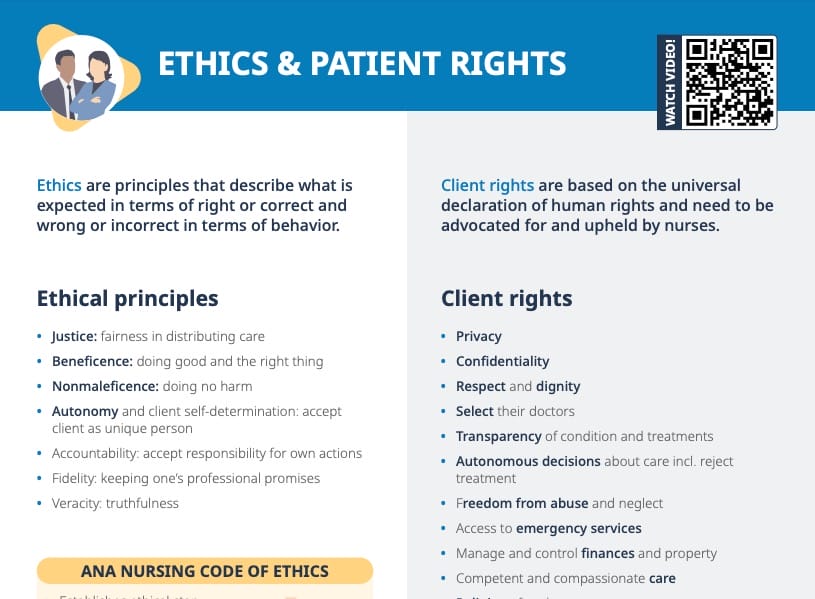
Clinical decision-making is a cornerstone of nursing practice, involving critical thinking and judgment to determine the best actions for patient care. Next to the ethical standards nursing practice is based on, various clinical decision-making models can help nurses structure this process, helping organize thought processes, reduce complexity, and clarify important considerations.
Last updated: January 20, 2026
RELATED STUDY SHEET
Remember the universal patient rights and the ethical principles that should guide every nurse's practice with this handy cheat sheet.
Clinical decision-making is a contextual, continuous, and evolving process where data is gathered, interpreted, and evaluated in order to select an evidence-based choice of action.
Clinical decision-making process
Define the problem or identify the goal
Collect data or information about the problem, or establish needs
Do data analysis/take deep look at the problem
Identify, explore, and generate possible problem solutions/options to reach the goal as well as their implications, and prioritize
Select the best possible solution and make a plan
Perform the selected course of action
Evaluate the results
Stages of clinical decision-making
The clinical decision-making process can be conceptualized into three stages:
Nurses share accountability for effective decision making by acquiring necessary skills, mastering relevant content, assessing situations accurately, sharing fact-based information, communicating opinions clearly, and inquiring actively.
Examples of clinical decision-making in nursing:
Prioritizing care among multiple patients based on acuity
Developing patient care plans based on ongoing assessments of progress and feedback
Delegation of tasks considering competencies and patient needs
Advocating for patients (questioning unclear physician orders)
Assessing patient symptoms using clinical judgment
The role of the healthcare organization in clinical decision-making
In a scenario ensuring effective and safe clinical decision-making, the healthcare organization:
Articulates organizational values, and team members incorporate these values when making decisions.
Ensures that nurses in positions from the bedside to the boardroom participate in all levels of decision-making.
Provides team members with support for and access to ongoing interprofessional education and development programs focusing on strategies that ensure collaborative decision-making. Program content includes mutual goal setting, negotiation, facilitation, conflict management, systems thinking, and performance improvement.
Has operational structures in place that ensure the perspectives of patients and their families are incorporated into decisions affecting patient care.
Establishes systems, such as structured forums involving appropriate departments and health care professions, to facilitate data-driven decisions.
Establishes deliberate decision making-processes that ensure respect for the rights of every individual, incorporate all key perspectives, and designate clear accountability.
Has fair and effective processes in place at all levels to objectively evaluate the results of decisions, including delayed decisions and indecisions.
Clinical decision-making models
Clinical decision-making models are frameworks that guide nurses through a systematic process of making informed decisions regarding patient care.
Standing for Assessment, Diagnosis, Planning, Implementation, and Evaluation, the nursing process is the basis of most actions in nursing practice and guides decision-making.
Clinical judgment model
Tanner’s model of clinical judgment is another structured approach to clinical decision-making, involving
Noticing (recognizing and gathering information)
Interpreting
Responding (deciding on and implementing actions)
Reflecting (reviewing outcomes)
Recognition-primed decision model
This model, developed by Gary Klein, focuses on the naturalistic decision-making process and has the following components:
Experience (learning from the past to recognize patterns)
Intuition (helping to rapidly identify a feasible action)
Analysis (less emphasis on systematic analysis)
Evidence-based practice model
This model combines the best available research evidence with clinical expertise and values to inform the concrete decision-making process in the clinical setting.
Formulating clear clinical question based on a problem
Searching for available evidence
Critically appraising the evidence for validity and applicability
Applying results to clinical practice
Evaluating outcomes
EPI model
The EPI model involves asking focused questions, acquiring relevant evidence and appraising its quality and applicability. EPI stands for:
Ethical: focus on what should be done according to ethical principles of nursing
Practical: looking at feasibility and consequences of actions
Intuitive: relying on the nurse’s intuition informed by experience
The “decide-model” for ethical decision-making
Define the problem: key facts and context
Ethical review: what ethical principles impact the situation?
Consider the options: think outside the box!
Investigate outcomes: include consequences in considerations
Decide on an action: choose and implement
Evaluate results
Clinical decision support systems (CDSS)
Clinical decision support systems (CDSS) are computer-based tools based on clinical decision-making strategies and large quantities of data that give clinicians concrete, real-time recommendations to help with decision-making.